A fracture refers to a complete or partial break in a bone and is one of the most common injuries to the musculoskeletal system. A bone fracture can result from a strong impact, a blow, or indirectly from stress on the bone. It is often accompanied by pain, swelling, and impaired function of the affected body part.
Some types of fractures are also caused by osteoporosis or other bone diseases. In orthopedics and trauma surgery, various types of bone fractures are distinguished, including open fractures, complicated fractures, and closed fractures. X-rays or CT scans are usually used for diagnosis to visualize the fracture line and any bone fragments. Treatment for a fracture ranges from immobilization to surgical intervention, depending on the location, the ends of the fracture, and the stability of the bone.
What is a bone fracture?
A bone fracture refers to damage to the bony structures and their alignment. Medically, it is also referred to as a fracture.
Causes of a broken bone can include
- Falls
- blows
- twisting, or
- impacts
.
The video shows how the human skeleton is structured, from the little toe to the skull:
A bone does not always have to break completely—it can also be just cracked. In addition, there are also
- contusions, in which bones and soft tissues are damaged by external forces but not broken.
- In sprains, bone structures are compressed without resulting in a misalignment of the bones.
- Hairline fractures are caused by minute cracks in the bone structure that are often not visible or barely visible.
What types of bone fractures are there?
Here, a distinction should be made between the location and the type of bone fracture. In principle, any bone in the body can be fractured, from the skull to the toes. The extremities—that is, the arms and legs—are most commonly affected
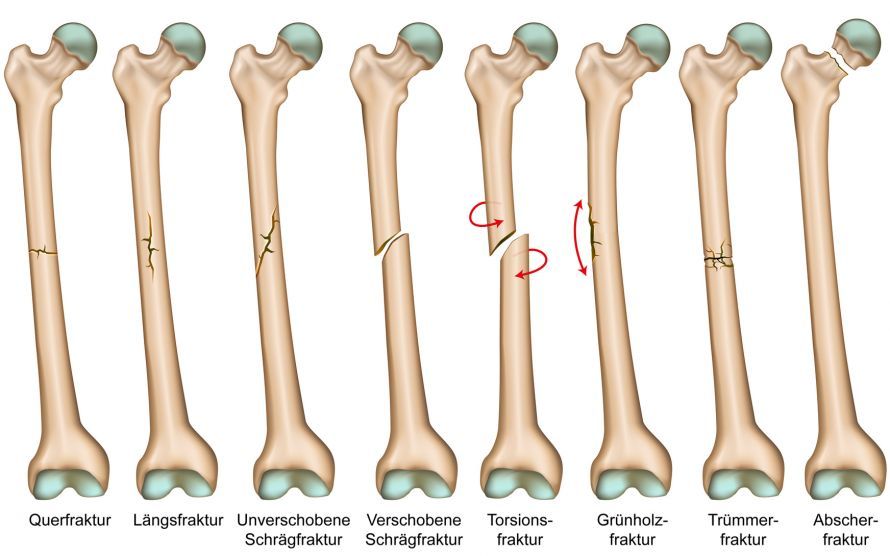
Medically, the following types of fractures can also be distinguished:
- open and closed fractures
- Transverse fracture
- Stress fracture
- Oblique fracture
- Compression fracture
- Shear fracture and
- Bending fracture
- Greenstick fracture
In open fractures, the bone is exposed and visible from the outside due to significant soft tissue damage. Open fractures carry a very high risk of infection.
Transverse fractures are characterized by a fracture line that runs nearly horizontal. These types of fractures are often stable and show little or no displacement. They occur most frequently in the long bones (e.g., the femur).
A stress fracture is a special type of fracture, as it is not caused by acute trauma but develops chronically due to prolonged stress. A typical example is the so-called “marching fracture,” in which one or more bones of the foot fracture after a long march or run (marathon). Oblique fractures are also most commonly observed in the extremities and result from torsional trauma. For this reason, they are often referred to as torsion fractures (torsion = twisting).
The characteristic feature of a compression fracture is that it results from the bone being compressed. It is typically observed in the spine. Avulsion fractures primarily affect the bony attachments of muscles; due to the human body’s upright posture and the particular stress placed on the legs, they occur more frequently in the lower extremities. Examples include avulsion fractures of the Achilles tendon at the heel bone or the patellar tendon at the kneecap.
Bending fractures affect the long bones (also called tubular bones), as a lever effect can occur here. Notable examples include fractures of the upper and lower arm, as well as the upper and lower leg. A specific type of flexion fracture can occur in children up to 8 years of age. It is also called a greenstick fracture or toddler fracture (from the English word “toddler”—a young child). Children’s bones are still relatively flexible but have a strong and elastic periosteum. The bending mechanism causes the bone to fracture while the periosteum remains intact. This is comparable to trying to break a young branch (green wood) by bending it. Often, the branch breaks, but its outer layer remains intact for a long time.
Bone fractures in children, especially at a very young age, should be treated by pediatricians or pediatric surgeons. They generally heal quickly and without complications.
Where can bone fractures occur?
The severity of the injury varies depending on the location of the fracture in the body. Different specialized medical fields may also be responsible for treating them. The thigh bone is considered very strong and stable, so significant force is required to cause a fracture. In the case of small bones—such as those in the toes—fractures can occur even with relatively minor trauma.
The wrist (scaphoid fracture or distal radius fracture) or the foot (foot fracture or ankle fracture) can also break.
The most common injury to the upper arm and shoulder girdle is a humeral head fracture. This involves a fracture of the head of the humerus, which is typically observed following a fall onto an outstretched hand—in the form of a compression fracture. Since the humeral head is a very strong and stable bone, a so-called “pathological” fracture must also be considered, especially in older adults. This refers to a fracture of a pre-existing damaged bone, e.g., caused by a bone tumor itself or metastases from another tumor.
A jaw fracture is extremely painful and, due to the facial structures involved, is a case for oral and maxillofacial surgery (OMF surgery). A patella fracture is often the result of an accident or a fall. A vertebral fracture can be dangerous due to its proximity to the spinal cord—in such cases, spinal surgeons treat the patient.
How do you know if you have a bone fracture?
Various symptoms can occur with a bone fracture. If there is a “dent” or misalignment in the injured area, it’s safe to assume that the bone has been damaged.
In an open fracture, the bone protrudes through the skin. A fracture is often accompanied by severe pain, which is also associated with significant swelling. This swelling is even more pronounced if, in addition to the bone, other structures in the affected area have also been damaged by trauma.
For example, if there is a capsular injury, the pain can also be severe and accompanied by swelling. If only the capsule is injured, the pain can even be more intense than with a simple bone fracture.
For this reason, it is essential to have an injury evaluated by a specialist—usually an orthopedic surgeon or trauma surgeon. Often, this is the only way to confirm or rule out a bone fracture.
How is a bone fracture treated?
Before a bone fracture can be treated, a definitive diagnosis must first be made. In addition to clinical tests, this is usually done using an X-ray or computed tomography (CT) scan. Depending on the type of fracture, different measures must be taken. There are two treatment approaches: conservative and surgical.
For stable, non-displaced fractures, conservative treatment is usually performed, with a focus on stabilization and rest. Medication and “first aid” through cooling can help reduce swelling and pain. A fracture is often stabilized using a splint or cast. In the case of displaced fractures, the fracture site must be surgically realigned before a cast can be applied for stabilization. This often requires general anesthesia.
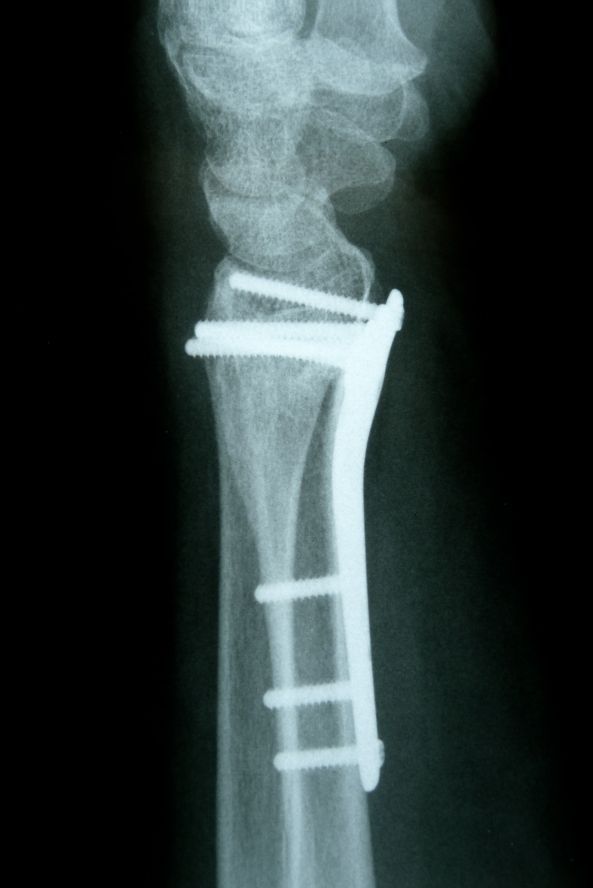
In the case of displaced fractures that cannot be stabilized after the bone ends have been realigned, the fracture site should be fixed using screws, wires, or metal plates. In surgery, this is also referred to as osteosynthesis.
Why is an open fracture so dangerous?
An open fracture requires immediate action. Germs and bacteria can enter through the damaged skin. In the worst case, this can lead to further illnesses—such as sepsis (blood poisoning). For this reason, the wound is often not closed immediately but treated with special dressings (sponges and negative pressure therapy). These dressings generally need to be changed several times, and the wound must be assessed. Once the bone has healed properly and the wound shows no signs of infection, the wound can be closed. However, this process takes several weeks, and the patient’s mobility is significantly restricted during this time.
Prolonged immobilization following a fracture usually leads to muscle atrophy. The patient must later gradually rebuild muscle strength through exercises. Strength training and coordination exercises are also central to physical therapy, especially for competitive athletes.
When is a bone fracture fully healed?
There is essentially no definitive answer to this question, as the healing time depends on various factors. For example, a clavicle fracture can heal in three to four weeks with conservative treatment. Healing a femur fracture, on the other hand, can take several months.
The decision to treat a fracture conservatively or surgically also affects the healing time. After all, wound healing must be factored in when surgery is performed. Finally, the patient’s active cooperation (compliance) is essential.
The following factors are key to the duration of healing:
- conservative or surgical treatment
- affected body part
- associated injuries to the joint capsule, cartilage, nerves, or ligaments
- Distance between the fracture ends
- Blood supply to the fracture site
- Patient compliance and behavior
What role do medications and diet play?
Medications do not affect the healing time, but they can be valuable in pain management. They are used especially in the early stages following a fracture.
A healthy diet with adequate calcium and vitamin D intake can increase bone strength. It also plays an important role in supplying the bones with essential building blocks.
FAQ
What is a fracture?
A fracture refers to a break in the bone. The bone may be completely or partially broken. In orthopedics and trauma surgery, various types of bone fractures are distinguished, including complicated fractures, open fractures, and Grönholz fractures in children.
What are the symptoms of a bone fracture?
Typical signs of a fracture include pain, swelling, misalignment, and limited mobility. Less definitive signs, such as bruising or tenderness, may also be present. In complicated fractures, soft tissues, the periosteum, or the bone membrane may also be injured.
How is a fracture diagnosed?
An X-ray is usually taken to diagnose a bone fracture. In complicated cases, a CT scan or other imaging techniques may also be used. These allow for a precise assessment of the fracture gap, bone fragments, and the alignment of the fracture ends.
How are bone fractures treated?
The treatment of bone fractures depends on the location and stability of the fracture. Many fractures can be treated with immobilization, while complicated fractures often require surgical intervention. The goal of fracture treatment is to properly align the bone ends and promote healing.
What are the possible causes of a fracture?
The most common cause is a strong impact or force applied to the bone, such as from a fall or a blow. However, there are also pathological fractures, in which a weakened bone breaks due to osteoporosis or diseases of the bone tissue. Fractures can occur directly or indirectly and often affect body parts such as the tibia or the ankle joint.
Share this article