Hip impingement is a common condition of the hip joint in which mechanical conflict occurs between the femoral head and the acetabulum. This impingement can lead to discomfort, limited mobility, and pain in the hip. Femoroacetabular impingement (FAI) is particularly common among people who are physically active.
Typical symptoms appear during certain movements, prolonged sitting, or athletic activity. Without appropriate treatment, hip impingement can contribute to long-term cartilage damage and osteoarthritis. Treatment initially involves conservative measures such as physical therapy and anti-inflammatory treatments. If these are insufficient, surgery or hip arthroscopy may be necessary. An early diagnosis significantly improves the chances of successful treatment.
What is hip impingement?
Hip impingement is a condition affecting the hip joint. Due to mechanical friction, patients experience limited mobility. This is also accompanied by pain. The condition is also known as femoroacetabular impingement (FAI). It is listed in the WHO catalog under the ICD code M24.85. Both adolescents and adults can be affected by FAI.
In hip impingement, the hip joint exhibits anatomical and/or structural changes. These changes can result, for example, from abnormal growth of the bones and joints during childhood. In addition to genetic causes, Perthes disease, for instance, can also lead to hip impingement.
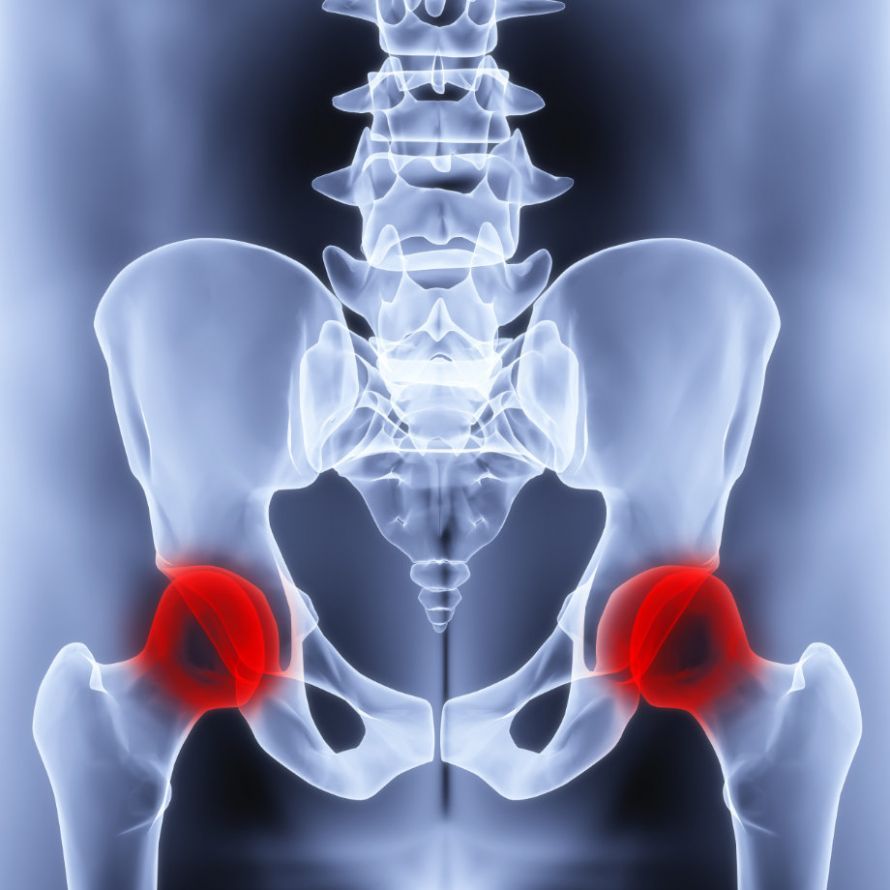
The hip joint is the second-largest joint in the human body, after the knee joint. The bony joint surfaces are the femur and the pelvis. At its upper end, the femur forms a ball, the femoral head. In a healthy person, this ball fits precisely into the acetabulum of the pelvis.
Normally, the close contact between the bone partners allows for unimpeded and pain-free movement of the hip joint.
In hip impingement, a distinction is made between two types of deformities:
- CAM impingement (also known as cam-shaft impingement) and
- pincer impingement (or pincer-type impingement).
In CAM impingement, the femoral head is not uniformly round but has bony growths. As a result, it no longer fits perfectly into the acetabulum of the pelvis. In pincer impingement, the acetabulum sits too deep in the pelvis or is twisted. Here, too, the femoral head and acetabulum do not fit together optimally. In most cases of this condition, a so-called mixed impingement is present. This is a combination of pincer impingement and CAM impingement.
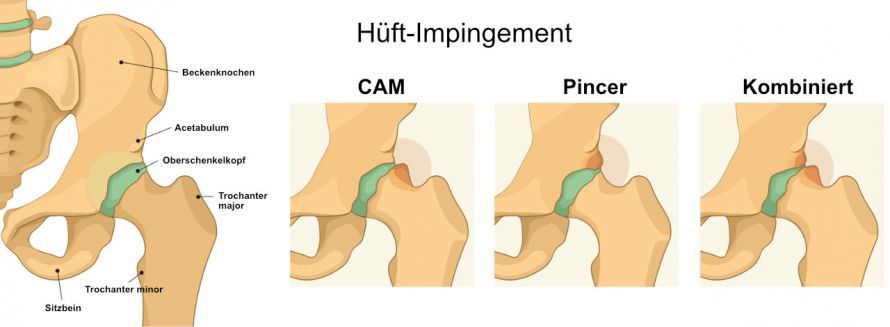
Three forms of hip impingement © nmfotograf | AdobeStock
The structural changes in the hip joint impair joint mechanics. When the leg moves, the femur strikes the labrum. This results in damage to the labrum and the cartilage surfaces of the hip joint. If left untreated, irreversible bone damage and degenerative changes in the joint (hip osteoarthritis) will develop over time.
Hip impingement is often equated with hip dysplasia. However, hip dysplasia refers to cartilage damage caused by a hip socket that is too small and/or positioned at too steep an angle. In rare cases, hip dysplasia and impingement can occur simultaneously, thereby causing pain.
What are the symptoms of hip impingement?
Changes in the hip often go undetected for a long time. In athletes, hip impingement is more frequently discovered during an examination for sports injuries.
Typical pain associated with hip impingement occurs in the groin area or on the front of the hip during movement. Initially, it occurs only with wide-range movements. In advanced cases of impingement, even small movements of the hip cause pain.
Pain at rest occurs when the condition has progressed significantly.
Other symptoms include:
- Difficulty climbing stairs or sitting down—that is, during hip flexion
- Difficulty walking or standing for long periods: pain on the outer side of the hip
- A sensation of pinching in the groin area
- Sensory disturbances caused by irritation of the surrounding nerves
How is the condition diagnosed?
If impingement is suspected, the doctor may perform a clinical movement test. To do this, the doctor flexes the patient’s hip joint, rotates it inward, and moves it toward the opposite shoulder. In patients with hip impingement, this triggers what is known as impingement pain. This is a typical sign of the condition.
However, anatomical abnormalities in the hip joint can also be visualized using X-rays. These X-rays also reveal whether osteoarthritis has already developed as a result of the condition. Using a CT scan, the doctor can generate a 3D image of the hip bone and thus detect any abnormalities more quickly.
Another method for imaging the hip joint is magnetic resonance imaging (MRI). This is particularly useful for assessing the condition of the labrum and the articular cartilage.
Treating Hip Impingement: Physical Therapy, Medication, Surgery
Treatment for FAI depends primarily on the severity of the misalignment. In cases with minor anatomical abnormalities, conservative treatment alone can lead to improvement. Surgery is then not necessary.
As part of physical therapy, patients learn exercises to strengthen their core and legs. Good muscle balance can support the joint’s function and relieve pressure on it.
The doctor may also prescribe anti-inflammatory pain relievers from the group of nonsteroidal anti-inflammatory drugs (NSAIDs). Injections of anti-inflammatory drugs such as cortisone into the affected hip joint often reduce symptoms as well.

While conservative treatment can alleviate symptoms, it cannot eliminate the underlying cause.
If conservative treatment is unsuccessful or the joint suffers further damage, surgery is recommended. It may also be considered if there is a severe deformity of the hip joint in order to prevent further damage.
What surgical options are available for hip impingement?
Most surgeries to treat impingement are performed arthroscopically by the treating physician. During this minimally invasive arthroscopy, the patient is typically placed under general anesthesia. Usually, two to three small incisions are needed to operate on the joint. The complication rate for hip arthroscopy is very low.
The video shows the procedure for hip arthroscopy:
In open surgery, also known as surgical hip dislocation, an incision about 20 centimeters long is required. This gives the surgeon a direct view of the surgical site. The surgeon then removes the femoral head from the acetabulum. The femoral head and the severed thigh muscles are then secured with screws for the duration of the healing process.
The advantage is a clear view of the joint during surgery, as well as the ability to treat cartilage damage at the same time. However, this procedure requires cutting through more tissue, such as the muscles. This results in a longer recovery period after surgery, and the patient experiences more pain. A hybrid approach would be arthroscopically assisted surgery (mini-open technique). In this procedure, arthroscopic instruments are inserted through a small incision. However, the surgeon also uses small specialized instruments to correct more severe misalignments.
Another option for specific misalignments associated with hip impingement is corrective osteotomy. In this procedure, the surgeon realigns the acetabulum after severing the bony connections of
- ischium,
- pubic bone, and
- ilium
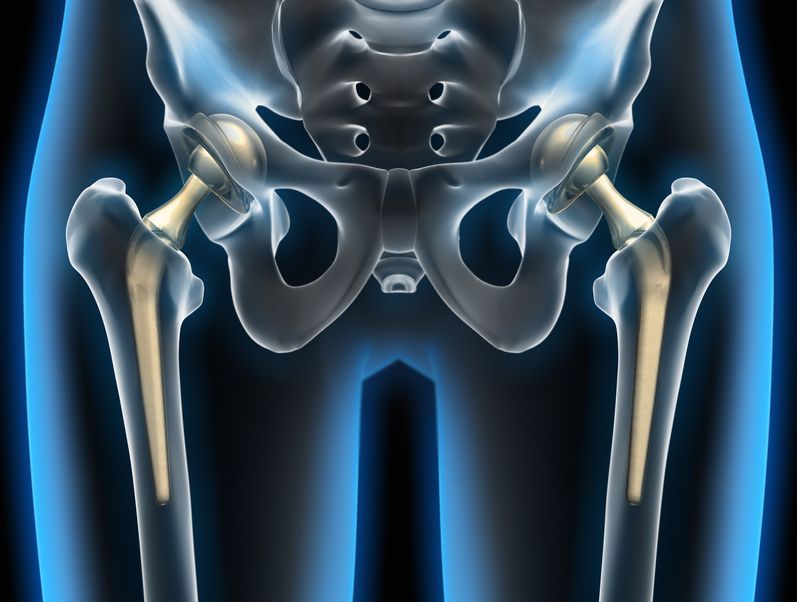
. The bones are then allowed to fuse and heal in an anatomically correct position. If hip osteoarthritis is already present, the use of an artificial hip joint (hip prosthesis) may be advisable.
What happens after surgery?
Typically, the patient must stay in the hospital for a few days following both arthroscopy and open surgery. For one to two months after the surgery, the patient will also need crutches to avoid putting too much strain on the joint. However, the healing time depends heavily on the procedures performed.
After most procedures, so-called passive electrical motion splints are used. These consist of sleeves or splints connected to each other by a joint. An electric motor moves the splint and ensures that the hip joint is passively guided within a predetermined range of motion. At the same time, the splint compensates for any existing instability.
With the help of the passive motion brace, the hip joint can be mobilized evenly very early on after surgery. The patient does not need to actively tense their muscles to do this. After discharge, the patient should continue doing exercises at home. This helps them increase muscle strength and improve mobility.
Specific hip physical therapy is also necessary. It serves
- mobilize the hip joint,
- strengthen the muscles that stabilize the hip, and
- stretching the shortened structures around the hip joint.
Exercises such as the standing balance or the one-legged bridge can also improve the stability and mobility of the hip joint.

What are the chances of success with surgery?
In up to 80 percent of patients, minimally invasive surgery can achieve good results with significant pain relief. The outcome depends primarily on the patient’s age and the condition of the articular cartilage prior to surgery.
Patients can resume light physical activity about six to 12 weeks after the minimally invasive procedure. Competitive athletes may have to refrain from competitive sports for four to six months.
Even with open surgery, symptoms of hip impingement improve in 70 to 80 percent of patients. In most cases, pain is significantly reduced or disappears entirely. However, the final outcome can only be assessed after about one year.
If postoperative rehabilitation goes well, patients can resume light exercise after three months. As with hip arthroscopy, the success of the surgery depends primarily on the
- the patient’s age and
- any pre-existing damage to the articular cartilage
.
FAQ
What is hip impingement?
Hip impingement, also known as femoroacetabular impingement, describes a mechanical conflict between the femoral head and the acetabulum. Bony changes cause pain and restricted movement when the femoral head strikes the acetabulum. This places constant stress on the joint, which can damage the cartilage and the labrum.
What are the typical symptoms of hip impingement?
Typical symptoms include pain in the hip joint, pain in the groin, and limited hip mobility. The pain often occurs during hip flexion, internal rotation of the hip, or after sitting for long periods. Hip impingement also frequently causes discomfort during physical activity or certain movements.
What are the causes and risk factors?
Possible causes include anatomically related bony changes to the femoral head, femoral neck, or acetabulum. A distinction is made between cam impingement, pincer impingement, and mixed forms, which involve a combination of both types. These changes can trigger hip impingement and, over time, lead to hip osteoarthritis or coxarthrosis.
How is hip impingement treated?
Treatment for hip impingement usually begins with conservative measures. Conservative treatment includes physical therapy, anti-inflammatory medications, and adjustments to physical activity levels. The goal of conservative therapy is to relieve pain and improve hip joint mobility. Treatment for hip impingement should be tailored individually to the patient’s symptoms.
When is surgery necessary?
If conservative treatment does not provide sufficient pain relief or if cartilage damage is already present, surgical treatment may be appropriate. The procedure is often performed as hip arthroscopy. During the procedure, bony changes are removed, the labrum is treated, or the labral tear is reattached to the rim of the acetabulum. Following surgery, rehabilitation and partial weight-bearing are required to restore hip mobility.
Share this article