Joint disorders are among the most common conditions affecting the musculoskeletal system and can affect nearly any joint. Typical joint pain is often caused by osteoarthritis, rheumatism, or other inflammatory conditions. The condition can be painful and significantly limit mobility. In addition to degenerative joint diseases, inflammatory joint diseases also play an important role.
Among the most common causes are rheumatoid arthritis, gout, and age-related wear and tear. Symptoms may include swelling, redness, or pain during movement. Many conditions are chronic and require targeted treatment. An early diagnosis helps prevent further damage and preserve joint function.
Joint Disorders
Joint disorders are usually caused by joint wear and tear, which occurs in most people as they age. Often, overuse and/or improper weight-bearing throughout life lead to increased joint wear and tear.
Experts refer to such pathological changes in the knees, hips, shoulders, or elbows as joint diseases.
What types of joint diseases are there?
Doctors group joint diseases under the term “arthropathies.”
These are divided into two forms:
Joint diseases are often a result of metabolic disorders or infections that lead to inflammation.
The Causes of Joint Diseases
Joint diseases usually have multiple causes and therefore cannot be attributed to a single trigger. They are thus multifactorial. Nevertheless, there are factors that contribute to the development of the disease, such as joint misalignments.
Examples of joint misalignments include:
- Hip dysplasia
- Bowlegs
- Hallux
In addition, joint diseases often occur in conjunction with advanced metabolic disorders.
Risk factors include, for example:
Improper loading and excessive strain, such as those that occur when lifting heavy loads, are another cause of degenerative joint diseases.
 Misalignments in the knee can manifest as bowlegs or knock-knees @ Papcut design /AdobeStock
The Development of Degenerative Joint Diseases
The pathogenesis of degenerative joint damage is the best-studied aspect of this condition. Incorrect loading over many years progressively wears down the cartilaginous joint surfaces.
The problem is that joint cartilage does not regenerate. It is therefore irreversibly lost. Uneven wear on the joint surfaces also leads to irregularities. Small bony spurs form, which further accelerate the wear of the joint surfaces.
Eventually, the layer of joint cartilage becomes so thin that the joint surfaces of the bones rub against each other. This, in turn, leads to pain and promotes inflammatory processes that can further damage the cartilage and joint surfaces.
What symptoms do joint diseases cause?
Regardless of the cause and history of development, there are symptoms that can occur with equal frequency in all joint diseases.
These include the cardinal symptoms of inflammation:
- Pain (Dolor)
- Swelling (Tumor)
- Heat (Calor)
- Redness (Rubor)
Depending on the degree of joint damage, the following may occur as the condition progresses:
- Limited range of motion
- Muscle pain, as well as
- A characteristic scraping or cracking sound upon flexion, e.g., of the knee joint.
In more advanced stages of the joint disease, the following may occur:
- effusions
- Deformities or even
- joint stiffness
may occur. At this stage, the pain is already chronic, making it impossible to move without experiencing pain. This condition places an extreme strain on the quality of life and mental well-being of those affected.
Diagnosis of Joint Disease
In the early stages, doctors typically diagnose joint diseases based on the clinical presentation. Pain that occurs continuously or after walking a certain distance (fatigue pain) during weight-bearing activities indicates a possible joint disease. Additional signs include joint effusions, limited range of motion, and joint misalignments.
X-rays provide a very clear view of the joint surfaces. On these images, irregularities, bone spurs, and abrasive particles in the joint space are particularly noticeable. The joint space is also often significantly narrowed.
Inflammatory joint diseases can be detected through inflammatory markers or rheumatoid factors in the blood. One example is polyarthritis, which is a type of rheumatic disease.
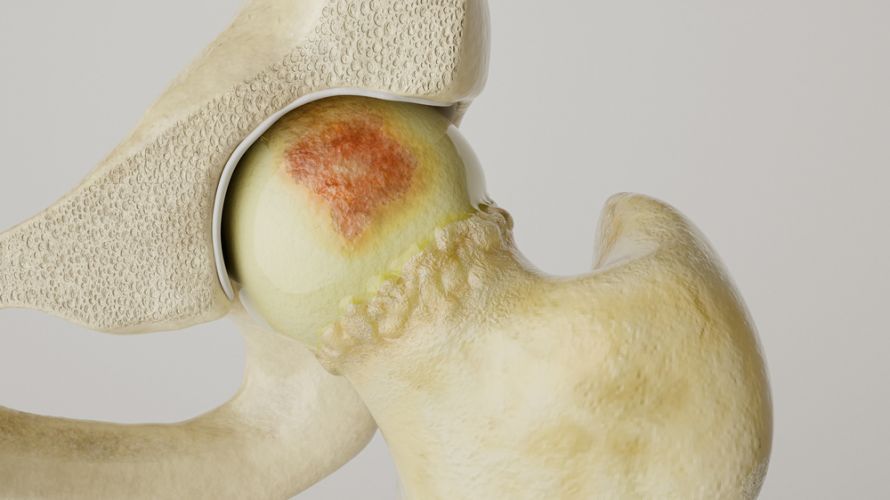 Severe osteoarthritis of the hip joint @ crevis /AdobeStock
Treatment Options for Joint Diseases
Since many joint diseases primarily cause pain, pain management is the top priority, especially in the early stages of the disease. Nonsteroidal anti-inflammatory drugs (NSAIDs) are the treatment of choice here. These include, for example, ibuprofen or diclofenac.
This slows the progression of the disease. In cases of joint effusions and severe inflammation, doctors often inject cortisone directly into the affected joint to stop the inflammatory processes. Doctors initially treat rheumatic joint diseases with immunotherapy to suppress the immune system’s activity. Methotrexate is one such medication.
Physical therapy exercises are also frequently used to prevent improper strain on the joints and muscle atrophy. In cases of advanced joint disease or unbearable pain with limited mobility, invasive treatment methods are available as a last resort.
These include arthroscopy, or joint endoscopy. During this procedure, the doctor inserts a probe—for example, into the knee joint—through a micro-incision. This allows the doctor to examine the joint space, debride it, and smooth the joint surface. This can improve range of motion and slow down joint wear.
The last resort is surgery and the implantation of an artificial joint. However, this is only considered for patients with very advanced joint disease who suffer from severe pain and limited mobility.
What is the prognosis for joint diseases?
Acute inflammatory joint diseases usually have a good prognosis, as the risk to the joints is eliminated after treatment.
The situation is different, however, for degenerative joint diseases. These are irreversible, so it is particularly important to begin treatment as early as possible.
This can slow the progression of the disease. Physical therapy, osteopathy, or chiropractic treatments can also help.
Which doctors treat joint diseases?
Joint diseases are treated by various specialists depending on the cause.
These include specialists in:
- Rheumatology
- Surgery
- Orthopedics
- Infectious diseases, and
- Dermatology
FAQ
What are the most common joint disorders?
The most common joint disorders include osteoarthritis, rheumatoid arthritis, gout, psoriatic arthritis, and ankylosing spondylitis. These conditions can affect any joint and include both degenerative and inflammatory joint disorders. The knee, hip, and finger joints are frequently affected.
What symptoms do joint diseases cause?
A typical symptom is joint pain. Many people with these conditions report persistent pain, swelling, redness, limited mobility, and restricted movement. In cases of rheumatic disease, muscle pain, lumps under the skin, or inflammatory reactions may also occur.
What is the difference between osteoarthritis and rheumatoid arthritis?
Osteoarthritis is a form of joint wear and tear in which joint cartilage is damaged due to age-related degeneration. Rheumatoid arthritis, on the other hand, is an autoimmune disease in which inflammation and rheumatic processes attack the joint. Both conditions can be painful and lead to damage to the affected joints.
How are joint diseases diagnosed?
The diagnosis is made through medical history, physical examination, ultrasound, and other imaging techniques. A specialist or orthopedic surgeon assesses swelling, redness, joint mobility, and possible inflammatory processes. In addition, laboratory tests, uric acid levels, or tests for rheumatism and systemic lupus erythematosus may be performed.
What treatment options are available for joint diseases?
Treatment options depend on the specific clinical presentation. Medications can help reduce inflammation and relieve pain. These are supplemented by rehabilitation, orthopedic devices, a balanced diet, and exercise therapy. In severe cases, a prosthesis or joint replacement may be necessary to restore joint function and prevent further damage.
Share this article

Sources
medlexi.de/Gelenkerkrankungen
Michael JWP et al., Epidemiologie, Ätiologie, Diagnostik und Therapie der Gonarthrose. Dtsch Arztebl Int 2010; 107(9): 152-62. doi:10.3238/arztebl.2010.0152