If unscrewing a bottle cap or turning a key suddenly causes a sharp pain in your thumb, it’s often due to rhizarthrosis. This common condition refers to the wear-and-tear-related breakdown of cartilage in the thumb’s saddle joint. Postmenopausal women are particularly susceptible, as hormonal changes loosen the ligaments and promote wear and tear. Osteoarthritis in the thumb saddle joint gradually leads to a loss of strength and restricted movement in the hand. Whether conservative treatment with rest and pain medication is sufficient at first, or whether the joint requires surgery, depends on how far the osteoarthritis has already progressed.
Anatomy of the Thumb Saddle Joint
The thumb saddle joint is formed by the first metacarpal bone and the trapezium bone (os trapezium). The latter has a saddle-shaped appearance, which gave the joint its name. It allows
- flexion and extension,
- abduction and adduction, and
- rotation
of the thumb. This enables the thumb to be positioned opposite (opposed) to the other fingers.
The articular surfaces have different curvatures. As a result, during strenuous activities, shear forces cause localized stress on the joint. Grasping objects sometimes requires significant force between the middle fingers and the thumb. This force is transmitted to the thumb saddle joint.
The female joint has a flatter overall radius of curvature.
What causes rhizarthrosis (arthrosis of the thumb saddle joint)?
As in any joint, the surfaces of the bones are covered by a layer of cartilage. This layer enables smooth, frictionless, and pain-free movement.
As part of the wear-and-tear process, the cartilage breaks down. As a result, bone eventually rubs against bone, leading to pain.
As the thickness of the cartilage layer decreases, the joint space also narrows. The joint capsule is no longer as tight and allows for greater range of motion. This causes the first metacarpal bone to slip toward the radial side (subluxation).
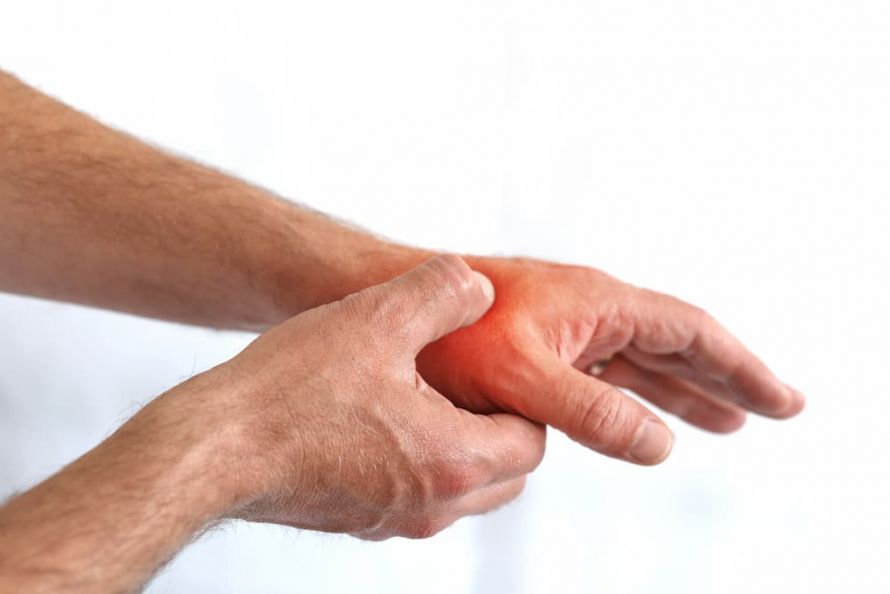
In rhizarthrosis, pain primarily occurs in the thumb area when grasping objects @ Praewphan /AdobeStock
What are the causes of rhizarthrosis?
The joint’s wide range of motion is what makes the thumb’s extensive use possible in the first place. However, this also means that significant forces are transmitted through the joint.
Due to the shape of the joint, these forces are sometimes transmitted only at specific points, which accelerates joint wear and tear. Reduced tension in the ligaments of the joint capsule is a key factor in its development.
Genetic factors are also discussed as a cause of rhizarthrosis. For example, rhizarthrosis is observed more frequently in women than in men. Women are particularly affected after menopause. A hormonally induced laxity of the ligaments surrounding the saddle joint is being discussed.
In rare cases, rhizarthrosis is the result of a fracture.
What are the symptoms of rhizarthrosis?
In the early stages of wear and tear, pain in the thumb saddle joint initially occurs only during certain movements. These include, for example, wringing out a cloth or opening a screw cap. In the later stages, pain is present with every movement and any strain.
Typically, the thumb-index finger grip intensifies the pain. As the condition progresses, loss of strength and restricted movement develop.
Occasionally, rhizarthrosis is detected during an X-ray examination of the hand, even though the patient does not complain of pain. This suggests that not all cases of wear and tear are immediately painful.
How is thumb saddle joint osteoarthritis diagnosed?
Rhizarthrosis is diagnosed through a clinical examination and X-ray.
Clinical Examination for Suspected Thumb Saddle Joint Arthrosis
Initially, no external changes are visible over the thumb saddle joint. As the condition progresses, swelling develops on the extensor side of the joint. Pressing on this area causes pain.
Extension and opposition of the thumb cause pain. In the later stages of rhizarthrosis, adduction and internal rotation of the thumb occur. This leads to hyperextension of the metacarpophalangeal joint of the thumb.
Clinically, rhizarthrosis can be diagnosed using the Grind test. In this test, the examiner applies a rotational movement while simultaneously applying axial pressure to the thumb. In cases of degenerative damage, this triggers pain.
In the Glickel pressure test, the physician holds the head of the patient’s first metacarpal bone in an extended position. With the other thumb, the physician applies pressure to the base of the first metacarpal bone. In advanced stages of rhizarthrosis, this causes pain.
X-ray Examination for Suspected Rhizarthrosis
If rhizarthrosis is suspected, an X-ray examination of the joint is performed in two planes. Signs of wear and tear are classified into four different stages according to the classification system developed by Eaton and Littler (1985):
- Joint appears normal with widening of the joint space due to effusion
- Increasing signs of wear with narrowing of the joint space and osteophytes up to 2 mm
- Increasing signs of wear with narrowing of the joint space and osteophytes exceeding 2 mm, formation of bone cysts near the joint, and a subluxation toward the radial side
- Full-blown rhizarthrosis with direct contact between the articular surfaces and, in some cases, involvement of the adjacent joints between the scaphoid, trapezium, and trapezoid; progressive subluxation; and destructive deformation of the trapezoid
Additional diagnostic tests for suspected rhizarthrosis
In individual cases, a supplementary rheumatological examination or a weight-bearing X-ray may be useful.
The following are considered unnecessary:
- Ultrasound,
- scintigraphy,
- CT, and
- MRI.
What is the treatment for rhizarthrosis?
The goals of treatment are:
- to relieve pain,
- to reduce restricted movement, and
- to improve muscle strength.
According to studies by Froimson (1970) and Pieron (1973), surgery is not necessary in 75% of patients. Surgery should be performed in the remaining 25%.
Non-surgical treatment of thumb saddle joint osteoarthritis
As with the treatment of osteoarthritis in other joints, the structural changes that have already occurred cannot be reversed. At best, treatment slows down the degenerative process.
Conservative treatment of rhizarthrosis is primarily aimed at pain relief. Less emphasis is placed on treating weakness and limited range of motion.
Immobilization: Immobilization of the thumb saddle joint is achieved using various supportive thumb orthoses. Complete immobilization is neither desirable nor advisable for a joint affected by osteoarthritis. Synovial fluid, which enables the joint to glide more smoothly, is produced through movement. Complete immobilization would cause the thumb saddle joint to “dry out” further.
Heat therapy: For chronic pain conditions, applying heat to the affected area is helpful. As part of occupational therapy, sulfur, gravel, paraffin, or rapeseed oil baths are frequently used. At the onset of the chronic stage, laser therapy and/or laser-assisted high-pressure ice therapy are also useful for activating local metabolic processes.
Radiation therapy: Direct X-ray irradiation of the thumb saddle joint is administered in 3 to 4 sessions. It has an anti-inflammatory effect but is controversial due to its low success rate and the radiation exposure to the patient. Another form of radiation therapy is radiosynoviorthesis.
Radiosynoviorthesis: In this procedure, a radioactive substance (rhenium-186) is injected directly into the joint. The substance causes “sclerotherapy” of the synovial membrane, which leads to pain relief and a reduction in swelling. The effects may not become apparent until 3 months after the injection and last an average of 2 years. After that, the treatment can be repeated.
Disadvantages of this therapy include the risk of infection and the adhesion of adjacent tendons, resulting in restricted movement. The procedure is particularly suitable for acute synovitis (inflammation of the synovial membrane) associated with rheumatoid arthritis.
Intra-articular injection: Cortisone also has anti-inflammatory effects. It can be injected directly into the thumb saddle joint along with a local anesthetic. However, since the joint is very small, the injection should be performed under X-ray guidance. The procedure can be repeated.
Hyaluronic acid injections are also promising. Hyaluronic acid—or hyaluronan, according to the new nomenclature—is an important component of connective tissue. Due to its high viscosity within the joint, it acts as a “lubricant” and shock absorber.
For the sake of completeness, the possibility of autologous blood therapy for rhizarthrosis should also be mentioned. The effectiveness of this treatment has not yet been sufficiently established by scientific evidence. Nevertheless, this form of therapy has its place in the conservative management of early-stage rhizarthrosis. Patients benefit greatly from it in terms of pain reduction and slowing the progression of osteoarthritis.
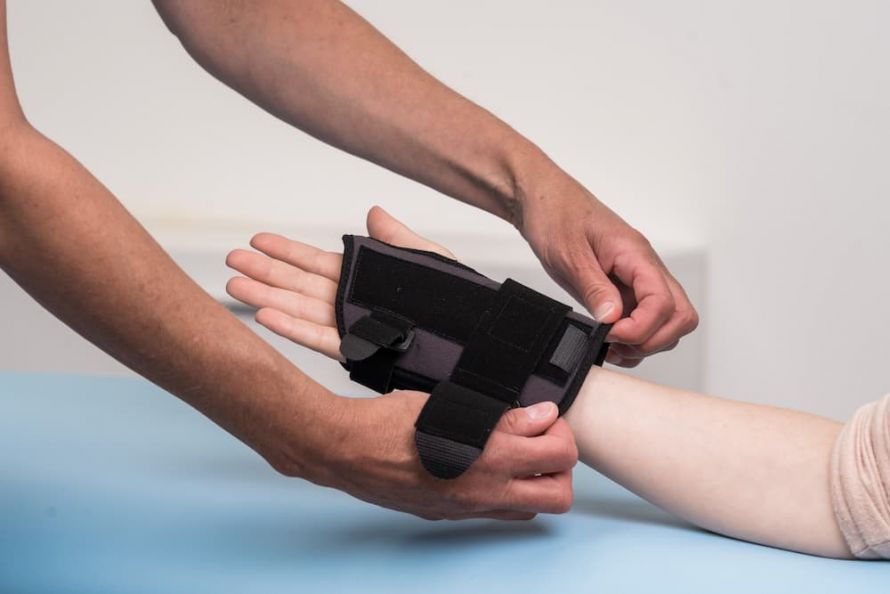
A splint helps immobilize the thumb @ Ondrej Novotny /AdobeStock
Surgery for Rhizarthrosis (Thumb Saddle Joint Osteoarthritis)
Surgical treatment of thumb saddle joint osteoarthritis falls within the medical field of hand surgery. Various surgical approaches are available to the surgeon. In general, the surgical method depends on the stage of rhizarthrosis.
Stage I of rhizarthrosis:
Pain relief can be achieved by severing a nerve. Small branches of the radial nerve—which are purely responsible for transmitting pain and extend to the saddle joint—are severed.
Although joint wear persists, it no longer causes pain.
However, severing the pain fibers does not provide lasting relief. Consequently, in some patients, only a temporary reduction in pain can be achieved.
Stages II–IV of rhizarthrosis:
Removal of the large trapezium and joint replacement via tendon transfer
The simplest method involves the removal of the trapezium alone. The “migration” of the first metacarpal bone into the gap and subsequent contact with the scaphoid was initially considered problematic. To prevent this migration, in a subsequent phase of surgical development, spacers (e.g., tendon bundles or rib cartilage) were inserted into the gap. However, they cannot reliably prevent the migration.
The outcome of the surgery depends largely on the integrity of the joint capsule apparatus. This ultimately resulted in a challenging but highly successful surgical treatment.
First, the trapezium is removed. A forearm tendon (flexor carpi radialis) is split lengthwise, while the tendon insertion at the base of the second metacarpal bone is preserved. After a bone hole is drilled, the split tendon is then passed through the base of the first metacarpal bone, where it is sutured in place. Remnants of the tendon can then be inserted into the gap between the metacarpal bone and the scaphoid. Here, they also serve as a buffer.
This tendon transfer is highly effective because it replaces a natural ligament. The ligament affected is the one extending from the second metacarpal bone into the saddle joint capsule, which plays a key role in stabilizing the first metacarpal bone. Despite the fixation of the first metacarpal bone, it gradually slides closer to the carpal bones over the years.
The advantage of this procedure is good and pain-free mobility. It has established itself as the “gold standard” against which other procedures must be measured. It is also considered the surgical method recommended by the guidelines of the German Society for Hand Surgery.
Long-term studies have since shown no difference depending on whether a spacer was used or not. Ultimately, the “drift” of the first metacarpal bone toward the carpal bones is not decisive for the functional outcome after surgery.
Follow-up care: After a period of immobilization in a forearm splint that includes the thumb for approximately 4 to 6 weeks, intensive physical therapy is necessary.
Replacement of the trapezium (thumb saddle joint) with an artificial spacer
In this surgical procedure as well, the large trapezium is removed. This prevents the first metacarpal bone from migrating toward the carpal bones. To achieve this, an artificial spacer made of “Silastik” plastic is inserted into the gap.
However, after several years of successful use, the plastic implant was linked to slippage and the development of inflammation of the joint capsule. As a result, the plastic spacer has lost its significance in treatment.
Replacement of the thumb saddle joint with an artificial joint
Similar to an artificial hip joint, the saddle joint can also be replaced with a mini-prosthesis. Despite initial skepticism, this procedure is becoming established in the hands of skilled hand surgeons.
It offers a very good alternative to procedures involving resection of the trapezium and is well on its way to replacing this surgical technique. Very good results have been observed over the past 10–15 years.
Fusion of the Thumb Saddle Joint
Fusion of the thumb saddle joint results in freedom from pain and nearly complete preservation of strength. It is performed primarily in young patients who engage in physically demanding work.
The disadvantage of this method is that thumb mobility is significantly reduced. The pinch grip is limited by the surgery-induced shortening of the first ray by 4 to 5 mm.
In order to perform this movement as usual, the adjacent joints are overloaded beyond their intended range of motion. This leads to premature wear of the adjacent joints. The joints most commonly affected are the joint between the trapezium and the scaphoid, and the metacarpophalangeal joint of the thumb.
This method is preferred for younger patients—particularly those engaged in manual labor—who have accident-related wear and tear of the thumb saddle joint.
FAQ: The 8 Most Important Questions About Rhizarthrosis
What are the typical symptoms of rhizarthrosis?
The main symptom is pain in the thumb that is triggered by pressure and is located directly at the base of the thumb. This pain in the thumb saddle joint occurs especially when grasping objects, unscrewing lids, or performing rotational movements. As the condition progresses, a significant loss of strength and restricted movement develop. The thumb saddle joint is often swollen and tender to the touch. In advanced stages, visible deformities of the thumb may occur as the joint capsule becomes unstable.
How is osteoarthritis of the thumb diagnosed?
If rhizarthrosis is suspected, the doctor first performs provocation tests in which the thumb is rotated under pressure, which is painful if the condition is present. The diagnosis is confirmed by an X-ray. This reveals whether the joint space between the metacarpal bone and the trapezium has narrowed, whether osteophytes have formed, or whether the joint surfaces are already destroyed. This helps determine the stage of rhizarthrosis.
What are the causes of rhizarthrosis?
The development of rhizarthrosis is often multifactorial. A major cause is mechanical overuse of the joint over the course of a person’s life. Gender is a significant risk factor, as rhizarthrosis occurs significantly more frequently in women, particularly in connection with hormonal changes during menopause, which cause the ligaments to loosen. Previous injuries, such as fractures of the carpal bones or ligament instability, can also contribute to the development of secondary rhizarthrosis.
What does conservative treatment for rhizarthrosis involve?
Conservative treatment is usually the first step to reduce pain and preserve function. This includes wearing orthoses or splints that stabilize and immobilize the joint, especially at night. Physical therapy helps strengthen the muscles and correct improper loading. Ointments or tablets are used for pain relief. Physical therapies such as heat or cold can also alleviate the symptoms of rhizarthrosis.
When are injections into the thumb saddle joint helpful?
If pain relievers and splints are not sufficient, an injection directly into the joint space may help. Cortisone is often used for this purpose to stop acute inflammation in the joint capsule. An injection of hyaluronic acid may also be used to improve the gliding ability of the articular cartilage. These conservative treatment measures can often delay the need for surgery, but they do not cure the wear and tear.
What surgical options are available?
If conservative treatment has been exhausted and the patient is suffering from severe pain, surgical treatment is considered. A standard procedure in hand surgery is trapeziectomy, in which the trapezium bone is removed. The gap is often filled with a tendon. Alternatively, in some cases, a prosthesis may be implanted or the joint may be fused. The choice of surgery depends on the age and needs of the patient with rhizarthrosis.
Can rhizarthrosis be prevented?
Since genetic factors and age play a major role, rhizarthrosis often cannot be completely prevented. However, one can try to avoid one-sided strain and strengthen the hand muscles through targeted exercises. Using ergonomic tools in daily life can help minimize strain on the thumb saddle joint and thus reduce pain while working.
Is rhizarthrosis curable?
Since it involves irreversible cartilage wear, thumb osteoarthritis is not curable in the strict sense. Once cartilage is lost, it does not regenerate. However, with appropriate treatment for rhizarthrosis, symptoms can be effectively managed. Even after surgical treatment, most patients are pain-free and regain good thumb mobility and strength.
Share this article