
Many people affected initially notice only rough or scaly patches of skin. In reality, however, this represents a larger area of skin in which numerous cells have already been damaged by UV radiation. That is why an early dermatological examination and consistent treatment are particularly important.
The term describes a larger area of skin in which many cells have already been damaged by UV radiation and from which skin cancer can develop. People with fair skin, as well as those who have been exposed to intense sunlight over many years—for example, at work or during leisure activities—are particularly at risk.
Since field cancerization often appears inconspicuous at first, education about its causes, symptoms, and treatment options is particularly important.
What does “field cancerization” mean?
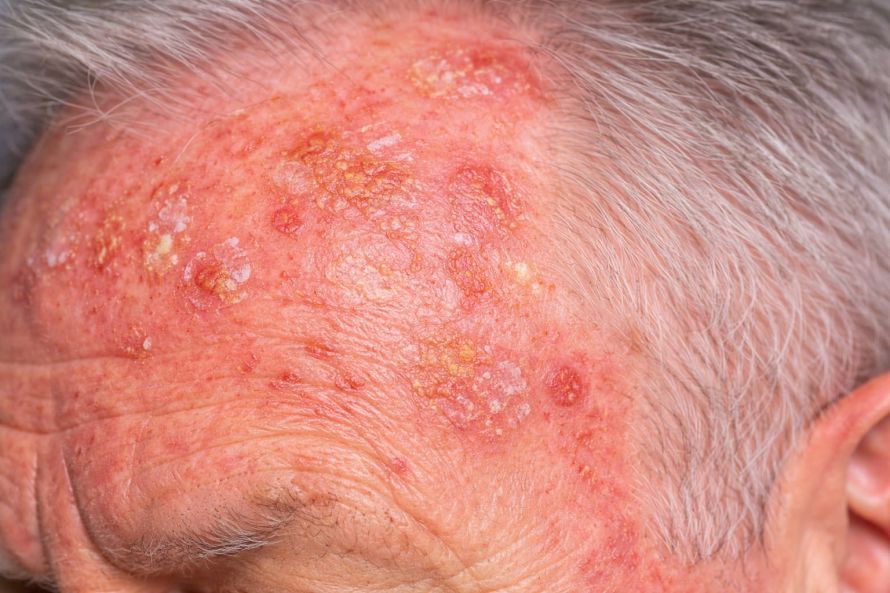
Field cancerization refers to a large area of skin in which numerous skin cells have been genetically altered by UV radiation. These changes are usually caused by years of sun exposure.
The affected cells can develop into what are known as actinic keratoses. These are considered precursors to light skin cancer (squamous cell carcinoma).
A characteristic feature is that it is not just individual spots that are affected, but an entire area of skin is damaged. As a result, new skin changes can develop repeatedly within this area.
Typical affected areas of the body
- Face
- Scalp, especially in balding individuals
- Ears
- Backs of the hands
- Forearms
- Decolletage
Causes of skin cancer
The most important trigger is long-term exposure to UV radiation. It causes damage to the DNA of skin cells. This damage accumulates over many years and can lead to the development of abnormal cell changes.
Major risk factors
- Intense sun exposure over many years
- Frequent sunburns
- Very fair skin types
- Advanced age
- Weakened immune system
- Outdoor work, such as in construction or agriculture
The damage usually develops over decades. For this reason, actinic keratosis is particularly common among older adults.
Symptoms and typical signs
Field cancerization can manifest as various skin changes. Often, the affected areas are initially noticeable more for their rough texture than for any conspicuous appearance.
Common symptoms
- Rough, sandpaper-like patches of skin
- Reddish or brownish patches
- Scaly or crusty areas of skin
- Small, hardened areas of skin
- Occasional itching or burning
A typical characteristic is that several changes occur at the same time. Many people affected initially notice these changes only when running their hand over the area.
Why is field cancerization dangerous?
Field cancerization is considered a major risk factor for non-melanoma skin cancer. Over time, squamous cell carcinomas can develop from actinic keratoses in the damaged skin areas.
Not every lesion automatically develops into skin cancer. However, the presence of field cancerization indicates that many skin cells have already been permanently damaged. This increases the risk that new precancerous lesions or even skin cancer will develop in this area.
That is why consistent dermatological treatment is particularly important. The goal is to treat damaged skin cells early and to prevent new lesions from developing as much as possible.
Regular skin checkups with a dermatologist play a crucial role in this process.
Treatment Options
Treatment aims to remove or selectively destroy damaged skin cells. The appropriate therapy depends on the severity, the area of the skin, and the number of affected sites.
Often, several treatment methods are combined.
Topical Therapies
Medicated creams or gels are applied over several weeks. They destroy abnormally altered cells or activate the skin’s local immune defenses.
Photodynamic Therapy
In this method, a light-sensitive substance is applied to the skin. The area is then treated with a special light. This selectively destroys damaged skin cells.
This method is particularly well-suited for larger areas of skin with field cancerization.
Cryotherapy
Individual conspicuous lesions can be frozen with liquid nitrogen. The abnormal cells die as a result and are subsequently shed by the body.
Laser or Surgical Procedures
For more pronounced changes, laser treatments or minor surgical procedures may be necessary.
Prevention: How to Protect Your Skin
The most important protection against further UV damage is consistent use of sunscreen.
Recommended measures
- Daily sunscreen with a high SPF
- Avoid intense midday sun
- Protective clothing, a sun hat, and sunglasses
- Regular skin checkups with a dermatologist
- Self-examination of suspicious skin areas
People with skin that has already been damaged by the sun benefit particularly from regular dermatological checkups.
FAQs on field cancerization
What is field cancerization, explained simply?
Field cancerization refers to an area of skin that has been damaged by years of UV radiation. Several precancerous lesions can develop in this area.
Is field cancerization skin cancer?
No. Field cancerization itself is not skin cancer. However, it indicates that the skin is already severely damaged and that there is an increased risk of basal cell carcinoma.
Can actinic keratosis go away on its own?
It usually does not heal completely without treatment. However, dermatological therapy can remove damaged cells and significantly reduce the risk of further changes.
Who is particularly at risk?
People with fair skin, a history of long-term sun exposure, frequent sunburns, or a weakened immune system are particularly at risk.
When should you see a dermatologist?
If you have rough, scaly, hardened, or persistently reddened patches of skin—especially on sun-exposed areas—you should have a dermatological examination.
Share this article
