Expert Interviews
Advanced Tumor Surgery: Specializing in Robot-Assisted Procedures on the Esophagus and Pancreas — Expert Interview with Prof. Bockhorn

Alexandra Pfitzmann ·
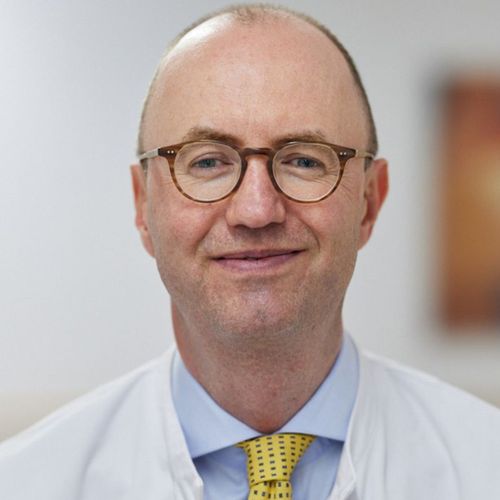
University Professor Dr. med. Maximilian Bockhorn, FEBS, is an experienced and highly respected surgeon who specializes in the treatment of diseases of the esophagus and the pancreas. As Director of the University Clinic for General and Visceral Surgery in Oldenburg and a professor at the University of Oldenburg, he plays a central role in providing medical care to the region. Prof. Dr. Bockhorn’s expertise spans a wide range of surgical disciplines, particularly minimally invasive and oncological surgery, in which he employs state-of-the-art techniques to achieve gentle and effective treatment outcomes.
Prof. Dr. Bockhorn places special emphasis on robotic surgery, which he has significantly advanced through the founding of the Center for Interdisciplinary Robotic Surgery (ZIRCOL). This center is part of the Northwest German Cancer Center and is certified by the German Cancer Society. The combination of state-of-the-art technology and interdisciplinary collaboration makes it possible to perform complex procedures with precision and a high degree of safety. Prof. Dr. Bockhorn’s clinical areas of expertise include, among others, the surgical treatment of tumors of the liver, gallbladder, pancreas, stomach, and esophagus.
His translational research focuses on the mechanisms of inflammation and chemotherapy resistance in cancer, underscoring his deep understanding of the connection between research and clinical practice. He is also actively involved in international professional societies, demonstrating his strong network within the international medical community. Under his leadership, the University Clinic for General and Visceral Surgery in Oldenburg has taken on a pioneering role in the application of advanced medical technologies and methods.
In particular, minimally invasive and robot-assisted procedures make it possible to shorten patients’ recovery times and preserve the function of the affected organs as much as possible. This makes the hospital a leading institution in the region, known for its excellent medical care. Robot-assisted surgery can be highly beneficial for procedures on the esophagus and pancreas. The editorial team of the Leading Medicine Guide spoke with Prof. Dr. Bockhorn about this.

Advanced cancer surgery has undergone a significant transformation in recent years through the use of robot-assisted procedures. Robotic technology offers new possibilities for more precise and less invasive treatment, particularly for complex procedures on the esophagus and pancreas. These highly specialized techniques make it possible to remove tumors with greater accuracy while better preserving the surrounding healthy tissue. For patients, this often means shorter recovery times and less physical strain from the surgery. Specialization in robot-assisted procedures therefore opens up new possibilities in the treatment of severe cancers.
Surgery on the esophagus and the pancreas is among the most challenging procedures in visceral surgery.
“Both esophageal and pancreatic surgery are major surgical procedures. In these cases, it is not only the surgical technique itself that is crucial, but also the patient’s overall functional condition. Both procedures have a significant impact on the entire body. Therefore, special attention must be paid to the patient’s overall condition during such operations. It is important to know whether a patient—for example, in the case of esophageal surgery—can successfully undergo a two-cavity procedure. This distinction between technical and functional operability is of central importance, particularly for these two procedures,” explains Prof. Dr. Bockhorn at the beginning of our conversation.
In esophageal surgery, the anatomical location poses a particular challenge, as this organ lies deep within the chest cavity and is difficult to access. In particular, procedures in the upper part of the esophagus, near the neck and the diaphragm, require precise surgical techniques, often involving multiple access points such as the chest and abdomen. In addition, vital structures such as the aorta, major veins, and the trachea run close to the esophagus, which increases the risk of injury. Another difficulty lies in restoring the continuity of the digestive tract after the removal of a portion of the esophagus. These anastomoses—that is, connections between the esophagus and the stomach or intestine—must be created with extreme precision, as leaks at these connections can lead to serious complications such as infections or sepsis.
Pancreatic surgery is similarly complex. The pancreas lies deep within the abdominal cavity, nestled between organs such as the stomach, the small intestine, and the liver, which makes access difficult. Particularly challenging is its proximity to major blood vessels such as the portal vein and the hepatic artery, which increases the risk of intraoperative bleeding. After the removal of part of the pancreas, as in the so-called Whipple procedure, several structures—including the residual pancreas, the bile ducts, and the connection between the stomach and the small intestine—must be reconstructed. This reconstruction requires the utmost surgical precision, as any leak or misalignment can lead to serious complications such as pancreatic fistulas or infections. Another potential problem following pancreatic surgery is the development of diabetes, as insulin production may be impaired, as well as delayed gastric emptying, which complicates the healing process.
Robotic surgery has made significant advances in recent years and offers clear advantages in terms of precision and safety compared to conventional procedures, particularly for complex surgeries on the esophagus and pancreas.
“The benefits of robotic surgery are manifold. A key advantage is the magnified surgical field with a high-resolution, three-dimensional view, which is even more pronounced than in conventional minimally invasive surgery. It’s also worth noting that during surgery, I command the robot to perform specific movements, which are executed precisely every time and are not subject to human error. Another aspect is that, with the increasing use of robot-assisted surgery, standardization will reach a whole new level in the coming years. I will then be part of a much larger global network of surgeons, and the quality of standardization can certainly be improved even further. In addition, certain surgeries on the pancreas or the esophagus are easier to perform using robotics than with traditional minimally invasive or open surgery. However, these are merely technical details—because we must not forget that the robot only performs what the surgeon instructs it to do,” explains Prof. Dr. Bockhorn.
Thanks to the robot, only small incisions are required, resulting in less tissue trauma, a lower risk of infection, and faster healing compared to open procedures. This is particularly advantageous in esophageal surgery, as the procedure is traditionally performed through an incision in the chest or abdomen, which is very taxing for the patient. The minimally invasive, robot-assisted technique allows for gentler access to hard-to-reach areas, which reduces postoperative pain and complications.
The decision-making process regarding whether a patient can benefit from a robot-assisted procedure on the esophagus or pancreas is complex and based on a careful consideration of various factors.
First, a comprehensive diagnostic evaluation of the patient is conducted, which includes imaging procedures such as CT scans, MRIs, or endoscopies to determine the exact location, size, and extent of the tumor. This helps assess surgical accessibility and proximity to important anatomical structures.
“An individualized treatment plan must be designed for each patient. However, not every patient is suitable for robot-assisted surgery or, in general, for minimally invasive surgery. And here, once again, the functional aspect comes into play. Of course, we try to perform surgery as minimally invasively as possible, but we can only make that decision after seeing the patient in person to establish a treatment algorithm. In patients who have already undergone surgery in the abdomen or chest, scar tissue or adhesions can make minimally invasive surgery very difficult or even impossible. In addition, the location of the tumor and its proximity to certain vascular structures play a role. “So if the tumor has infiltrated certain vessels or is located in particularly delicate areas, open surgery is advisable, especially when it comes to pancreatic surgery,” explains Prof. Dr. Bockhorn.
In addition to the tumor’s characteristics, the patient’s physical condition is taken into account. Patients in good general health and without significant comorbidities are often better candidates for robot-assisted procedures. The surgical teams evaluate the patient’s general condition, comorbidities, and medical history to ensure that the patient can tolerate the additional demands and the specific technique of robot-assisted surgery well. Prof. Dr. Bockhorn comments on this: “We have specialized teams for each type of surgery. Decisions are then made on an interdisciplinary basis within a team—not only does surgery play a role here, but so do anesthesiology and oncology. We weigh which treatment is most effective for the patient. It all comes down to the parameters of functional and technical operability.”
Patient wishes and preferences are also factored into the decision-making process. Informed patient decisions, in which the patient is educated about the benefits and potential risks of robot-assisted surgery as well as alternative open procedures, are an important part of the decision-making process. The patient’s individual preference, together with the physician’s recommendation, is incorporated into the final decision. Finally, expectations regarding postoperative recovery and potential complications are taken into account.
Compared to conventional open surgeries, minimally invasive, robot-assisted procedures offer a number of specific advantages that positively impact patients’ postoperative recovery and quality of life.
“In general, minimally invasive surgeries allow for faster patient recovery after the procedure. However, this is only the case if the perioperative course is uneventful. As soon as problems or complications arise, the advantage of minimally invasive or robot-assisted surgery over open surgery is lost. Not every open surgery has a worse outcome. Of course, we also perform open surgeries, and these procedures also go very well. However, we find that patients who undergo classic minimally invasive or robotic surgeries recover more quickly and ultimately have fewer scars. “On average, patients stay in the hospital for ten days after esophageal or pancreatic surgery,” says Prof. Dr. Bockhorn, before turning to the overall survival rate:
“For both types of cancer—pancreatic and esophageal—overall success, and thus the survival rate, depends on detecting them at the earliest possible stage. As soon as surgery is an option, patients have a significantly better survival rate than without surgery. In recent years, the close collaboration between surgery, oncology, radiation therapy, and anesthesia in integrated tumor treatment has been crucial for improving survival rates. Newer oncological approaches, such as immunotherapy, also play a role here.”
The education and training of surgeons in the field of robotic tumor surgery are crucial to ensuring optimal treatment outcomes.
“Every surgeon who wishes to perform robotic surgery must complete a very comprehensive and structured training program that initially involves computer-based exercises on the robot. These are then continued on models before the surgeon can operate on patients alongside an experienced robotic surgeon, until they are finally able and authorized to operate independently—a process that is subject to recurring recertification. This is a dynamic learning process, even for those who have been working with the robot for some time. There are regular continuing education sessions with training modules. Since we perform a relatively large number of esophageal and pancreatic surgeries here at Oldenburg Hospital, the learning curve is ultimately quite short—we perform approximately 40 esophageal and 60–70 pancreatic surgeries per year. This places us in a very good range by national standards, and it’s no coincidence that we are one of 30 certified esophageal centers. As for training on the robot, what sets us apart here is that we have a training console where you can sit without having to actually perform the surgery. This console allows you to carry out smaller surgical steps, much like a driving instructor with a second steering wheel.”
Robotic surgery is constantly evolving, and current and future innovations could significantly improve the treatment of esophageal and pancreatic tumors.
“In terms of purely technical instrument development, there’s definitely still room for improvement, including when it comes to preventing suture weaknesses. And as far as operating the surgical robot is concerned, there’s certainly room for further optimization—for example, docking and undocking the robot to the operating table or the patient. There are many aspects that are still under development,” notes Prof. Dr. Bockhorn, bringing our conversation to a close.
Thank you very much, Professor Dr. Bockhorn, for this informative insight into the world of robotic surgery!
Share this article
Expert Interviews
Read next
- Expert interview
Expert interview with Professor Dr Elmar Herbst, PhD
Oct 15, 2026
Patient-centred and personalised knee surgery
Read more - Expert interview
Cardiogeriatrics: Significance and benefits in the context of hospital reform
Sep 21, 2026
Cardiogeriatrics: Significance and benefits in the context of hospital reform
Read more - Expert interview
Expert Interview with Professor Dr. Amadeus Hornemann, MPH
Sep 18, 2026
Prof. Amadeus Hornemann on Precision Medicine in Gynecology: Modern Surgery, New Techniques, Better Quality of Life
Read more