Expert Interviews
Ankle Replacement and Osteoarthritis: Suitability, Procedure, Sports, and Therapy

Alexandra Pfitzmann ·
When osteoarthritis of the ankle noticeably limits daily life, crucial questions quickly arise: Who truly benefits from an ankle replacement, how is the procedure performed—and what does this mean for mobility, sports, and long-term quality of life? At the same time, many people are interested in what modern treatment options are actually available today.

An ankle replacement is only truly an option when a whole range of medical, functional, and patient-specific factors align—and it is precisely this combination that makes the decision so challenging.
“When deciding between joint-preserving measures, a prosthesis, or fusion, the first consideration is that artificial joints have a limited lifespan and that fusion often leads to secondary problems because natural mobility is lost. For this reason—especially in people under 60—we always assess whether a joint-preserving approach is possible.
Individual needs and activity level play a major role here: A very active person would wear out an artificial joint more quickly, while a fusion places greater strain on the adjacent joints,” notes Prof. Dr. Knupp at the start of our conversation, explaining the diagnostic procedures:
“First, the range of motion of the joint is assessed. If it is already severely restricted, the question arises as to whether preserving mobility makes sense at all. X-rays show where joint wear is most severe. If the entire joint is affected, joint-preserving procedures are usually of no benefit. However, if the damage is limited to a single area, redistributing the load can help—similar to a tire that’s worn unevenly, where the intact portion is intentionally used more heavily.
Such corrective osteotomies are considered when less than half of the joint surface is destroyed. In cases of more extensive damage, the decision tends to favor fusion or joint replacement. If it is unclear whether a joint-preserving procedure is likely to be successful, additional imaging studies such as CT, MRI, or—in particular—SPECT-CT can help. These show how active the osteoarthritis is and how likely it is that preserving the joint will actually provide benefits.
Especially for younger patients with osteoarthritis, for whom the need for a joint replacement should be delayed as long as possible, SPECT-CT provides important insights into whether joint-preserving surgery is appropriate and likely to be effective in the long term.”
A SPECT-CT (Single Photon Emission Computed Tomography) is an examination that combines two imaging techniques. You can think of it like two maps layered on top of each other: one shows exactly how the body is structured (that’s what the CT does), while the other shows where in the body something is particularly active—that is, where inflammation, wear and tear, or other problems are “at work” (that’s what the SPECT does). For the SPECT, you’re injected with a small amount of a mildly radioactive substance that accumulates where there’s a lot of activity in the joint or bone. The CT scan then provides the sharp, anatomical images to go along with it. Together, they give a very precise picture: You can see exactly where something hurts and why. This makes it much easier to assess which treatment makes sense and whether a procedure—such as joint-preserving surgery or a prosthesis—will truly help.
Surgery isn’t the only option for osteoarthritis. Before surgery is even considered, there are a number of conservative treatment options aimed at relieving pain, maintaining mobility, and making daily life easier again.
These include measures such as targeted physical therapy, orthopedic insoles, special shoes, anti-inflammatory medications, or injections into the joint. Often, these methods can effectively manage symptoms over the long term, so that surgery is needed much later—or sometimes not at all.
“If the level of discomfort is not yet very high or the osteoarthritis is less advanced, treatment usually begins with shoe adjustments. Well-cushioned shoes—which modern sneakers often provide without any problems—can significantly reduce the strain on the joints. In cases of misalignment, orthotic insoles are added. At the same time, physical therapy is used to strengthen the muscles surrounding the joint, which not only alleviates symptoms but also makes any potential future surgery easier and speeds up rehabilitation.
Pain relievers can be used short-term, but not as a long-term solution. In addition, there are topical treatments such as ointments or patches, as well as various injection therapies. These are performed under X-ray guidance and include cortisone, hyaluronic acid, or autologous blood preparations. “All of these measures can alleviate symptoms and buy time, but in cases of advanced osteoarthritis, they do not replace surgical options such as joint-preserving procedures, fusion, or joint replacement,” states Prof. Dr. Knupp, adding:
“Being overweight certainly plays a role in the decision to undergo ankle replacement surgery, even if the scientific evidence is not conclusive. Very high body weight places an enormous additional strain on the implant: With every step, three to four times the body weight acts on the prosthesis—with several thousand steps per day, this corresponds to a continuous load equivalent to a freight train repeatedly rolling over the joint.
However, a high BMI is not an absolute contraindication. If it is above 35, weight loss is usually recommended, as symptoms can often improve significantly with reduced stress on the joint, and in some cases, a prosthesis may no longer be necessary at all.”
The patients who benefit most are those with advanced osteoarthritis, whose joint and soft tissue conditions allow for stable implantation, who meet the functional requirements, and whose health risks are well controlled. Equally important is a clear, realistic understanding of what an artificial ankle joint can do—and what it cannot.
The decision between joint-preserving measures, an ankle prosthesis, or ankle fusion is always based on a careful evaluation of medical findings, functional requirements, and individual circumstances.
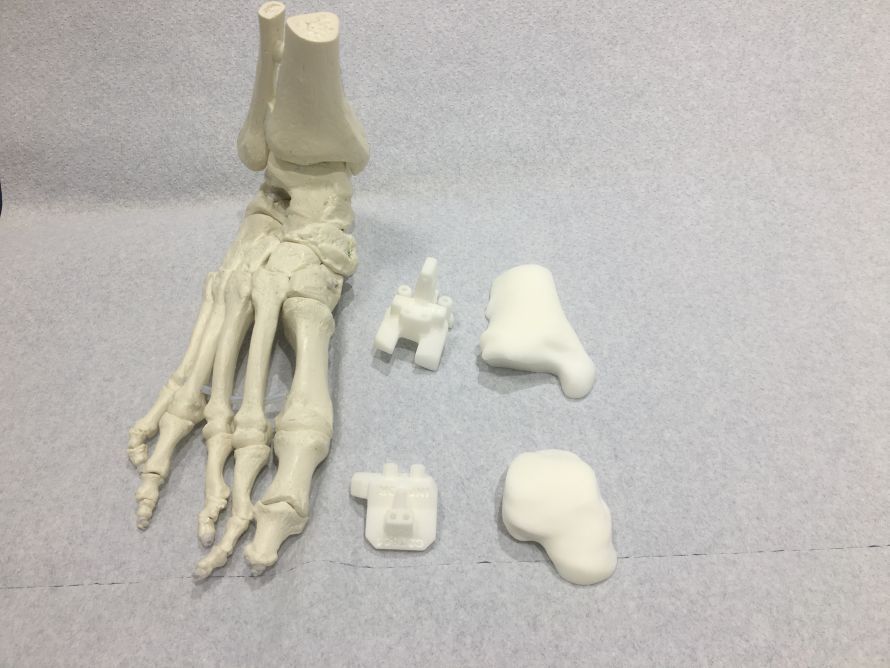
Anatomical Model
“For an ankle replacement, certain conditions must be met to ensure a stable outcome and that patients can walk well afterward. First and foremost, the range of motion is crucial: a joint that is already very stiff will tend to remain stiff even after surgery. A prosthesis often provides only five to ten degrees of additional mobility—its main benefit lies in significant pain reduction, not in a major functional improvement. Anyone who has had an almost immobile joint for many years must therefore be aware that mobility will remain limited even after the procedure. The quality of the bone is also important.
The prosthesis requires stable anchoring; larger cysts or defects must be taken into account during planning, as they can compromise its durability. Ligaments and tendons are equally crucial: they must be sufficiently stable and functional, because—unlike in fusion—the prosthesis relies on a functioning soft-tissue environment. Malfunctions can be reconstructed, either before or during surgery, but must be factored into the planning.
Finally, the leg axis also plays a major role. If there is a misalignment—in the foot, the ankle, or even higher up at the knee or thigh—it must be corrected or incorporated into the planning. “Otherwise, a misaligned axis leads to a shorter lifespan of the prosthesis because it is subjected to uneven stress,” explains Prof. Dr. Knupp.
Modern ankle replacements now have a lifespan of about 15 to 20 years. Older models tended to last 10 to 15 years, but the new generation shows significantly better results. Hip replacements now often last up to 30 years.
The modern implantation of an artificial ankle joint begins long before the actual procedure and is now based on precise digital preparation.
“Once it is confirmed that all the criteria for an ankle replacement are met, detailed surgical planning begins. Custom-made prostheses are not available in this area, but in complex cases, individually tailored surgical guides can be produced. To do this, a CT scan is performed, from which a 3D model is created. Based on this, patient-specific guides are manufactured, enabling particularly precise implantation in the operating room—especially when previous surgeries or old prostheses have altered the anatomical landmarks.
The surgery itself usually lasts between one and one and a half hours, depending on its complexity. Patients receive regional anesthesia or a brief general anesthetic. Immediately after the procedure, a pain catheter ensures that the joint remains virtually pain-free for the first 24 hours. On the day of surgery, patients remain in bed or get up briefly; as early as the next day, they are allowed to bear full weight on the leg and begin physical therapy.
A brace is worn for three to six weeks, during which time the leg may also bear full weight. “During the first two weeks, walking time should be limited so that the wound heals properly and the foot does not swell too much,” explains Prof. Dr. Knupp, adding:
“A follow-up X-ray is performed after six weeks. If the prosthesis has healed well, the patient can walk in normal shoes again, even though the foot often remains swollen for another one to two months. After three to four months, most daily activities are possible again. More strenuous activities such as hiking, skiing, or golfing are generally also feasible after this period.
Restrictions apply to certain sports: Skiing is usually no problem, but snowboarding should be avoided during the first year or done only in hard-shell boots. Stop-and-go sports like tennis or badminton are better suited for doubles than singles. Leg presses should be avoided at the gym. Cycling is permitted after eight weeks, but clipless pedals should not be used until four to six months have passed, as they generate higher shear and tensile forces.”
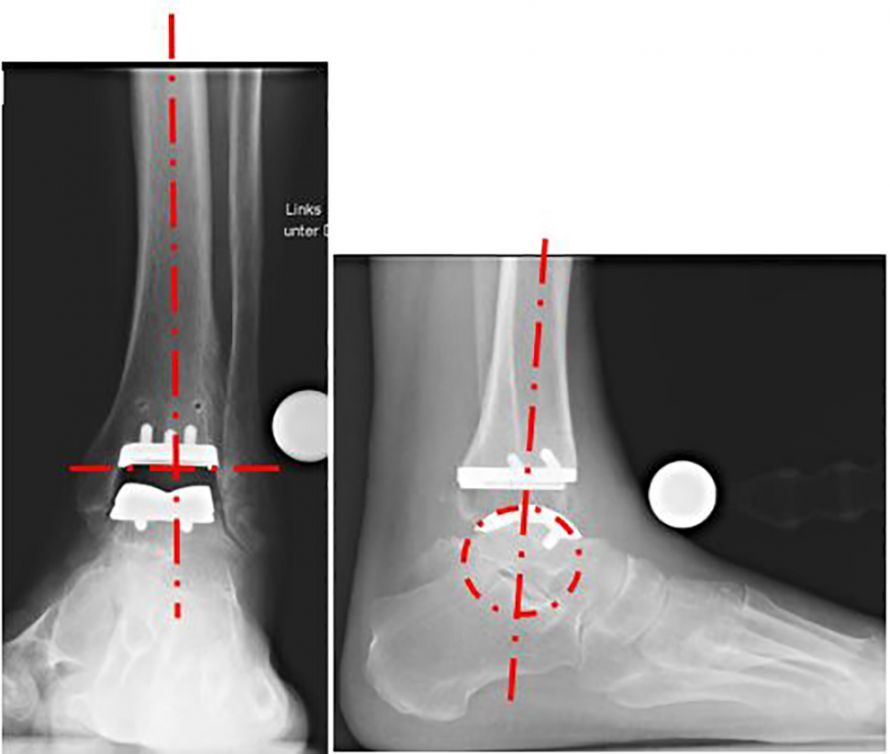
X-ray after surgery
Treatment options differ primarily in whether they preserve or replace joint function, how effectively they reduce pain, and what levels of physical activity remain possible in the long term. While conservative measures alleviate symptoms without altering the joint structure, joint-preserving surgeries can improve joint mechanics and slow the progression of osteoarthritis. In cases of advanced damage, joint replacement and fusion provide the most reliable results—joint replacement with the advantage of preserved mobility, and fusion with maximum stability.
Over the past twenty years, there have been enormous advances in ankle surgery. Both surgical techniques and the prostheses themselves have made significant strides. What was once often associated with greater uncertainty, less precise techniques, and a significantly higher rate of residual symptoms is now a highly standardized, technically sophisticated procedure with substantially better outcomes. Modern implants are more durable, surgeries can be planned with greater precision, and the overall results for patients are significantly more reliable than they were two decades ago.
Prof. Dr. Knupp comments: “In the past, patients had to expect that 30 to 50 percent would continue to experience symptoms after the procedure. About ten years ago, this figure was still around one-third. With the new generation of prostheses, which has been in use since 2016/2017, the results have now reached a level comparable to that of modern knee replacements. Only about 15 percent of patients report that, while they feel a significant improvement, they had hoped for an even better outcome; the vast majority are very satisfied.
The materials used have also proven effective. The main component of the prosthesis is titanium, making it suitable even for people with nickel allergies. A small portion is nickel-coated, but according to current scientific knowledge, this does not cause any problems. Between the metallic components lies a polyethylene element that takes over the function of the cartilage and ensures smooth gliding motion within the joint.”
The durability of an ankle prosthesis depends on a combination of biological, mechanical, and patient-related factors. First and foremost, the precise positioning of the prosthesis is crucial, as even small deviations in the axis or angle can lead to uneven stress, premature wear, or loosening over the long term.
“Ankle prostheses today have a lifespan of about 15 to 20 years. Many older models now need to be replaced, which naturally leads to an increasing number of revision surgeries. Such procedures are challenging but benefit significantly from modern planning techniques and custom-made surgical guides. As a result, prostheses can now be replaced with much greater precision than in the past, which also makes it possible to offer prostheses to younger patients more readily—revision surgery can now be performed more reliably. Nevertheless, surgeons who implant ankle prostheses should have extensive experience.
A minimum of twenty primary prostheses per year is considered a benchmark for ensuring the necessary routine and confidence. While uncomplicated initial implantations are usually manageable, complex cases or the replacement of a prosthesis require a high degree of surgical skill. Since only a few centers offer ankle replacements, many patients with problems or in need of revision surgery seek them out specifically. Some have already undergone surgery elsewhere, while others are referred by their surgeons when revision becomes necessary.
“Managing such cases is part of the core mission of specialized centers, which handle both primary care and complex follow-up procedures,” Prof. Dr. Knupp explains.
The longevity of an ankle prosthesis depends largely on precise surgical technique, stable anatomical conditions, controlled weight-bearing, and consistent postoperative care. If these factors are met, the chances of maintaining a pain-free and functionally stable joint in the long term increase significantly.
At the specialized center “Mein Fusszentrum Basel,” approximately 50 to 60 ankle replacements are performed annually—a remarkably high number for this highly specialized field. By comparison, approximately 200 such procedures are performed annually throughout Switzerland. The center thus makes a significant contribution to national care and is among the most experienced facilities in this field.
“Revision surgeries—that is, the replacement of an old or problematic prosthesis—account for about five to ten cases per year. These procedures cover a broad spectrum: prostheses that have reached the end of their service life after many years, implants that never functioned properly, or acute complications such as infections or wound-healing disorders. The greatest challenges arise with patients who have undergone numerous previous surgeries, often following serious accidents at a young age.
These cases require particularly careful planning and often close collaboration with plastic surgery and infectious disease specialists. Technically, however, the situation has improved significantly: modern tools, precise planning, and personalized cutting guides have made these procedures—which were often performed freehand in the past—significantly safer and more accurate. Artificial intelligence plays a role primarily in planning, such as in the creation of individualized incision lines. Robotics, as is common in hip and knee surgery, has not yet been established for foot surgery due to the complex anatomy, but is expected to be adopted in the long term.
Advances have also been made in imaging: Stress CT scans now help better assess which patients will actually benefit from a prosthesis and who is more likely to require a different treatment. The Basel location is regarded as a long-standing center for ankle joint prosthetics, with over twenty years of experience and scientific follow-up of many cases. “This long-standing expertise also attracts patients from abroad, particularly in complex situations that require specialized care,” emphasizes Prof. Dr. Knupp, and with that, we conclude our conversation.
- Internationally recognized ankle specialist — over 20 years of surgical experience, several thousand procedures
- Focus on ankle osteoarthritis — nuanced decision-making between joint preservation, prosthetics, and arthrodesis; use of state-of-the-art technology such as 3D planning and patient-specific instruments
- Specialist in ankle fusion (arthrodesis) — a proven option for malalignment, instability, or complex osteoarthritis
- Complex conversion surgeries — switching from fusion to prosthesis and vice versa, with extensive biomechanical expertise
- Reconstructive ankle surgery — full spectrum of procedures, including revisions and complex corrective surgeries
- Scientifically recognized expert — professor at the University of Basel, numerous publications, shaping the future of ankle surgery
- State-of-the-art facilities in Basel — interdisciplinary team, high-precision diagnostics, structured surgical planning, and follow-up care
Share this article
Expert Interviews
Read next
- Expert interview
Expert interview with Professor Dr Elmar Herbst, PhD
Oct 15, 2026
Patient-centred and personalised knee surgery
Read more - Expert interview
Cardiogeriatrics: Significance and benefits in the context of hospital reform
Sep 21, 2026
Cardiogeriatrics: Significance and benefits in the context of hospital reform
Read more - Expert interview
Expert Interview with Professor Dr. Amadeus Hornemann, MPH
Sep 18, 2026
Prof. Amadeus Hornemann on Precision Medicine in Gynecology: Modern Surgery, New Techniques, Better Quality of Life
Read more