Expert Interviews
As Far as Our Feet Will Carry Us: Priv.-Doz. Dr. med. Dariusch Arbab on the Secrets of the Foot and Ankle

Alexandra Pfitzmann ·
He is the Clinical Director of the Department of Orthopedics at St. Elisabeth Hospital Herten, part of the PROSELIS Foundation Hospital—and he is regarded as an experienced expert in all areas of his discipline: Priv.-Doz. Dr. med. Dariusch Arbab enjoys an excellent reputation in knee, hip, and shoulder surgery as well as in rheumatological orthopedics and pain medicine. However, he specializes in foot and ankle surgery. He spoke with the Leading Medicine Guide about what we can do to take better care of our feet and what treatment options are available for a wide variety of foot conditions.

Every day, our feet bear our entire body weight and provide the necessary balance. This makes them the parts of our body that are subjected to the most strain in everyday life. Our body weight rests primarily on the balls of our feet and our heels. The foot is an extremely complex structure: it consists of nearly sixty muscles, over a hundred ligaments, more than two hundred tendons—and the ankle joint alone contains a total of 26 bones. And although we generally put a lot of strain on our feet every day, most people don’t give their feet enough attention or care.
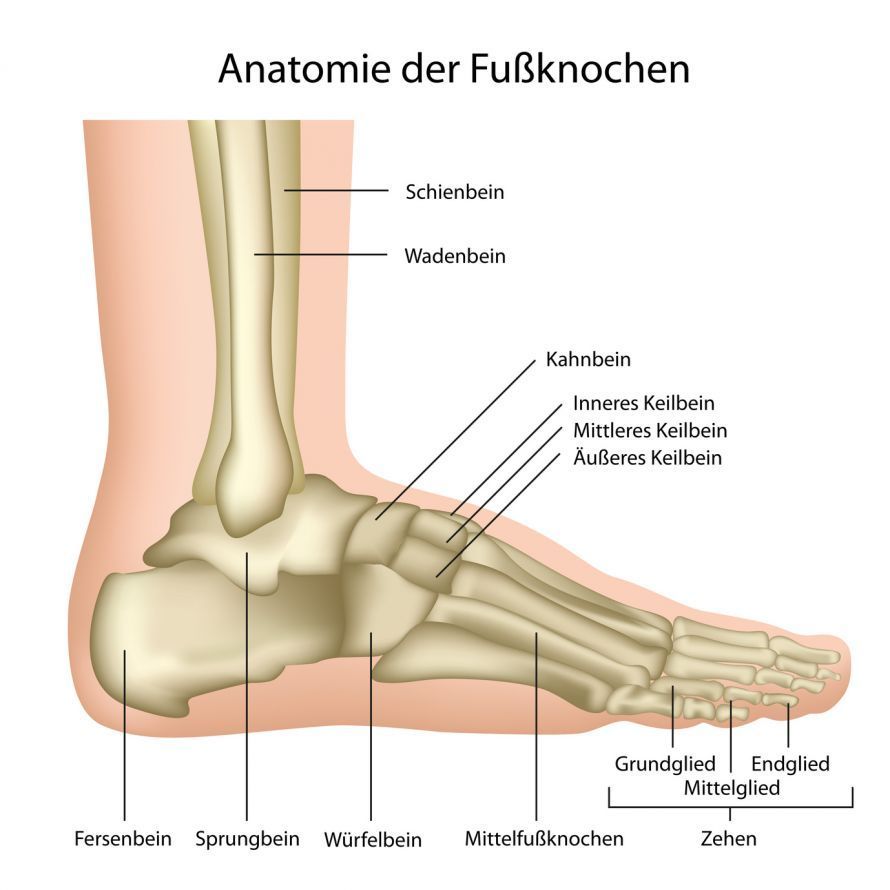
Anatomy of the Foot © bilderzwerg #54960419 | AdobeStock
In fact, over the course of a lifetime, our feet carry us the equivalent of one trip around the Earth on average. So it’s clear that wearing the wrong shoes can cause foot problems. But genetic factors also play a role, for example, in toe deformities. There are essentially four common types of small toe deformities: hammertoe, claw toe, terminal joint hammertoe, and tailor’s bunion. Women in particular suffer from the widespread condition known as hammertoe: “The hammertoe deformity is often associated with hallux valgus of the big toe. The big toe no longer functions properly, so the smaller toes have to take over and become overloaded. Patients primarily notice this because their toes bump against the top of their shoes,” explains Dr. Arbab. This type of deformity often develops in connection with the flattening of the foot arch in a fallen arch, also known as flatfoot.
“Of course, my first approach is to try conservative treatment. I advise patients on shoe selection and provide them with custom orthotics. I can customize padding for existing and painful corns, demonstrate manual stretching exercises, and recommend doing them regularly,” says Dr. Arbab, describing the initial conservative treatment measures. If conservative treatment methods don’t help, surgical treatment must be considered. “There are essentially two options here: open surgery, in which the metatarsophalangeal joint is realigned, or minimally invasive surgery, in which a drill is used to correct the misalignments,” says Dr. Arbab, describing the two treatment options.
Walking barefoot is good for your feet!
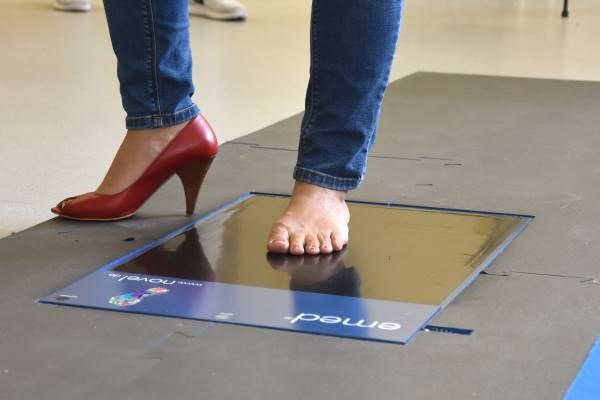
“If you have the opportunity, you should walk barefoot as often as possible. This completely relieves pressure on the foot, which isn’t constricted or restricted by footwear, and provides a good workout for the many muscles in the foot,” recommends Dr. Arbab. Many people get up in the morning and slip into their slippers, drink coffee, take a shower, and then get dressed—and putting on shoes is part of that routine. Walking barefoot is completely left out. Of course, walking barefoot leads to increased callus formation, which isn’t necessarily considered aesthetically ideal. But this is a trade-off worth accepting, and you can always have the calluses removed during your next pedicure.
Numerous types of foot deformities can occur, ranging from flat feet, fallen arches, and splayfoot to pes cavus, which can develop especially after surgery. So-called “pointed feet” can develop as a result of prolonged bed rest in a hospital bed when movement is completely restricted due to illness. “In particular, patients who, for example, were in a coma for a long time following a severe case of COVID-19 and were ventilated while lying on their stomachs have developed pointed feet. This is a shortening of the calf muscles, meaning the heel is raised so high that the foot can no longer touch the ground, which is why patients walk on their tiptoes or, without orthotics, are unable to move at all,” explains Dr. Arbab regarding this specific condition. Functional orthoses are worn while walking and aim to promote a heel-to-toe gait, whereas positioning orthoses are worn exclusively at night while at rest, stretching the muscles and improving joint mobility.
Of course, genetic factors also play a role when it comes to foot deformities. For example, some teenagers already have pronounced flat feet, just like their grandpa did.
The Flat-Footed Foot
In a flat-footed gait, the arch of the foot collapses and the foot is much flatter than normal. If the foot is only slightly lowered, it is referred to as a fallen arch. If it is severely lowered, it is referred to as a flat foot. “If a flat-footed condition is detected at an early stage, it can be effectively treated with customized foot exercises. For example, walking on sand, wearing orthotics, and performing various foot exercises can help the foot. The goal here is to support the inner sides of the foot,” explains Dr. Arbab regarding the conservative treatment method. In children, a temporary flat-sagging foot is completely normal; it usually corrects itself between the ages of eight and ten, once the arch of the foot has fully developed.
Splayfoot
The entire forefoot is much wider, and the metatarsal bones fan out. As a result, the person affected has great difficulty even putting on shoes. The causes of splayfoot can include poor footwear, being overweight, prolonged standing, or connective tissue weakness. Common signs of a splayfoot include painful calluses and corns under the tips of the toes. If a splayfoot is left untreated, it can lead to bursitis. “Here, too, the first step is to attempt conservative treatment using orthopedic shoes, foot exercises, and insoles. Only if these measures do not result in improvement should surgical treatment be discussed,” says Dr. Arbab.
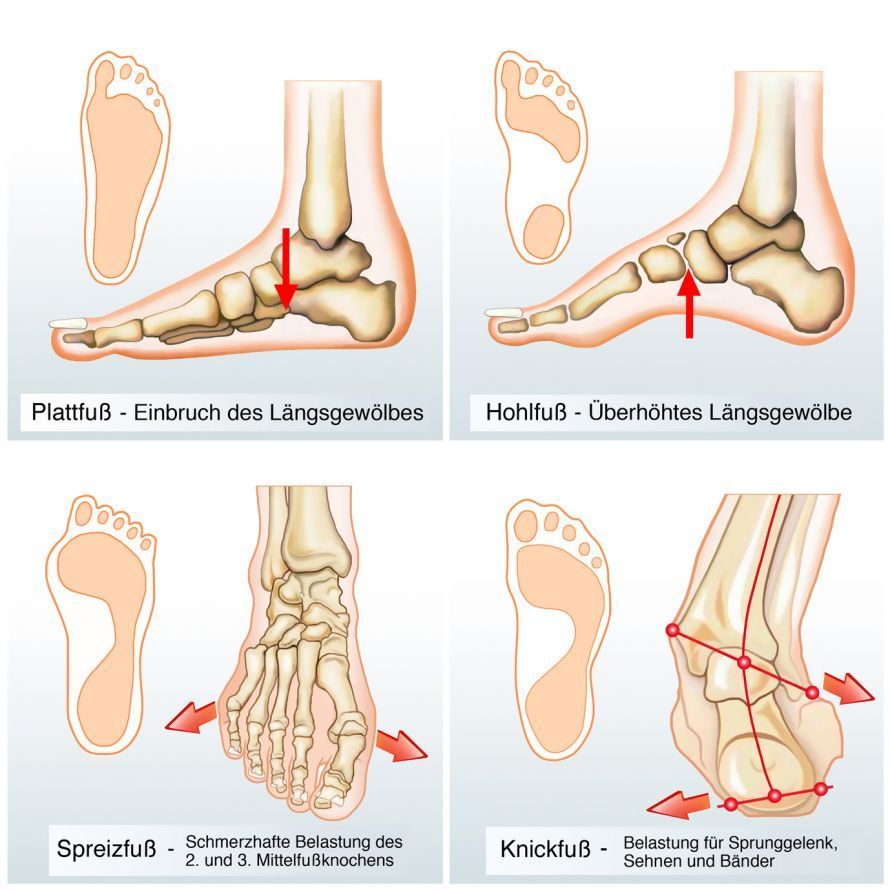
Various forms of foot deformities © Henrie / Fotolia
Is there a link to type II diabetes?
“If a person has type II diabetes, blood flow to the blood vessels and nerves is impaired—and consequently, to the foot as well. When the nerves in the foot are damaged, the very unpleasant consequence is that the person no longer notices when, for example, they develop a callus. Due to the reduced sensitivity to pain, those affected take no action; the foot may have an open wound, allowing bacteria to form and take hold more quickly, and the delayed healing process also makes things difficult for the patient,” explains Dr. Arbab regarding diabetic foot syndrome.
Nearly ten out of every hundred patients with type 2 diabetes suffer from diabetic foot syndrome. It is treated according to the guidelines of the German Diabetes Society, which are in line with the RIA principle.
The abbreviation RIA stands for the following measures:
R = Revascularization, i.e., improving blood flow
I = Treating infection, using, for example, antiseptics and/or antibiotics
A = Amputation; approximately 39,000 amputations are performed in Germany each year
The severity of the condition can be classified on a scale from 0 to 5: from 0 = no-risk foot, no injuries, but possibly foot deformities, to 5 = dead tissue (necrosis) affecting the entire foot.
Amputation of toes, feet, or the entire leg is performed only in extremely severe cases and is considered only after all other options have been exhausted.
“Every person with diabetes should keep a close eye on their feet and examine them daily. They should also see their primary care physician, diabetes specialist, or podiatrist regularly for a foot examination,” Dr. Arbab advises patients. Another important preventive measure is to avoid smoking, as smoking contributes to circulatory problems.
The best way to treat diabetic foot is by controlling blood sugar levels so that the blood vessels and nerves do not suffer further damage. High cholesterol levels and any high blood pressure must be treated. “If the patient’s vascular narrowing is far advanced, the vessel can be dilated using a catheter, for example, with balloon angioplasty. For this procedure, a tube is guided through the leg artery in the groin to the narrowed area, where the balloon then expands the narrowing via the tube,” says Dr. Arbab, describing the catheter treatment. If that doesn’t help, a stent can also be placed there. Only if the narrowing extends over a longer section of the vessel should bypass surgery be considered.
Do More for Foot Health!
“The foot has fallen a bit into the ‘dirty’ category. Many people are ashamed of their feet and hide them. Feet also have a bad reputation for being ‘unclean.’ Unfortunately, however, many people also neglect their feet. Shoes, for example, should be changed regularly so they can dry out properly after being worn. Foot health urgently needs to be promoted!” urges Dr. Arbab, concluding our conversation with his recommendations.
Dr. Arbab, we would like to thank you very much for this informative conversation and for raising awareness about this topic. You can contact our specialist directly via his profile page on the Leading Medicine Guide.
Share this article
Expert Interviews
Read next
- Expert interview
Expert interview with Professor Dr Elmar Herbst, PhD
Oct 15, 2026
Patient-centred and personalised knee surgery
Read more - Expert interview
Cardiogeriatrics: Significance and benefits in the context of hospital reform
Sep 21, 2026
Cardiogeriatrics: Significance and benefits in the context of hospital reform
Read more - Expert interview
Expert Interview with Professor Dr. Amadeus Hornemann, MPH
Sep 18, 2026
Prof. Amadeus Hornemann on Precision Medicine in Gynecology: Modern Surgery, New Techniques, Better Quality of Life
Read more