Expert Interviews
Surgical Lung Volume Reduction in Patients with Advanced Pulmonary Emphysema

Alexandra Pfitzmann ·
Surgical Lung Volume Reduction in Patients with Advanced Pulmonary Emphysema
Surgical lung volume reduction is an innovative procedure for treating patients with advanced pulmonary emphysema, a chronic lung disease characterized by irreversible enlargement of the alveoli and a gradual decline in lung function. The editorial team at Leading Medicine Guide learned exactly what this entails in a conversation with Dr. Akil.

The progression of pulmonary emphysema (permanent overinflation of the lungs due to damaged alveoli) usually occurs slowly and insidiously over a long period of time. Even in the early stages, patients often experience mild shortness of breath, which initially occurs only during strenuous physical activity, such as climbing stairs or exercising. Those affected often underestimate these symptoms at first or dismiss them as normal wear and tear associated with aging.
“The course of pulmonary emphysema is usually insidious and progressive, but in some cases it can develop rapidly depending on the course of COPD. The disease is irreversible. It is characterized by a progressive deterioration of lung function accompanied by increasing hyperinflation. In addition, those affected notice an increase in breathing difficulties as well as a progressive decrease in exercise tolerance and, as a result, a reduction in quality of life,” Dr. Akil summarizes at the beginning of our conversation.
In patients with pulmonary emphysema, the lungs are permanently overinflated because the tiny air sacs—the alveoli—have been irreversibly destroyed by chronic inflammatory processes and smoking. As a result, the lung tissue loses its elasticity, air can no longer be fully exhaled, and a veritable “air congestion” develops.
This overinflation compresses the healthy lung tissue, makes breathing difficult, and places an increasing strain on the heart and muscles. As a result, many patients experience severe shortness of breath even with the slightest exertion and a significant loss of quality of life. This is where surgical lung volume reduction comes into play: By removing areas of the lung that are particularly severely damaged and non-functional, space is created so that the remaining, still-functional areas can expand more effectively again.
In addition to shortness of breath, coughing and sputum production are common, particularly among smokers or patients with chronic bronchitis, which often accompany emphysema. Recurrent respiratory tract infections, such as bronchitis or pneumonia, further worsen the condition. Progression to the advanced stage is also characterized by an increased susceptibility to complications, including acute exacerbations, pulmonary infarction, episodes of shortness of breath (exacerbations), or respiratory failure.
These conditions significantly impair quality of life, severely limit daily activities, and often require intensive medical treatment, including oxygen therapy or even life-prolonging measures such as a lung transplant.
Surgical lung volume reduction (LVRS) is a specialized procedure for treating patients with advanced pulmonary emphysema, in which excessive, damaged, and air-filled areas of the lungs are removed. The goal is to allow the remaining lung to function more efficiently, improve respiratory mechanics, and reduce shortness of breath.
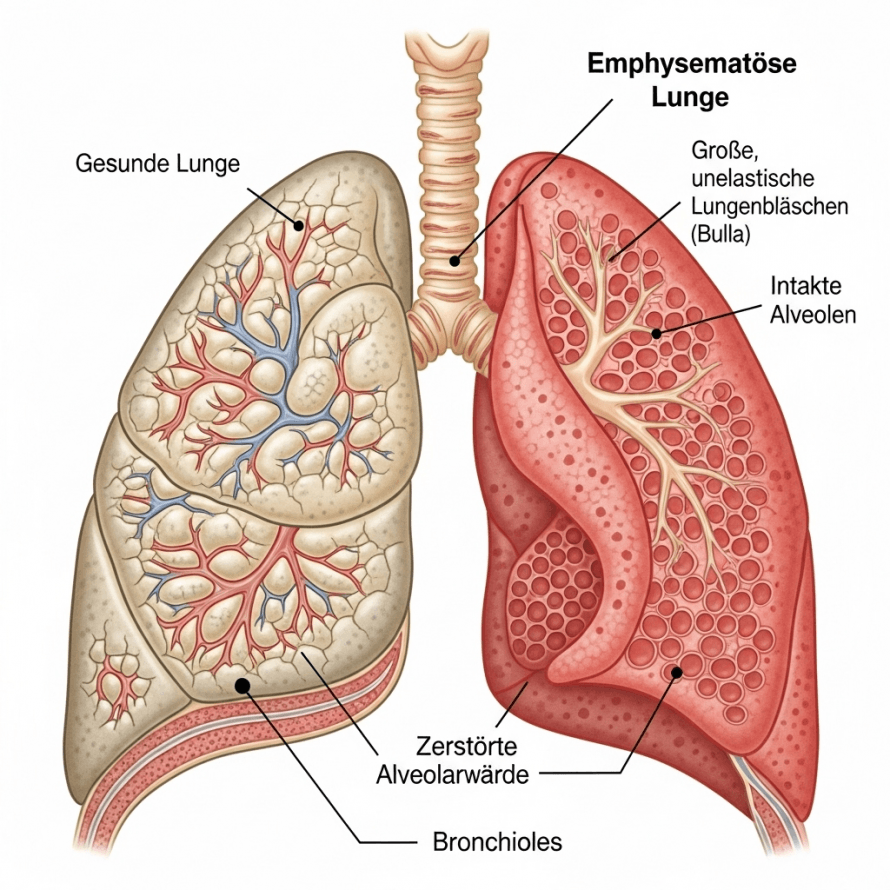
The procedure is typically performed using a minimally invasive approach, usually as so-called keyhole surgery (minimally invasive thoracoscopy). During the procedure, small incisions are made through which special instruments and a camera are inserted. “During the operation, non-functional lung tissue is removed to reduce lung volume and create more space in the chest cavity. This is referred to as surgical lung volume reduction, or ‘lung volume reduction surgery’ (LVRS).
Lung volume reduction surgery is a safe and effective option for patients with advanced COPD (Gold III–IV) and severe pulmonary emphysema who have difficulty breathing. It can significantly improve breathing difficulties, exercise tolerance, and quality of life. Today, these surgeries are performed using minimally invasive techniques (keyhole surgery, video-assisted thoracoscopy, or VATS).
Most of these procedures are performed through a single small incision (uniportal), resulting in less postoperative discomfort for our patients (less pain, rapid mobilization, and prompt discharge). Surgical lung volume reduction is performed on both sides in most cases. In principle, the procedure begins with the more severely affected lung or lung area.
At a later stage, following a re-evaluation, surgery on the opposite side may be performed. Simultaneous surgery on both lungs is possible, but we do not recommend it. One reason for this is to achieve the best possible long-term outcome after surgery,” explains Dr. Akil.
As for the results, patients can generally expect a significant improvement in their symptoms following a well-performed lung volume reduction surgery. Many report less shortness of breath, increased exercise tolerance, and an improved quality of life.
A patient’s suitability for surgical lung volume reduction in cases of advanced pulmonary emphysema depends on several important criteria that must be assessed on an individual basis.
Dr. Akil explains: “Patients with advanced pulmonary emphysema have few effective treatment options. That is why it is important to refer them to a specialized center that offers both surgical and endoscopic lung volume reduction procedures. A prerequisite for such a procedure is not only the airway obstruction typical of COPD, but above all, clinically and functionally confirmed lung hyperinflation, coupled with a preserved diffusion capacity of over 20 percent.
Key inclusion criteria include at least three months of nicotine abstinence, an FEV₁ below 50 percent of the predicted value, a residual volume above 150 percent, and a six-minute walk distance between 100 and 450 meters. Following the initial assessment, a comprehensive evaluation is conducted to determine whether lung volume reduction is appropriate and safely feasible. The results of these examinations are then presented to an interdisciplinary pulmonary emphysema board.
There, specialists from various disciplines jointly discuss the most appropriate treatment strategy for each individual and then coordinate it in detail with the patient. The patient’s motivation plays a central role in the success of the procedure, as does reliable cooperation throughout all therapeutic steps.”
FEV stands for “Forced Expiratory Volume in 1 second,” abbreviated as FEV₁. This is a key lung function measure that quantifies how much air a person can forcefully exhale within the first second after taking the deepest possible breath. This value is particularly important in cases of COPD and pulmonary emphysema because it indicates the degree to which the airways are narrowed and the severity of the obstruction. An FEV₁ below 50% of the expected value indicates significantly impaired lung function and is therefore one of the criteria for evaluating a potential lung volume reduction procedure.
Pronounced hyperinflation—that is, significant overstretching of the lung structure with a high residual volume—is another important criterion for determining the prospects for success. In addition, the elasticity of the remaining lung tissue should still be sufficient to allow the surgery to improve respiratory mechanics.
In addition to lung parameters, it is equally essential that the patient be in good overall health. The patient must not have any severe comorbidities, such as severe heart failure or severe pulmonary hypertension, as these can significantly increase surgical risk and limit the effectiveness of the procedure.
Surgical lung volume reduction is considered the preferred treatment primarily for selected patients in whom medication alone is no longer sufficient and who seek a significant improvement in quality of life.
In contrast to drug therapy, which is particularly useful in less advanced stages, lung volume reduction aims to reduce existing hyperinflation and thereby improve lung mechanics, which can yield clearly visible results in severe cases with pronounced hyperinflation.
“The surgery can lead to an improvement in dyspnea, exercise tolerance, and quality of life for most patients. The long-term effects are usually dependent on the course of COPD. The positive effects following bilateral surgical lung volume reduction can last for several years.
In most cases, a stable course of the disease can be achieved. Most patients report in the initial phase after the procedure that they are better able to take deep breaths. This is due to the corresponding relief of pressure on the chest following the removal of the severely overinflated lung tissue,” states Dr. Akil.
The long-term prognosis depends largely on the selection of suitable patients, the surgical technique, postoperative care, and lifestyle, particularly smoking habits. With well-managed therapy and consistent follow-up care, the positive effects can significantly outweigh the risks and substantially improve quality of life.

“Postoperatively, patients receive intensive respiratory and physical therapy. Patients are mobilized immediately after surgery. Building up and training the respiratory muscles and the diaphragm are essential. Therefore, pulmonary rehabilitation (even if rehabilitation has already taken place preoperatively) is strongly recommended after surgery,” advises Dr. Akil.
The importance of rehabilitation cannot be overstated. The long-term effectiveness of the surgery depends heavily on consistent rehabilitation. It not only helps prevent complications but also plays a crucial role in ensuring that the treatment outcomes achieved are sustained over the long term and in helping patients return to as normal a daily routine as possible.
Recent advances and innovations in the technology and methodology of lung volume reduction surgery (LVRS) play a key role in improving treatment outcomes and minimizing risks for patients.
Dr. Akil explains: “Patients who are considered inoperable due to elevated carbon dioxide levels and are excluded from surgery because of the high surgical risk can undergo surgery with lung support (ECMO, extracorporeal membrane oxygenation). ECMO first diverts the blood out of the body to an exchange membrane. There, the carbon dioxide concentration is reduced and the oxygen concentration is increased, thereby supporting and improving gas exchange. The blood is then returned to the body.
During lung surgery, the side of the lung being operated on must be disconnected from ventilation for the duration of the procedure. Access to the lung is often achieved using the minimally invasive keyhole technique. In lung surgery without ECMO, gas exchange in the body occurs solely through the lung that is not being operated on. While this is usually not a problem in lung surgeries without significant hyperinflation, it can occur—particularly in patients with COPD and advanced emphysema—that gas exchange of carbon dioxide and oxygen in the body is insufficient via the unilaterally ventilated lung.
If one were to attempt to compensate for the gas exchange by increasing ventilation of the lung being operated on, this lung could potentially sustain further damage due to its pre-existing condition. This, too, can be prevented by using ECMO. A significantly elevated level of carbon dioxide in the blood or a lack of oxygen could lead to organ damage or even be life-threatening without the use of ECMO.
ECMO supports gas exchange in the ventilated lung, allowing for protective ventilation. Thus, the use of ECMO also makes it possible to operate on patients who, due to their impaired lung function, are generally considered inoperable in most hospitals. This is true not only for patients with advanced COPD but also for those with lung cancer. “ECMO therapy thus allows us to increase surgical safety and make surgery possible for patients with severe lung disease,” and with that, we conclude our conversation.
Thank you very much, Dr. Akil, for this insight into the encouraging treatment option of lung volume reduction!
- Experienced thoracic surgeon at Emden University Hospital with proven expertise in lung and thoracic surgery.
- Many years of clinical experience at renowned centers, including the University Hospital of Münster and hospitals in Essen.
- Specializes in minimally invasive procedures, lung tumor resections, and extracorporeal membrane oxygenation (ECMO).
- Particular expertise in the modern treatment of pulmonary emphysema, especially through innovative lung volume reduction.
- Combines surgical precision with state-of-the-art technology to provide individually tailored therapies for complex lung diseases.
- Actively drives scientific developments and innovations in thoracic surgery, particularly in the field of ECMO.
Share this article
Expert Interviews
Read next
- Expert interview
Expert interview with Professor Dr Elmar Herbst, PhD
Oct 15, 2026
Patient-centred and personalised knee surgery
Read more - Expert interview
Cardiogeriatrics: Significance and benefits in the context of hospital reform
Sep 21, 2026
Cardiogeriatrics: Significance and benefits in the context of hospital reform
Read more - Expert interview
Expert Interview with Professor Dr. Amadeus Hornemann, MPH
Sep 18, 2026
Prof. Amadeus Hornemann on Precision Medicine in Gynecology: Modern Surgery, New Techniques, Better Quality of Life
Read more