Expert Interviews
Dr. med. univ. Franklin Kuehhas: “Andrology is still a taboo subject”

Claudia Dechamps ·
Treatment options for male genital conditions—that is the specialty of Dr. med. univ. Franklin Kuehhas. With this clear focus on an area that is still considered a taboo subject in urology, the specialist in reconstructive andrology and genital surgery in Vienna has earned an international reputation. As an empathetic, discreet, and thoroughly professional expert, he has also made an excellent name for himself within the medical community for performing complex surgeries on the penis. He granted the Leading Medicine Guide rare insights into his expertise.

Dr. med. Franklin Kuehhas is an andrologist and is therefore regarded as a rather unusual specialist and expert even within the medical community. Andrology can be simply defined as men’s health; it is, so to speak, the male counterpart to gynecology, the medical field dedicated to women’s health. An andrologist deals with all issues related to male reproductive functions. Dr. Kuehhas has focused entirely on reconstructive andrology, both medically and in terms of medical technology, and today primarily performs surgeries on the penis. “I’m addressing a taboo subject,” explains the specialist in urology and andrology, “and not only in the general public’s perception, but even among experts—urologists—the topic of penile medicine is still considered taboo.”
That’s why it wasn’t easy for Dr. Kuehhas to specialize in this field and receive a solid education. Dr. Kuehhas first acquired his expertise in urology at the renowned university hospitals in Heidelberg and Vienna and then completed specialized training in reconstructive andrology at University College London. Through continuing professional development in the U.S., Brazil, and England, he stays continuously up to date on the latest scientific and technical advancements. “In the U.S., there are many experts in reconstructive andrology, and there is also a long history of experience in the manufacture and implantation of penile prostheses,” reports Dr. Kuehhas. That said, he actually dislikes the term “penile prosthesis” and prefers to refer to them as “corpus cavernosum implants.” “I find time and again that the term ‘penile prosthesis’ unsettles my patients. And in fact, we’re not replacing the penis itself, but rather the erectile tissues.” With this procedure, he achieves a high satisfaction rate among his patients and—which is certainly just as important in this context—satisfaction among their partners is also around 98 percent.
What are the indications for a penile prosthesis or a corpus cavernosum implant?
“The implant is always the last treatment option,” explains Dr. Kuehhas. Only after all conservative methods have been exhausted would he discuss the possibility of an implant with his patients. His many years of experience and his empathy help him find the right approach for each patient. After all, this is a very sensitive topic. Trust in the treating physician, a relaxed and friendly environment, and the feeling of being in good hands and receiving expert care are key factors in the overall treatment experience.
Dr. Kuehhas has structured his practice in Vienna entirely around these principles. Medical equipment that meets the latest standards ensures precise diagnostics. In trusting conversations, he discusses treatment options with his patients. Conditions such as diabetes, major pelvic surgery, colorectal cancer, or an aortic aneurysm may make the implantation of a penile prosthesis advisable.
How does a man find the right specialist for his problem?
The first point of contact for a men’s health issue is always a urologist. Once the diagnosis is confirmed, says Dr. Kuehhas, the patient should seek an open and honest conversation with his doctor and ask which specialist he can recommend. This is not an easy conversation, because even among medical professionals, the topic of reconstructive andrology is unfortunately still considered taboo. “But such procedures should only be performed by a specialist with extensive experience in this field. In other words, someone who performs such an operation perhaps 300 times a year has a completely different level of confidence than someone who does it maybe only five times a year,” Dr. Kuehhas explains.
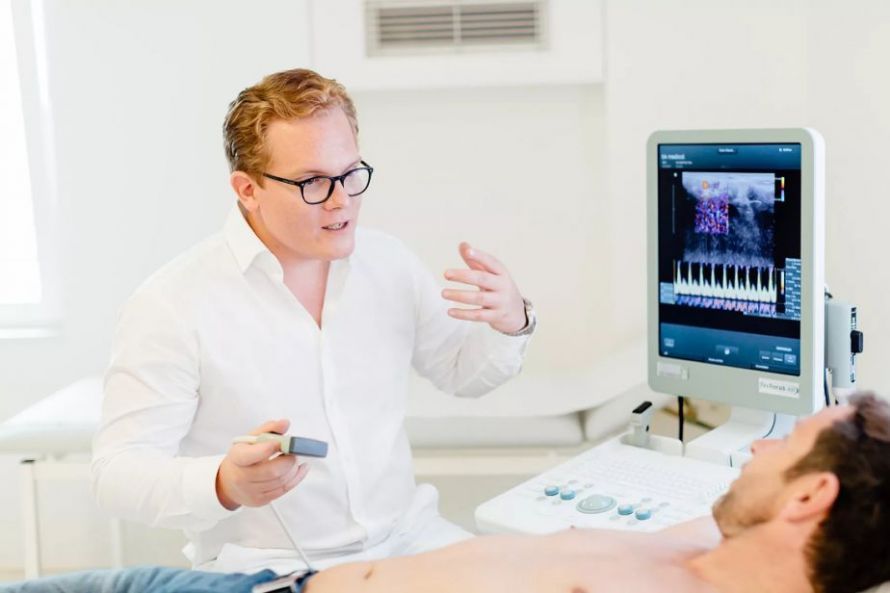
He finds it sad that many men are left in the dark for years, left to deal with the issue on their own, unable to find the right person to consult about their medical problem, or not taken seriously when they describe their symptoms. “This isn’t just a health issue—it affects their mental well-being, it shapes their sex life, their relationships, and their psychosocial life—men withdraw from relationships or don’t dare to enter into one. There’s a tremendous amount of psychological distress involved,” Dr. Kuehhas observes time and again. And he’s glad to be able to help with his expert knowledge and skills. “None of this has to happen; we can help these men,” he emphasizes.
IPP—Induratio penis plastica, or penile curvature—a case for a penile implant?
About ten percent of men between the ages of 40 and 60 suffer from IPP (Induratio penis plastica), colloquially known as penile curvature. The likely cause is believed to be microscopic injuries to the corpora cavernosa, which can harden over time. Medically, a distinction is made between the acute and chronic phases of IPP. In the acute stage, small nodules form; the erectile tissue can no longer fully expand during an erection, leading to discomfort and pain, and the penis takes on a curved shape. “See a doctor immediately—don’t wait,” Dr. Kuehhas advises any man who notices such changes in himself. “If treatment is started early, the progression of the disease can be prevented,” he reassures patients.
Unfortunately, however, he repeatedly observes in his practice that IPP is often neglected, and men come to him who should have received proper treatment much earlier. “They’re often told that nothing can be done about such a curvature. Of course, treatment isn’t easy, but there are various options,” emphasizes Dr. Kuehhas. A penile implant isn’t the right treatment option for every case of IPP.
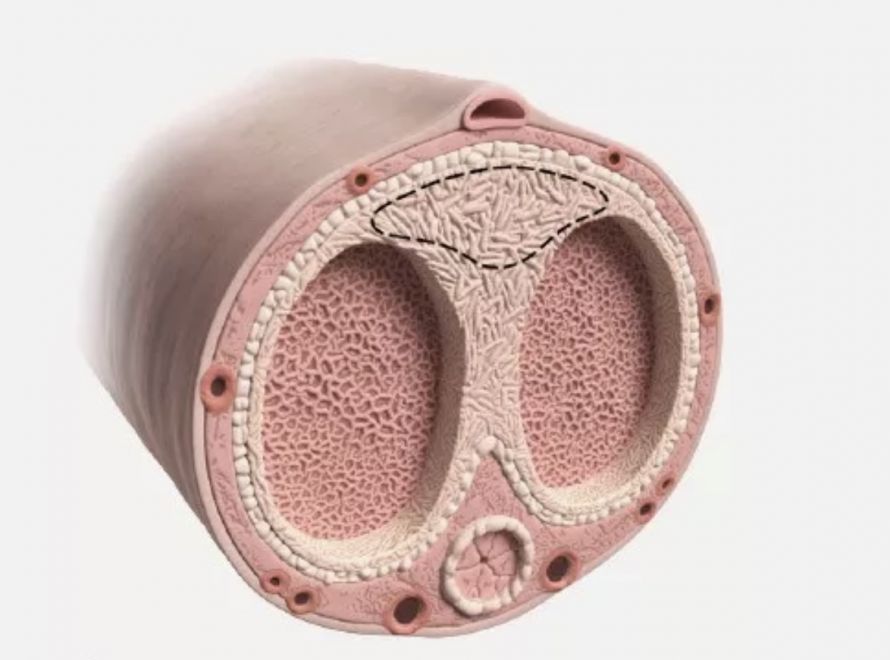
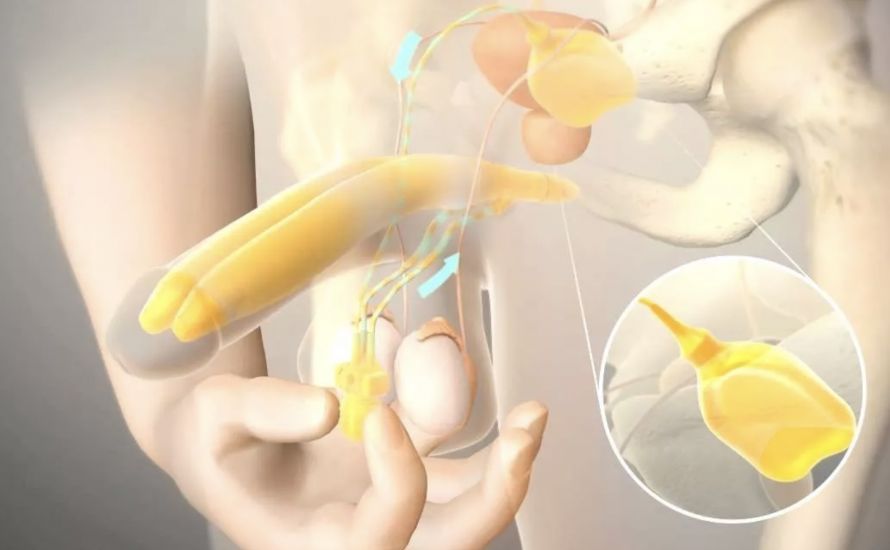
How do penile prostheses or penile implants work?
The implant does not replace the penis; rather, it is inserted into the penis, where it takes over the function of the non-functioning erectile tissues. Today, only hydraulic implants are used. They consist of three components: two silicone cylinders, a small hydraulic pump, and a fluid reservoir. During the procedure, the silicone cylinders are inserted into the corpora cavernosa and connected via small tubes to the small hydraulic pump, which Dr. Kuehhas implants in the scrotum. A fluid reservoir is also placed in the abdominal cavity, from which a sterile saline solution can be pumped into the cylinders as needed and then drained again.
In this way, the penis can be erect, just as in the natural process. After intercourse, the cylinders are emptied again; the saline solution flows back into the reservoir in the abdominal cavity, and the penis returns to a flaccid state. “Operating the hydraulic prosthesis is incredibly simple; it simply mimics the natural erection mechanism,” says Dr. Kuehhas, describing the process.

He knows from numerous studies and research that penile prostheses are among the treatment options for erectile dysfunction with the highest satisfaction rates: 98 percent of patients and their partners are satisfied with the results. Since the implant is not visible from the outside, couples do not notice any difference. “And the best part is: the implant does not impair sexual sensation, the ability to achieve orgasm, or the ability to father a child,” Dr. Kuehhas emphasizes.
However, you should only entrust this procedure to a specialist. The surgery itself is complex and takes one to two hours. The implants used today consist of medical-grade plastic and silicone components and are manufactured with an antibiotic microcoating, which has significantly reduced the risk of infection. About four to six weeks after the surgery, the healing process has progressed to the point where the implant can be used. “In general, a penile prosthesis can remain in the body for between eight and fifteen years,” Dr. Kuehhas notes based on his experience.
Dr. med. univ. Franklin Kuehhas would like to see more education and openness—especially among specialists—regarding this important men’s health issue. “No man is making a fool of himself if he has problems in this area and is looking for the right person to talk to.”
Dr. Kuehhas, thank you very much for this interesting and candid conversation.
You can contact our specialist directly via his profile page on the Leading Medicine Guide.
Share this article
About the medical author
Claudia Dechamps
Editor
Claudia Dechamps – medical author: expert articles, professional insights and medical knowledge in the Leading Medicine Guide.
More about the medical author →Expert Interviews
Read next
- Expert interview
Cardiogeriatrics: Significance and benefits in the context of hospital reform
Sep 21, 2026
Cardiogeriatrics: Significance and benefits in the context of hospital reform
Read more - Expert interview
Expert Interview with Professor Dr. Amadeus Hornemann, MPH
Sep 18, 2026
Prof. Amadeus Hornemann on Precision Medicine in Gynecology: Modern Surgery, New Techniques, Better Quality of Life
Read more - Expert interview
Expert Interview with Professor Dr. Konstantinos Anagnostakos
Sep 15, 2026
Prof. Anagnostakos on Painful Knee Replacements
Read more