Expert Interviews
Robot-Assisted Joint Replacement - Expert Interview with Dr. Matthias Pothmann

Alexandra Pfitzmann ·
Dr. Matthias Pothmann is a highly qualified specialist in specialized orthopedic surgery and sports medicine. As a senior physician at the Westphalian Joint and Endoprosthetics Center at the Christliches Klinikum Unna, he specializes in hip and knee replacement surgery. In the treatment of osteoarthritis, particularly in cases of complex deformities (especially hip dysplasia), he combines state-of-the-art minimally invasive techniques with exceptional expertise, which has earned him an excellent reputation in the field.
His clinic is known not only for its expertise in joint replacement surgery—particularly for the hip and knee—but also for the high standard of joint-preserving procedures, such as corrective surgeries of the pelvis (triple osteotomies) and the hip, which are performed by the clinic’s chief attending physician, Dr. Axel Küpper. Through the targeted use of minimally invasive procedures, Dr. Pothmann and his team ensure that the muscles and surrounding tissue are subjected to as little stress as possible, leading to a faster recovery and a lower risk of postoperative complications.
The clinic ranks among those in Germany with the lowest complication and infection rates following joint replacement and prosthesis revision. These methods and results have made the Westphalian Joint and Endoprosthetics Center one of the leading centers for hip endoprosthetics and have even established it as a German reference center for minimally invasive hip endoprosthetics for several prosthesis manufacturers. In addition to his successful work in the field of joint replacement, Dr. Pothmann is also highly skilled in complex prosthesis revision surgeries. When artificial joints lose their function, specialized procedures may be necessary to restore functionality. This requires not only technical expertise but also a great deal of experience with bone grafts and bone augmentation procedures.
Particularly noteworthy is Dr. Pothmann’s personal approach, which is based on a patient-centered philosophy. For him, an individualized treatment approach is paramount—he always strives to offer each patient the gentlest, most personalized, and effective therapy possible. With his extensive expertise and personal dedication, Dr. Pothmann plays a key role in ensuring that patients at the Westphalian Joint and Endoprosthesis Center can rely on the highest standards of medical care.
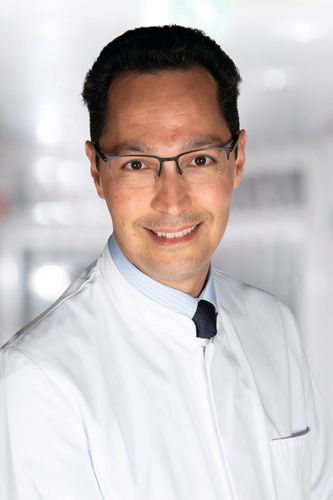
The editorial team of the Leading Medicine Guide spoke with Dr. Pothmann about the use of robot-assisted technology in joint replacement surgery, specifically the MAKO robotic system, which is primarily used in knee surgeries. Photo: Dr. Matthias Pothmann
Robot-assisted joint replacement is revolutionizing the implantation of artificial joints through unparalleled precision and personalized customization. Modern robot-assisted systems support surgeons in planning and performing procedures, particularly for hip and knee replacements. With the help of high-resolution imaging and computer-assisted navigation, the implant can be optimally positioned, resulting in an improved fit and greater durability. This technology, combined with minimally invasive procedures that cause less tissue damage, leads to faster rehabilitation and better functional outcomes. In specialized clinics, robot-assisted surgery is increasingly establishing itself as the standard of the future.
“Before the surgery, a detailed analysis is performed in which, in addition to conventional methods, a three-dimensional image of the knee joint is first captured via computed tomography. This data is processed in a specialized MAKO computer program so that the prosthetic components can be virtually positioned in three dimensions to ensure a proper fit. This means the surgery can essentially be planned in advance, including the size and position of the prosthesis, tailored to the bone. This leads to optimized material planning, ensuring that the appropriate implants are available in sufficient quantities and that the surgery becomes safer and more efficient. During the surgery, the actual situation is compared with the pre-calculated data. Typically, a conventional approach—minimally invasive when possible—is chosen. Using an infrared interface and special detectors, approximately 60 preconfigured points on the knee are measured. This data is transmitted in real time to the computer, which is monitored by specially trained MAKO product specialists. These experts, who have completed a comprehensive training program provided by the manufacturer Stryker, set up the robot and ensure a continuous interface connection to the computer. The surgeon marks the points on the knee, which are then aligned with the data captured on the CT scan, so that the robot knows exactly where individual structures—such as the ideal leg axis or specific areas inside the knee—are positioned in the three-dimensional space, down to the millimeter. “The result is ultra-precise planning, with deviations often less than 0.1 millimeter,” explains Dr. Pothmann, going into even greater detail about the advantages of robotics:
“All imaging data can be collected before surgery and consolidated on the computer. This allows the surgery to be simulated with pixel-level precision, and planning with the MAKO system is typically carried out in close coordination with the MAKO technician to ensure optimal implementation. The result is a very high degree of certainty that the actual surgery will follow the virtual plan exactly. This enables precise bone cuts that are optimally tailored to the individual joint, as well as better control of ligament tension throughout the entire range of motion—an innovation that was previously not possible in this way in knee surgery. This is because the ligaments that stabilize the knee vary from person to person, and the system makes it possible to simulate this ligament tension even before the incision is made. The simulation takes place during surgery to ensure that the knee remains stable even after prosthesis implantation and does not give way during movement. The most important advantage is that ligament tension remains optimal at all times, even during knee movement—something that is difficult to achieve in traditional surgery. Until now, knee surgery has relied heavily on the surgeon’s experience, as the ideal level of joint stability could be determined primarily through experience. With the MAKO system, the learning curve is significantly steeper, so that even less experienced surgeons can achieve good results if they work with this system regularly. The combination of a surgeon with decades of experience and the MAKO system is now the gold standard in knee arthroplasty. The system ensures extremely precise, stable, and personalized treatment—a true breakthrough in knee surgery.” 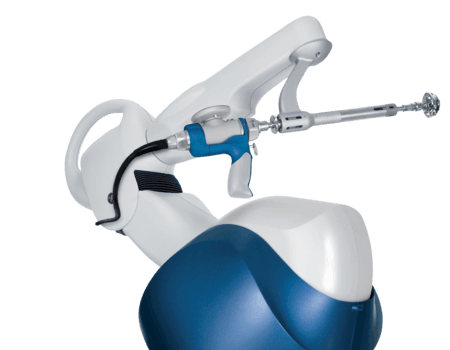
Photo of the MAKO System – ©Stryker.
It is important to have the surgical skills and expertise necessary to ensure a high-quality knee replacement outcome.
“The surgical approach, technique, and many other factors also play a role, but conversely, it can be said that if every German orthopedic clinic had a MAKO system, the average outcomes would be significantly better and complication rates—such as those related to malpositioning or instability—would decrease. Overall, the outcome for patients would then very likely be significantly better—and I am firmly convinced that this will be the case in the future. Currently, however, this is hardly feasible due to the financial pressures on the German healthcare system. This is because such a device costs about three-quarters of a million euros, plus annual maintenance costs of approximately 55,000.00 to 60,000.00 euros for the technician who is on site in the operating rooms every day. The additional single-use supplies for the procedure cost about 480.00 euros. All of this must be factored into our cost calculations without requiring the patient to pay any out-of-pocket fees at our facility. I hope this remains possible for a long time to come. We’ve been using the system since 2022. After a one-year lease trial period to test its performance, we purchased it. I previously observed procedures at a clinic that uses four of these systems—the largest number in Europe. I was able to observe the surgeries and learn the technique. The specialists who work with the system at our clinic were required to complete special certification and intensive training. They only perform surgeries after completing comprehensive training, which also includes working with cadaver bones and plastic bones, to ensure they are fully familiar with the technology,” explains Dr. Pothmann, adding:
“Since we started using the system, demand for MAKO knee surgeries has increased significantly. For most hospitals, the incentive to purchase the system is that it not only improves the quality of surgeries but also attracts more patients—which increases the overall number of surgeries. For us, that wasn’t the primary reason, since our appointment books were already full, but in the affiliated hospitals where we’ve introduced the system, we’ve observed a significant increase in the number of surgeries because the data from global research is credible and clearly demonstrates the benefits. There had been previous attempts to use robotics and navigation in orthopedic surgery, but it is only with the MAKO system that it is considered a revolutionary quantum leap in improving outcomes. Of course, the technology is also used for PR to attract more patients for surgery. At our hospital, surgical capacity has long been limited because demand is enormous. For the hospital, the system is also a symbol of prestige that reflects our innovative strength and sets the entire institution apart from other clinics in Germany. It demonstrates that we are at the forefront of modern procedures and also enjoy a strong international reputation. I am firmly convinced that this development will become the standard in the future, provided that economic conditions allow it. Currently, however, it is difficult to always realize all the benefits economically, as investments and operating costs play a major role and hospitals are under increasing pressure to use their resources efficiently.”
Robot-assisted joint replacement offers significant advantages, particularly for patients who require precise and individually tailored implantation. In particular, people suffering from severe joint deformities or advanced osteoarthritis can benefit from the technology’s high precision.
In modern joint surgery, there is a growing reliance on innovative assistance systems such as the MAKO system to improve surgical precision. However, the MAKO system is not yet as effective for revision surgeries where metal implants are already present in the joint. This is a challenge that is being actively addressed in order to integrate the MAKO system into procedures involving prosthesis replacements as well. Until then, it will primarily be used in primary, or first-time, surgeries.
Dr. Pothmann explains: “In principle, we can use the system on almost any patient. The procedure involves temporarily inserting two small metal antennas—known as threaded pins—into the tibia and femur of the knee joint, in addition to the standard surgical approach. These are attached to the infrared interfaces, which are positioned according to the antennas during the operation. The infrared interfaces are positioned relative to these antennas. The antennas are inserted through small incisions above and below the joint. This is what distinguishes the technique from a traditional surgery, as it serves exclusively for navigation. It ensures that data can be transmitted precisely, which would not be possible without these interfaces. In some patients, virtually no scar remains, as the antennas are about half the thickness of a ballpoint pen, so hardly anything is visible. In hip surgeries, however, the procedure is somewhat more complex, since the iliac crest must be opened to create the attachment points for the antennas. This results in a larger incision and more pain for the patient at that site. The advantages of the MAKO system in hip surgery are generally not as pronounced as in knee surgery, because there are no complex ligament structures—such as the knee ligaments—that need to be taken into account. The positioning of the prosthetic components is also carried out as planned here; however, the clear advantage that the system offers—for example, with the knee sled prosthesis—is less pronounced in hip surgery. The advantage of the MAKO system clearly lies in knee surgery, especially for less experienced surgeons, as the technology significantly reduces the error rate. However, since our clinic has specialized in large, complex hip surgeries for years and our knowledge and experience in this area are very high, the added value of the MAKO system for hip surgery is comparatively lower for us. In addition, the surgery takes longer because the additional incisions for the navigation antennas must be made and closed again, and the system is less straightforward to use with a minimally invasive approach. Overall, for an experienced surgeon, the advantages in hip surgery are rather limited compared to knee surgery.”
It remains to be seen whether the increasing prevalence and use of the MAKO system will lead to the training of future surgeons becoming increasingly focused on this technique, while traditional, purely manual surgery gradually fades into the background. There is concern as to whether traditional surgical techniques without robots will still be adequately taught as a result.
“In my view, it is essential to continue mastering the traditional surgical approach. The robot merely assists in checking and simulating ligament tension and in guiding the incision with precision. The actual work—such as sawing the bone—is performed by the surgeon as usual: he holds the saw, presses the button, and makes the incision himself. The robot only controls the plane of the cut, ensures the optimal orientation of the sawing system, and holds the saw in the ideal position. To date, conventional templates have often been used for these procedures; these are either standardized or custom-made based on a CT or MRI scan. These templates are produced using 3D printing, which provides more precise guidance for the cut. They are a simpler, more cost-effective alternative to using the robot; however, they cannot simulate the ligament tension situation as accurately as the system can. Although the robot holds the saws in the precise plane, the surgeon continues to control and apply pressure during the sawing process. Another major advantage of the robot is that it automatically stops when the saw moves outside the defined cutting area. This means it shuts off as soon as the sawing site reaches the vicinity of blood vessels or nerves. This automatic shut-off feature enhances safety, especially for less experienced surgeons, and ensures that there is no risk of cutting into vital structures within the defined area. “This makes the use of the robot very attractive for safety reasons as well—it’s a feature that enhances overall safety,” emphasizes Dr. Pothmann.
In modern orthopedics, robot-assisted implantation is becoming increasingly important. This raises the question of whether this technology also has long-term positive effects on the durability of the prosthesis.
“The robot improves the accuracy of the fit during surgery. For example, in the femur, where the prosthesis must be precisely aligned at five cut surfaces, the robot ensures extremely precise alignment so that the five surfaces of the prosthesis fit exactly onto the corresponding cut surfaces on the bone. This is important because the more precisely the parts fit together, the better the prosthesis locks into place, the better it heals when implanted cementlessly, and the longer its lifespan will be. The lifespan of a prosthesis depends not only on the quality of the cut but also heavily on the nature of the bone—that is, how soft or hard it is—and on whether there is still enough bone material present. However, what the patient does and how they load the prosthesis is far more critical. Overloading, loosening, or instability that leads to pain often results from insufficient ligament tension. This is one of the most common reasons why a prosthesis must be replaced. The technology—that is, the use of the robot—significantly improves patient satisfaction, not only through a better fit but, above all, through improved control of ligament tension. This minimizes deviations, leading to a significantly lower complication rate due to knee instability, which in turn reduces the risk of revisions—that is, repeat surgeries or prosthesis replacements. “The more precise implementation helps to extend the duration of the prosthesis’s stability,” states Dr. Pothmann.
Robot-assisted joint replacement is currently undergoing intensive research and development, which promises further progress. The current state of the art shows continuous improvement in technologies that enable surgeons to perform even more precise and customized implantation of knee and hip prostheses.
“The technology will certainly continue to advance, perhaps even incorporating even more high-tech elements. AI has, after all, long been part of the equation. The system is based on artificial intelligence. The developers are working tirelessly on it and continuously improving the system. There are constant minor refinements, such as color-coded components on the operating room computer screen, to better identify where cutting has already taken place, where more tissue needs to be removed, and to prevent the system from entering areas where cutting should no longer be performed. Replacement endoprosthetics will also be integrated at some point. These improvements concern both the hardware—that is, the further development of the robot—and, above all, the software. One drawback, however, is that the system isn’t compatible with every prosthesis. You’re essentially tied to a specific company. The system is used with a specific prosthesis, which we were already using primarily out of conviction even before the MAKO era—one of the most successful and most widely implanted prostheses worldwide. Nevertheless, you remain tied to a specific company in a certain sense if you want to continue using the MAKO system,” says Dr. Pothmann, adding:
“If, for example, a system like autonomous driving were already safely brought to market in Germany, then manufacturers could develop a kind of monopoly. Once people are convinced, they would increasingly want this system because it’s the best. With any new technology, the pioneers are, of course, the ones who dominate the market. They’re usually five to six years ahead of the competition and continue to refine the technology. There are other navigation and robotics systems on the market, but none has yet been able to match MAKO’s system in terms of sawing precision, band tension analysis, and data management—even though competitors always claim otherwise. “But for now, MAKO remains the technological leader, and that will likely remain the case for several more years, as long as no other system is comparable,” explains Dr. Pothmann.
Over the past 10 years, the MAKO system has evolved tremendously. The robot is currently in use in over 35 countries worldwide. In Germany, Dr. Pothmann estimates that about 30 systems are in use. It is impressive that over 1.5 million surgeries have already been successfully performed using MAKO. The level of research is very high, thanks to over 400 scientific publications, and the number of patent applications filed for the system totals over 1,500.
“After using the MAKO for about a year and becoming convinced that we wanted to use it on a permanent basis, we decided to purchase the system. The system is particularly significant for partial prostheses, also known as ‘slide prostheses.’ When the indication is appropriate, this type of prosthesis is considered one of the most successful because the economical and precise removal of the defective joint segment optimally preserves the healthy residual structures and allows for ideal prosthesis fitting. This is the greatest advantage in clinical practice, as it makes partial knee replacement significantly more successful. Results with sled prostheses have improved noticeably with the MAKO system. In 2021, the German Endoprosthesis Registry certified our clinic as having the lowest complication rate following partial knee replacement, even though our case volume was significantly lower then than it is today. “Today, with MAKO, we’re performing significantly more of these surgeries, and we’re very pleased with this method,” explains Dr. Pothmann. 
©Katholischer Hospitalverbund Hellweg
“World Record” at the Westphalian Joint and Endoprosthesis Center, Unna Hospital
“On September 25, 2023, we even set a ‘world record’ by performing eleven prosthesis surgeries using MAKO in a single day. That had never happened before. The high volume of patient inquiries expressing a desire for MAKO surgeries meant that we had many patients on the waiting list who were suffering from severe pain. That’s why we set aside a specific day for this, during which two teams operated in two operating rooms at staggered times using a MAKO system that was moved between the operating rooms. This was only possible because the MAKO is used only for the core part of the surgery; the incision and wound closure are performed without the MAKO. The average duration of a knee replacement surgery using MAKO is about 75 minutes. That’s slightly longer than a conventional surgery because the setup and precise preparation with MAKO take more time. However, it’s only a small difference—about 15 minutes,” explains Dr. Pothmann.
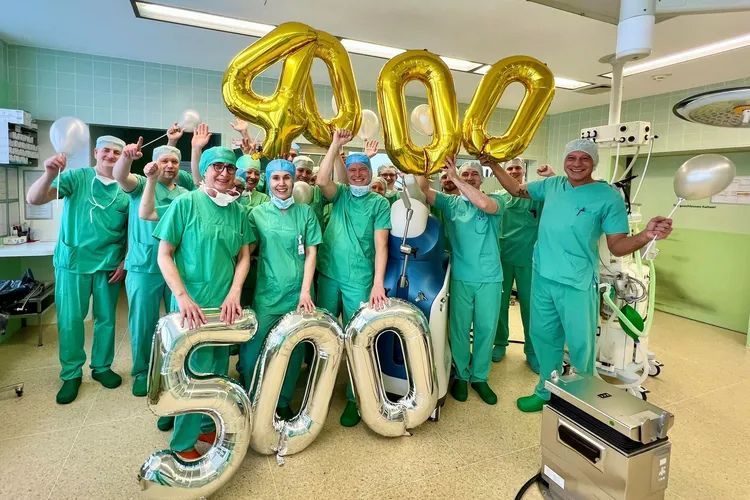
©Katholischer Hospitalverbund Hellweg
Following the 4,000th total knee replacement since the orthopedics department was established in Unna and the 500th MAKO knee replacement.
Dr. Pothmann makes one thing clear: “It’s important that, in the event the MAKO system should ever fail, you also master the conventional surgical technique. The system has never failed for us so far, but theoretically, it’s possible. That’s why it’s crucial that the surgeon can perform the procedure safely even without the robot. We only operate on a patient if we would perform the same procedure on a member of our own family and if the medical indication for surgery is clear. Ultimately, even with a clear medical indication, the patient always decides for themselves whether they want to undergo surgery. In Germany, we have a system where virtually every patient can have the necessary surgery—such as knee replacement—covered by their health insurance. This care is available nationwide almost everywhere in Germany when medically indicated, which is why so many joint replacement surgeries are performed. However, in the future, only hospitals with a high volume of cases will be authorized to perform joint replacement surgeries. Switzerland is similar, but otherwise there is no other country in the world where this is handled in the patient’s best interest, because in other countries the costs for such procedures are not covered—or only partially covered—by statutory health insurance. In England, for example, such surgery is often not covered by the healthcare system, which is why many people simply cannot afford it. That is why the German system is very well positioned in many respects. While criticism is certainly warranted here as well, the complaints about the German healthcare system are not justified when compared to other countries.”
Thank you very much, Dr. Pothmann, for this insightful look into robot-assisted joint replacement!
Share this article
Expert Interviews
Read next
- Expert interview
Expert interview with Professor Dr Elmar Herbst, PhD
Oct 15, 2026
Patient-centred and personalised knee surgery
Read more - Expert interview
Cardiogeriatrics: Significance and benefits in the context of hospital reform
Sep 21, 2026
Cardiogeriatrics: Significance and benefits in the context of hospital reform
Read more - Expert interview
Expert Interview with Professor Dr. Amadeus Hornemann, MPH
Sep 18, 2026
Prof. Amadeus Hornemann on Precision Medicine in Gynecology: Modern Surgery, New Techniques, Better Quality of Life
Read more