Expert Interviews
Outpatient Advanced Surgery in Transition: Modern Treatment Approaches for Large Abdominal Wall Hernias and Rectus Diastases in the Swiss Healthcare System

Alexandra Pfitzmann ·
Outpatient surgeries are becoming increasingly important in the Swiss healthcare system—particularly in specialized abdominal wall surgery. At the same time, there is a growing need for interdisciplinary treatment approaches to ensure that large abdominal wall hernias and rectus diastases are treated not only safely but also in a way that optimizes functional outcomes.
Today, modern centers combine surgical expertise, precise diagnostics, and coordinated treatment pathways into a treatment approach that provides patients with high-quality, efficient, and sustainable care.

The shift of complex surgical procedures to an outpatient setting requires physicians to make profound adjustments on multiple levels. From an organizational perspective, the precise structuring of the entire treatment pathway takes center stage. Outpatient procedures leave less room for delays or unclear processes, which is why scheduling, preoperative diagnostics, and OR logistics must be coordinated much more tightly.
This also includes selecting patients based on clearly defined criteria, as only medically stable individuals with a predictable postoperative course are suitable for an outpatient setting. Close coordination with anesthesiology, nursing, and primary care physicians thus becomes a central component of the process, because responsibility for postoperative care is more widely distributed and no longer takes place exclusively in an inpatient setting.
“Outpatient care requires the same level of patient safety as inpatient care—without this cornerstone, shifting complex procedures to an outpatient setting would be irresponsible. For this to succeed, a modern, clearly structured infrastructure is needed that enables short communication channels, streamlined processes, and reliable monitoring. A consistently well-coordinated team is just as essential as clearly defined processes: from preparation through admission and discharge to monitoring and follow-up care.
Efficiency depends directly on how well these structures are implemented. If the outpatient setting is operated like a hospital, costs rise and reimbursement does not cover the expenses. If, on the other hand, too little is invested in infrastructure and staff, quality suffers. It is therefore crucial to adapt the procedures—not a direct 1:1 replication of inpatient processes, but a precise adaptation for the outpatient setting. Infrastructure includes everything that is medically necessary for the respective procedures. Technical compromises must not be made simply because a procedure takes place on an outpatient basis. Procedures in line with guidelines—such as minimally invasive techniques for inguinal hernia surgery—must also be available in the outpatient setting.
A downgrade in surgical technology would increase the risk of complications and chronic symptoms and would be professionally unjustifiable. In terms of space, the outpatient setting presents a particular challenge. There must be sufficient space for medical equipment and a clearly defined layout: operating rooms, areas for patient admission and discharge, a day clinic for monitoring and preparation, and a seamless flow system in which patients continuously arrive and depart.
“This spatial and organizational precision forms the foundation for ensuring that outpatient procedures can be performed safely, efficiently, and to a high standard of quality,” says Dr. Pöschmann, describing the key measures for the optimal implementation of outpatient care.
The decision between outpatient and inpatient surgery for large abdominal wall hernias or severe rectus diastases follows a clearly structured medical decision-making process that takes into account both preoperative criteria and intraoperative factors. The central question is whether the entire course of treatment—from anesthesia through the procedure to the early postoperative phase—can be safely managed without inpatient monitoring.
“The decision on whether a patient with an abdominal wall hernia should be treated on an outpatient or inpatient basis is based on a clear interplay of policy guidelines, medical assessment, and individual risk evaluation. In Switzerland—similar to Germany—there are procedures that, by law, may no longer be performed on an inpatient basis. In some cantons, these rules are already in effect: gallbladder surgeries or bilateral inguinal hernias must be performed on an outpatient basis or, at the very least, are reimbursed only at the outpatient rate. For traditional hospital structures, performing these procedures on an inpatient basis under these conditions would not be economically viable.
Within this framework, however, the medical decision is made as a team. First, the team assesses whether the procedure can be safely performed on an outpatient basis from a technical standpoint and whether the patient’s individual situation permits it. This includes ensuring that the patient feels comfortable with the outpatient approach and that there are no uncertainties. Equally important is post-operative care at home: The patient must not be left alone; they need someone to accompany them home and someone to remain with them during the first few hours after surgery.
The final decision rests with the anesthesiologist. The anesthesiologist makes the final determination as to whether anesthesia can be safely administered on an outpatient basis or whether close postoperative monitoring would be necessary due to allergies, intolerances, or relevant pre-existing conditions. Only when all parties involved—the surgical team, the patient, and the anesthesiologist—deem outpatient surgery safe is the procedure scheduled accordingly.
This results in a decision that is politically guided, medically sound, and individually accountable. “Some supposedly simple surgeries are intended to be performed on an outpatient basis but are carried out as inpatient procedures if additional medical conditions increase the risk,” explains Dr. Pöschmann, adding:
“The decision to perform a procedure on an outpatient basis is not determined solely by the surgical and anesthesiology teams, but arises from the collaboration of several medical disciplines. Family physicians play a central role, as they have known many patients for a long time and provide important early insights: Is there a blood clotting disorder? Are there any relevant pre-existing conditions? Is the patient generally stable enough for an outpatient procedure? This information is already factored into the initial assessment and creates a solid foundation for further planning. As patients age, other specialists are often consulted, particularly cardiologists.
For patients with pacemakers, stents, or known arrhythmias, their assessment is crucial. They determine whether a low-risk outpatient procedure is feasible or whether an inpatient setting would be preferable for safety reasons. This creates a comprehensive medical picture in advance that guides the decision-making process. Despite careful preparation, situations may arise during surgery that require a change of plan. Bleeding, unexpected arrhythmias, or rare complications may necessitate inpatient monitoring of a patient following the procedure.
One example is the development of a sudden AV block in a previously unremarkable patient: The surgery is completed properly, followed by transfer to a partner hospital where cardiac evaluation and monitoring are possible. Such cases occur rarely—perhaps twice a year—and proceed without posing any critical risk. This requires close collaboration with a reliable partner hospital to ensure that patient transfers run smoothly and no information is lost. It is precisely this coordinated collaboration that makes outpatient surgery safe and responsible.”
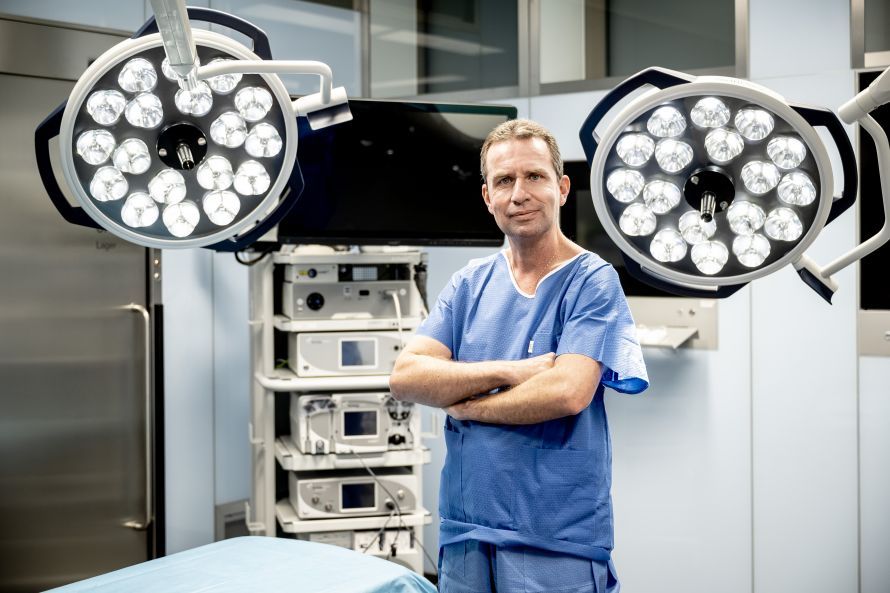
The increasing shift toward outpatient surgery is noticeably changing the selection of appropriate procedures for large abdominal wall hernias and rectus diastases, as it reevaluates surgical technique, perioperative planning, and postoperative safety. It is crucial that a procedure can only be performed on an outpatient basis if the entire process—from anesthesia through early convalescence—is designed so that complications remain rare, predictable, and easily manageable.
Dr. Pöschmann explains: “Performing more complex procedures such as abdominal wall hernia or rectus diastasis surgeries on an outpatient basis has only become possible due to several developments that were not available two decades ago. Back then, these surgeries were predominantly performed using open techniques—with larger incisions, significantly more pain, longer wound healing times, and anesthesia methods that were less precisely controllable. Today, minimally invasive and endoscopic techniques dominate clinical practice. Smaller incisions, shorter operating times, and modern instruments enable a gentle approach that significantly reduces the immediate burden on patients.
Technological advancements are the decisive factor here. Improved cameras, clearer optics, more precise instruments, and lower operating pressures within the abdominal cavity allow for precise procedures with lower risk. Even more complex superficial procedures, such as the treatment of rectus diastasis, can now be performed using targeted anesthesia of the abdominal wall or pain catheters in such a way that patients experience virtually no postoperative discomfort. The combination of shorter operating times, controllable anesthesia, and tissue-sparing techniques forms the basis for safely performing such procedures on an outpatient basis.
This development is also changing the training landscape. Outpatient procedures must be performed to specialist standards, and they must be efficient—otherwise, they are not economically viable. Many of these operations used to be classic training cases for resident physicians, but in the outpatient setting, the longer learning time is difficult to accommodate. This significantly complicates the practical training of young surgeons. At the same time, the new generation brings advantages: they are often more proficient in minimally invasive surgery than older colleagues, who still predominantly performed open surgery.
Many young doctors find working with robotic systems intuitively easy, which shortens the learning curve. The more robotic systems become established in outpatient surgery, the more training opportunities can be regained. Nevertheless, the current transition phase remains challenging: outpatient efficiency and training needs are at odds with one another, a conflict that can only be fully resolved through further technical and structural developments.”
The increasing time and cost pressures do indeed carry the risk that procedures in an outpatient setting will be performed too quickly. Hospitals that operate on both outpatient and inpatient patients within the same infrastructure face a particular structural dilemma here.
“Lean processes are difficult to implement under such conditions; procedures remain time-consuming, and the pace of surgery inevitably increases. This, in turn, can increase complication rates—an effect that is likely to show up in quality assurance registries and studies, even if reliable data will only become available after some time has passed. A key protective measure lies in the careful selection of suitable patients. The more complex the medical condition, the riskier outpatient surgery becomes.
Some procedures—such as major, radical hemorrhoid surgeries—are technically possible on an outpatient basis but regularly result in emergency room visits at night once the anesthesia wears off. Such cases improve neither the quality of care nor the cost structure and demonstrate that not every procedure can be meaningfully performed on an outpatient basis. When economic pressure increases and processes must be accelerated, cost control becomes challenging. Quality assurance systems are slow to respond, so it will take several years before it becomes clear how the increasing shift toward outpatient care affects complications and the quality of outcomes.
Until then, careful determination of indications—selecting the right patients for the right setting—remains the most important factor in ensuring safety and quality,” notes Dr. Pöschmann.
Outpatient procedures carry specific risks compared to inpatient treatments, risks that lie less in the surgical part itself than in the postoperative phase. As long as the infrastructure, monitoring, equipment quality, and staffing standards are identical, there are no additional risks during the operation.
“The differences only become apparent later on: allergies, intolerances, severe nausea, circulatory problems, or new cardiac arrhythmias may not manifest until hours after the procedure—a time when the patient is at home and no longer under direct clinical observation. This is precisely where the central risk of the outpatient setting lies. To ensure that such situations can be safely managed, a clear emergency follow-up plan is required.
After general anesthesia, the patient must not be left alone but requires an accompanying person who can take them home, monitor them, and react immediately if necessary. Equally essential is a medical contact person—the surgeon or anesthesiologist—who is available at all times and can be contacted immediately in case of complications. After surgery, patients are first monitored in the recovery room. There, small, well-equipped rooms are available, as well as some larger rooms with a shower and a recliner, depending on the type of procedure.
The proximity to the anesthesia team and the surgeons is deliberately kept close so that nothing is overlooked in the first minutes and hours after surgery. As soon as the anesthesia wears off, gradual mobilization begins: getting up, getting dressed, taking a few steps, drinking, possibly eating something, and using the restroom. These steps are designed to identify potential problems early on rather than waiting until the patient returns home. Discharge does not occur until all vital signs are stable—and always with a clear plan outlining what to watch for, which symptoms are normal, and which require immediate notification.
An accompanying person or professional transportation is required for the trip home. Patients who have undergone regional anesthesia can walk on their own, but after general anesthesia, pickup is mandatory. Family members or a trained taxi company that is familiar with medical considerations and ensures safe transportation are available for this purpose. Public transportation is not an option because the journey cannot be monitored. If a patient does not have reliable support, this may be a reason not to perform the procedure on an outpatient basis. In addition to medical factors, psychological aspects also play a role. Anxiety, uncertainty, a lack of social support, dementia, or conditions such as Parkinson’s disease can increase the risk.
Such stressors must be taken seriously, as panic or disorientation after surgery can be dangerous. In such cases, inpatient admission is preferred, even if the procedure is technically feasible on an outpatient basis. Following discharge, a follow-up examination usually takes place at the surgical center the next day. Only if the patient lives very close to their primary care physician and the physician is closely involved can the follow-up take place there. There are exceptions for minor procedures, but as a general rule: A follow-up examination the next day is an integral part of the outpatient treatment plan,” explains Dr. Pöschmann.

Postoperative monitoring following outpatient procedures must be structured in such a way that it fully compensates for the lack of inpatient observation while simultaneously meeting the specific requirements of complex abdominal wall reconstructions. A multi-layered safety concept that combines medical stability, clear procedures, and digital support is crucial.
The increasing shift toward outpatient care is not only changing processes and reimbursement structures but also has far-reaching consequences for nursing staff in the inpatient setting.
Dr. Pöschmann comments: “With the departure of those younger or middle-aged patients who used to stay in the hospital for one or two days after minor procedures, the entire patient population is shifting. These relatively straightforward cases often provided nursing staff with brief moments of relief: a conversation, a smile, or rapid progress that was visibly motivating. Today, the wards are primarily occupied by older, seriously ill, and high-care-need patients. The number of beds is being reduced, facilities are being closed, and processes are being streamlined—yet staffing ratios often remain unchanged.
This means fewer patients but a significantly higher workload. Nursing staff are increasingly caring for people with dementia, multimorbidity, limited mobility, or complex medical conditions that require a great deal of time, attention, and both physical and emotional energy. This “dilution effect”—the disappearance of “easy” cases—hits nursing staff twice as hard. On the one hand, the workload increases; on the other, the positive feedback that provides relief and psychological stability in everyday life disappears. Caregivers are more frequently confronted with suffering, slow-progressing conditions, uncertainties, and poor prognoses.
This affects morale, motivation, and mental health. At the same time, structural adjustments are not being made. Patients are getting older and sicker, but staffing levels remain the same. This leads to burnout, frustration, and the feeling of no longer being able to meet the demands of the job. Many are leaving the profession—a trend that could intensify further due to the shift toward outpatient care if no countermeasures are taken.”
The shift toward outpatient care will continue to expand. Switzerland currently still benefits from short travel distances and a comparatively dense hospital network, even in rural regions. But these structures are becoming sparser, hospitals are closing, beds are being cut, and the pressure to perform procedures on an outpatient basis is rising steadily.
“A look at other countries shows where this trend might lead. In the U.S. or the British NHS, many surgeries are performed on an outpatient basis, but patients do not go home afterward. Instead, they spend the first night in so-called patient hotels—facilities that function like a hospital but are financed differently. Nursing staff are on hand there, there are call systems, and complications can be addressed immediately.
Patients who undergo major procedures, such as gastric bypass surgery, would never be discharged directly to their home environment without such intermediate care facilities. Such models do not yet exist in Switzerland. Neither “patient hotels” nor outpatient facilities with medical supervision have been established. Therefore, the expansion to major surgeries will proceed more slowly as long as this infrastructure is lacking. In the future, hospitals could create their own small overnight accommodations—a sort of mini-hotel that accommodates outpatient patients for one night at cost to reduce risks.
The conversion of closed hospitals into outpatient centers with overnight accommodations is also a realistic future scenario. Currently, the situation varies by canton. In the Canton of Zurich, bilateral fractures or patients with clearly defined comorbidities can still undergo inpatient surgery, provided this is justified and approved in advance. Major abdominal wall reconstructions, incisional hernias, or complex rectus diastases also remain inpatient procedures—which is medically sound and justifiable to patients. Nevertheless, the leeway is shrinking: Insurance companies are increasingly pushing to shift as many procedures as possible to the outpatient sector to reduce costs.
This trend presents doctors with additional challenges. In addition to medical considerations, administrative and logistical aspects must be given greater weight. In the past, it was clear: a patient would undergo surgery, stay for two nights, and the flat fee would be reimbursed. With the introduction of DRGs, there was even a minimum length of stay—those who discharged patients early received less money.
Today, the logic is reversed: many procedures are no longer allowed to be performed on an inpatient basis at all. This abrupt change puts a strain on daily practice and alters the doctor-patient relationship,” says Dr. Pöschmann, emphasizing at the conclusion of our conversation:
“In large outpatient centers, patients sometimes no longer know their surgeon personally. Preoperative counseling, the surgery itself, and postoperative follow-up are handled by different people because the workflows are extremely streamlined. This contradicts the traditional understanding of continuous medical care. Some centers are trying to counteract this by having surgeons personally oversee their own cases—but the structural constraints remain.
Ultimately, the conclusion is that shifting to an outpatient model is only justifiable if the infrastructure, team stability, and clear processes are in place. Streamlined workflows, reliable staff, and a well-thought-out organization are fundamental requirements. How reimbursement rates, pressure from insurers, and demographic trends will continue to impact the situation remains to be seen. One thing is certain: this trend is advancing, and the systems must adapt to ensure that quality and safety are maintained.”
- Leading hernia specialist — Approximately 500 procedures per year, specializing in complex hernias and rectus diastases.
- Expert in minimally invasive surgery — Laparoscopic and robot-assisted procedures (daVinci) for precise, minimally invasive surgeries.
- Director of Seechirurgie Zürich — A modern surgical center with a dual-operating room, radiology integration, and high-end infrastructure.
- Specialist in complex abdominal surgery — Treatment of adhesions, intestinal obstruction, and tumor surgery.
- Certified hernia specialist — Recognized by the German Hernia Society and the Herniamed Registry.
- Internationally connected — Active participation in professional societies; high demand for second opinions.
Share this article
About the medical author
Alexandra Pfitzmann
Editor
Alexandra Pfitzmann – medical author: expert knowledge, professional articles and medical insights in the Leading Medicine Guide.
More about the medical author →Expert Interviews
Read next
- Expert interview
Cardiogeriatrics: Significance and benefits in the context of hospital reform
Sep 21, 2026
Cardiogeriatrics: Significance and benefits in the context of hospital reform
Read more - Expert interview
Expert Interview with Professor Dr. Amadeus Hornemann, MPH
Sep 18, 2026
Prof. Amadeus Hornemann on Precision Medicine in Gynecology: Modern Surgery, New Techniques, Better Quality of Life
Read more - Expert interview
Expert Interview with Professor Dr. Konstantinos Anagnostakos
Sep 15, 2026
Prof. Anagnostakos on Painful Knee Replacements
Read more