Expert Interviews
Hallux valgus: When the big toe goes off track

Alexandra Pfitzmann ·
Hallux valgus is one of the most common misalignments of the forefoot—and it’s far more than just a cosmetic issue. As the big toe gradually tilts outward and the midfoot drifts inward, the entire biomechanics of the foot are altered. This leads to pain, pressure points, and often significant limitations in daily life. Early diagnosis and targeted treatment are crucial for alleviating symptoms and preserving the foot’s natural function.

Hallux valgus develops through a complex interplay of biomechanical stress imbalances and genetic factors, which together cause the big toe to gradually shift outward.
“The causes of hallux valgus—commonly known as a bunion—are varied. It often runs in families, which is why genetic factors and a congenital predisposition play an important role.
In addition, biomechanical changes in the foot, such as a flatfoot with a collapsed arch, can contribute to the development and progression of the deformity. Such changes lead to altered weight distribution and stability in the forefoot. In rare cases, an accident can also trigger the deformity.
In addition, ill-fitting footwear can exacerbate the symptoms. In particular, narrow or tight-fitting shoes, as well as high heels, increase pressure on the forefoot and the ball of the foot. While they are usually not the sole cause of hallux valgus, they can significantly worsen existing deformities and symptoms.
Other possible causes include inflammatory joint diseases that compromise joint stability, as well as muscular weakness or neurological disorders that can lead to altered weight distribution on the foot and, consequently, a misalignment of the big toe,” explains Dr. Krapf at the beginning of our conversation.
In cases of hallux valgus, patients usually seek medical attention when the misalignment is no longer just a cosmetic issue but noticeably interferes with daily life.
“Most patients complain of pain that worsens with weight-bearing while walking or standing. These symptoms often develop gradually over the course of years, but they can also increase significantly within a relatively short period of time. In addition to pain in the ball of the foot, pressure points, swelling, and difficulty wearing shoes frequently occur. In advanced stages, nighttime discomfort, burning, tingling, or other sensory disturbances may also occur,” explains Dr. Krapf.
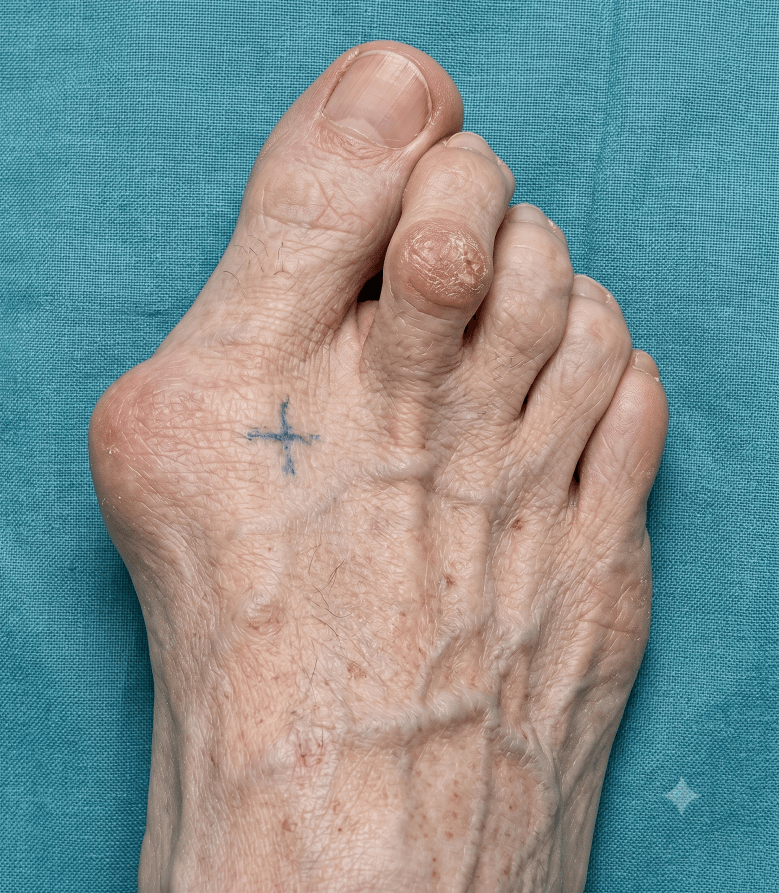
Photo: Hallux Valgus (AI-generated)
Those affected report an unstable gait, a tendency to shift weight to the outer edge of the foot, or weight-bearing pain in the midfoot caused by the altered distribution of pressure. Some also develop symptoms in the smaller toes, such as hammertoes or metatarsalgia (pain in the midfoot), which are secondary to the deformity.
Nighttime pain, a feeling of instability, or the sensation of “no longer being able to walk properly” are also common reasons for seeking medical attention. Many also seek care because they notice that the big toe is visibly shifting further outward or because the deformity is suddenly progressing more rapidly.
Whether a hallux valgus remains stable or worsens significantly can only be reliably assessed through a combination of clinical examination, functional analysis, and imaging diagnostics. The diagnosis follows a clear process in which both the visible deformity and the underlying biomechanical patterns are evaluated.
First, the clinical examination reveals the extent to which the axis of the big toe has already deviated and whether any associated changes are present. Signs of progressive disease include increasing pressure pain on the inner side of the foot, an inflamed or thickened bursa region, and secondary changes such as hammertoes or an overloaded midfoot.
The mobility of the metatarsophalangeal joint of the big toe also plays a role: an unstable or hypermobile joint promotes worsening of the condition, while a firm, less mobile joint tends to indicate a stable course.
Dr. Krapf comments on this: “A reliable prognosis is difficult to make on a case-by-case basis. However, various factors can provide clues as to whether an increase in the deformity is to be expected. Of particular importance are the cause of hallux valgus and the overall stability of the foot.
In addition, instability in the midfoot—for example, in the area of the Lisfranc joint (the series of joints between the metatarsals and the tarsal bones)—can contribute to the progression of the deformity. If changes are already present, an early evaluation by an orthopedic surgeon specializing in foot surgery is therefore advisable. Preventive measures such as appropriate footwear, orthotic inserts, and targeted strengthening and mobility exercises can often help slow the progression of the deformity.”
The progression of hallux valgus can be accurately assessed based on visible changes, functional limitations, radiographic angles, and biomechanical patterns. The diagnosis is therefore always a combination of clinical examination, technical measurements, and the evaluation of individual risk factors.
Conservative measures can influence the progression of hallux valgus by improving the biomechanical forces acting on the forefoot and thereby functionally stabilizing the deformity. It is crucial that these measures are most effective when the hallux valgus is still flexible and the joint axes have not been permanently altered.
“Conservative treatment measures are primarily aimed at alleviating symptoms and slowing the progression of the deformity as much as possible. Existing biomechanical issues, such as a flatfoot with a pronated arch or muscular imbalances, can be improved through custom-fitted orthotics, physical therapy, and targeted exercises. Equally important is choosing appropriate footwear with sufficient space in the forefoot area to reduce pressure points and pain.
However, the limitations of conservative therapy lie in the fact that an existing bony deformity generally cannot be permanently corrected. “If symptoms worsen despite conservative treatment or if the deformity progresses significantly, the situation should be reassessed and, if necessary, surgical intervention discussed,” recommends Dr. Krapf.
Whether surgery for hallux valgus is advisable or medically necessary is determined by a combination of clinical symptoms, functional limitations, radiological findings, and whether the deformity is still flexible or already structurally fixed.
“The most important factor in determining the indication for surgery is the patient’s symptoms and the resulting impairment of quality of life. Surgery may be advisable if everyday activities, occupational demands, or important leisure activities can no longer be performed without discomfort.
Similarly, surgery may be indicated if pain medication is required on a regular basis or if conservative treatment measures no longer achieve sufficient improvement. As a general rule, a conservative treatment approach should be attempted first before surgical intervention, provided it is medically justifiable,” advises Dr. Krapf.
During the examination, the doctor assesses whether the big toe is still mobile and correctable or whether the alignment is already structurally fixed. A flexible hallux valgus can often be stabilized conservatively, while a fixed deformity usually requires surgery in the long term. The X-ray provides the decisive objective evidence: a significantly increased angle, displaced sesamoid bones, or early-stage osteoarthritis indicate that the deformity is fixed and will continue to worsen without surgery.
The course of the condition is also important. If the hallux valgus visibly worsens over months despite consistent use of orthotics, physical therapy, and appropriate footwear, it is considered progressive. Additional changes, such as hammertoes or significant metatarsal pain, are further signs that the forefoot is already overloaded and that surgical correction may be advisable.
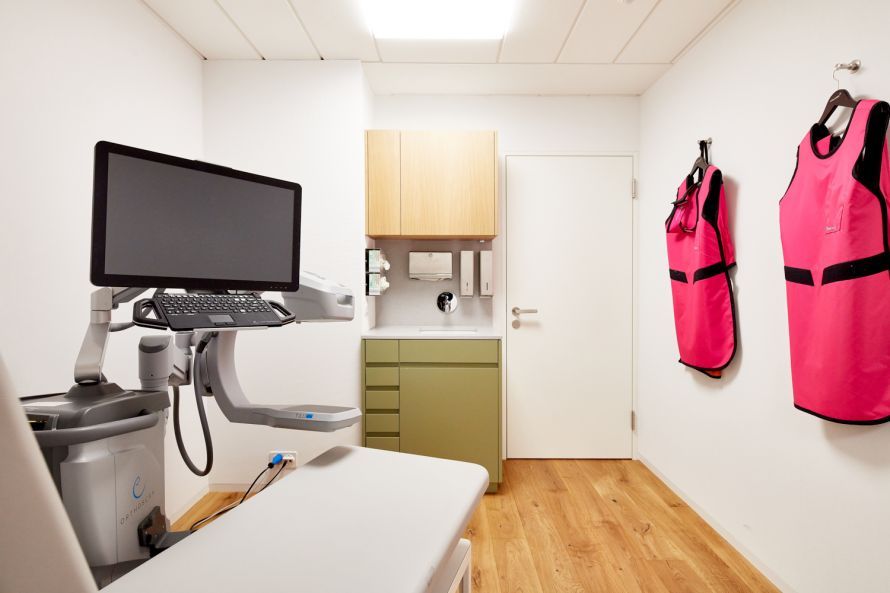
Surgery is indicated when pain and functional limitations increase, conservative measures have been exhausted, the deformity is structurally fixed, or radiological findings show a progressive axial deviation. The medical necessity thus arises from a combination of symptoms, objective findings, and the question of whether the foot can regain its natural function without surgical correction.
Modern hallux valgus surgeries today differ significantly in how they correct the deformity, how stable the correction is in the long term, and what outcomes patients can expect. A key factor is the level of the first metatarsal bone at which the surgery is performed and whether the cause of the deformity—such as instability of the first metatarsal ray—is directly addressed.
The various surgical procedures and techniques differ not only in where on the bone the correction is made, but also in the meaning of their names. Distal procedures such as the chevron osteotomy are so named because the bone is cut in a V-shape—a “chevron”—directly at the metatarsophalangeal joint of the big toe. This small, targeted realignment is well-suited for mild to moderate deformities, heals quickly, and allows for early weight-bearing, but reaches its limits with steeper angles.
Diaphyseal procedures such as the Scarf osteotomy are named because the bone is cut along a long, oblique pattern reminiscent of a fabric scarf (“scarf”). This shape creates a large contact surface and thus high stability, allowing moderate to severe deformities to be reliably corrected and ensuring that long-term relapses are rare.
Proximal procedures such as the Lapidus arthrodesis are named after the surgeon Paul Lapidus. In this procedure, the unstable joint between the metatarsus and the tarsus is fused to stabilize the root cause of severe deformities directly at the source. Healing takes longer, but biomechanical stability is greatest, especially in cases of severe instability or hypermobile joints.
“Hallux valgus is not a single, uniform condition, but rather encompasses various deformities with different causes and degrees of severity. That is why numerous surgical procedures are available today. The goal of modern hallux valgus surgery is to treat the underlying causes as specifically as possible, to precisely correct the deformity, and to achieve long-term stable results. Depending on the findings, both minimally invasive and open surgical techniques are used.
The optimal procedure is selected on an individual basis based on the clinical examination, medical history, and detailed imaging. A weight-bearing X-ray or a modern standing 3D X-ray is particularly helpful in this regard. Subsequently, the various treatment options are discussed with the patient and tailored to their anatomical conditions and personal needs,” explains Dr. Krapf.
The duration of recovery after hallux valgus surgery depends on several interrelated factors that determine how quickly the bones, joints, and soft tissues can bear weight again.
“The duration of recovery depends on various factors. These include the patient’s general state of health, the surgical technique chosen, and consistent adherence to the postoperative care plan. Patients can actively support the healing process by carefully following the recommended measures before and after surgery.
These include, in particular, abstaining from nicotine, consistently elevating the foot, adhering to weight-bearing guidelines, performing regular exercises, and wearing supportive shoes, splints, or bandages, if prescribed. Equally important are regular follow-up visits so that the healing process can be monitored and treatment adjusted in a timely manner if necessary,” states Dr. Krapf, and concludes our conversation by emphasizing the care provided at the Lucerne Foot Center:
“At the Foot Center, patients are cared for by specialized physicians in orthopedics and trauma surgery who focus on foot and ankle surgery. Thanks to many years of experience and ongoing continuing education, we offer comprehensive diagnostics as well as individualized conservative and surgical treatment plans. Our care is interdisciplinary and provided in close collaboration with physical therapists, orthopedic technicians, and other therapeutic specialists. This enables us to ensure optimal care with orthotic insoles, orthopedic shoes, and complementary therapies.
If surgery becomes necessary, we support our patients throughout the entire treatment process, from preoperative planning through rehabilitation. The procedures are performed at the Hirslanden Clinics St. Anna in Lucerne, St. Anna Meggen, and the Swiss Paraplegic Center. Even after surgery, our patients benefit from a close-knit network of primary care physicians, physical therapists, and other specialists to achieve the best possible rehabilitation and long-lasting treatment outcomes.”
- Specialist in foot and ankle surgery with an international reputation
- Expert in hallux valgus, osteoarthritis, and rheumatism—surgical and conservative treatment
- Director of the Lucerne Foot Center since 2018
- Team physician for FC Lucerne – providing care for athletes of all skill levels
- Certified foot surgeon (DGFF Expert Certificate, microsurgery at the University of Basel)
- Focus on sports traumatology and sports orthopedics, including training optimization and equipment adaptation
- Specialized biomechanical gait analysis for precise diagnosis and prevention
- Broad range of conservative treatments: orthopedic shoes, insoles, orthoses, physical therapy
- Full range of surgical procedures, from the forefoot, midfoot, and hindfoot to deformities, tendon injuries, instabilities, and fractures
- Interdisciplinary collaboration
Share this article
Expert Interviews
Read next
- Expert interview
Expert interview with Professor Dr Elmar Herbst, PhD
Oct 15, 2026
Patient-centred and personalised knee surgery
Read more - Expert interview
Cardiogeriatrics: Significance and benefits in the context of hospital reform
Sep 21, 2026
Cardiogeriatrics: Significance and benefits in the context of hospital reform
Read more - Expert interview
Expert Interview with Professor Dr. Amadeus Hornemann, MPH
Sep 18, 2026
Prof. Amadeus Hornemann on Precision Medicine in Gynecology: Modern Surgery, New Techniques, Better Quality of Life
Read more