Expert Interviews
Focus on Hernia Surgery - Expert Interview with Dr. Eucker

Alexandra Pfitzmann ·
With over 600 hernia surgeries performed each year, the certified reference center for hernia surgery at the Baselland Cantonal Hospital is one of the largest in Switzerland. Under the leadership of Chief Physician Professor Dr. Robert Rosenberg and Dr. Dietmar Eucker (Senior Physician), the center offers the highest level of internationally renowned expertise—with a team of proven experts: Dr. Christine Glaser, Dr. Bernd Schenkluhn, Dr. Andres Heigl, and Dr. Sebastian Lamm.
The KSBL Hernia Center offers a highly specialized range of diagnostic and treatment services for patients with hernias or pain in the abdominal wall and groin. The Surgical Clinic at the Baselland Cantonal Hospital, with its locations in Liestal and Bruderholz, covers the entire spectrum of general and visceral surgery, also known as abdominal surgery. This primarily includes surgeries on the organs of the digestive tract—namely the stomach, intestines, and esophagus—as well as surgeries on the gallbladder, liver, and pancreas.
Diseases affecting organs outside the abdominal cavity are also treated surgically within the scope of general and visceral surgery. These include, in particular, diseases of the hormone-producing organs—the thyroid, parathyroid, and adrenal glands—which are addressed by specialists at the Surgical Clinics of the Baselland Cantonal Hospital as part of what is known as endocrine surgery.
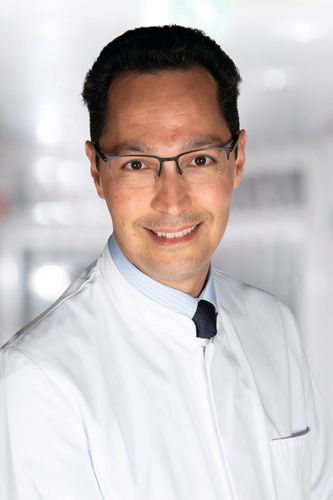
Dr. Eucker was the first to develop the method of intraoperative abdominal wall extension/fascial traction (IFT) at the Reference Center for Hernia Surgery at the Baselland Cantonal Hospital. The editorial team of the Leading Medicine Guide wanted to learn more about this and spoke with Dr. Eucker about the broad topic of hernias and their treatment options.
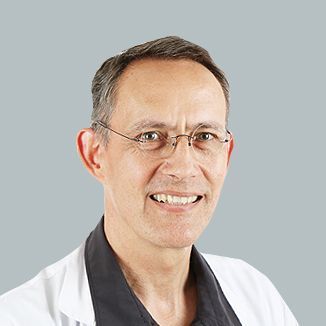
“A hernia is a weak spot in the abdominal wall and most commonly occurs in the groin, at the navel, along a surgical scar, or in the upper abdomen. The peritoneum and, in some cases, internal organs push through the abdominal wall, causing a bulge—the hernia,” Dr. Eucker begins our conversation and explains: “Hernias are usually painless, grow slowly, and gradually become noticeable as a swelling. Strangulation is rather rare. The most common type of hernia is an inguinal hernia, which affects, on average, one in three men over the course of their lives. Here at the Baselland Cantonal Hospital, we perform surgery on approximately 400 male patients per year for inguinal hernias.”
The symptoms of a hernia can vary depending on the type and location of the hernia. With an inguinal hernia, umbilical hernia, or incisional hernia, a noticeable bulge or lump generally appears in the affected area. Hernias can cause pain, but they usually cause discomfort, such as a feeling of pressure, especially when abdominal pressure increases—for example, during prolonged walking or standing, when carrying heavy objects, when coughing, or during a bowel movement.
Significant advances have been made in hernia surgery in recent years.
“Hernia surgery has now evolved into a specialized discipline. This makes sense when you consider that inguinal hernia surgery, for example, is the most common procedure in general surgery. What is performed frequently should also be developed to a particularly high standard. As a result, hernia surgery has given rise to some entirely new surgical techniques in recent years. What was considered state-of-the-art just ten years ago may now be outdated. Keeping pace with these developments and offering the full range of technical options now requires a certain degree of specialization. “Minimally invasive and robotic surgical methods are just one part of the spectrum,” explains Dr. Eucker.
What exactly is minimally invasive hernia surgery?
Most patients are now familiar with the terms “minimally invasive surgery,” “laparoscopic surgery,” and “keyhole surgery,” and they often ask about them. There is usually an assumption that this is the opposite of “open” surgery. The fact is, however, that even in “open” surgery, incisions and access points are kept as small as possible. Even a so-called open technique should be kept as minimally invasive as possible. The principle of using the smallest possible incisions and, in some cases, working with cameras and specialized instruments is therefore almost always followed at specialized centers and offers the advantages of reduced pain, faster recovery, and minimal infection rates.
Typical procedures that combine minimal access with what is still considered “open” surgery are MILOS procedures:
MILOS Surgical Technique (MILOS: Mini or Less Open Sublay Operation)
The MILOS procedure combines the advantages of minimally invasive and open surgical techniques. In the MILOS procedure, the synthetic mesh required to stabilize the abdominal wall is placed through the smallest possible incisions in the abdominal wall but outside the abdominal cavity—for example, in the layer between the peritoneum and the supporting abdominal wall. It is therefore a minimally open surgery: this combines the advantages of conventional procedures while avoiding potential disadvantages.
A Smooth Transition from Open to Minimally Invasive Surgery
“Minimally invasive surgery is not limited to laparoscopy, or the ‘keyhole’ technique. Explaining this to patients is often not easy, as the terms are frequently misleading. With the MILOS technique, the surgery is performed open, but with the smallest possible access point. This allows, for example, the mesh to be placed exactly where it belongs—namely, between the muscles and other layers of the abdominal wall. For example, a 30-cm mesh can be inserted through a small 6-cm incision. “MILOS is therefore a hybrid technique,” says Dr. Eucker, explaining this effective surgical method.
Intraoperative Abdominal Wall Extension/Fascial Traction (AWEX/IFT), fasciotens®
Dr. Dietmar Eucker has extensive experience with complex abdominal wall reconstructions, i.e., the restoration of the abdominal wall in cases of large and extreme incisional hernias. As early as 2012, the KSBL team developed and published a technique that has since spread worldwide: intraoperative abdominal wall extension/intraoperative fascial traction.
“The problem with reconstructing very large abdominal wall hernias is that the abdominal muscles shorten and retract. This is not easy to reverse. Technically, with AWEX/IFT, the shortened abdominal wall is gently lengthened again during surgery through stretching, without the need for additional incisions. The method is characterized by an exceptionally low complication rate and time efficiency. As a supportive measure, Botox can be injected into the abdominal wall four weeks before surgery. This helps the muscle relax somewhat even before the operation, allowing for greater length,” says Dr. Eucker as he begins his explanation of this absolutely fascinating surgical method.
AWEX stands for Abdominal Wall Extension (a stretching technique) and was developed as an innovative surgical method by Dr. Dietmar Eucker and his team at the Center of Excellence for Hernia Surgery at the Baselland Cantonal Hospital. In the meantime, the name IFT (intraoperative fascial traction) has been adopted. Today, the technique is performed using specially developed devices: fasciotens® is the brand name of the device manufacturer.
AWEX/IFT/fasciotens® is a method used to stretch the abdominal wall so that abdominal wall surgery can be performed with minimal tension. This is achieved using an external device that applies traction to the abdominal wall by gently pulling the abdominal wall structures toward the front of the body. The traction device allows for precise adjustment of the traction forces and controlled re-tensioning during the operation. This traction can be maintained until the abdominal wall is sufficiently stretched to perform the necessary closure procedure. The traction can be directed either straight from top to bottom or diagonally from top to bottom.
“With fasciotens®, we have already been able to repair many large hernias without additional measures (e.g., so-called component separations). Patients generally report very little postoperative pain and can be discharged after just a few days. This is an impressive result for large hernias. In particular, the risk of complications is significantly lower due to the elimination of additional procedures. Based on these experiences, I am absolutely convinced of the effectiveness and benefits of fasciotens® in the treatment of complex abdominal wall hernias,” Dr. Eucker emphasizes, adding: “Furthermore, the device is easy to use. Unfortunately, we were unable to renew the patent in 2014 for the device we developed ourselves due to a lack of sponsor interest, so we are now collaborating with the company faciotens. However, we have no stake in the company! The device is now known worldwide, from Norway to Portugal and Greece, as well as in India, Australia, and the U.S. This has also brought the KSBL Hernia Center international recognition.”
Baselland Cantonal Hospital – Certified Reference Center for Hernia Surgery
“Ten years ago, we began using the Herniamed database for quality assurance, and in 2015 we became Switzerland’s first certified hernia center (center of excellence). Today, we are one of the largest hernia centers and hold the status of a reference center for hernia surgery (and, incidentally, for minimally invasive surgery as well). A reference center is characterized by a high volume of cases, offering clinical rotations and continuing education, conducting scientific research, and publishing findings. “Quality comes first, and we share our expertise—for example, through our annual surgical workshops,” says Dr. Eucker of the Baselland Cantonal Hospital. Looking to the future, he concludes: “Knowledge about the abdominal wall should be disseminated widely so that the level of quality rises. Specialization should be encouraged. Here at the Baselland Cantonal Hospital, there’s hardly an abdominal wall we can’t reconstruct!”
Dr. Eucker—thank you very much for providing such valuable insight into the complex topic of hernia surgery!
Share this article
Expert Interviews
Read next
- Expert interview
Expert interview with Professor Dr Elmar Herbst, PhD
Oct 15, 2026
Patient-centred and personalised knee surgery
Read more - Expert interview
Cardiogeriatrics: Significance and benefits in the context of hospital reform
Sep 21, 2026
Cardiogeriatrics: Significance and benefits in the context of hospital reform
Read more - Expert interview
Expert Interview with Professor Dr. Amadeus Hornemann, MPH
Sep 18, 2026
Prof. Amadeus Hornemann on Precision Medicine in Gynecology: Modern Surgery, New Techniques, Better Quality of Life
Read more