Expert Interviews
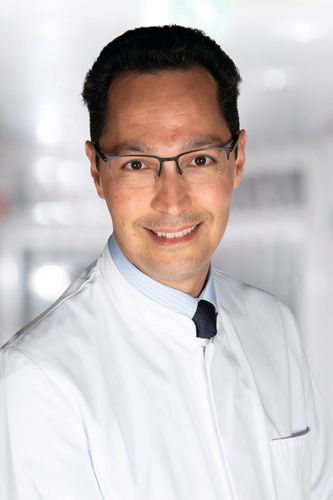
Expert Interview with Dr. Volker Fackeldey, M.D.

Alexandra Pfitzmann ·
Dr. Volker Fackeldey, M.D., heads the renowned Hernia Center at Maindreieck within the Kitzinger Land Clinic, which under his leadership has developed into a leading facility for abdominal wall hernias in the Würzburg area and beyond. As early as 2013, it was recognized as one of the first centers in Germany to be designated a Center of Excellence for Hernia Surgery—a testament to the highest quality of patient care.
Dr. Fackeldey follows a consistently individualized approach: Each hernia is treated according to a tailored surgical plan (“tailored approach”), as recommended by the German Hernia Society. A specialist in general and visceral surgery as well as specialized visceral surgery, he has additional specializations in sports medicine, proctology, chiropractic therapy, and European coloproctology (EBSQ). In addition to hernia surgery, his comprehensive range of services includes procedures on the gallbladder, intestines, and appendix, as well as the treatment of incontinence.
In hernia treatment, Dr. Fackeldey is proficient in all standard procedures—from minimally invasive techniques such as TAPP and IPOM to open procedures according to Shouldice and Lichtenstein, as well as specialized methods for incisional hernias. A key focus is the use of state-of-the-art technologies such as 3D laparoscopy, which enables particularly precise, minimally invasive, and virtually scar-free procedures. The center’s technical equipment, including a 3D video tower and innovative instruments, underscores its high standards of quality. On the scientific front, Dr. Fackeldey is active in several national professional societies and expert committees and maintains regular dialogue with colleagues to stay at the cutting edge of research.
The Hernia Center is also a sought-after training center for medical colleagues from throughout the German-speaking world. Patients benefit from excellent follow-up care, including a free follow-up examination six months after surgery, if desired. Dr. Fackeldey stands for modern, responsible medicine of the highest standard and offers patients with abdominal wall hernias a reliable point of contact at one of Germany’s leading facilities.
He is observing the effects of the current changes in the healthcare system with concern—particularly for smaller hospitals—a topic the editorial team of the Leading Medicine Guide discussed with him.
Healthcare reform is bringing far-reaching changes to the entire healthcare system—but the effects are particularly noticeable for small and medium-sized clinics. The goal of the reform is to make medical care sustainable for the future, ensure quality, and control costs. However, facilities with limited financial and human resources are coming under increasing pressure as a result. Many smaller clinics fulfill important healthcare roles in rural or structurally disadvantaged regions, yet they now face the challenge of meeting new requirements in areas such as quality assurance, digitalization, and staffing standards—without jeopardizing their financial viability. The reform therefore raises key questions: How can these hospitals survive without losing their role in providing local healthcare? And how can the balancing act between economic viability and patient well-being be managed?
The current healthcare reform poses significant challenges for small and medium-sized hospitals providing primary and standard care. Particularly problematic is the introduction of new service groups and the associated shift to flat-rate funding, as these are often tied to structural requirements—such as specific case volumes, a high concentration of specialists, or specialized technical equipment—that many smaller facilities cannot meet.
“The concrete challenge for small and medium-sized hospitals is simply to survive. After a law was passed by the Bundestag and the Bundesrat last year, there was hope for planning certainty. However, the current coalition agreement now states that this law is to be revised by summer, which creates uncertainty once again. Several hospitals in the region have already closed or are on the verge of doing so, which is the political intention. The law will make it impossible for many small hospitals to survive. Even though there are some positive approaches, the implementation of the law under the still-incumbent Health Minister Karl Lauterbach is often viewed as disastrous. A concrete example of these shortcomings is the regulation regarding service groups. It was decided that not all hospitals would be permitted to perform every procedure. For example, a service group was introduced for deep rectal resections in cases of carcinoma. The original plan was that only certified centers would be allowed to continue performing these procedures in order to ensure quality. However, Lauterbach decided to base the criteria on the quantity of procedures performed. Now, hospitals in a region must perform at least 15 percent of the total number of these procedures, regardless of their certification. However, this ignores the fact that in small hospitals, often only 1–2 surgeons perform these complex procedures, whereas in large hospitals, there are often many more colleagues doing so. “The number of surgeries should be evaluated per surgeon and not just per hospital,” Dr. Fackeldey explains at the beginning of our conversation, and continues:
“Another problem is the planned implementation of service groups. In North Rhine-Westphalia, a politically driven process was carried out by Karl-Josef Laumann (Minister of Labor, Health, and Social Affairs of the State of North Rhine-Westphalia), during which regional conferences were held to discuss which hospitals would be allowed to continue offering which services. Nevertheless, there are a large number of lawsuits in North Rhine-Westphalia. In the future, this will largely be decided by the MDK (Medical Service of the Health Insurance Funds). This will lead to further conflicts. The issue is also evident in professional society certification, which is intended to ensure high-quality care. However, Lauterbach’s focus on quantity when assigning service groups fails to take into account the importance of surgeons’ individual expertise and experience, which could be ensured through certifications by professional associations and oncology centers. Another major problem is the new G-BA decision-making regulation (Joint Federal Committee, the most important decision-making body in the German healthcare system): In order to perform colorectal oncology surgery, hospitals will in future be required to perform 20 rectal and 30 colon surgeries per year. If a hospital loses its authorization to perform deep rectal resections, it also loses its authorization for colon surgery. This means that only a few hundred hospitals in Germany would be permitted to perform these procedures, which would lead to a massive overload on the remaining hospitals. Capacity would be insufficient to meet demand, and mid-sized hospitals would be excluded from providing care.”
The separation of billing systems between inpatient and outpatient care has a significantly negative impact on the efficiency and cost-effectiveness of small and medium-sized hospitals.
In practice, this artificial system boundary means that medical services are often not provided where it would be most sensible and cost-effective for patients, but rather where it is billing-wise feasible or better compensated. Hospitals that would otherwise be capable of performing certain outpatient procedures efficiently and to a high standard are prevented from doing so by the current distinction—for example, because they do not have a contract with a health insurance provider or because outpatient billing is structurally disadvantaged within the inpatient sector.
Dr. Fackeldey explains: “Billing in the healthcare system has become very complex and encompasses three main types: outpatient billing according to the EBM, hybrid DRG—a cross-sector billing method—and inpatient billing. However, it is evident that mistakes are being made at various levels—both politically and within the hospital itself. Even though mismanagement and poor decisions play a role in many hospitals, this issue is sometimes not addressed sufficiently. A concrete example is the hybrid DRG, which was introduced last year. This has resulted in a revenue loss of more than half a million euros for the department. Originally, the hybrid DRG was intended as a subsidy for private practitioners, as they received significantly more money for the same surgery and could also bill separately for additional services such as pre- and post-operative care. Hospitals, such as ours, receive only a flat fee for these procedures, which is significantly lower—about 800 to 1,000 euros less for an inguinal hernia, for example. Given the number of procedures performed here, this amount adds up considerably. While some procedures, such as umbilical hernias treated with local suturing, are better compensated, overall the department generates significantly lower revenue due to these regulations.”
Another issue affecting the hospital is the lack of a medical care center (MVZ) for surgery. This was described as a clear misstep, as an MVZ would enable the clinic to better position itself in outpatient billing and thereby generate additional revenue. This is particularly important for small and medium-sized clinics, which need to better align their outpatient care to compensate for deficits.
“In the future, the so-called capacity-reservation flat rate will be introduced, DRGs (Diagnosis-Related Groups) will be further reduced, and flat rates will be paid for maintaining capacity. However, it is expected that these flat rates will not be sufficient and will be linked to the number of inpatient cases. Hospitals must handle as many cases as possible this year to secure a favorable capacity-maintenance flat rate for 2027. I cannot understand this approach. In 2027, we will have completely different cost structures and completely different service groups. Services provided today might then no longer be eligible and would be excluded from the calculation. At the same time, new services could be added by then that are not yet permitted. This would once again entail a massive bureaucratic burden. I therefore consider the planned link to this year’s DRG revenues to be fundamentally flawed. Another problem for the hospital is the lingering effects of the COVID-19 pandemic. Some departments are struggling to reach pre-pandemic levels. My own department, however, is well-positioned and has an advantage thanks to its large catchment area and partnerships, such as with the Leading Medicine Guide,” emphasizes Dr. Fackeldey.
The shift toward outpatient care, particularly among smaller hospitals, is often not implemented sufficiently, even though this would be an important step toward better positioning themselves in the healthcare market.
“Some hospitals have already acquired contracts with health insurance providers and established medical care centers (MVZs) to optimize this outpatient care—as has been done at our hospital, for example, in internal medicine, anesthesiology, and gynecology. In surgery, however, this opportunity was missed—a misstep by the hospital administration. This decision costs the department a significant amount annually and denies it the benefit of improved revenue and closer integration between outpatient and inpatient care. The lack of a medical care center (MVZ) results in patients coming to the hospital who do not actually need to be treated there, which in turn puts a strain on the cost structure. In a hospital with an MVZ, this outpatient sector could be better organized. An MVZ requires its own premises and must be clearly separated from the inpatient area. Staff resources must also be allocated, which means that senior physicians no longer hold a full-time position at the hospital but must divide their time. “While this division of resources poses organizational challenges, the long-term benefits outweigh them,” Dr. Fackeldey makes clear, commenting on excessive bureaucracy:
“Another major problem is the bureaucratic hurdles in the healthcare system. Documentation requirements and the associated tasks take up a lot of time that should actually be spent benefiting patients. Despite the fact that the hospital is well digitized, there is often a lack of interfaces between the various systems. As a result, data must be entered multiple times, which is not only inefficient but also leads to additional effort. Data protection is, of course, important, but the lack of system integration complicates the work and results in unnecessary extra effort. The slow progress in introducing electronic health records is a hindrance. Despite decades of announcements, there are still no functioning solutions that enable the easy exchange of patient data among physicians. This is particularly problematic in cases of complex illnesses, where rapid, uncomplicated information sharing between different medical specialties would be necessary to provide optimal care for the patient.” Taken together, these factors mean that many smaller hospital locations can barely remain financially viable. The danger of an increasing reduction in inpatient care in rural areas is therefore real and imminent.
Service groups and new reimbursement models play a central role in assessing the long-term viability of medium-sized hospitals—they significantly determine which hospitals will still be allowed to provide certain medical services in the future and how these services will be financed.
Dr. Fackeldey explains: “For real progress in the healthcare system, the fundamental problem of reimbursement must be solved, since hospitals have a different cost structure than private practices. Hospitals have not received inflation adjustments for years, which has caused a structural deficit. An important legislative proposal provides that hospitals can better position themselves in the outpatient sector if they apply for authorization. However, this process depends on the Associations of Statutory Health Insurance Physicians (KV), which often pursue their own interests. What is needed here is a legal provision that automatically guarantees hospitals authorization for their specialized departments. Furthermore, in my view, hospitals lack a strong lobby, whereas private practitioners and health insurance companies are better connected. Hospitals are often seen as cost drivers, which weakens their position in political discussions—yet private practitioners also contribute to the high number of surgeries,” and he adds:
“Despite the economic pressure on both sides, the law’s approach to reducing surgeries is understandable. The goal is to perform only medically necessary procedures and to strengthen conservative treatment approaches—in line with international standards, where significantly fewer surgeries are performed. Hospitals that do not meet the required criteria—such as the number of specialists, case volumes, or technical equipment—face exclusion from key areas of care. This jeopardizes their financial viability and their role as local cornerstones of care, especially in rural regions. Medium-sized hospitals, which serve as a bridge between primary and specialized care, are particularly affected by this. The new reimbursement models, with their flat-rate standby fees, mark a shift away from the volume-based DRG system: hospitals receive payments for the infrastructure they provide, regardless of the number of cases. This offers opportunities—for example, in emergency care or obstetrics—but depends crucially on the amount and conditions of these flat-rate payments. If they are too low or too restrictive, financially vulnerable hospitals will come under even greater pressure.”
The current healthcare reforms certainly offer opportunities for smaller hospitals, particularly through specialization and collaboration. One of the key opportunities arising for these hospitals is specialization in specific treatment areas or medical services.
One possible solution for smaller hospitals could be a merger with neighboring hospitals. Such a merger would enable the facilities to specialize in specific fields and thus leverage synergies. “Currently, one hospital is in merger negotiations with a neighboring hospital to increase efficiency. Both hospitals will reduce their bed capacities and attempt to optimize their structures. The problem with this merger, however, is that despite the intended consolidation, many parallel structures are to be retained. This is due to political requirements that make it difficult to restructure the hospitals in an economically sound manner. In an ideal merger, the surgical departments would be concentrated in one hospital, while the other hospital would specialize in other fields such as geriatrics. At the moment, however, political and administrative hurdles are preventing such a restructuring. The merger itself would give the hospitals involved the opportunity to operate more efficiently and ensure their long-term survival. However, the current course of action could merely lead to a prolongation of the “closure process” without achieving any real improvement. “This is particularly problematic, as both hospitals are struggling with deficits of several million, and the planned structural changes do little to solve the underlying financial problems,” explains Dr. Fackeldey.
When hospitals in rural areas are closed, it often means that patients have to travel long distances to receive the necessary treatment. In many cases, this could be 50 to 70 kilometers, which poses a major challenge for elderly or sick patients.
Dr. Fackeldey adds: “A sensible solution could be to restructure existing hospitals so that they offer only the most essential services—such as emergency care and basic surgical and internal medicine care—while specialized treatments are concentrated at larger centers. This is essentially what the law aims to achieve. Nevertheless, these hospitals should also be allowed to continue providing the services they have traditionally offered. Another important point is that many elderly and ill people are unable to organize their own medical care. In such cases, they often rely on emergency medical services, which places an additional burden on them. Another option would be to convert closed hospitals into long-term care facilities to meet the growing demand for care beds and ensure patient care. There is also a significant staff shortage in the long-term care sector, which further exacerbates the situation. Therefore, greater cooperation between healthcare and long-term care facilities may be necessary to overcome these challenges.”
The current situation in the healthcare system shows that the coming years will be extremely challenging for both hospitals and the healthcare system as a whole.
“The coming years will be extremely challenging and demanding, accompanied by many hospital closures. At present, it is primarily a matter of persevering in order to be among the survivors. Religiously affiliated and publicly funded hospitals are struggling in particular, as the counties will face significant financial challenges in the coming years and many simply can no longer afford the necessary millions in contributions. The coming years remain uncertain, primarily due to unclear legislative developments. A transition period until January 1, 2028, has already been announced, and until then, it remains unclear how the situation will unfold. As a result, planned mergers and structural decisions are being delayed, as no clear information is expected until summer. As for young doctors, this uncertainty is also having a negative impact on their career prospects. Many aspiring physicians face the challenge that hospitals cannot make firm commitments to them, as it is unclear what the future holds for these institutions. “This uncertainty and the lack of planning lead to frustration and discourage many young doctors from continuing their careers at hospitals,” said Dr. Fackeldey.
The challenges facing the German healthcare system are manifold, particularly for smaller hospitals in rural areas. There is an urgent need for reforms that enable better financial support and a sustainable organizational structure for hospitals.
“In Germany, there is often a lack of team spirit and collaboration, which is certainly also due to the mindset. In comparison, Scandinavian countries like Denmark do it better by focusing more on cooperation and less on self-congratulation. Another problem with the current law is the cap on the nursing care budget, which results in many costs from the nursing care sector being shifted back to the general budget. There is also no physician budget that could meaningfully alleviate the financial burden on hospitals. The nursing budget introduced several years ago is even set to be restricted again. To improve the cost structure, it would make sense to introduce a flat-rate reserve fee calculated independently of DRG revenue. The costs are particularly high for a central emergency room in a rural area, which must be open around the clock, and should be covered in full rather than only on a pro-rata basis. “If such an emergency department is needed, it should also be fully funded, without depending on other DRG revenues,” states Dr. Fackeldey, highlighting another key point:
“Small hospital locations in rural areas should be developed into large polyclinics with beds and a broad range of outpatient services. To this end, they must automatically be granted authorization to provide outpatient care, without being dependent on self-governance. Another area in need of reform is inflation adjustment: While employees received pay adjustments, hospitals were left to absorb the additional costs, which led to massive underfunding. However, there are positive signals from policymakers in this regard. Specialization by small hospitals is difficult within the framework of service groups, as high staffing requirements—such as having five cardiologists in interventional cardiology—place an excessive financial burden on small facilities. Collaborations and mergers can be beneficial if implemented effectively. The basic structure of the new law appears to be set; the introduction of service groups makes sense in principle, provided that the focus is on quality criteria rather than sheer quantity. Hospitals that do good work and are certified should continue to be allowed to offer these services. However, employee motivation remains crucial, which poses a major challenge given the current frustration.”
Thank you very much, Dr. Fackeldey, for this policy discussion!
Share this article
Expert Interviews
Read next
- Expert interview
Expert interview with Professor Dr Elmar Herbst, PhD
Oct 15, 2026
Patient-centred and personalised knee surgery
Read more - Expert interview
Cardiogeriatrics: Significance and benefits in the context of hospital reform
Sep 21, 2026
Cardiogeriatrics: Significance and benefits in the context of hospital reform
Read more - Expert interview
Expert Interview with Professor Dr. Amadeus Hornemann, MPH
Sep 18, 2026
Prof. Amadeus Hornemann on Precision Medicine in Gynecology: Modern Surgery, New Techniques, Better Quality of Life
Read more