Expert Interviews
Developments in Hip Replacement Surgery—An Expert Interview with Prof. Nowakowski

Alexandra Pfitzmann ·
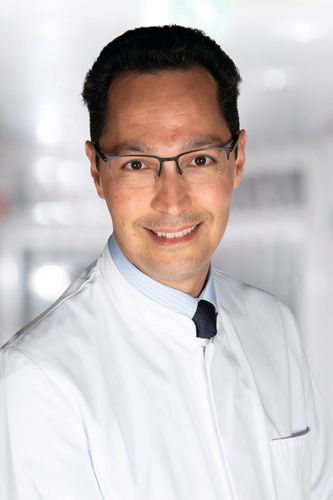
Prof. Dr. med., Dr. phil., Dipl.-Ing. (FH) Andrej M. Nowakowski, a highly respected expert in hip surgery and hip replacement, serves as Chief Physician and Director of the Department of Orthopedics and Traumatology of the Musculoskeletal System at the Baselland Cantonal Hospital. His outstanding expertise spans all areas of hip health, from joint-preserving surgeries to minimally invasive procedures involving artificial hip joints.
As a highly specialized physician, Prof. Dr. Dr. Nowakowski impresses not only with his broad expertise but also with his passion for orthopedics. He has specialized in particular in the hip and is internationally recognized as an expert in joint replacement. The Department of Orthopedics and Traumatology of the Musculoskeletal System at the Baselland Cantonal Hospital is known for its outstanding medical care and its status as one of the largest orthopedic centers in Switzerland.
Prof. Dr. Dr. Nowakowski brings a unique perspective to the field of orthopedics. His career began with a degree in mechanical engineering, followed by a career as an officer and a focus on medical technology. His passion led him to found an engineering firm, where he worked as a consultant while simultaneously filing several patents for the optimization of artificial joints. At the age of 28, he decided to study medicine in Hanover and also earned a PhD in biomedical engineering from the University of Basel. Prof. Dr. Dr. Nowakowski’s impressive career then took him from the University Hospital of Basel to Uster Hospital in the canton of Zurich, where he significantly expanded the orthopedics department and turned it into a successful unit. At the request of the Baselland Cantonal Hospital, he eventually returned to Basel.
As a hip specialist, Prof. Dr. Dr. Nowakowski is known for his expertise in injuries, fractures, infections, and tumors in the hip region. Together with Prof. Dr. med. Michael Hirschmann, he heads the “Musculoskeletal Center” at the Baselland Cantonal Hospital, which offers patients comprehensive care in orthopedics, traumatology, pain management, and rehabilitation. The editorial team at Leading Medicine Guide took the opportunity to speak with him to learn more about the latest developments in hip replacement surgery.

About 60 years ago, Sir John Charnley laid the foundations for hip replacement surgery as it is still practiced today. The use of stainless steel, bone cement made of polymethyl methacrylate (PMMA), and polyethylene (PE) for hip sockets forms the proven basis for successful artificial hip joint implantations. The last two decades have brought groundbreaking progress in the form of tribological improvements and novel materials. These innovations have led to longer-lasting prostheses and improved outcomes. In particular, the introduction of titanium in the 1980s helped increase the service life of uncemented stems. New highly cross-linked polyethylene variants are designed to reduce wear and prevent osteolysis.
Advances in tribological improvements and material innovations over the past two decades have had a significant impact on the long-term durability of hip prostheses.
The overall lifespan of hip prostheses has improved. In particular, the introduction of highly cross-linked polyethylene variants marks a significant step forward. Compared to traditional materials, they offer improved tribological properties, leading to reduced wear and a lower likelihood of osteolysis.
Tribology is the science and technology of moving surfaces, particularly with regard to friction, wear, and lubrication.
“In a joint—especially an artificial joint—we always have two so-called sliding partners, sometimes even more. And wherever something slides, friction always occurs. And where there is friction, there is wear. Only in an ideal scenario do wear-free joints exist. But wherever a force acts on two sliding surfaces, we are dealing with wear. Even the artificial joints we use today—whether for the shoulder, hip, knee, or ankle—all experience some form of wear. And that, in turn, depends heavily on the specific sliding surfaces involved. In hip joints, the classic configuration involves metal or ceramic sliding against polyethylene. Wear occurs here over a period of decades. For conventional prostheses, linear wear—measurable on an X-ray—is estimated at approximately 0.2 mm per year for polyethylene-metal bearing pairs and 0.1 mm per year for polyethylene-ceramic bearing pairs. “In particularly active and athletic individuals, or those who are severely overweight, have poor acetabular alignment, etc., wear can also occur much more rapidly,” explains Prof. Dr. Dr. Nowakowski at the beginning of our conversation, describing the considerations that were then made to minimize wear as much as possible:
“The metal-on-metal bearing pair was then considered, but in some cases this led to high concentrations of metal ions in the blood and other undesirable reactions. Another option is the ceramic-on-ceramic bearing pair, which has very low volumetric wear. However, this can lead to squeaking noises, for example, and if the range of motion becomes too great, it can also result in a hard stop (risk of implant loosening, dislocation, or ceramic fracture). Today, a steel or ceramic femoral head is frequently used, which contacts a polyethylene acetabular cup as its bearing surface; this polyethylene is now also available in a highly cross-linked form at the molecular level.”
Cross-linking aims to strengthen the material’s structural integrity and increase its wear resistance. The significance of these cross-linked polyethylene variants lies not only in their ability to reduce wear but also in the fact that they enable a longer service life for hip prostheses. Patients benefit from improved implant durability, which can lead to long-term joint stability and a lower risk of revision surgery.
“In principle, the body reacts to any form of wear and seeks to remove the resulting particles. It does this, for example, using cells that absorb such foreign bodies. However, this can also trigger processes that lead to bone resorption and, consequently, to prosthesis loosening. This, in turn, can necessitate a revision surgery or even cause the prosthesis to fracture. For this reason, efforts have been made to further improve the tribological properties of hip prostheses. Polyethylene consists of carbon chains, which have been ultra-highly cross-linked, and the surface has been partially treated with vitamin E to better neutralize free radicals. The goal here is to achieve further material-related improvements, combined with the expectation of a longer service life due to reduced wear. Young people in particular can benefit from this, as prostheses prepared in this way last longer—though, of course, we cannot yet prove this. We still need to wait for and analyze long-term results. “In any case, the goal is that replacement surgery due to wear and tear will simply no longer be necessary,” says Prof. Dr. Dr. Nowakowski, explaining the latest developments.
The introduction of titanium in the 1980s marked a significant step forward in hip arthroplasty, particularly in connection with cementless stems.
Efforts to increase the service life of cementless steel stems had a positive impact on the practice of hip replacement surgery. Titanium, due to its unique properties such as strength, corrosion resistance, and biocompatibility, ultimately enabled improvements in the long-term stability of cementless stems. This development led to a broader use of titanium in the manufacture of hip prostheses and helped extend the lifespan of the implants. Patients benefited from a reduced likelihood of loosening or other complications related to implant fixation.
“The advantage of cemented implants is that they can bear weight immediately and pose less risk of periprosthetic fractures, for example, in cases of osteoporotic bone quality. However, wear can occur at the cement-implant interface, among other factors, which can then lead to premature loosening. Overall poorer long-term results were observed, particularly in young male patients, prompting the development of cementless prostheses. Prosthesis surfaces were treated using various methods to allow for better bone integration. However, these prostheses were so rigid that they frequently caused thigh pain. With titanium, researchers then had a material that exhibits similar flexural stiffness to human bone and, in addition, has a hydroxylated surface that promotes bone growth. “Titanium has become the material of choice for hip stems, especially in cementless prostheses,” explains Prof. Dr. Dr. Nowakowski.
The hydroxylation of titanium surfaces leads to the formation of a thin layer of titanium oxide that is functionalized with hydroxyl groups (-OH). This hydroxylated layer promotes the formation of a strong bond between the implant and the surrounding bone tissue, a process known as osseointegration.
Advances in nanotechnology and biocompatible materials could lead to even more durable and long-lasting implants. Furthermore, novel material compositions could help further minimize wear and tear and increase the overall efficiency of hip replacement surgery. Ongoing research and innovation in materials science are crucial for further improving the quality and durability of hip prostheses and providing patients with optimal long-term solutions.
Prof. Dr. Dr. Nowakowski presented his concept of the “Bidirectional Total Hip Prosthesis” (Bi-HTP), which aims to minimize dislocations and impingement. By taking the physiological range of motion (RoM) into account, the goal is to achieve improved outcomes.
“Dislocation of an artificial hip joint is a complication that, while relatively rare, is nonetheless significant: If it occurs—for example, following a fall—it leads to severe pain and requires reduction, usually in a hospital setting. Although minimally invasive surgery has further reduced the risk of dislocation, dislocations still account for a significant proportion of the reasons for revision surgery. Here, two biomechanical factors must be considered. One aspect is the dislocation of the prosthesis due to joint instability, and the other is impact during joint movement. So, for example, if someone performs an extreme rotational movement—such as doing the splits—the sliding components of the artificial joint may collide with one another. Normally, rotationally symmetric hemispheres are used as hip sockets, but this is not entirely ideal. To address this dilemma, I have conducted my own research to design prostheses more intelligently using a special geometry. We are currently in the process of testing this geometry through simulations. “I definitely see potential for development in my field of research,” said Prof. Dr. Dr. Nowakowski.
The assessment of tribological issues in hip arthroplasty takes place at various levels.
Comprehensive tribological research is being conducted to strike a balance between the potential benefits of larger femoral head diameters and the associated potential drawbacks. These studies analyze the interactions between the materials and components of the hip prosthesis, particularly when comparing larger femoral head diameters to traditional sizes. Long-term studies are designed to monitor the performance of hip replacements with larger femoral head diameters over an extended period. The focus is on a comprehensive evaluation of long-term stability, wear resistance, and potential complications such as trunnionosis, a complication that can occur in patients with hip replacements. It refers to wear or corrosion at the junction between the stem (trunnion), the prosthesis, and the head, which is inserted into the hip socket.
Trunnionosis can be caused by various factors, including friction between the materials that occurs during movement of the artificial hip joint, as well as chemical reactions between the metals and the surrounding tissues. This can result in the release of metal particles that accumulate in the tissue surrounding the prosthesis and may cause inflammation, pain, and loosening of the implants. “The larger the femoral head, the greater the potential range of motion—but also the greater the wear. This means that such a femoral head is implanted at the expense of tribological performance. We are currently working to find new biomechanical solutions to define the ideal geometry,” comments Prof. Dr. Dr. Nowakowski.
Tribological improvements refer to advances in the field of tribology, the science of friction, wear, and lubrication of moving surfaces. With regard to hip replacement and medical implants in general, tribological improvements involve measures to optimize the interactions between the various materials used in the prostheses. The goal is to minimize friction, reduce wear, and improve the long-term stability of the implants.
“A phrase I heard time and again at the start of my medical career was: ‘What else do you want to improve about hip replacement surgery? We already have such good implants and techniques—there’s nothing more to be done’… Shortly thereafter, the entire surgical technique changed due to minimally invasive surgery, even for hip replacements, which means that during the procedure, we simply cause less damage to muscles and soft tissues when inserting the implant. In the past, the incisions were much larger, a lot of muscle had to be cut through, and the surgeries took longer. Today, minimally invasive surgery is the standard. The materials have also changed dramatically, and as a result, the shapes of the prostheses have evolved to some extent—they’ve been adapted to minimally invasive techniques to allow for easier insertion, depending on the approach. What has remained the same, however, are the acetabular cups. “Personally, I think it’s in the nature of things to always want to improve things, and I’m convinced that in a few years or decades we’ll see entirely different developments regarding the geometry of the acetabular cups,” Prof. Dr. Dr. Nowakowski explains.
The use of robotics in surgery has undergone remarkable development in recent years and is revolutionizing the way many surgical procedures are performed.
Robot-assisted surgery, also known as robot-guided surgery, combines the precision and control of robotic technology with the skills and expertise of an experienced surgeon. The introduction of robots into surgery has brought a variety of benefits, including improved accuracy during complex procedures, smaller incisions, faster recovery times for patients, and a lower likelihood of complications during and after surgery.
“Robotics in orthopedics is, for the most part, primarily about navigation. And navigation aids are there to ensure that, in the end, the implant is placed exactly where you want it to be. Knee arthroplasty—where the alignment of the individual components relative to one another can have a huge impact on ligament tension—is probably the better field for this. With the help of robotics, we certainly have the ability to be extremely precise. But in many areas, robotics is more of a gimmick and a marketing tool than something that actually benefits the patient. Personally, given today’s systems, I wouldn’t pay for it as a patient just to get a perceived improvement. It may well become standard practice in the future for certain procedures to be performed with robotic assistance, but the benefit in terms of state-of-the-art technology must first be demonstrated—and for most procedures, that hasn’t happened yet. Here at the Baselland Cantonal Hospital, we take X-rays during surgery to check the implant’s position and alignment. “As a trained mechanical engineer, I’m naturally a tech geek, but I see in some areas that the advantages of robotics are still far from being clearly demonstrated,” explains Professor Dr. Dr. Nowakowski regarding robotics, adding as an example: “We recently performed hip surgery for a femoral neck fracture and treated it with a hip prosthesis: The entire procedure, from the incision to the sutures, took just 17 minutes. I can’t achieve that with robotics, since the preparation time for the adjustments alone is very long. In the end, it’s the surgeon’s expertise and experience that count.”
“Perhaps someday we’ll have the option of injecting a healing fluid or something similar into the joint to avoid implants—who knows. But implants will be with us for a long time to come, and here it’s important to make the most of the best available options. In any case, there is great potential for improvement in optimizing the acetabular geometry,” says Prof. Dr. Dr. Nowakowski, looking to the future.
The Baselland Cantonal Hospital is exceptionally well-equipped.
“Even though we’re very well equipped here with all the latest technology, including robotics, it’s my belief that for a successful and long-lasting joint replacement—whether for the hip or knee— years of training are required—training that ultimately enables the surgery to be performed perfectly in the shortest possible time, combined with ensuring that the implants are securely and stably in place. As a musculoskeletal center, the Baselland Cantonal Hospital is highly specialized in revision surgeries, precisely because we have such extensive expertise here and have internalized the motto ‘We always find a solution!’ And the vast majority of our patients are extremely satisfied with the results. “Hip replacement is one of the most successful surgeries currently available, but it also requires a high degree of experience to maximize the potential and quality of the procedure,” explains Prof. Dr. Dr. Nowakowski, and with that, we conclude our conversation.
Thank you very much, Professor Dr. Nowakowski, for all the fascinating information about hip replacement surgery!
Share this article
About the medical author
Alexandra Pfitzmann
Editor
Alexandra Pfitzmann – medical author: expert knowledge, professional articles and medical insights in the Leading Medicine Guide.
More about the medical author →Expert Interviews
Read next
- Expert interview
Cardiogeriatrics: Significance and benefits in the context of hospital reform
Sep 21, 2026
Cardiogeriatrics: Significance and benefits in the context of hospital reform
Read more - Expert interview
Expert Interview with Professor Dr. Amadeus Hornemann, MPH
Sep 18, 2026
Prof. Amadeus Hornemann on Precision Medicine in Gynecology: Modern Surgery, New Techniques, Better Quality of Life
Read more - Expert interview
Expert Interview with Professor Dr. Konstantinos Anagnostakos
Sep 15, 2026
Prof. Anagnostakos on Painful Knee Replacements
Read more