Expert Interviews
Precise Spinal Surgery of the Future: Robot-Assisted Preservation of Natural Movement—An Expert Interview with Prof. El Hindy

Alexandra Pfitzmann ·
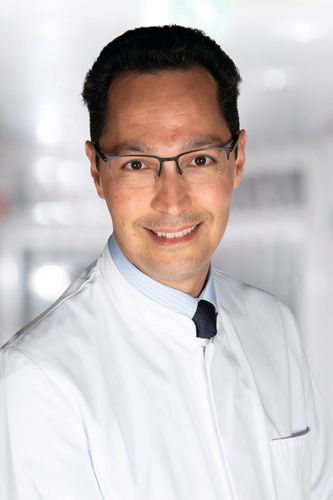
Professor Nicolai El Hindy, M.D., is an outstanding neurosurgeon whose expertise and visionary leadership have shaped the Spine Center at St. Christophorus Hospital in Werne, part of the Catholic St. Paulus Society. As a leading expert in spinal surgery, he has further developed robot-assisted spinal surgery into a groundbreaking treatment method. The Spine Center in Werne is certified by the German Spine Society (DWG) as a specialized center for degenerative diseases, inflammatory conditions, metabolic disorders, and deformities.
Prof. Dr. El Hindy has made significant advances in robot-assisted spinal surgery in collaboration with Globus Medical. Since the introduction of this method in 2021, over 650 successful procedures have been performed at the Spine Center in Werne. These surgeries range from routine to highly complex procedures. His innovative technique of placing spinal implants (cages) minimally invasively and laterally while the patient is in the prone position is a groundbreaking approach and is used in only a few centers worldwide. This pioneering work has made the Werne Spine Center an internationally leading center for spinal surgery. In addition to his outstanding surgical achievements, Prof. Dr. El Hindy is also a dedicated educator who trains medical professionals from around the world in the use of the surgical robot.
His presentations at international conferences have impressively demonstrated the wide range of applications for the “ExcelsiusGPS®” surgical robot. As a member of prestigious professional societies and holder of numerous additional qualifications, he has established himself as a leading expert in this field. The Werne Spine Center, led by Prof. Dr. El Hindy and Priv.-Doz. Dr. Pierscianek, is continuously working to develop innovative robot-assisted surgical procedures and improve existing surgical techniques. It is distinguished by its excellent medical care and successful treatment methods for degenerative spinal disorders, dynamic stabilization, and cervical spine disorders.
Prof. Dr. El Hindy is a renowned expert in the field of spinal surgery and is considered one of the most experienced and innovative specialists in Germany. The Spine Center in Werne offers not only outstanding medical care and state-of-the-art technologies, but also a highly specialized team that is constantly striving to find new, effective treatment methods. Since late 2023, Prof. Dr. El Hindy has served not only as a spine specialist at the Werne location—which has 50 beds and 2 operating rooms—but also as chief physician at the Lünen location, which has 20 beds and one operating room, where, in addition to spinal surgery, he serves as a neurosurgeon responsible for head surgery. The editorial team of the Leading Medicine Guide had the opportunity to speak with Prof. Dr. El Hindy about the highly interesting topic of robot-assisted spinal surgery and learn more.

The spine is a series of interconnected bones that serve to protect the spinal cord. The spinal cord is part of the central nervous system and runs through the spinal canal, which is formed by the vertebrae of the spine. The spinal cord is surrounded by the meninges, which provide protection. These meninges are the same layers that also surround and protect the brain. As a multifaceted and constantly evolving field of medicine, spinal surgery focuses on the diagnosis and treatment of diseases, injuries, and deformities of the spine. Through innovative technologies, robot-assisted procedures, and advanced implants, spinal surgery has established itself as a pioneering discipline aimed at improving patients’ quality of life and preserving spinal mobility.
Spinal surgery covers a broad spectrum of diseases and conditions affecting the spine.
“A very good classification of these conditions is the one used by our Spine Society: The primary conditions affecting the spine are, first and foremost, degenerative diseases—that is, conditions caused by wear and tear. These include herniated discs, in which the soft center of a disc protrudes through the outer layer and presses on nerve structures, which can cause pain and functional impairment. Another common condition is spondylolisthesis, in which a vertebra slips over the one below it, which can lead to pain and neurological problems. Spinal stenosis—that is, narrowing of the spinal canal—is also a common problem, often caused by degenerative changes associated with aging and capable of triggering back pain as well as pain in the legs or arms,” explains Prof. Dr. El Hindy at the beginning of our conversation, before moving on to the next category: traumatic injuries:
“These include injuries such as vertebral fractures resulting from accidents or falls. Tumors in the spine—whether primary tumors or metastases—often require surgery to remove the tumor mass and relieve pressure on surrounding nerve structures. Here, one must distinguish between primary and secondary tumors. Secondary tumors form in the spine, for example, due to existing prostate cancer or breast cancer. However, primary tumors can form within the meninges in the area of the spine. Certain spinal deformities, such as scoliosis (lateral curvature of the spine) or kyphosis (excessive forward curvature of the thoracic spine), may also require surgical correction to stabilize the spine and correct misalignments. We must not forget osteoporotic fractures, which mostly affect older patients, simply because the bone structure is no longer stable. Inflammation of the spine—spondylodiscitis—is also more common; this is an inflammatory condition affecting the vertebral bodies (spondylitis) and the adjacent intervertebral discs (discitis). It can be caused by a bacterial infection, a fungal infection, or, more rarely, by other pathogens; notably, it usually occurs in late fall and winter, as I have observed, though I don’t really know why.”
There are various measures and treatment options to avoid spinal surgery or at least delay it.
“Basically, you should definitely try everything possible to avoid spinal surgery. This is different from, say, brain tumors, which I also operate on. In those cases, immediate action is essential. With the spine, it’s very rare that we have to operate immediately. Here, the patient’s quality of life and the pros and cons must be discussed in a personal consultation. Any fears about surgery must also be discussed, as some patients believe they’ll be immobilized for weeks after spinal surgery. “In fact, the opposite is true—the patient should be able to get back on their feet on the very day of the surgery,” explains Prof. Dr. El Hindy.
Spinal implants are medical devices or instruments used in the treatment of spinal disorders or injuries.
They are surgically implanted into the spine to stabilize it, correct deformed areas, or replace damaged tissue. These implants can be made of various materials, such as metal, plastic, or ceramic, and come in different shapes and sizes, depending on the patient’s specific needs and the type of spinal condition. Common spinal implants include screws, rods, plates, cages, and artificial intervertebral discs. “When it comes to stabilizing procedures—that is, spinal fusion or correcting deformities—there are now expandable implants that can be inserted in a folded state, which is much less traumatic. This is because implants often have to pass near the spinal canal and the nerves. And the less invasive the procedure is in these sensitive areas, the better. Once they are properly positioned, they can be expanded to their full size. As for the surfaces, these new implants are titanium cages that are 3D-printed and integrate into the bone much more quickly. In addition, the preservation of motion is much better today. For example, when it comes to intervertebral disc implants inserted in the lumbar or cervical spine, the full range of motion is restored despite the implants. Sometimes, however, it’s necessary to fuse the spine, which means removing a segment from the string-of-pearls-like spine. As a result, the remaining segments bear more pressure and load. And, provided the wear and tear is not too advanced, this can be addressed by using intervertebral disc prostheses. This is ideal, especially for young and athletic people, because they can do everything again after the procedure,” says Prof. Dr. El Hindy regarding the preservation of mobility thanks to the use of implants.
A “cage” is a type of cage that is placed between the vertebrae to create a cavity that can be filled with bone material. This promotes bone growth and allows the vertebrae to fuse over a longer period of time. The titanium cage is a popular choice for this type of implant due to its strength, durability, and biocompatible properties.
Robot-assisted spinal surgery is revolutionizing the precision and accuracy of procedures by bringing state-of-the-art technology into the operating room.
Using preoperative imaging, the surgeon creates a customized surgical plan. The robot then assists during the procedure by providing the surgeon with precise guidance and real-time feedback on the position of the instruments. “The advantages lie in the improved precision and the customized planning. For example, with the help of the robot, we can plan the screw placement much more effectively. The robotic guidance enables more precise incisions, minimally invasive approaches, and the positioning of implants with millimeter-level accuracy. Thanks to the detailed planning, I have no choice during a procedure but to place the required screw exactly where it was planned. With the robot, we can place four screws in ten minutes—something that’s impossible using conventional methods. The conventional method also involves increased radiation exposure due to the necessary X-rays—not only for the patient but for the entire team involved. The robotic arm doesn’t get in my way; on the contrary, it’s my “smartest” assistant in the operating room, and thanks to the three-dimensional visualization, I can see exactly what I’m doing in depth. Many patients come to us because they’ve heard about the robot-assisted spinal surgery—which isn’t yet widely practiced—that we perform here. Other patients are sometimes skeptical and wonder whether the robot does everything on its own. We first have to explain to these patients that the surgeon remains in charge in the operating room,” explains Prof. Dr. El Hindy.
The “ExcelsiusGPS®” surgical robot is a state-of-the-art platform for robot-assisted spinal surgery that enables procedures to be performed with precision and safety.
“Many people are familiar with the Da Vinci robot when it comes to robot-assisted surgery. However, that robot is designed for soft-tissue surgery, whereas the Excelsius system we use was developed for bone surgery. These are two different systems. There are a total of 3–4 robotic systems available for the spine, and Excelsius comes from the U.S. One of the remarkable features of the ExcelsiusGPS® system is its ability to enable highly precise, minimally invasive approaches, which results in less tissue trauma and a faster healing process for patients. For example, in the cervical spine, millimeter-level precision is required, which Excelsius handles exceptionally well. “In addition, the robot provides real-time feedback during the procedure, which allows the surgeon to make precise adjustments to ensure optimal implant positioning while minimizing the risk of complications,” explains Prof. Dr. El Hindy enthusiastically.
Both the ExcelsiusGPS® and the da Vinci robot belong to the category of robot-assisted surgical systems, but their applications and modes of operation differ significantly from one another. The ExcelsiusGPS® specializes in robot-assisted spinal surgery and enables precise navigation and placement of implants in this area. In contrast, the da Vinci robot is used in a wide range of surgical specialties and is not limited to spinal surgery. It is used in fields such as urology, gynecology, cardiac surgery, and general surgery.
The integration of robots into spinal surgery has the potential to shorten recovery times and improve postoperative outcomes in terms of preserving natural movement.
“For the patient, the length of the hospital stay is dramatically reduced. The minimum length of stay is the shortest amount of time a patient must spend in the hospital to receive adequate medical care. The upper limit of stay is the maximum allowed time in the hospital before the patient should be discharged to optimize bed utilization. And with robot-assisted procedures, we’re operating within the lower limit of the length of stay. Incidentally, this was also the main argument presented to hospital administration when it came to purchasing the robot. It does cost a bit—but ultimately, because patients stay for a shorter time, we can treat more patients overall, since we have shorter bed occupancy times. So we can treat more patients with fewer beds. Of course, we have to make individual distinctions here as well. Patients who are severely overweight or have diabetes may, in some cases, stay on the ward longer, even with the robot. The “average” patient can usually leave the hospital after three nights. Furthermore, the robot offers another decisive advantage—to come back to the topic of precision. “There are different ways to insert screws. And there’s one method that can only be performed using navigation and robotics—it can’t be done by hand alone—and this spares a tremendous amount of muscle tissue, which ultimately leads to faster mobility,” explains Prof. Dr. El Hindy, who also provides insight into training with the robot:
“We’ve had the Excelsior here at the clinic since January 21, 2021. Due to the COVID-19 restrictions still in place at the time, training specialists came to us from the U.S. rather than us going to them, and we were able to perform and learn from the first trial surgeries on an artificial cadaver over the course of three days. During the first 20 surgeries, the so-called ‘field specialists’—trained technical staff from the company—are present to assist and explain specific techniques and procedures. I am now a reference surgeon for the company myself, and fellow doctors from many countries come to us to observe a surgery performed with the robot. That’s also fun, especially when you see how colleagues keep improving. “To become proficient and comfortable using the robot, you need to perform about 30–50 surgeries.”
Robotics is still in its infancy
“Work with robotic assistance will certainly continue to evolve. It’s still in its infancy. One challenge, for example, is the so-called dissection work, because the spine and the meninges are closely connected anatomically. It would therefore be desirable to have a kind of early-warning system—known in professional circles as a ‘no-fly zone’—during a surgical procedure that issues a warning if one gets too close to highly sensitive tissue. In any case, robotic technology as a whole will become safer, even faster, and even less invasive. There will certainly be innovations regarding implants as well. So far, there are implants that can expand upward and downward. These will surely soon be able to expand in all directions. Artificial intelligence will certainly be an additional aid, especially during planning, since AI can remember every small correction and alert the surgeon during the next procedure. “Ultimately, however, a human supervisor will always be necessary—someone who, even without all the technology, keeps the patient’s well-being in mind and can also treat them using conventional methods,” says Prof. Dr. El Hindy, assessing the future and thus concluding our conversation.
Dear Prof. Dr. El Hindy, thank you very much for this forward-looking and insightful conversation about robot-assisted spinal surgery!
Share this article
Expert Interviews
Read next
- Expert interview
Expert interview with Professor Dr Elmar Herbst, PhD
Oct 15, 2026
Patient-centred and personalised knee surgery
Read more - Expert interview
Cardiogeriatrics: Significance and benefits in the context of hospital reform
Sep 21, 2026
Cardiogeriatrics: Significance and benefits in the context of hospital reform
Read more - Expert interview
Expert Interview with Professor Dr. Amadeus Hornemann, MPH
Sep 18, 2026
Prof. Amadeus Hornemann on Precision Medicine in Gynecology: Modern Surgery, New Techniques, Better Quality of Life
Read more