Expert Interviews
New Advances in Hip and Knee Replacement Surgery Improve Quality of Life and Mobility: An Expert Interview with Prof. Drees

Alexandra Pfitzmann ·
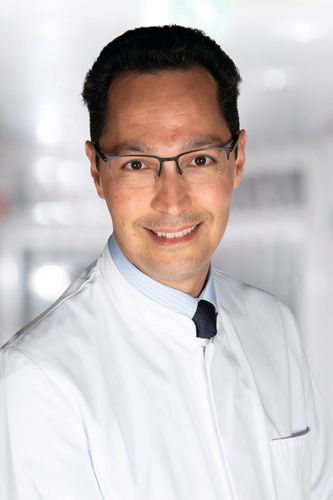
Professor Dr. med. Philipp Drees, a specialist in orthopedics and trauma surgery, orthopedic rheumatology, and specialized orthopedic surgery, has been Head of Orthopedics and Rheumatological Orthopedics since 2014 and, since April 2020, Director of the Center for Orthopedics and Trauma Surgery (ZOU) at the University Medical Center of Johannes Gutenberg University Mainz. The center covers the full spectrum of diagnosis, treatment, and follow-up care for diseases and injuries of the musculoskeletal system.
Of particular note is Prof. Dr. Drees’ commitment to optimizing the quality of care for hip and knee replacements. The PROMISE project (“Patient-Reported Outcome Measures in Surgery and Medicine”), which he initiated, aims to improve the entire care process, from the initial examination through discharge.
Through less invasive surgical procedures, innovative anesthesia techniques, and accelerated patient mobilization, faster rehabilitation can be achieved. Thanks to these measures, the Center for Orthopedics and Trauma Surgery at Mainz University Medical Center became the first German university hospital to be designated a “Rapid Recovery Hospital.” The University Medical Center of Johannes Gutenberg University Mainz is the only internationally recognized supramaximal care medical facility in Rhineland-Palatinate and, with over 60 clinics, institutes, and departments as well as more than 7,500 employees, is also one of the largest employers in the region.
The editorial team of the Leading Medicine Guide spoke with Prof. Dr. Drees to learn more about hip and knee replacement surgery.

Hip and knee joint replacement is a crucial area of orthopedic surgery that has evolved rapidly in recent years and has a transformative impact on the lives of many people. This specialized medical discipline focuses on restoring the function and mobility of the hip and knee—and thus the patient’s quality of life—through the use of artificial joints. Whether caused by degenerative diseases, advanced osteoarthritis, or severe injuries, hip and knee replacements can help alleviate pain, improve quality of life, and restore patients’ mobility.
Hip and knee surgeries are essential orthopedic procedures that may be necessary for various joint diseases and injuries.
“As a general rule, of course, the goal is always to avoid surgery. However, there are different stages of various joint diseases. Starting with hip osteoarthritis—a degenerative change in the hip joint—which, in later stages, leads to significant pain and limited mobility. In such cases, hip replacement is a commonly used solution,” Prof. Dr. Drees begins in our conversation and explains: “The diagnosis is based on the relevant imaging results, combined with the patient’s own description of their symptoms and the medical examination. Hip fractures, especially those caused by osteoporosis in older adults, are almost always indications for surgical intervention. In such cases, surgical reduction and fixation of the fracture—or, in the case of severe fractures, even the implantation of a hip prosthesis—may be necessary. There are numerous surgical treatment options, and not all are suitable for every case; some have even been withdrawn from the market. “Therefore, a decision must be made on a case-by-case basis as to whether, for example, a short-shaft or standard-shaft prosthesis is used, with or without cement, and this is usually done using a minimally invasive approach,” says Prof. Dr. Drees.
Degenerative changes in the knee joint lead to significant pain and limited mobility. Knee replacement surgery—whether total or partial—offers an effective treatment option in these cases. Alternatively, in less advanced cases, cartilage replacement procedures or arthroscopic surgery may also be considered. Knee injuries such as cruciate ligament or meniscus tears often require surgical procedures such as cruciate ligament reconstruction or meniscus repair. In some cases, a meniscus transplant may also be considered. Knee fractures caused by accidents or trauma require, depending on their severity, surgical reduction and fixation or, in extreme cases, the implantation of a knee prosthesis.
The decision between minimally invasive and conventional joint replacement surgery for hip and knee procedures is complex and influenced by various factors.
“Here at the University Medical Center Mainz, we perform primary hip surgeries exclusively using minimally invasive techniques—we no longer use any other method for implantation. The short-stem prosthesis, which is also suitable for older patients, has the advantage of allowing for bone-preserving implantation. It provides better anatomical reconstruction, and, depending on the approach, the short-shaft prosthesis simply allows for better maneuverability ‘around the corner,’ which further reduces trauma for the patient. “But it’s not the case that minimally invasive surgery isn’t possible with standard-stem prostheses,” explains Prof. Dr. Drees, who, when asked why prostheses are still being implanted using conventional arthroplasty techniques at all, replies: “There are different philosophies here. Ultimately, it’s about what works best, and we shouldn’t get hung up on the size of the incision for the procedure. And then there’s the fact that a company that offers, for example, cemented short-shaft prostheses isn’t necessarily part of every hospital’s portfolio. Nowadays, this decision is generally not made by the surgeons, but by the hospitals’ purchasing groups or hospital administration, which often decides to order everything from a single company because it’s more cost-effective that way. We’re fortunate here in Mainz because we can choose the products that we believe are best suited for each patient. And that’s why, for example, an 80-year-old patient for whom only a cemented short-shaft prosthesis really makes sense will receive one here. But that doesn’t mean patients are worse off elsewhere—they’re just treated differently. The surgeon’s experience always comes first.” The patient’s preferences and expectations also play an important role. The patient’s overall health and any comorbidities must also be taken into account to minimize the risk of complications.
Total knee replacement (TKR), a surgical procedure involving the implantation of a total knee prosthesis, is typically used successfully to treat advanced knee osteoarthritis.
“In Germany, we perform the most customized total knee replacements at a university hospital in Mainz, and we are the first university hospital to be certified as a ‘Rapid Recovery House.’ At the same time, through the PROMISE project of the GBA (Joint Federal Committee of the Federal Ministry of Health), we have developed the criteria for quality contracts and offer customized knee replacement as a complementary service,” emphasizes Prof. Dr. Drees, going on to elaborate further on the potential benefits of customized prostheses:
“We handle this just like in the clothing industry. There are sizes XS, S, M, L, XL, etc., and yet the same size doesn’t fit everyone—size M fits one person better than another. And it’s the same with the knee. Anatomy is so diverse that, even with the same size, the implant doesn’t always fit equally well. Every surgeon who performs these operations finds that they’re forced to make compromises. With a standard prosthesis, you have to do a bit more tinkering during surgery to adapt the bone to the implant (with a customized implant, the implant is adapted to the bone; with a standard prosthesis, the bone is adapted to the implant). Nevertheless, it’s fair to say that “off-the-shelf” prosthetics work well. However, in our studies, customized prostheses have shown even better results. This is because, for most patients, the so-called “forgotten knee score” yields very good results after about a year—meaning the patients forget they have a prosthesis. To make the study results even more meaningful, we are currently conducting a double-blind study in which the patient does not know what type of prosthesis they are receiving, so that their expressed satisfaction after the procedure is not biased and the difference can thus be measured even more accurately. The medical community is eagerly awaiting the results of this study, and we are seeking 100 patients for each group. This will allow us to determine whether the customized prosthesis is objectively superior or whether the perception is purely subjective. Here in Mainz, we implant the most individualized prostheses at a university hospital—about 100 per year. We’ve earned a reputation for this from Hamburg all the way to Oberammergau!”
The PROMISE project in hospitals stands for “Patient-Reported Outcome Measures in Surgery and Medicine.” It is an initiative aimed at improving the quality of healthcare by focusing on the patient’s perspective. Patients are asked to evaluate and report on their own health outcomes and experiences with medical treatment. This information can be used to monitor the quality of care, identify areas for improvement, and ultimately increase patient satisfaction.
A knee replacement revision becomes necessary when the existing prosthesis is no longer functioning effectively or is causing various problems such as loosening, wear and tear, infection, malalignment, or prosthesis fracture.
The particular challenge of a revision surgery lies in its complexity compared to the initial implantation. The surgeon faces the task of precisely removing the old prosthesis, which may require consideration of bone loss or complications. Protecting anatomical structures and accurately placing the new prosthesis are crucial. Restoring the soft tissues and ensuring stable anchoring of the new prosthesis require a meticulous approach. The precise alignment of the components is crucial for the prosthesis’s optimal function and longevity.
“Even though revision surgeries have decreased overall in terms of implant failure, they still occur. Due to the increasing number of implantations over the past two decades, the total number of revision surgeries is on the rise. The most common cause is aseptic loosening—that is, loosening not caused by bacteria. This means that either there is insufficient bonding between the bone and the cement, or loosening occurs due to the age of the prosthesis. The next most common cause is infection, whereby a distinction is made between an early infection (4–8 weeks after surgery) and a late infection (even 10 years after surgery, caused, for example, by bacteria in the bloodstream following major dental surgery). “Since we’re also a trauma surgery department, we can take appropriate action even in cases of traumatic loosening, such as after an accident or a fall,” says Prof. Dr. Drees regarding the reasons for a revision surgery, adding:
“What we do in cases of ‘failing’ hip prostheses with severe defects in the pelvis is perform a customized pelvic component replacement. The patient must be informed that this procedure is complex and that a somewhat difficult period lies ahead, as they will be without a hip joint for 6–8 weeks (we have to remove everything to repair the damage), but the final result is good and compensates for the entire defect. However, partial pelvic replacement is the last resort for joint preservation and is a highly complex surgical procedure. For less severe defects, implant manufacturers also offer less complicated solutions. In the case of the knee joint, we may also insert a spacer before we can implant a revision prosthesis. Thanks to the wide range of options available today, this is much more successful than it was 10 years ago,” Prof. Dr. Drees explains.
Of course, it is absolutely crucial that the surgeon has as much experience as possible to perform a revision surgery, as it is a much more complex procedure. “However, it doesn’t just depend on the surgeon, but also on the capabilities of the respective hospital. As a university hospital, we have everything we need—there’s nowhere else we’d have to refer a patient to. This means we can also perform a partial hip replacement, and to do that, you have to be at least a certified center—and not just perform 5 revision prostheses per year, but 30 or 50. Because that’s where experience and expertise are truly required. On top of that, such a revision procedure is expensive and time-consuming. A private practice physician simply cannot afford it, and the necessary anesthesiological resources are not even available. It is therefore always better to concentrate revision surgeries in specialized centers. “In Mainz, for example, as a center, we also have a large tumor surgery program and implant tumor prostheses,” Prof. Dr. Drees emphatically clarifies.
Modern materials play a crucial role in the longevity of prostheses, particularly in total knee replacements (TKR) and total hip replacements (THR).
Advances in materials science have helped improve the functionality, durability, and biocompatibility of prostheses. The most important materials used in modern prostheses are metals, plastics, and ceramics. Prof. Dr. Drees is positive about the overall development: “What has changed for the better, especially recently, is the change in the bearing pair. In the past, metal-on-metal was often used, meaning that both the head of the stem and the cup’s inlay were made of metal. This led to very high wear and an increased concentration of metal ions in the blood. Today, the head is made of ceramic, which is far superior. In addition, the inlay is now fortified with vitamin E to neutralize oxidants—something that wasn’t available before—and wear caused by polyethylene used to be a disaster. As a result, the inlay no longer becomes brittle, and we haven’t really seen any plastic wear for the past 10–15 years.”
Ceramic materials such as aluminum oxide and zirconia are used in some prosthetic components, particularly in total hip replacements (THR). Ceramics are characterized by high hardness, smoothness, and low wear. This helps minimize wear on the prosthesis and extend its service life. “There is also the ceramic-on-ceramic articulation, which has the least amount of wear. However, the prosthesis may then squeak, or a part could even break off. For this reason, in over 90% of hip cases, the combination of polyethylene and ceramic is chosen, and for the knee, a polyethylene liner and metal. Prosthetics typically contain nickel components. For people with allergies, there are therefore implants available in Germany with nickel-free coatings on their surfaces, even if the allergy is triggered only by skin contact (and not by contact with the bone). “But if the implant becomes loose in a person with an allergy for any reason, the burden of proof would fall on us to demonstrate that this definitely cannot be due to the nickel. That’s why we opt for the nickel-free surface, simply to be on the safe side,” explains Prof. Dr. Drees.
Rehabilitation measures following hip or knee surgery are crucial for a successful recovery.
“At our clinic, the patient is prepared for surgery. They come to us about two weeks before the procedure, ideally accompanied by a trainer (such as a partner, friend, or family member), and attend a three-hour seminar. During this session, a staff member from each of the following departments—surgery, nursing, physical therapy, anesthesia, and social services—explains what the patient can expect. This already alleviates many fears, and it is made clear to the patient that they will be back on their feet two hours after surgery,” explains Prof. Dr. Drees regarding patient preparation.
“At the end of the surgery, our patients receive a local anesthetic as well as an anticoagulant administered into the joint and muscles, and the physical therapist gives them a small scoop of ice cream two hours after the surgery and upon waking to provide a glucose boost. This provides a quick energy boost, and ultimately, we want to avoid any kind of catheter, because that would leave the patient ‘tethered,’ so to speak, and unable to move independently. There are also no longer any drains. The patient is then helped to their feet and asked to take a few steps. Often after just one night, many patients are already able to go home. For those who stay in the hospital a few days longer, we offer an outdoor group on the university campus where patients go for walks with the help of a physical therapist. “This program is extremely successful, as the exercise helps patients develop far fewer thromboses or embolisms,” says Prof. Dr. Drees, describing the course of events shortly before and shortly after surgery.
Modern advances in hip and knee replacement surgery have led to significant improvements in mobility and stability following surgery.
Robot-assisted surgery is revolutionizing the precision of incisions and the placement of knee prostheses, leading to improved alignment and, ultimately, stable prosthesis positioning. “We’re considering whether to acquire a robot ourselves, simply to expand our range of services. After all, the optimal solution is likely a customized prosthesis that is then implanted with the aid of a robot,” explains Prof. Dr. Drees.
Innovative developments are playing a key role in shortening rehabilitation time, improving patient mobility, and ultimately significantly enhancing quality of life following hip or knee replacement surgeries. “Next, we have now launched the world’s largest international multicenter study, which is funded by the German Research Foundation (DFG) with a total of over 2 million euros (the highest grant ever awarded). This study was developed by us and our partners at the University Medical Center Mainz and involves numerous partners. Nevertheless, we are seeking additional hospitals that would like to participate in this innovative study. The study aims to investigate the merits or lack thereof of administering heparin injections. Currently, the standard protocol requires patients to receive heparin injections for 30 days following hip surgery to prevent blood clots. However, we believe that patients are mobilized to such an extent that this may not be necessary in some cases. The study requires 2,000 patients, who will either receive oral antithrombotic medication for 30 days or for 5 days followed by a placebo. However, patients who wish to participate must be treated at a hospital that follows the “Enhanced Recovery Concept.” It is important to emphasize that the patient actively participates in their own recovery. “That’s also why we hold patient education sessions before surgery—so that patients don’t view us doctors as the authority figures in white coats, but rather take an active role in their own recovery process,” emphasizes Prof. Dr. Drees, referring to the patient’s own role.
“The ‘Enhanced Recovery Principle’ for early patient mobilization is an absolute game-changer for better patient care. Everyone should follow this principle—those who don’t should simply no longer be allowed to provide treatment. Personally, I’m a big advocate of centralizing services. And the fact is that a surgeon who performs surgeries frequently also performs them better. We must therefore move away from the option of being able to receive such treatment anywhere. Evidence-based standardization is therefore a very important issue. What I would also like to see is an even more critical review of indications to avoid unnecessary surgeries in cases of doubt. “Ultimately, the goal is to create evidence, not eminence,” Prof. Dr. Drees emphatically states, and with this wish, we conclude our conversation.
Thank you very much, Professor Dr. Drees, for the in-depth insight and the forward-looking developments in the field of hip and knee arthroplasty!
Share this article
Expert Interviews
Read next
- Expert interview
Expert interview with Professor Dr Elmar Herbst, PhD
Oct 15, 2026
Patient-centred and personalised knee surgery
Read more - Expert interview
Cardiogeriatrics: Significance and benefits in the context of hospital reform
Sep 21, 2026
Cardiogeriatrics: Significance and benefits in the context of hospital reform
Read more - Expert interview
Expert Interview with Professor Dr. Amadeus Hornemann, MPH
Sep 18, 2026
Prof. Amadeus Hornemann on Precision Medicine in Gynecology: Modern Surgery, New Techniques, Better Quality of Life
Read more