Expert Interviews
Hip and Knee Replacement Surgery

Alexandra Pfitzmann ·
There are currently more than 2 million people in Germany with a hip replacement and over 1.5 million with a knee replacement. Combined, that means there are about 3.5 to 4 million people who have an artificial hip or knee joint. Sometimes the prostheses need to be replaced. Each year, approximately 19,000 hip replacement surgeries and about 10,000–12,000 knee replacement surgeries are performed. The editorial team at Leading Medicine Guide spoke with Prof. Dr. Konstantinos Anagnostakos, a specialist in hip and knee arthroplasty, to learn about the specific challenges involved in revision surgeries and what patients need to be aware of.
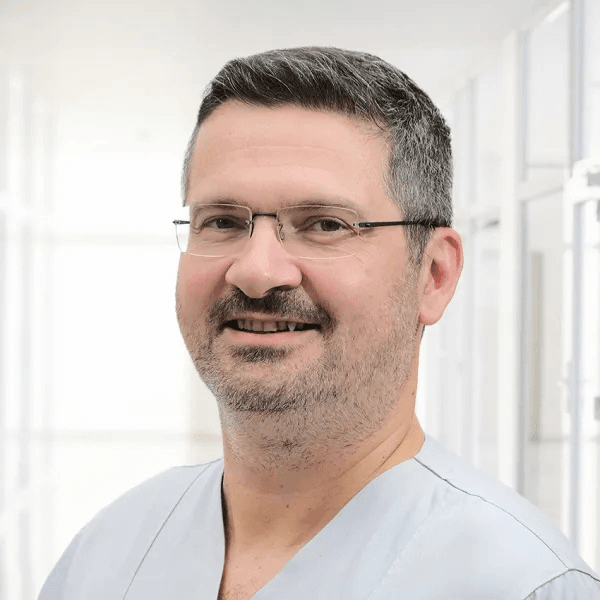
A hip or knee prosthesis definitely needs to be replaced if certain problems arise that significantly impair the joint’s function or comfort. The most common reason for replacement is loosening of the prosthesis, which can occur after several years due to wear and tear and stress on the joint.
“There are many reasons why a prosthesis—whether hip or knee—needs to be replaced. The most common reason is loosening of the prosthesis after a few years. This loosening is caused by wear and tear and constant stress. For the hip joint, additional causes include infections, dislocations, and periprosthetic fractures. It’s interesting to note that we don’t have more infections in Germany than we used to; rather, diagnostic capabilities have simply improved significantly in recent years. As a result, we can now determine that many cases where we previously didn’t know why the prosthesis was causing pain are often due to an infection. For the knee joint, stability plays an important role in addition to loosening. There are different types of knee prostheses, and some rely on the posterior cruciate ligament, while others also require the collateral ligaments to be stable. If one of these ligaments isn’t functioning properly, it leads to instability of the prosthesis and may necessitate a replacement. The urgency of the replacement depends on the cause. In the case of an acute infection or a fracture, the prosthesis must be replaced quickly. However, if it is simply classic loosening that has been observed over weeks or months, the orthopedic surgeon usually recommends elective replacement surgery. This is not, however, an emergency procedure that must be performed immediately. “It is important to distinguish between the various reasons and their urgency,” explains Prof. Dr. Anagnostakos at the outset.
Individual bone quality significantly influences primary stability, osseointegration, and thus the long-term risk of loosening in hip and knee prostheses. Low bone density, impaired microarchitecture, and reduced mineralization lead to increased micromovement at the implant-bone interface, promote fibrotic rather than bony healing, and increase the likelihood of aseptic loosening.
“There are various reasons why an infection can occur in a hip prosthesis that has been in the body for a long time. Generally, we distinguish between three types of infections: acute infections, so-called low-grade infections, and late-onset infections. An acute infection usually occurs within the first four to six weeks after surgery. During this period, the connection to the surgery is clear and easily recognizable. If a patient has recently undergone surgery and then, after a week, two weeks, or a month, shows symptoms such as redness, fever, or general signs of infection, we know that the infection is directly related to the surgical procedure. Late-onset infections, on the other hand, can occur years after surgery. In such cases, the causes are often hematogenous, meaning that the patient had an infection elsewhere in the body that spread via the bloodstream to the site of the prosthesis. In this scenario, a temporary immune deficiency in the patient can trigger the infection at the prosthesis site. Low-grade infections tend to be diffuse and may also be related to the original surgery. These infections may not immediately cause acute symptoms if the patient’s immune system is functioning well or if the bacterial load is low. Instead, they can cause minor, nonspecific symptoms over a longer period of time. These symptoms are often so mild that the patient does not immediately associate them with an infection; instead, they experience general, nonspecific problems such as mild pain, swelling, or redness. “In these cases, the typical signs of infection—such as fever, chills, or pus formation—are absent, so the infection is not immediately recognized,” explains Prof. Dr. Anagnostakos regarding the causes of infection.
Modern hip and knee prostheses are highly sophisticated medical devices designed for a long service life. Studies show that over 80% of knee prostheses and about 60% of hip prostheses are still functional after 25 years. Nevertheless, there are various factors that influence their durability.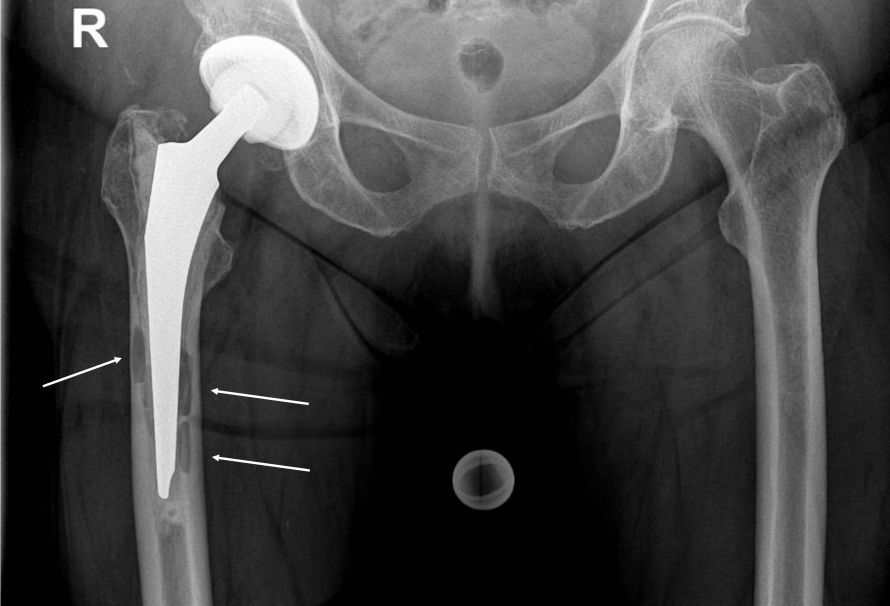
A partially cemented right hip prosthesis with multiple areas of osteolysis (“arrows”) in the stem region, indicating an existing infection.
Patient behavior after surgery is also crucial. Being overweight, for example, increases mechanical stress and accelerates wear, while maintaining a normal body weight reduces the load on the prosthesis. Regular, low-impact exercise such as swimming, cycling, or Nordic walking strengthens the muscles and stabilizes the joint without placing excessive strain on the prosthesis. In contrast, extreme sports involving impact, such as jogging or skiing, can shorten the prosthesis’s lifespan. Regular follow-up medical checkups are also important to detect loosening or misalignment early on.
“First and foremost, it is important that the patient, in a discussion with the surgeon prior to surgery, understands what goals they can and should aim to achieve with the procedure. In doing so, they should remain realistic and also take into account their biological age as well as any underlying medical conditions. It is crucial to identify shared goals, whether that be freedom from pain, restoration of joint function, or improved mobility. After surgery, these realistic goals should also be actively pursued. If a patient attempts to achieve unrealistic goals or places excessive strain on the joint too soon, this can overburden not only the affected joint but the entire lower extremity. Such overloading can significantly complicate and prolong the healing process. Furthermore, placing weight on the joint too early—especially depending on the type of prosthesis used, whether cemented or cementless—can also lead to loosening of the prosthesis,” Prof. Dr. Anagnostakos explains.
Bone quality plays a crucial role in the long-term stability of hip and knee prostheses. If bone density is reduced or the microstructure is damaged by osteoporosis, the risk increases that the prosthesis will not fuse securely and will become loose over time.
Good bone quality is particularly important for cementless implants, as they are anchored directly into the bone and their integration depends on the bone’s structure. If micro-movements occur between the bone and the implant, a soft, fibrous layer may form instead of a solid bony union, which reduces stability. Abrasion particles from the prosthetic materials can also trigger osteolysis through inflammatory processes and further weaken bone strength, which additionally increases the risk of loosening.
Prof. Dr. Anagnostakos comments on this: “Especially in cases of osteoporosis, a bone density measurement is advisable to better assess the stability of the prosthesis. Preoperative diagnosis is of the utmost importance, and the surgeon must rely on the information provided by the patient. If osteoporosis is known to be present, the patient should definitely disclose this so that the surgeon can select the appropriate prosthesis fixation method. In addition to the clinical history, imaging procedures such as X-rays are typically performed. If there is suspicion of inadequate bone quality, it is advisable to conduct a detailed osteoporosis evaluation, which includes laboratory tests and bone density measurements. If reduced bone quality is confirmed, the patient is likely a better candidate for a cemented implant, as this reduces the risk of complications. In general, it is extremely rare that a prosthesis cannot be implanted at all due to very poor bone density. Medicine and implant technology have advanced to the point where there are now models that can be cemented to the bone using longer shafts. This method minimizes the forces exerted and reduces the risk of bone fractures. It is crucial that the surgeon be able to determine when a cemented implant is appropriate and when a cementless implant is appropriate. This typically affects older patients, often aged 70 or older, who may already be suffering from osteoporosis without realizing it. In such cases, the diagnosis is often not made until during the treatment of injuries, such as a fall, or as part of a comprehensive medical examination.”
To identify these risks early on, careful preoperative diagnostics are necessary. As a standard procedure, bone density is measured using DXA (Dual-Energy X-ray Absorptiometry), a method for determining bone density and body composition. In addition, modern techniques such as quantitative CT or high-resolution peripheral CT can be used to more accurately assess regional bone structure and trabecular architecture. Laboratory tests, such as those for bone metabolism markers or vitamin D status, help identify metabolic disorders or secondary causes of impaired bone quality. Based on these findings, a decision regarding cemented or cementless fixation can be made on an individual basis, and the choice of implant can be tailored to the specific bone quality. In practice, this means that patients with good bone quality can benefit from cementless systems, whereas in cases of limited stability, a cemented prosthesis is often the safer solution. A precise surgical technique, supported by navigation if necessary, further helps to optimally distribute the load and prevent loosening.
Fracture of the femur in the presence of a cementless dual-head prosthesis (“periprosthetic femoral fracture”).
Revision surgeries for hip and knee prostheses are among the most demanding procedures in endoprosthetics, as they present unique challenges. Unlike in primary implantation, the surgeon must contend with an already altered bone bed, scar tissue, and often significant defects. Certified endoprosthetics centers play a central role in minimizing risks.
“The challenges involved in a revision surgery are indeed quite varied and depend heavily on the specific reason for the surgery. In cases of prosthesis loosening, the challenges primarily focus on factors such as bone defects and their reconstruction, the stable anchoring of the new prosthesis, and the restoration of joint function and mobility. In contrast, in cases of infection, the primary focus is on successfully eradicating the infection. In the case of hip dislocation, the priority is restoring joint stability, whereas in the case of a fracture, both pre- and post-operative care involve managing the fracture as well as ensuring the stable fixation of the newly implanted prosthetic components. A careful preoperative analysis of the case and preparation for surgery are crucial for identifying and addressing potential difficulties. “If the surgeon is well-prepared and properly interprets the imaging findings, they can usually assess the challenges of the revision surgery well,” explains Prof. Dr. Anagnostakos, adding:
“One of the greatest risks lies in underestimating the scope of the revision surgery, whether due to a lack of knowledge or experience. This can lead to serious challenges during the procedure. Therefore, it makes sense to have revision surgeries performed at specialized centers. These centers handle a higher volume of cases and thus have more experience, which is crucial for better identifying and overcoming typical difficulties. In Germany, there are certified endoprosthetics centers, such as the Nardini Clinic, which are distinguished by their high volume of surgeries and the associated expertise. Studies show that clinics with a higher number of procedures generally have lower complication rates, whether in terms of intraoperative fractures, dislocations, or infections. This means that it is worthwhile for every patient to go to a specialized facility for planned surgeries, even if this involves traveling a longer distance. However, when the situation is acute, there is of course no time for long trips, and swift action is often required. In such emergencies, it is crucial that medical care be available quickly.”
At the Nardini Clinic in Rhineland-Palatinate, which has two locations (Zweibrücken and Landstuhl), more than 1,200 prosthetic surgeries are performed annually. This is a remarkable figure and speaks to the clinic’s extensive experience and expertise.
To better illustrate the patient’s situation, Prof. Dr. Anagnostakos explains: “For patients seeking treatment at a clinic, it is not uncommon to initially choose the nearest facility, possibly without sufficiently informing themselves about the quality of the treatment offered there. Nowadays, however, thanks to the internet and social media, patients have better access to information about treatment options and the quality standards of various clinics. Thirty or forty years ago, such information was very limited, and patients were often forced to base their decision on the clinic’s proximity. Despite the availability of information, medical laypeople should exercise caution, as not everything found online is reliable. It is advisable to keep two things in mind: First, many health insurance providers recommend not relying on just one opinion but also seeking a second opinion, which is a valuable way to make informed decisions. Second, it is important to feel that you are in good hands when you first make contact with the doctor or surgeon. Patients should feel that a human connection and trust can be established. There should be no impression that the doctor is trying to sell something; rather, the focus should be on improving the patient’s quality of life. A good doctor-patient relationship is crucial for the success of the treatment and the patient’s well-being.”
Every patient’s anatomy is unique, and it’s important to remember that in revision surgery, it is difficult to predict exactly in advance what bone loss will occur, for example, during the removal of a prosthesis.
Prof. Anagnostakos explains: “That’s why I can’t commit one hundred percent—not even based on preoperative planning—to whether I’ll ultimately choose prosthesis A, B, or C. You always need a certain amount of leeway to be able to react flexibly during surgery. Depending on what unforeseen circumstances arise, you must have the option to say: ‘I can now properly treat this with Option A, Option B, or Option C.’ That is precisely why it is so important in a revision surgery that all implants and instruments that might be needed are actually on hand. You must never commit exclusively to Plan A. If something unexpected happens during the surgery but you don’t have Option B on hand, you must not be forced to abort the procedure. That would simply be the result of a lack of experience, ignorance, or poor organization—regardless of the reason.”
In recent years, the number of revision surgeries has not decreased overall, but the underlying causes have shifted. Traditional loosening surgeries are becoming less common, while improved diagnostics now allow for the detection of more infections, which increases the number of septic revision surgeries. At the same time, an aging population is leading to more fractures. Hospitals must therefore be particularly well-prepared and keep sufficient implants and instruments on hand to be able to treat even unexpected emergencies immediately, because every delay costs valuable time and directly affects patient care.
Modern techniques such as navigation-guided implantation and robotic assistance systems have significantly advanced joint replacement surgery in recent years.
In navigation-guided implantation, the surgeon is assisted by computer-aided systems that use imaging or intraoperative sensors to display the exact position of the prosthetic components. This helps prevent axial deviations and allows the implants to be placed with millimeter precision.
“Navigation-assisted surgery and robotics are playing an increasingly important role in medical progress, particularly in joint replacement surgery. In recent years, robotic systems have gained popularity, both in Germany and worldwide. Results to date from various joint replacement studies show that surgeries using robotic technology have a good longevity and a low revision rate. However, it is important to note that these are, for now, mid-term results. Long-term data, available 20 or 30 years after robotic application, is still pending. It remains to be seen what the long-term results will look like, including comparisons between different robotic systems and their applications. Currently, the positive results we are seeing from robotic applications pertain to primary replacements and not to more complex revision surgeries, for which such systems are not yet approved. Nevertheless, I am optimistic that, with increasing experience and the analysis of collected data, the field of revision arthroplasty will also benefit from these technologies. Exactly when this will happen—and whether it will initially involve the hip or the knee—cannot yet be predicted with certainty. It is also important to consider our dependence on the industry, as these developments are influenced by its progress. “The use of navigation and robotic technology is already a plus for primary joint replacement, and in the future we can also expect innovations in revision joint replacement—though exactly when remains to be seen,” said Prof. Dr. Anagnostakos.
However, robotic procedures are associated with higher costs and a significant training burden. Not every hospital has the necessary equipment, and the benefits must always be weighed against the economic conditions. Nevertheless, the combination of navigation and robotics is now considered a major advance that makes joint replacement safer and more successful.
Materials research in joint replacement has made enormous strides in recent years and aims to further extend the lifespan of hip and knee prostheses and significantly reduce the number of necessary revision surgeries.
“In recent years alone, there have been major advances affecting many individual components. One example is polyethylene—the plastic used for the inner lining of artificial hip sockets or for certain prosthetic components. This material is now offered by all manufacturers in a highly cross-linked form. This has significantly improved wear resistance and thus also ensures a longer service life for the implants. The situation is similar with ceramic implants. Here, too, the industry has made great strides—both with hip sockets and, increasingly, with other implants. The surface coating has been optimized so that, thanks to its macroporosity and improved microstructure, not only is excellent primary stability achieved, but long-term bone integration is also significantly enhanced. This, in turn, leads to very long service lives. And I think this development is far from over. The industry will continue to conduct research into new materials—and that is also necessary. Experience shows that, for various reasons, some prostheses have become loose or failed over time. That’s why we must remain dynamic. “Anyone who rests on their laurels ultimately risks compromising the quality of their work—and in the end, that always comes at the expense of the patients,” emphasizes Prof. Dr. Anagnostakos, and with that, we conclude our conversation.
Thank you very much, Professor Dr. Anagnostakos, for this important information on revision surgeries!
- Specialist in Orthopedics and Trauma Surgery
- Specialization: Endoprosthetics (hip, knee), revision surgery, revision procedures, minimally invasive procedures
- Since September 15, 2025, Chief of the Department of Joint Surgery and Sports Traumatology at Nardini Klinikum Zweibrücken (jointly with Dr. Burkhardt Muschalik)
- Areas of Focus: Implantation and revision of hip and knee prostheses, treatment of complex revision cases (loose, infected, or defective prostheses), arthroscopic procedures on the knee, shoulder, and ankle; management of acute and chronic sports injuries; minimally invasive techniques to preserve tissue and facilitate faster rehabilitation; navigation-assisted implantation for precise prosthesis placement
- Director of a certified Endoprosthetics Center (EndoCert® since 2014) with the highest quality standards
- Internationally recognized for expertise in endoprosthetics and revision surgery
Share this article
Expert Interviews
Read next
- Expert interview
Expert interview with Professor Dr Elmar Herbst, PhD
Oct 15, 2026
Patient-centred and personalised knee surgery
Read more - Expert interview
Cardiogeriatrics: Significance and benefits in the context of hospital reform
Sep 21, 2026
Cardiogeriatrics: Significance and benefits in the context of hospital reform
Read more - Expert interview
Expert Interview with Professor Dr. Amadeus Hornemann, MPH
Sep 18, 2026
Prof. Amadeus Hornemann on Precision Medicine in Gynecology: Modern Surgery, New Techniques, Better Quality of Life
Read more