Expert Interviews
Prof. Christoph Erggelet: The Meniscus—The Knee’s Shock Absorber

Alexandra Pfitzmann ·
We need our knees for almost every movement we make. Whether we’re walking, running, or stretching—even when sitting—the knee joint, which is, by the way, the largest joint in our body, plays a central role. If there’s a problem with the knee, it has an immediate impact on our musculoskeletal system. This is especially true, of course, when the meniscus tears or wears down. To shed more light on the specifics of the meniscus—which consists of two crescent-shaped cartilage discs—Leading Medicine spoke with Professor Dr. med. Christoph Erggelet. The internationally renowned specialist in orthopedic surgery and traumatology (FMH) is the Medical Director of the ADUS Specialized Orthopedic Surgery Clinic in Dielsdorf near Zurich.
They are located between the tibia and the femur: our menisci, which stabilize the movements of the knee joint and act as a buffer to absorb all pressure and potential sudden impacts in the knee. This cartilaginous connective tissue, which lies within the knee joint in a triangular shape, extends to the inner and outer sides of the knee joint and evenly distributes force from the thigh to the lower leg, allowing both legs to work together effectively. This enables rotational movements, extension, and flexion. The medial meniscus is particularly stressed when the knee rotates outward, while the lateral meniscus is stressed during inward rotation. The menisci also reduce the weight exerted on the knee joint and supply the joint with synovial fluid.
“If the meniscus is damaged, there are two aspects to consider. First, the meniscus can be damaged as a result of an accident—for example, if you fall, stand up incorrectly from a chair, or make a wrong movement while playing sports. In such cases, a sudden and usually sharp pain sets in immediately, and the knee often swells spontaneously. On the other hand, there is also degenerative meniscus damage, which is age-related wear and tear. In this case, the pain develops gradually. “People who used to enjoy three- to four-hour hikes when they were younger will find, once their meniscus has worn down, that only a shorter, half-hour walk is possible without pain,” says Professor Dr. Erggelet, describing the initial symptoms.
Patients also speak of a “knee lock” when meniscus damage is present. This is because if the meniscus is pinched, the knee joint can no longer be fully extended. It’s also important to know that the meniscus itself does not cause pain, since, like cartilage, it has no nerves. However, if the knee is twisted or bent incorrectly, the meniscus can irritate the knee’s joint capsule and thus trigger pain.
A thorough discussion with the patient plays a major role in the diagnostic process
“As part of the diagnostic process, it is very important to have the patient describe exactly what happened. Did they slip? Did they make an awkward twisting motion, or were they exercising too intensely and lost their balance?” emphasizes Professor Dr. Erggelet. Only in this way can the doctor narrow down in advance the nature of the injury. This is naturally followed by a clinical examination, which always includes an MRI—an imaging technique that uses a strong magnetic field and radio waves to produce cross-sectional images of the body and provide further information about the size, type, and location of the meniscus tear, as well as any additional damage—such as cartilage damage—in the knee joint. Once the meniscus injury is identified and classified—for example, whether it is torn, partially torn, or worn—the appropriate treatment can be discussed.
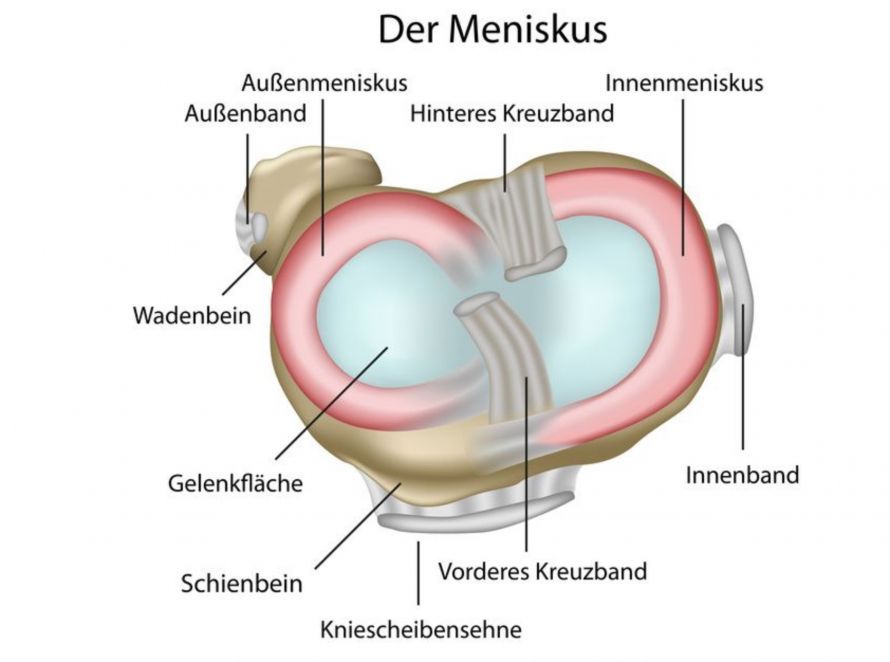
Cross-section of the knee joint—menisci viewed from above (Photo: bilderzwerg/fotolia)
“Personally, I think it’s very important at this point to also clarify what kind of person I’m dealing with. Is this a young, active person who participates in a lot of sports and would like to continue doing so in the future? Is it someone who tends to have a sedentary lifestyle? Because only through this individualized assessment can I tailor a meaningful treatment plan,” explains Professor Dr. Erggelet, who always takes plenty of time for this.
Just a few years ago, surgery was performed much more frequently and more quickly when it came to meniscus injuries—today, many cases can be treated conservatively
For example, if the meniscus tear is stable and causes hardly any symptoms, a combination of medication and physical therapy may be sufficient. “After all, a meniscus injury isn’t life-threatening,” says Prof. Dr. Erggelet, adding: “As long as quality of life isn’t dramatically impaired and you can walk without pain, you can live without an intact meniscus. However, it’s important to keep in mind that a torn meniscus damages the cartilage over time, which can lead to osteoarthritis in the long run. To illustrate this, imagine driving on a smooth paved road versus a gravel road. In this case, the torn meniscus would be the gravel road, so the cartilage gliding over it naturally wears down faster,” explains Prof. Dr. Erggelet.
In younger people, damaged sections of the meniscus are typically removed, and the meniscus is sutured. Here, the surgeon faces the particular challenge of determining which approach is best, taking into account the specific characteristics of the patient. Is the meniscus repairable? Is blood flow still adequate? “The question of blood supply is a crucial one. The outer surfaces of the meniscus are supplied with blood, but the inner surfaces are not. However, if areas on the inner surface are damaged, it makes no sense to try to suture them, since blood supply is essential for healing. The likelihood that a suture will tear again is extremely high. In such cases, I have to thoroughly explain the situation to the patient and make it clear that, if there’s any doubt, we’ll meet again in six months,” says Professor Dr. Erggelet, describing the considerations that take place before surgery.
Soccer players subject their knees to extremely high levels of stress. How often do we see nasty collisions and accidents during a soccer game? Here, too, we must weigh what makes the most sense. For example, a 17-year-old soccer player can certainly afford to sit out for a year to recover if a meniscus is sutured back in place and requires that amount of time to heal. A 31-year-old soccer player, on the other hand, is already considered “past his prime” and would likely be facing the end of his career with such a long recovery period; for this reason, the decision in this case would likely be to remove the meniscus and replace it rather than suture it back in place.
When the Meniscus Needs to Be Removed
As long as only small parts of the meniscus are damaged, these can be removed, and you can live just fine with what remains. However, if the entire meniscus is damaged, it should be completely removed and replaced. “Here we rely on donations from people who have an organ donor card. The donated meniscus is customized, inserted in the operating room using special instruments, and must heal in place. The surgery takes about an hour. I’ve been performing meniscus transplants for a good fifteen years now, and I can say that the chances of a successful recovery are excellent. The patient can usually walk again after two to three days. It can take up to half a year before they can squat deeply. “Unfortunately, the costs for this are not covered in Switzerland, and the willingness to donate organs is also rather problematic here, so we very often have to resort to prostheses. And artificial implants are, after all, only an imitation of nature and, of course, cannot compare in terms of quality,” laments Professor Dr. Erggelet.
Of every hundred patients affected, about seventy have damage to the medial meniscus and thirty have damage to the lateral meniscus. Of those thirty, four or five would require a transplant.
Distinctive Features of the ADUS Clinic – Motto: “Simple. Good. Well-Cared-For”
What sets the ADUS Clinic apart is its broad range of orthopedic services. “There’s no chief physician here who has to be able to do everything, nor a group of resident physicians who aren’t as experienced. We have experienced physicians for every specialty. We wouldn’t offer certain therapies or procedures if we weren’t capable of performing them. It’s also the case that surgeries always follow the same protocol. That means it’s always the same doctor who performs shoulder surgeries and always the same one who performs knee surgeries, using the same technique and following the same procedure every time. As a result, there are far fewer complications and patients recover more successfully, since the procedures are consistent in terms of timing and are performed with sound routine,” explains Professor Dr. Erggelet regarding the hospital’s working methods.
“For the future, I hope to see less austerity in Switzerland. Often, we are unable to offer patients what they are entitled to. I’d like to cite the case-based flat rates as an example here. The flat rate itself remains the same, but the associated costs keep rising, so the value of the flat rate inevitably decreases—and hospitals have to make up for this by cutting back on staff, instruments, implants, and services… Of course, this is in line with political objectives, but it’s the insured who suffer as a result of these decisions. Fewer staff members, for example, means longer wait times to see a nurse when you’re in pain in the hospital or need to use the restroom. Fewer staff members mean longer wait times for diagnoses and treatments. “The situation in England and Canada clearly shows where this is leading,” Professor Dr. Erggelet laments, concluding our conversation with the statement: “It’s better to stay healthy!”
Thank you very much, Professor Dr. Erggelet, for this interesting and candid conversation!
You can contact our specialist directly via his profile page in the Leading Medicine Guide.
Share this article
About the medical author
Alexandra Pfitzmann
Editor
Alexandra Pfitzmann – medical author: expert knowledge, professional articles and medical insights in the Leading Medicine Guide.
More about the medical author →ADUS Clinic
ProfileExpert Interviews
Read next
- Expert interview
Cardiogeriatrics: Significance and benefits in the context of hospital reform
Sep 21, 2026
Cardiogeriatrics: Significance and benefits in the context of hospital reform
Read more - Expert interview
Expert Interview with Professor Dr. Amadeus Hornemann, MPH
Sep 18, 2026
Prof. Amadeus Hornemann on Precision Medicine in Gynecology: Modern Surgery, New Techniques, Better Quality of Life
Read more - Expert interview
Expert Interview with Professor Dr. Konstantinos Anagnostakos
Sep 15, 2026
Prof. Anagnostakos on Painful Knee Replacements
Read more