Expert Interviews
Prof. Düx on MRgFUS: A Minimally Invasive Procedure for Non-Surgical Treatments

Sabine Schneider ·
When we introduced the renowned radiologist Prof. Dr. med. Markus Düx and his innovative ultrasound method called MRgFUS a while back, many people were surprised. That’s because this extremely gentle procedure makes it possible to successfully treat conditions and symptoms—some of which are very painful—without any invasive surgery at all. As a result, many people became aware of the MRgFUS Center at Prof. Dr. Markus Düx’s Radiology Practice, which, with locations in Frankfurt and Königstein im Taunus, plays a pioneering role in this still-novel method.

The first part of the discussion focused on applications and treatment options using MRgFUS, such as for uterine fibroids, painful facet joint osteoarthritis, or bone tumors. We learned that, from a technical standpoint, highly focused ultrasound can generate heat of up to 100 degrees Celsius, which is then directed at the target structure. With the help of MRI, temperature changes can be measured, and it is also possible to see exactly how much energy is generated in the tissue. This allows tumors to be destroyed—and can trigger regenerative processes in cells, which can be very helpful in cancer treatments. Prof. Düx and his team in Frankfurt and Königstein exclusively use MRgFUS therapies that are approved for clinical use in treating diseases—such as osteoid osteomas: For these often tiny bone tumors, which mainly occur in children, the gentle ultrasound method is “the treatment of choice,” as Prof. Düx put it.
MRgFUS is now also being used successfully to treat prostate cancer—and it helps overcome the blood-brain barrier. This follow-up article explores what that entails and the future prospects for this innovation. Dr. Daniel Düx, who spent a year conducting research on the topic at Stanford University in California, also joined the video conference.
Leading Medicine Guide: Professor Düx, could you briefly outline once again what MRgFUS is actually about?
Prof. Dr. med. Markus Düx: Certainly, I’d be happy to. MRgFUS stands for magnetic resonance imaging-guided focused ultrasound therapy. This therapeutic method can replace surgical intervention for certain conditions. Highly focused ultrasound was already used clinically in the 1990s—for example, in urology—but purely from a physical standpoint and without MRI guidance. Magnetic resonance imaging allows us to measure temperatures. While this has been known for a long time, the combination of these two techniques—creating a distinct therapeutic unit from MRI and focused ultrasound—is relatively new. This allows us to heat and destroy damaged tissue with high-energy ultrasound instead of removing it invasively with a needle or scalpel.
Leading Medicine Guide: And can you also use this to treat prostate cancer?
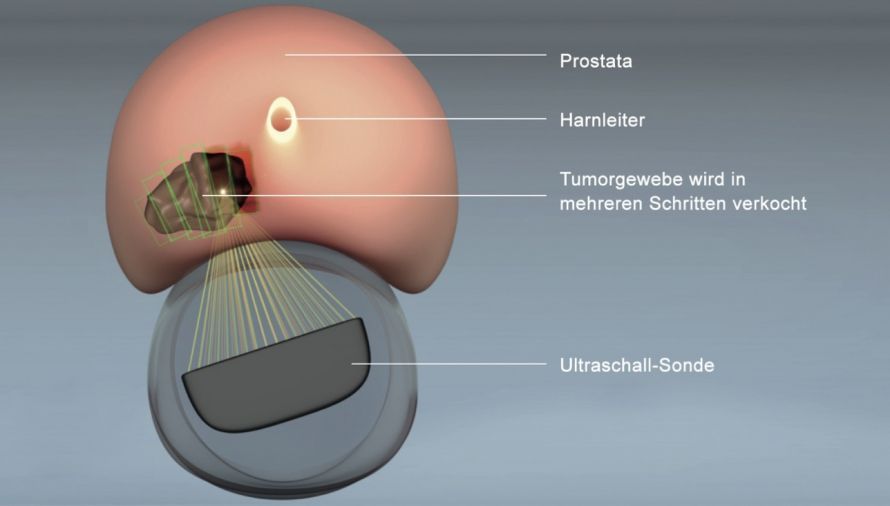
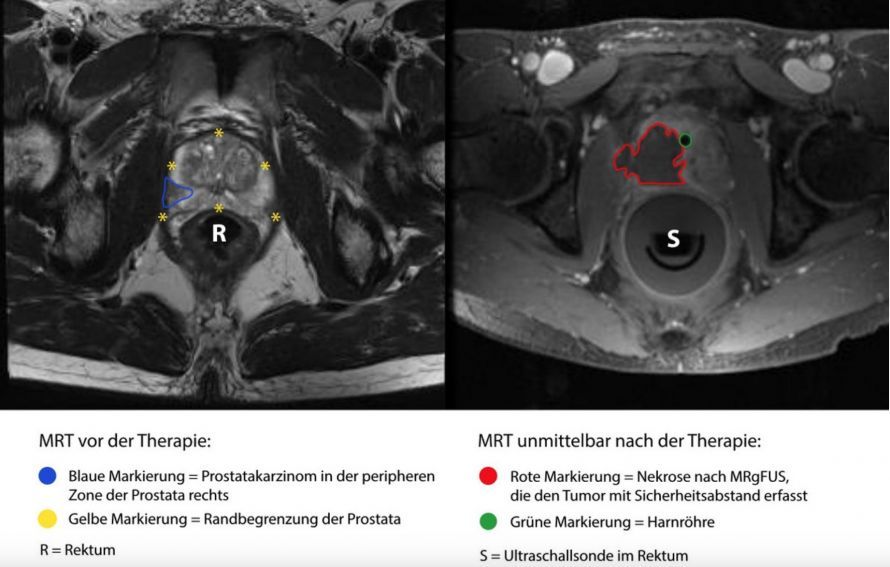
Prof. Dr. med. Markus Düx: Exactly. We destroy early-stage prostate cancers using heat and MRI guidance. The probes, which carry the elements that generate the highly focused ultrasound, are kept small enough to be inserted through the rectum. Our system is currently the only one in Europe that inserts the ultrasound source through the rectum and, even while the prostate is being treated with heat, displays the results—specifically, the temperature distribution within the tumor and surrounding tissue—using MRI. In this way, ultrasound waves are directed into the prostate, where they destroy the tumor.
Leading Medicine Guide: ... quite simply through heat.
Prof. Dr. med. Markus Düx: Through heat. These tumors can be diagnosed very effectively with MRI today; prostate cancer can be identified precisely, and with MRI-guided treatment, it’s usually possible to maintain a safe distance from healthy tissue without any problems. On the other hand, when a prostate cancer patient has to undergo surgery, they often face side effects such as incontinence and erectile dysfunction—there’s a high risk of side effects that all of us men fear. Even though surgical techniques are constantly improving, the risk is always present. If the neurovascular bundle in the prostate is damaged during surgery, patients often experience unwanted side effects and complications after the procedure. With MRI, we can see the neurovascular bundle in detail, so we can guide the MRgFUS therapy to avoid the critical structures and effectively shield them from the heat. So we treat only the tumor from a safe distance and destroy it. At the moment, we’re performing this treatment only for early-stage prostate cancer.
Leading Medicine Guide: Why is that?
Prof. Dr. med. Markus Düx: First of all, this type of cancer is very common. Nearly one in two men develops prostate cancer. There are three of us sitting here now, and it’s highly likely that one of us will develop prostate cancer at some point in our lives. Prostate cancers are common tumors that usually do not prove fatal. Men diagnosed with prostate cancer can certainly live to a ripe old age, but the key is to diagnose and remove it early. With the help of MRI, prostate cancer is often detected early. Then it can be treated locally at an early stage, in keeping with the motto “nip it in the bud.” Early-stage prostate cancer is almost always confined to the prostate, which justifies local therapy using heat. In cases of advanced cancer, lymph node or distant metastases are often already present, at which point local therapy is no longer effective. An elevated PSA level is an indicator of prostate cancer.
Leading Medicine Guide: PSA level?
Prof. Dr. med. Markus Düx: PSA stands for prostate-specific antigen, a protein produced exclusively by prostate cells. It is an important component of prostatic fluid, and small amounts of PSA can also be detected in the blood. If this level is elevated, we look for cancer—and often find one using magnetic resonance imaging (MRI). When we then biopsy the tumor under MRI guidance, we can determine what stage it is in. Through early diagnosis, we can achieve successful treatment outcomes, ensuring that prostate cancer causes as few men as possible to die from the disease. And, of course, it’s wonderful that patients can have such a tumor removed without surgery—and thus without side effects or scars.

PSA Level Measurement © jarun011 / AdobeStock
Leading Medicine Guide: But isn’t radiation therapy also an option?
Prof. Dr. med. Markus Düx: Radiation therapy for prostate cancer in the early stages is usually like using a cannon to shoot sparrows. Radiation therapy causes side effects; for example, bowel problems can arise years later—or lifelong bladder infections that flare up repeatedly. MRgFUS is a very good alternative because it destroys the tumor with heat in a single treatment. The tumor is no longer present, side effects are rare, and if the cancer were to reappear, it can of course be treated again with heat. This closes the loop, since we can also use MRI to very effectively monitor the scar tissue in the prostate that forms after the heat treatment. The absence of tumor activity on MRI, combined with a drop in the PSA level, allows us to differentiate between a recurrence and scar tissue. This enables us to monitor the course of the disease and the effectiveness of the treatment.
Leading Medicine Guide: And how long does this MRgFUS treatment take?
Prof. Dr. med. Markus Düx: The treatment of prostate cancer takes three to four hours. It is a complex process, and the patient is under general anesthesia during the procedure. Patients have a urinary catheter in place for two days afterward—the treatment is performed on an outpatient basis, and patients go home with the catheter, usually without any side effects. The catheter is left in place solely to prevent urinary retention. The ablation of the tumor causes the prostate to swell for a short time, which can compress the urethra and lead to urinary retention. The swelling usually subsides within two days, at which point the catheter is removed. The placement of the urinary catheter is therefore purely prophylactic. After treatment, the PSA level usually rises significantly, a sign that the tumor has been destroyed. Over the course of the next few weeks, the PSA level returns to normal. The trend in the PSA level is an important marker that allows us to determine whether the tumor has been completely destroyed or whether a new tumor has developed. Of course, we also perform follow-up MRI scans to provide patients with the necessary reassurance.
Leading Medicine Guide: How likely is it that you will actually detect such a carcinoma?
Prof. Dr. med. Markus Düx: Very high! We have now reached a point where the diagnosis of prostate cancer via MRI is so reliable that we detect many cancers at an early stage. Just a few years ago, these would not have been detectable. This means that today we detect small carcinomas in the prostate that urologists cannot find at all using ultrasound. We have learned a great deal in recent years and perfected MRI diagnostics of the prostate. This is certainly true for the centers and radiology departments that perform prostate MRI exams regularly—usually several times a day. We often see men with elevated PSA levels whose urologists were unable to determine whether or not they have cancer. We are extremely precise in this regard, as studies also show: The rate of ruling out so-called significant prostate cancer is nearly one hundred percent; significant prostate cancers are those that require treatment, either through surgery or radiation therapy. However, we also diagnose most non-significant prostate cancers—that is, early-stage cancers where the tumor is confined to the prostate. These cancers are the target for MRgFUS, in which the tumor is destroyed by heat and the resulting scar tissue is monitored. From the perspective of many men, this is a significantly better alternative to active surveillance! With active surveillance, the cancer is monitored to see if it grows and becomes a significant cancer. This means repeatedly checking the tumor on an MRI and hoping that it has not changed. Over time, this can be mentally draining.
Leading Medicine Guide: Why, then, isn’t this procedure standard practice in prostate treatment?
Prof. Dr. med. Markus Düx: In the long term, we hope that our method will be approved as a service covered by health insurance—and that the public health care system will reimburse these services on an outpatient basis. But there’s still a long way to go, as we need more data for this, especially in comparison to active surveillance. We know that sixty percent of all men with early-stage prostate cancer (Gleason 6 and 7) do not develop significant, treatment-requiring cancer over a ten-year period. That is why the concept of active surveillance exists. The cancer is monitored, and the goal is to identify those tumors that develop into significant cancer. These are treated, while the others are simply monitored. The idea behind focal therapy is that the number of significant cancers arising from early tumor stages can be significantly reduced. Ideally, a scar resulting from focal therapy should be free of carcinoma cells; consequently, no significant carcinoma can develop from it. This is a different scenario than simply monitoring a carcinoma, even if it is only in an early stage. The probability that this carcinoma will transform is likely higher. However, this logic has yet to be proven; this requires comparative long-term studies, which do not yet exist. For this reason, MRgFUS treatment will not yet become the standard of care for prostate cancer in the foreseeable future! At the moment, we are still in the pioneering phase: We have demonstrated through studies that it works, and the approvals are in place. MRgFUS therapy for early-stage prostate cancer has now also been approved by the FDA in the U.S. As we know, the hurdles for approving a new treatment method there are very high. That alone shows that our MRgFUS procedure has great potential—but it isn’t widely available. Partly because there aren’t enough devices.
Leading Medicine Guide: There aren’t enough devices?
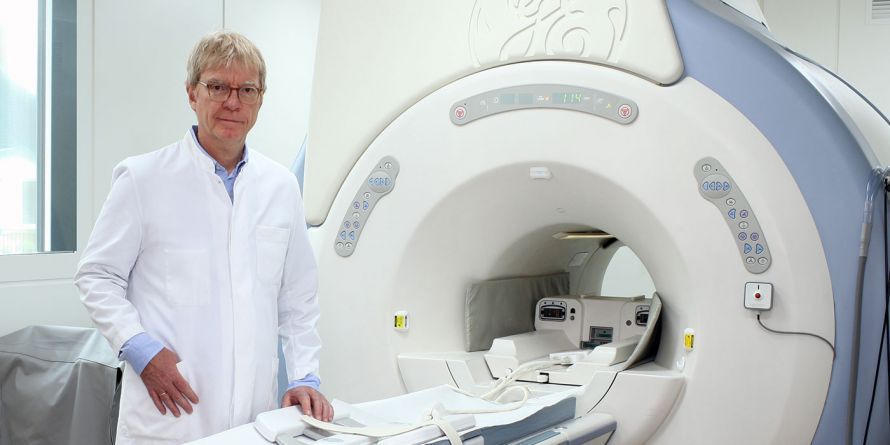
Prof. Dr. med. Markus Düx: HIFU therapy for prostate cancer has been around for a long time and is used by urologists in individual cases. Controlling HIFU heat treatment via real-time MR thermometry is an entirely different ballgame. To do this, you need a system like our MRgFUS, in which highly focused ultrasound is integrated into the MRI scanner. The technical and equipment requirements are enormous, and so are the costs. Many centers are hesitant to make the investment, especially since reimbursement for each case must be negotiated individually. It’s like with other innovations in medicine—every beginning is difficult, and we have to overcome these hurdles. But I believe in its success because I can see the results directly on the MRI scan, which allows me to demonstrate the difference compared to a standard HIFU treatment. We can prove that we reach 80 degrees within the tumor because we measure and visualize the temperature via MRI. This is the only way to systematically destroy the cells. We already know from our data that in about seventy percent of treatments, we have to adjust the parameters to adapt the therapy to the characteristics of the prostate tissue and achieve homogeneous, complete tumor necrosis. If you only reach fifty degrees in the tissue, the tumor survives and grows back. This is what happens, in some cases, with standard HIFU treatment.
Leading Medicine Guide: So HIFU treatment is not MRgFUS?
Prof. Dr. med. Markus Düx: Yes and no! HIFU is the method of heat generation. HIFU stands for high-intensity focused ultrasound, which many urologists use. However, it lacks MRI guidance—and thus temperature measurement. Consequently, it’s impossible to verify what is actually being achieved. A defined amount of energy is delivered, and one hopes that the tumor will be completely destroyed. But that is often not the case: We have to readjust the HIFU treatment in nearly seventy percent of all cases. The prostate is usually highly heterogeneous—scarring, benign tissue growths, inflammation, calcifications, and cancer cells adjacent to well- or poorly perfused tissue repeatedly alter heat sensitivity. We must take this into account during treatment and regularly adjust the temperature parameters to achieve a good outcome. To do this, we need real-time feedback on the temperature distribution in the tissue—even while the treatment is still in progress! That’s MRgFUS! We completely destroy the tumor and can see and measure the results immediately. Throughout the entire area surrounding the prostate, we can see where heat is generated and can thus tailor the treatment accordingly. At the same time, we monitor sensitive structures such as the neurovascular bundle to prevent unwanted side effects from prostate treatment.
Leading Medicine Guide: Then why aren’t there many more of these devices?
Prof. Dr. med. Markus Düx: This type of treatment for prostate tumors is still in its infancy. The FDA in the U.S. has only recently approved MRgFUS for the treatment of prostate cancer patients based on compelling study data. It’s also true that you have to be convinced of this approach—and you need a high degree of enthusiasm. Hospitals are always calculating cost factors, and MRgFUS cannot yet be accurately costed. But we believe in this technology of the future—including my son Daniel. We need to continue developing the technology, and we need to make it available. And that’s exactly what we want to do. It has the potential to make a huge difference. Wider acceptance of MRgFUS will come later.
Leading Medicine Guide: Through research, of course.
Prof. Dr. med. Markus Düx: Exactly. Completely different studies are currently underway at Stanford University in California. That’s home to the world’s largest MRgFUS center. But my son can tell you more about that.
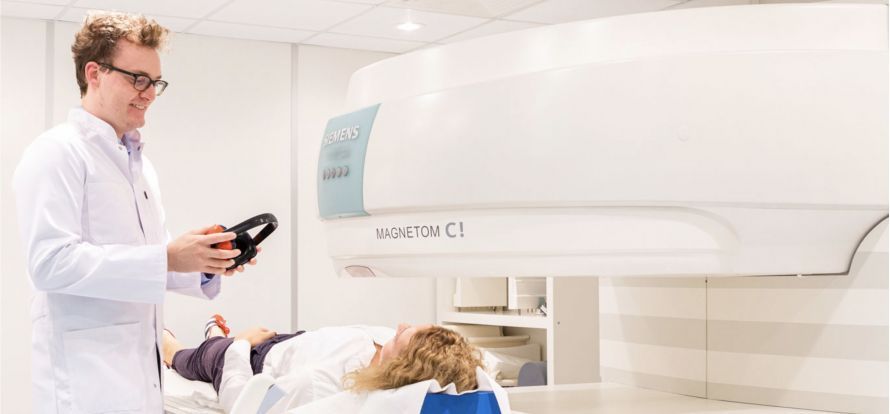
Dr. Daniel Düx, M.D.: Even while I was still in medical school, I watched my father perform these therapies, and I then decided to go where the broadest spectrum of MRgFUS research exists. Then I received an offer to spend a year in the U.S. and participate in MRgFUS therapies there. Stanford University has the world’s largest cohort of patients who have received MRgFUS treatment for desmoid tumors. These are rare, aggressively growing soft-tissue tumors that are often neither operable nor responsive to other therapies. I had the opportunity to participate in the scientific analysis of this unique collection of cases. These patients also exist in Germany, but there are no such treatment options available. The therapies my father mentioned are all performed at Stanford as well. In addition, there are MRgFUS treatments in the field of neurology, an area in which Stanford conducts a great deal of research.
Leading Medicine Guide: MRgFUS in neurology?
Dr. Daniel Düx: In the United States, this procedure is already just as well established in neurology as, for example, the treatment of uterine fibroids is in Germany—specifically for tremors. This refers to the tremors suffered by people with Parkinson’s disease, for instance. Of course, MRgFUS is also a symptomatic therapy in this field. At Stanford, MRgFUS is frequently used to address this issue: it can effectively treat the symptoms of Parkinson’s disease and other essential tremor disorders that impair quality of life.
Leading Medicine Guide: How does that work?
Dr. Daniel Düx: Tremors are usually treated with medication. The problem is that such medications have a high rate of side effects. Over time, patients require increasingly higher doses, and eventually the medications lose their effectiveness. And it’s not just hand tremors that limit people—many can only eat through a straw and can barely speak. This often leads to complete isolation. With MRgFUS, it’s possible to selectively heat the area of the brain where tremors in Parkinson’s are triggered, thereby alleviating the symptoms.
Leading Medicine Guide: Heat in the brain?
Dr. Daniel Düx: At first, only a small amount of heat. The problem is that this center is located quite centrally in the brain. If you try to stimulate this center with a needle, you have to pass through many structures, and you have to be very careful and exercise appropriate caution. MRgFUS, on the other hand, is something entirely different: You guide the ultrasound through the brain, and only the specific point where the tremor originates is destroyed by heat. In fact, most people no longer experience any tremors at all after such a treatment. It’s wonderful to see how happy and relieved the patients are afterward.
Prof. Dr. med. Markus Düx: This procedure is performed while the patient is fully conscious. So the patients are always awake.
Dr. Daniel Düx: Exactly. They also need to be awake because the patients provide constant feedback: Is there still a tremor? Are there any side effects? We start with low temperatures that merely stimulate without causing any damage, but the effect lasts for a quarter of an hour. That’s what makes the therapy so safe—we only create a permanent lesion once we’re absolutely certain we’ve located the correct site. This ensures the tremors are effectively treated.
Prof. Dr. med. Markus Düx: The blood-brain barrier can also be opened using MRgFUS. A lot of research is being done on this at Stanford as well.
Dr. Daniel Düx: That’s another exciting topic. We were just talking about this: When medications are only effective at high doses, it’s because of the fairly impermeable blood-brain barrier. This means that the exchange between the blood and the brain is limited, which is why brain tumors cannot be treated as effectively with chemotherapy—because these drugs do not penetrate the brain well. To bypass this barrier, one would have to choose a dosage that the patient could not tolerate.
Leading Medicine Guide: And where does MRgFUS come into play here?
Dr. Daniel Düx: Small air bubbles can be transported into the brain via the bloodstream and then made to vibrate in the area of the tumor using MRgFUS. These vibrations selectively open the blood-brain barrier for up to 24 hours, allowing drugs to penetrate and take effect within the tumor. This makes it possible to administer low doses of chemotherapy drugs to the brain. Studies have shown that this works particularly well for brain tumors with a poor prognosis. This has enormous therapeutic and diagnostic relevance. It also makes it possible to treat mental illnesses with medications whose active ingredients enter the brain due to the temporary opening of the blood-brain barrier. Many patients do not take these medications at all because of the severe side effects—so this method could be a solution with great potential.
Prof. Dr. med. Markus Düx: Many more indications will be added in the future—for example, to increase the effectiveness of medications for inoperable pancreatic tumors. Over the next few years, it will become clear how else we can use MRgFUS. We are absolutely convinced that great successes await us here. Of course, we’ll have to wait until studies actually confirm all the benefits we’re convinced of.
Leading Medicine Guide: When highly specialized physicians like you are so committed, success shouldn’t be long in coming.
Prof. Dr. med. Markus Düx: You can see it in the patients: Almost all of these are outpatient treatments. You see it immediately, especially in children! When a benign tumor in the hip joint—such as an osteoid osteoma—causes severe pain and restricted movement, we can use ultrasound to destroy the tumor. Completely without X-rays, without a scalpel, and without disfiguring scars! We see the effect immediately after treatment! Children don’t fake it, and as soon as they leave our treatment center, we notice a completely different gait because the pain is gone. In some cases, we can cure the condition; in many others, we can only alleviate symptoms—at least for a certain period of time. This often helps patients greatly, and the great thing about MRgFUS is that the treatments can be repeated. MRgFUS is a method that delivers results quickly with virtually no side effects.
Leading Medicine Guide: Which is, of course, a great incentive.
Prof. Dr. med. Markus Düx: Certainly. Many patients come back. For example, if we’re able to temporarily relieve people’s back pain—then the patients come back when the pain returns. You don’t need an injection or a needle, and you achieve significant results. That’s the great thing about this method—even for me as a therapist.
Dr. med. Daniel Düx: You mustn’t forget that we also treat very rare tumors with MRgFUS, which often grow near nerves. This causes severe pain and muscle weakness. Until a few years ago, these tumors were treated surgically. I worked in surgery for nearly two years and saw this firsthand: During such operations, a great deal of tissue is often removed. If such tumors can be removed noninvasively, that’s a major advancement. And if MRgFUS allows us to administer chemotherapy in smaller doses—and thus minimize side effects—that’s a huge benefit, especially for young patients.
Leading Medicine Guide: We would like to thank you very much for the interview—and we hope that MRgFUS will continue to be used successfully in many other areas.
Further information is available on the profile page of Prof. Dr. med. Markus Düx. You can also contact this renowned specialist directly through that page.
Share this article
About the medical author
Sabine Schneider
Editor-in-Chief
Sabine Schneider – medical author: Explore expert articles and medical expertise in the Leading Medicine Guide.
More about the medical author →Expert Interviews
Read next
- Expert interview
Cardiogeriatrics: Significance and benefits in the context of hospital reform
Sep 21, 2026
Cardiogeriatrics: Significance and benefits in the context of hospital reform
Read more - Expert interview
Expert Interview with Professor Dr. Amadeus Hornemann, MPH
Sep 18, 2026
Prof. Amadeus Hornemann on Precision Medicine in Gynecology: Modern Surgery, New Techniques, Better Quality of Life
Read more - Expert interview
Expert Interview with Professor Dr. Konstantinos Anagnostakos
Sep 15, 2026
Prof. Anagnostakos on Painful Knee Replacements
Read more