Expert Interviews
Prof. Langenbach: Reflux can be caused by internal hernias

Claudia Dechamps ·
Prof. Dr. Mike Ralf Langenbach is a recognized specialist in hernia and reflux surgery—and, together with his team, performs several hundred hernia surgeries every year. The chief physician of the Department of General, Visceral Surgery, and Coloproctology at the Evangelical Hospital in Lippstadt has long since adopted a minimally invasive approach: surgical instruments are inserted into the body through tiny incisions to treat hernias in a wide variety of tissue structures. Prof. Langenbach is pleased to note that robot-assisted procedures will become far more common in the future—because this, above all, will enable even more precise and accurate surgical options. The Leading Medicine Guide spoke with the specialist in minimally invasive reflux surgery about the treatment of a common ailment—heartburn.

Leading Medicine Guide: Prof. Langenbach, heartburn is a truly widespread condition. But it has only been possible to treat it effectively for the past few decades. How is that possible—and what were the key advances in treatment?
Prof. Dr. Mike Ralf Langenbach: About thirty or forty years ago, every other emergency in surgery was an emergency stomach operation. Patients had stomach ulcers that suddenly perforated and then had to be operated on immediately. Back then, there were no medications available to treat reflux. So people developed stomach ulcers. The decisive step came in the 1980s with the patenting of pantoprazole, a so-called proton pump inhibitor that suppresses the production of stomach acid. Medications containing these active ingredients have been used ever since to treat heartburn and reflux.
Leading Medicine Guide: On the one hand, this is of course a blessing for those affected. But unfortunately, side effects became apparent with long-term use, didn’t they?
Prof. Dr. Mike Ralf Langenbach: Thanks to these acid-blocking medications, many stomach surgeries and gastric resections—that is, partial removals of the stomach—have been avoided. But stomach acid does serve a purpose in the body; it helps break down food and fends off bacteria and viruses. Today, proton pump inhibitors are suspected of causing a whole range of unpleasant side effects: vitamin B deficiency, osteoporosis, and dementia. Experts therefore warn against taking acid blockers over an extended period of time.
Leading Medicine Guide: But heartburn remains a nuisance. What can be done about it if one should avoid taking medication?
Prof. Dr. Mike Ralf Langenbach: First, we discuss conservative options with our patients, such as: following a diet, elevating the upper body while sleeping, eating less in the evening, and avoiding alcohol. You really have to take a very nuanced approach to this symptom. The junction between the esophagus and the stomach is normally closed off by muscles in the esophagus and the diaphragm. But this closure can weaken. Then stomach contents flow back into the esophagus.
Leading Medicine Guide: ... and that causes pain.
Prof. Dr. Mike Ralf Langenbach: Stomach acid irritates the lining of the esophagus—this manifests as heartburn. Of course, it makes sense to avoid surgery if possible. But long-term reflux can also have serious consequences. As stomach acid repeatedly rises into the esophagus, the tissue changes, becomes inflamed, and carcinogenic changes can develop, potentially leading to esophageal cancer.
Leading Medicine Guide: What are the indications for which surgery is unavoidable?
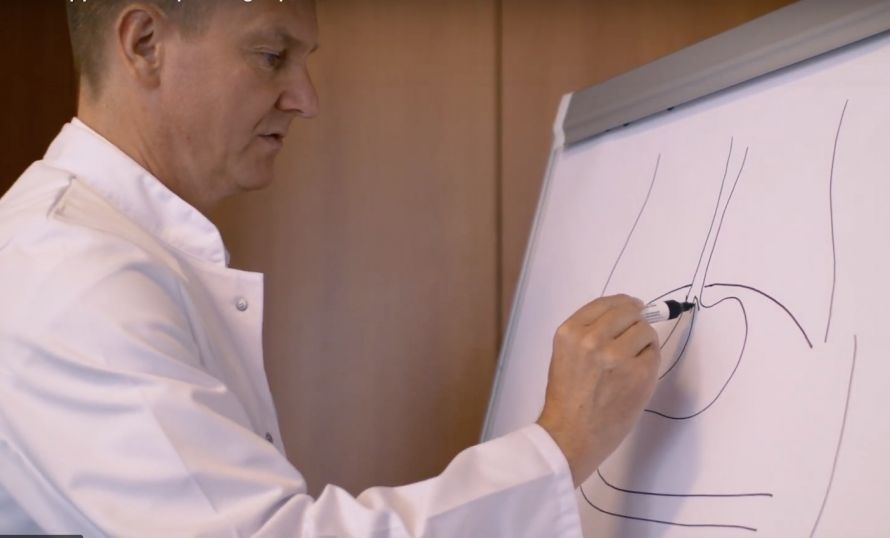
Prof. Dr. Mike Ralf Langenbach: Reflux disease can also develop—and this is my area of expertise—when internal hernias form in the diaphragm. The diaphragm is a semicircular structure of tissue that separates the abdominal cavity from the thoracic cavity. If a hernia develops here, parts of the stomach can migrate from the abdominal cavity into the thoracic cavity. There are various types of internal hernias; for example, many people have an axial hernia without it necessarily requiring surgery. However, all lateral hernias are indications for surgery because there is a risk that parts of the stomach could become strangulated.
Leading Medicine Guide: What factors contribute to these internal hernias of the diaphragm, which are medically referred to as hiatal hernias?
Prof. Dr. Mike Ralf Langenbach: On the one hand, there is a genetic predisposition. The composition of collagen determines the strength of the tissue—and some people are born with a congenital weakness in this tissue. On the other hand, being overweight poses a risk. Obesity places high pressure on the tissue. Eventually, the tissue at the natural junction between the esophagus and the stomach gives way. The risk factors for hiatal hernias are therefore both exogenous and genetic in nature.
Leading Medicine Guide: What does the diagnostic process for reflux involve?
Prof. Dr. Mike Ralf Langenbach: During our consultation, we conduct a thorough examination of the stomach and esophagus. Tissue samples are taken. The pressure conditions in the esophagus are measured using esophageal manometry. This allows us to identify malfunctions of the swallowing muscles and the lower esophageal sphincter and to determine whether the esophagus is otherwise healthy. If the esophageal motility is normal, we then examine the pH levels of the esophagus and stomach. To do this, we use long-term pH monitoring to measure the acidity in this area and determine how many reflux episodes occur over a specific period. Using a contrast agent while the patient is in the head-down position, we can visualize internal hernias. We discuss the options in detail with the patient. Once all conservative treatment options have been exhausted, we evaluate the patient’s symptoms. All of these findings together provide a comprehensive picture that then determines the appropriate surgical method.
Leading Medicine Guide: What type of surgery should a patient with an internal hernia expect?
Prof. Dr. Mike Ralf Langenbach: We perform laparoscopic surgery. Through small incisions in the abdominal wall—a minimally invasive procedure—we insert a camera and surgical instruments into the abdominal cavity. In most cases, the first step is to reposition the stomach—which has migrated into the lower thoracic cavity—back beneath the diaphragm. Once all organs have been carefully dissected from areas where they have already adhered, the diaphragmatic defect is closed. Then the upper portion of the stomach is mobilized and placed around the lower section of the esophagus to form a loose cuff. Depending on the results of the manometry examination, either a complete cuff or a partial cuff is created. After this procedure, eighty to ninety percent of patients remain symptom-free. Of course, they must initially eat only soft foods, should not reach for beer or cola too soon, and should avoid lifting heavy objects for some time.
Leading Medicine Guide: Can such internal hernias be prevented?
Prof. Dr. Mike Ralf Langenbach: As I mentioned at the beginning, there is a certain genetic predisposition. Any condition that causes chronic increased abdominal pressure—such as obesity, chronic cough, chronic constipation, heavy lifting, etc.—poses a potential risk for developing a diaphragmatic hernia. You can’t completely prevent an internal hernia, but there’s a lot you can do to keep the risk low.

Leading Medicine Guide: How will surgical techniques for hernias evolve in the near future?
Prof. Dr. Mike Ralf Langenbach: Robotic-assisted surgery will play an increasingly important role. To the medical layperson, this may sound a little daunting, but I can assure you that it is an absolutely safe form of surgery. With the help of artificial intelligence and robotics, we can see even the smallest details more clearly and work with even greater precision than before. I think this is a very positive development that will make our surgical work even more precise and effective.

Leading Medicine Guide: Thank you very much for this fascinating and insightful conversation, Prof. Dr. Langenbach!
Share this article
About the medical author
Claudia Dechamps
Editor
Claudia Dechamps – medical author: expert articles, professional insights and medical knowledge in the Leading Medicine Guide.
More about the medical author →Klinikum Lippstadt GmbH
ProfileExpert Interviews
Read next
- Expert interview
Cardiogeriatrics: Significance and benefits in the context of hospital reform
Sep 21, 2026
Cardiogeriatrics: Significance and benefits in the context of hospital reform
Read more - Expert interview
Expert Interview with Professor Dr. Amadeus Hornemann, MPH
Sep 18, 2026
Prof. Amadeus Hornemann on Precision Medicine in Gynecology: Modern Surgery, New Techniques, Better Quality of Life
Read more - Expert interview
Expert Interview with Professor Dr. Konstantinos Anagnostakos
Sep 15, 2026
Prof. Anagnostakos on Painful Knee Replacements
Read more