Prof. Dr. Mike Ralf Langenbach
Specialist for hernia and reflux surgery in Lippstadt
Klinikum Lippstadt GmbH· Wiedenbrücker Straße 33, 59555 Lippstadt
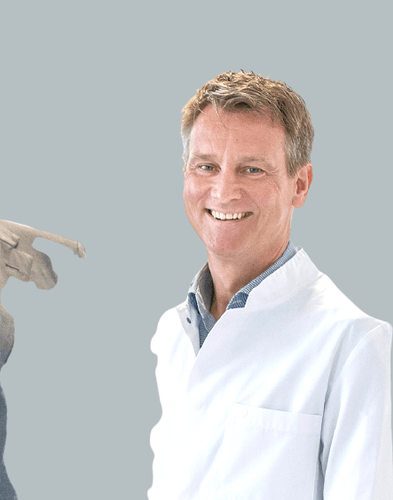
Prof. Langenbach has specialized in the following areas, among others: Hernia surgery – he and his team now perform several hundred hernia operations a year at the Lippstadt site – and reflux surgery. In doing so, the experienced surgeon relies on the use of both modern and well-established surgical procedures to provide his patients with long-term relief from their symptoms.
Admission criteria
- At least 10 years of surgical and treatment experience
- Expertise in modern diagnostic and surgical procedures
- An outstanding treatment focus within your own specialist area
- Member of a leading national professional association
- Leading professional position
- Active participation in specialist events (e.g. lectures)
- Active in research and teachin
- Evaluated quality management (e.g. certification)
- Participation in morbidity conference (Hernia Surgery)
- Pain treatment (Hernia Surgery)
- Herniamed documentation (Hernia Surgery)
- Ultrasound examination (Hernia Surgery)
- Pain intensity postop assessment (Hernia Surgery)
- Consultation hours for patients (Hernia Surgery)
- Outpatient surgery (Hernia Surgery)
- Guidelines for the treatment of bilateral inguinal hernias (Hernia Surgery)
- Proof of one-year follow-up (Hernia Surgery)
About Prof. Dr. Mike Ralf Langenbach
After many years of service as Chief Physician of the Surgical Department and Medical Director at Helios St. Elisabeth Hospital in Oberhausen, Prof. Dr. med. Mike Ralf Langenbach assumed the position of Chief Physician of the Department of General, Visceral Surgery and Coloproctology at Klinikum Lippstadt in the fall of 2019 – one of the largest acute care hospitals in the region, with approximately 18,000 inpatient cases annually. In addition to his clinical work, Prof. Dr. Langenbach is also actively involved in research and teaching at Witten/Herdecke University.
The board-certified specialist in surgery, visceral surgery, and advanced visceral surgery holds an additional qualification in proctology and minimally invasive surgery. Thanks to his comprehensive training and many years of practical experience, the physician is familiar with the full spectrum of surgical procedures involving the abdominal cavity and digestive tract. At Klinikum Lippstadt, together with his team, he has significantly expanded the field of hernia and reflux surgery. Today, more than 200 hernia procedures, such as inguinal and umbilical hernias, are performed at the hospital each year. As a member of the German Hernia Society (DHG), the clinic operates according to the highest quality standards. Prof. Langenbach also played a leading role in establishing the reflux center at Klinikum Lippstadt. Thanks to the “short distances” and close interdisciplinary collaboration “under one roof,” patients receive timely, comprehensive diagnostics and individually tailored treatment.
Interdisciplinary approach – always for the benefit of the patient
For Prof. Langenbach, interdisciplinary collaboration with other departments of the hospital as well as close cooperation with outpatient physicians is essential. Although surgery is at the center of treatment, effective pain management, early mobilization, and the prevention of complications – both during and after surgery – are equally important for successful outcomes.
Close and personal communication with patients and their families on an equal footing is also of central importance in the Chief Physician’s work. This includes individualized and clearly understandable counseling about the benefits and potential risks of surgery, as well as identifying the patient’s personal needs and expectations. From the physician’s perspective, it is crucial that patients feel comfortable at all times, experience compassionate care, and have complete trust in the professionalism of their healthcare provider. For Prof. Langenbach, his work does not end in the operating room – after surgery, he and his team continue to closely monitor the patient’s recovery and remain available as contact partners at all times.
Prof. Langenbach’s high level of commitment and empathy may be explained by the circumstances under which he discovered his passion for medicine: as a young man, he completed twenty months of civilian service in nursing – and after these experiences, it quickly became clear that he wanted to become a physician.
Hernia specialist: complex hernias
Prof. Langenbach is proficient in all modern surgical procedures for treating hernias: from classic inguinal hernias to umbilical and incisional hernias, as well as complex femoral and abdominal wall hernias. For inguinal hernias, the specialist and his team decide whether to use a synthetic mesh – which typically reduces the risk of recurrence – or to perform surgery without mesh. The decision whether to use a minimally invasive or open (conventional) approach is also made individually, in detailed consultation with each patient.
As a rule, procedures are performed using so-called keyhole surgery, i.e., minimally invasive techniques. Prof. Langenbach most commonly uses the TAPP technique – a very gentle and safe surgical method that allows patients to recover quickly. Open procedures are performed either according to Lichtenstein – with mesh – or according to Shouldice, without mesh.
Abdominal wall and incisional hernias are also generally treated using minimally invasive procedures. In cases of very large hernias or severe adhesions from previous surgeries, open surgery may be preferred. In such cases, Prof. Langenbach often uses synthetic meshes, for example, to reinforce the abdominal wall. Since he develops individualized treatment concepts for each patient, innovative combinations are sometimes used, which may lead to new standards in modern surgical practice.
Watch here an interesting video on hernia surgery from Klinikum Lippstadt!
Reflux: a widespread condition – heartburn
The second area in which Prof. Dr. med. Mike Ralf Langenbach specializes with great dedication is the extensive field of reflux disease. The reflux center established specifically at Klinikum Lippstadt is fully dedicated to the diagnosis and treatment of reflux disease. Officially known as reflux esophagitis, the condition describes the backflow of stomach acid into the esophagus – usually accompanied by severe heartburn. In addition to pain and discomfort, patients often suffer from sleep disturbances and a loss of enjoyment in eating and social activities. If left untreated for a long time, the condition carries additional risks: the acidic stomach contents can irritate the sensitive lining of the esophagus and cause inflammation. In the long term, malignant tissue changes, known as Barrett’s esophagus, may develop.
To determine the cause of the often varied and non-specific symptoms, several departments collaborate closely in the reflux center led by Prof. Langenbach. The teams from Internal Medicine and Gastroenterology as well as Radiology conduct comprehensive diagnostics to assess the severity and exact cause of symptoms. Based on the findings, patients initially receive recommendations for lifestyle changes and/or medication.
Reflux: particularly gentle procedures
If conservative treatment does not lead to lasting success or if significant mucosal changes are already present, surgery is often the only option. After thorough diagnostics, Prof. Langenbach discusses the most appropriate surgical method with the patient. The specialist and his team have extensive experience in surgical reflux treatment: procedures are performed as gently as possible – usually minimally invasive. Prof. Langenbach can also rely on the innovative equipment at Klinikum Lippstadt, which includes a state-of-the-art surgical robot. With the Da Vinci® system, the surgeon operates with high precision using a console that controls four robotic arms equipped with fine instruments in real time. Especially in complex procedures, the robot offers significant advantages, enabling tissue-sparing and low-bleeding surgery, which promotes faster recovery.
Facts & experience
- Hernia operations per year (Hernia Surgery)
over 30
Minimum requirement: 30
- Inguinal hernia reoperation rate (Hernia Surgery)
under 2%
- Incisional hernia reoperation rate (Hernia Surgery)
under 10%
- Follow-up rate (Hernia Surgery)
over 70%
- Infection rate laparascopic incisional hernia (Hernia Surgery)
under 3%
- Overall complication rate for inguinal hernias (Hernia Surgery)
under 5%
- Infection rate incisional hernias open surgery (Hernia Surgery)
under 10%
- Training points per year (Hernia Surgery)
over 16
Minimum requirement: 16
- Pancreatic head resections and total pancreatectomies (Pancreatic Surgery)
over 25
Minimum requirement: 25
- Pancreatic left and segmental resections (Pancreatic Surgery)
over 5
Minimum requirement: 5
- Other pancreatic procedures for the treatment of pancreatitis (Pancreatic Surgery)
over 10
Minimum requirement: 10
- Hospital mortality (Pancreatic Surgery)
under 7%
- Major complications according to the Clavien-Dindo classification grade 3b, 4a and 4b (Pancreatic Surgery)
under 20%
- MTL30 (Pancreatic Surgery)
under 25%
Video presentation
Expert interviews
- Prof. Langenbach: Reflux can be caused by internal hernias (opens in a new tab)
- Expert Interview with Prof. Dr. Mike Ralf Langenbach - The Pancreas: A Small Organ with a Major Role in Digestion and Metabolism (opens in a new tab)The Pancreas—A Small Organ with a Major Role in Digestion and Metabolism—An Interview with Prof. Langenbach
- Expert Interview with Prof. Langenbach (opens in a new tab)Treatment of Umbilical Hernias: An Expert Interview with Prof. Langenbach
Insights
Insights: Klinikum Lippstadt GmbH
Klinikum Lippstadt GmbH – Image 1 Klinikum Lippstadt GmbH – Image 2 Klinikum Lippstadt GmbH – Image 3 Klinikum Lippstadt GmbH – Image 4
Location
How to reach Prof. Dr. Mike Ralf Langenbach

Klinikum Lippstadt GmbH
Specialisation
The medical spectrum of Prof. Dr. Mike Ralf Langenbach
Diseases
- Esophageal atresia (opens in a new tab)
- Heartburn (opens in a new tab)
- Pancreatic Cancer (opens in a new tab)
- Esophageal Cancer (Esophageal Carcinoma) (opens in a new tab)
- Pancreatic Diseases (opens in a new tab)
- Abdominal Wall Hernia (Epigastric Hernia) (opens in a new tab)
- Inguinal Hernia (opens in a new tab)
- Umbilical Hernia (opens in a new tab)
- Incision Hernia (opens in a new tab)
- Pancreatitis (opens in a new tab)
- Parastomal hernia (opens in a new tab)
- Reflux Disease (opens in a new tab)
- Thigh hernia (inguinal hernia) (opens in a new tab)
- Esophageal disease (opens in a new tab)
- Diaphragmatic Hernia (Hiatal Hernia) (opens in a new tab)
- Esophagotracheal fistula (opens in a new tab)
Treatments
- Endocrine Surgery (opens in a new tab)
- Pancreas Transplant (opens in a new tab)
- Pancreatic Surgery (opens in a new tab)
- Minimally Invasive Pancreatic Surgery (opens in a new tab)
- Minimally Invasive Hernia Surgery (opens in a new tab)
- Pancreatic Cancer Surgery (opens in a new tab)
- Pancreatitis Surgery (opens in a new tab)
- Laparoscopic Pancreatic Surgery (opens in a new tab)
- TAPP / Transabdominal Preperitoneal Mesh Implantation (opens in a new tab)
- Antireflux surgery (opens in a new tab)
- Fundoplication (opens in a new tab)
- Abdominal Wall Hernia Surgery (opens in a new tab)
- Inguinal Hernia Surgery (opens in a new tab)
- Umbilical Hernia Surgery (opens in a new tab)
- Incision Hernia Surgery (opens in a new tab)
- Inguinal Hernia Surgery (opens in a new tab)
- Diaphragmatic Hernia Surgery (opens in a new tab)
- Da Vinci Surgery (opens in a new tab)
- Esophageal Surgery (opens in a new tab)
- Minimally Invasive Esophageal Surgery (opens in a new tab)
- TEPP / Total Extraperitoneal Mesh Implantation (opens in a new tab)
Diagnostics
- Gastroscopy (opens in a new tab)
- Esophageal manometry (opens in a new tab)
- Hernia Diagnosis (opens in a new tab)
- Esophagoscopy
- Impedance measurement of the esophagus