
Esophageal cancer is a rare but serious form of cancer that affects the esophagus. Because the disease causes few symptoms for a long time, it is often not detected until the tumor has already grown larger. The most important symptom is increasing difficulty eating.
Here you will find important information about esophageal cancer, how to recognize the warning signs, and treatment options for patients at specialized centers.
What is the esophagus?
The esophagus is a muscular tube about 25 centimeters long. It connects the mouth or throat to the stomach. The esophagus has a diameter of about two centimeters.
Through wave-like movements, the esophagus transports food from the mouth to the stomach. Sphincters at the upper and lower ends close off the esophagus. When necessary, the sphincters open to allow food to pass through.
The esophagus is divided into three sections:
- Cervical section (cervical region)
- Thoracic section
- Esophagogastric junction
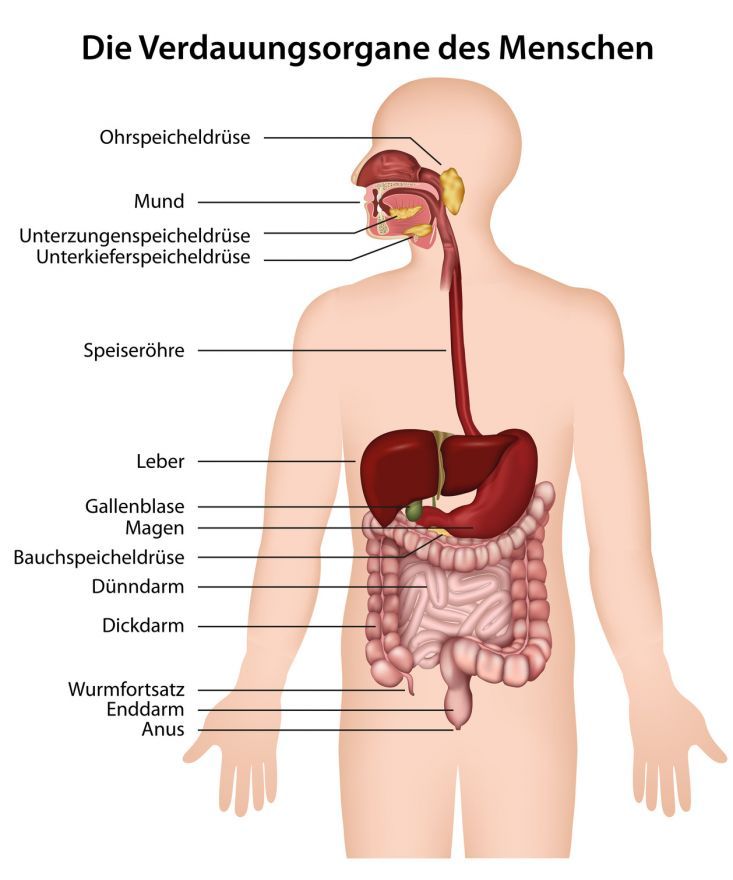
The esophagus is the tube connecting the pharynx to the stomach © bilderzwerg / Fotolia
Inside, the esophagus is lined with a mucous membrane (mucosa), the outermost layer of which consists of squamous epithelial cells. Above this is a layer of
- nerves,
- blood vessels, and
- glands
, followed by a layer of muscle. A layer of connective tissue connects the esophagus to other organs. At the junction with the stomach, the esophageal mucosa transitions into the gland-rich mucosa of the stomach.
Definition: Esophagus, Cancer, and Esophageal Carcinoma
Esophageal cancer, also known as esophageal carcinoma, is cancer of the esophagus (usually malignant). In this condition, cells undergo changes that cause them to grow uncontrollably and destroy surrounding tissue.
In Germany, approximately 5,700 men and 1,700 women were newly diagnosed with esophageal cancer in 2018. The median age at diagnosis in 2014 was 67 years for men and 71 years for women.
The two most common and significant types of esophageal cancer are squamous cell carcinoma and adenocarcinoma.
- Adenocarcinoma (Barrett’s carcinoma) originates in glandular tissue. It occurs almost exclusively at the junction with the stomach.
- Squamous cell carcinoma, on the other hand, originates in the mucous membrane.
Squamous cell carcinoma accounts for the largest proportion, at 50 to 60 percent, while adenocarcinoma accounts for about one-third.
Symptoms and Signs: Typical Warning Signs
The esophagus is a highly elastic organ. As a result, symptoms do not typically appear until a late stage. By then, the tumor has grown large enough to impair the organ’s function. Esophageal carcinoma is therefore often referred to as the “silent cancer.”
A key symptom of the later stages of the disease is dysphagia (difficulty swallowing). The swallowing process is disrupted by the space-occupying tumor, and the patient has trouble swallowing. Patients perceive this as pain behind the breastbone or in the upper abdomen, accompanied by a feeling of pressure.
For swallowing difficulties to occur at all, the cancer must have already significantly narrowed the esophagus. This narrowing makes it difficult to eat. As a result, many patients are no longer able to eat solid foods. This causes them to lose several kilograms of body weight within a few weeks. In the majority of cases, esophageal cancer is therefore accompanied by unintentional weight loss.
Other symptoms may include
- vomiting,
- loss of appetite, and
- digestive problems
. About one-third of those affected also complain of
- regurgitation—that is, the bringing up of food—and
- increased salivation.
If the cancer occurs in the lower part of the esophagus, a cough may be a possible symptom. If the tumor also presses on the larynx or the vocal cords, hoarseness may also occur.
In advanced stages and in cases of metastasis, enlarged lymph nodes in the neck area can be felt.
Causes and Risk Factors of Esophageal Cancer
The exact cause of esophageal cancer has not yet been clearly established. However, there are certain factors that increase the risk of developing the disease.
The most important risk factors for the development of squamous cell carcinoma are
- smoking,
- heavy consumption of high-proof alcohol,
- an unbalanced diet low in fruits and vegetables, and
- frequent consumption of very hot foods and beverages.
Adenocarcinomas often develop as a result of gastroesophageal reflux disease (GERD). In this condition, acidic stomach acid continuously flows back into the esophagus and irritates the tissue there (chronic heartburn).
This chronic reflux of digestive fluids into the esophagus promotes the development of Barrett’s esophagus. This is an inflammatory change in the lower part of the esophagus at the junction with the stomach (esophagogastric junction) accompanied by ulcer formation.
Barrett’s esophagus is a so-called precancerous condition (a precursor to cancer) from which carcinoma can develop. For this reason, adenocarcinoma is also referred to as Barrett’s carcinoma. Other risk factors for the development of adenocarcinoma include
- smoking and
- insufficient intake of fruits and vegetables, as well as
- being overweight.
The majority of esophageal tumors develop from a precancerous condition. Plummer-Vinson syndrome is also a precancerous condition that can lead to the development of an esophageal tumor. The syndrome develops as a result of long-standing iron-deficiency anemia. It is characterized, among other things, by cracked corners of the mouth and difficulty swallowing.
Achalasia (a functional disorder of the esophagus) can also increase the long-term risk of esophageal cancer. In esophageal achalasia, the function of the lower esophageal sphincter is impaired. As a result, undigested food, among other things, can reflux from the stomach into the esophagus.
In addition to the risk factors mentioned above, other factors can contribute to the development of esophageal cancer:
- Scarring following chemical burns caused by alkalis
- previous radiation therapy in the area of the esophagus to treat other types of cancer.
It is not certain whether infections with human papillomaviruses also play a role.
Diagnosis of Cancer and Staging
Pre-existing conditions and the presence of risk factors, in combination with
- difficulty swallowing,
- hoarseness, or
- coughing
may be considered indicative of esophageal cancer. A medical evaluation should be conducted promptly. Clues may be found in pre-existing conditions, risk factors, and symptoms such as difficulty swallowing or coughing.
To confirm the diagnosis, however, the doctor must perform an examination of the esophagus (endoscopy or esophagoscopy). During this procedure, the doctor inserts a thin, tubular, and flexible instrument with a built-in light source and camera (endoscope) into the esophagus through the mouth. This allows the doctor to examine the surface of the esophagus for abnormal tissue changes.
To better detect tissue changes, areas of the mucous membrane can be stained (chromendoscopy) and evaluated using computer-assisted analysis. If suspicious areas are found, the doctor can also immediately take a tissue sample. In the laboratory, a pathologist examines this sample histologically. This allows for a definitive diagnosis of esophageal cancer.
To determine the appropriate treatment, the size and extent of the tumor must be assessed. An endoscopic ultrasound examination (endosonography) can be used to determine
- how deep the tumor has already grown and
- whether it has spread to adjacent tissue.
Computed tomography (CT) scans of the neck, chest, and abdomen, as well as an ultrasound examination of the liver, are used to assess the extent of the disease. This involves searching for possible metastases and the involvement of neighboring tissues.
For advanced tumors, additional tests to detect metastases may also include
- PET/CT (a combined scan of positron emission tomography and CT),
- if necessary, an MRI scan as an alternative to CT,
- laparoscopy (abdominal endoscopy), and/or
- thoracoscopy (examination of the chest cavity and pleura)
. The results of these examinations enable the tumor to be staged using the TNM classification. This allows the most promising treatment to be determined.
Treatment of Esophageal Cancer: Surgery, Chemotherapy, and Radiation Therapy
Patients with esophageal cancer should be treated at specialized centers by experienced experts.
As part of an interdisciplinary tumor board, with the participation of
- radiologists,
- gastroenterologists,
- oncologists,
- radiation oncologists, and
- additional specialists as needed
discuss in detail which treatment is best for the patient.
The treatment methods used to treat esophageal cancer depend on
- the location,
- extent,
- the type, and
- the aggressiveness of the tumor
. It is therefore very important to determine whether the tumor is locally confined or has already spread to neighboring tissues or other organs.
In early stages, endoscopic removal may be sufficient under certain circumstances. In this procedure, superficial tumor tissue is excised as long as the lesion is confined to the mucosa. If the lesion is larger, surgery is usually the primary treatment. This involves partial or complete removal of the esophagus. Often, a portion of the stomach is used to create a replacement so that food can continue to enter the digestive tract. The connection between the esophagus and the stomach—or the stomach replacement—is crucial for swallowing function and quality of life. Radiation therapy is also usually administered.
The primary treatment is surgery as part of esophageal surgery, during which the tumor is removed from the esophagus. Chemotherapy or a combination of radiation and chemotherapy is often administered before surgery. These neoadjuvant treatment methods can improve the chances of success.
In the early stages of the disease, endoscopy is often sufficient. During this procedure, the surgeon removes the upper portions of the esophageal mucosa using a snare. This is possible if the tumor is still confined to the esophageal mucosa (known as early-stage carcinoma). Under certain circumstances, the esophagus can be preserved in its entirety.
Larger tumors, however, usually require complete or at least partial removal of the esophagus. Depending on the patient’s condition and the extent of the cancer, esophagectomies can be performed
- be performed using open surgical techniques,
- partially (known as the hybrid technique), or
- completely using a minimally invasive technique (keyhole surgery)
. The use of minimally invasive esophageal surgery can significantly reduce the complication rates associated with esophageal cancer surgery. Studies have demonstrated the benefits of minimally invasive esophageal surgery for patients. The hybrid technique or a completely minimally invasive procedure is therefore considered the new gold standard.
The remaining parts of the esophagus are then connected to the stomach. This allows for food intake even after the operation. A portion of the stomach, which has been shaped into a gastric tube, then functions as a replacement for the esophagus. This technique enables very good swallowing function and, consequently, a high quality of life.
If the stomach must also be partially or completely removed, a section of the small intestine can be reshaped to serve as an esophagus.
To improve the prognosis, the lymph nodes in the abdomen and chest/mediastinum (known as a 2-field lymphadenectomy) are also removed; in some cases, those in the neck are removed as well (known as a 3-field lymphadenectomy).
If metastases have already formed in other organs, the surgery is not intended to cure the disease but rather to alleviate symptoms. This is referred to as palliative therapy.
Course, Prognosis, and Chances of Cure for a Diagnosis of “Esophageal Cancer”
What sets esophageal cancer specialists apart?
Patients with esophageal cancer should seek treatment at hospitals with specialized experience in this field. There, various experts in esophageal cancer collaborate in a multidisciplinary tumor board. Together, they develop a personalized treatment strategy for the patient.
Most often, these specialists come from the fields of
- gastroenterology,
- oncology,
- radiation oncology,
- radiology,
- surgery, and
- Pathology
work together. The experts follow the diagnostic and therapeutic procedures recommended by clinical guidelines.
Oncology treatment centers, which are generally certified by the German Cancer Society, ensure consistently high-quality care for patients with esophageal cancer.
German Cancer Aid also provides patients with easy-to-understand information; the scientific basis for this is the S3 guideline from the Oncology Guidelines Program on the diagnosis and treatment of squamous cell carcinomas and on the treatment of squamous cell carcinomas and adenocarcinomas of the upper gastrointestinal tract.
For patients with esophageal cancer, it is important that diagnosis and treatment are planned by a tumor board and that the center has experience with complex esophageal surgery.
Frequently Asked Questions
What are the typical symptoms of esophageal cancer?
Early signs often appear late. They frequently begin with increasing difficulty eating, a feeling of pressure, or pain behind the breastbone. Other symptoms include unexplained weight loss, vomiting, heartburn, or changes in the voice.
How can you tell if there’s a tumor in the esophagus?
A tumor can go unnoticed for a long time. Symptoms that are particularly suspicious include difficulty swallowing, the sensation that food is getting stuck, as well as pain or repeated regurgitation of food.
Is this disease curable?
Whether a cure is possible depends heavily on the stage of the disease. If the disease is detected early and completely removed, the prognosis is better. In cases of metastasis, the focus is usually on symptom-relieving or palliative care.
What happens during an examination if a tumor is suspected?
An endoscopy is usually performed first, during which the doctor examines the esophagus from the inside and takes a tissue sample if necessary. Imaging tests are then used to determine the extent of the disease.
What is the standard treatment for esophageal cancer?
Depending on the stage, options may include endoscopic procedures, surgery, drug therapy, local radiation therapy, or combination approaches. The decision should be made at an experienced center. It is important to provide clear information, set realistic goals, and take the patient’s personal wishes into account.
Share this article
Sources
- S3-Leitlinie „Diagnostik und Therapie der Plattenepithelkarzinome und Adenokarzinome des Ösophagus“ (AWMF-Register-Nr. 021-023OL), Stand 15.12.2023: register.awmf.org/de/leitlinien/detail/021-023OL
- Zander T (2015) Ösophaguskarzinom. In: Lehnert H et al. (eds) DGIM Innere Medizin. Springer Reference Medizin. Springer, Berlin, Heidelberg
- Zentrum für Krebsregisterdaten (2017) Speiseröhrenkrebs (Ösophaguskarzinom). In: Krebs in Deutschlandfür 2013/2014. Robert Koch-Institut, Berlin. https://www.krebsdaten.de/Krebs/DE/Content/Publikationen/Krebs_in_Deutschland/kid_2017/krebs_in_deutschland_2017.pdf?__blob=publicationFile
- Schneider, Prof. Dr. med. Paul M. (2016): Minimalinvasive Chirurgie des Speiseröhrenkrebses. In: Patientenzeitschrift „Mittelpunkt“ (02/16), Klinik Hirslanden, Zürich, Schweiz.
- Lordick F, Hoffmeister A (2015) Ösophagustumoren. In: Lehnert H et al. (eds) SpringerReference Innere Medizin. Springer Reference Medizin. Springer, Berlin, Heidelberg
- Schünke M et al. (2018) Prometheus. Innere Organe: LernAtlas der Anatomie. Thieme, Stuttgart