An inguinal hernia is the most common type of hernia. Surgery is always necessary for an inguinal hernia, as failure to do so can lead to serious complications such as strangulation of the intestine or other abdominal organs.
Here you will find further information as well as qualified specialists for the treatment of inguinal hernias.
An inguinal hernia is a hernia in the area of the inguinal canal. It is also called an inguinal hernia.
A gap forms in the abdominal wall in the groin area. Through this so-called hernial orifice or hernial gap, portions of the internal organs can protrude outward.
The peritoneum bulges through the hernial orifice and forms the hernial sac. The parts of the intestines trapped inside constitute the so-called hernial contents; these may include, for example, sections of the intestine.
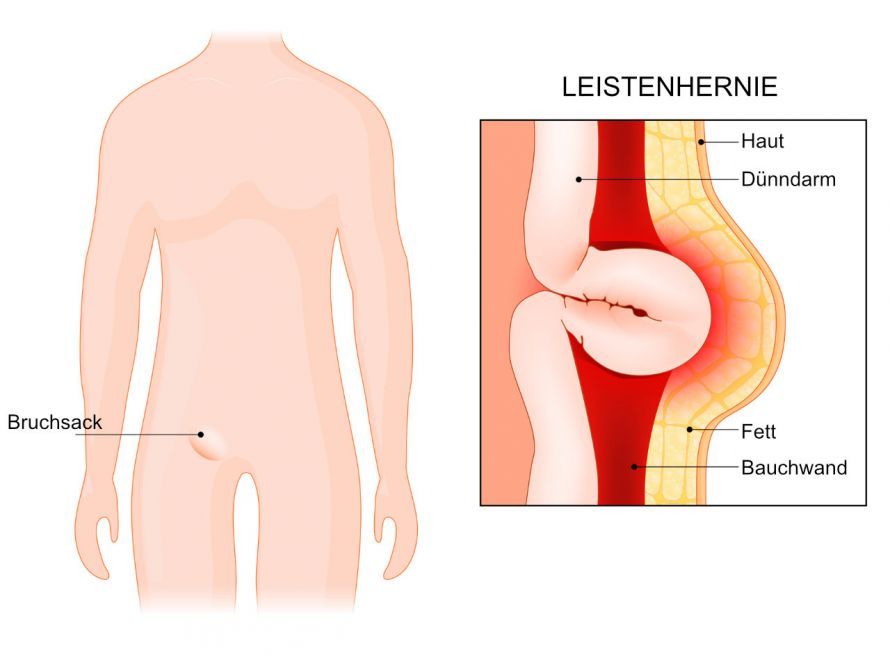
Each year, approximately 0.5% of the population develops an inguinal hernia in the inguinal canal. This makes the inguinal hernia one of the most common surgical conditions of all.
It is also the most common type of hernia: approximately 75–80% of all hernias are inguinal hernias. Men are particularly affected—about 80% of all inguinal hernias occur in men.
In the case of a strangulated hernia, the intestine is usually affected. If it is not operated on in time, the tissue can die or cause an intestinal obstruction. In rare cases, the blood vessels in the spermatic cord may also be compressed, disrupting blood flow to the testicle. Over time, this can lead to damage or shrinkage of the testicle.
Common Types of Inguinal Hernias
Generally, doctors distinguish between congenital and acquired inguinal hernias. “Acquired” means that the condition develops later in life.
A distinction is also made between direct and indirect inguinal hernias.
The classification is as follows:
- Depending on the location of the hernial orifice and
- the direction in which the hernial sac passes through the hernial orifice in the groin area
A direct inguinal hernia (medial inguinal hernia) is usually acquired and occurs primarily in older men.
The hernial sac emerges directly and vertically through the hernial orifice at the posterior wall of the inguinal canal, protruding from the abdominal cavity to the outside.
An indirect inguinal hernia (lateral or side inguinal hernia) is usually congenital. In this case, the hernial sac enters the inguinal canal along the spermatic cord (in men). In women, this occurs along the round ligament. About two-thirds of all inguinal hernias are indirect inguinal hernias.
Causes and Risk Factors of the Condition
An inguinal hernia develops due to a weak spot in the abdominal wall in the area of the inguinal canal. The causes differ depending on whether the hernia is congenital or acquired.
In the case of a congenital inguinal hernia, the susceptibility stems from an incomplete internal closure of the abdominal wall during early childhood.
The following factors may be responsible for the underlying tissue weakness in an acquired inguinal hernia:
- abdominal surgery and
- Congenital connective tissue weakness
Triggering events and risk factors that can cause an acquired inguinal hernia include:
Chronically elevated abdominal pressure, such as:
- when lifting heavy loads
- when coughing, or
- when vomiting
- pregnancy and obesity

Symptoms of an inguinal hernia
An inguinal hernia typically manifests as a visible and palpable bulge in the groin area. It can usually be pushed back into place easily. It becomes particularly noticeable in the evening or after physical exertion.
In addition, symptoms such as a feeling of pressure and mild, pulling pain in the groin area often occur with an inguinal hernia.
These symptoms intensify when abdominal pressure increases, such as when:
- Coughing
- Sneezing
- Straining (e.g., during a bowel movement) and
- Physical exertion
A hernia can lead to serious complications if intestinal loops become trapped in the hernial ring.
In this case, severe pain accompanied by nausea and vomiting occurs. In the worst-case scenario, there is a risk of intestinal obstruction, which can lead to a perforated bowel and inflammation of the peritoneum.
Diagnosis of an inguinal hernia
First, the doctor conducts a medical history interview with the patient. During this interview, the doctor asks specific questions about the patient’s symptoms and complaints. This is followed by a physical examination, during which the doctor inspects and carefully palpates the patient’s groin area.
Additional tests may be performed to diagnose an inguinal hernia, such as:
- Ultrasound (sonography)
- Magnetic resonance imaging (MRI)
These imaging techniques allow the doctor to better assess the inguinal hernia and rule out other conditions.
Treatment of an Inguinal Hernia: Surgical vs. Conservative Treatment
A hernia is usually treated surgically as part of hernia surgery. It cannot heal on its own without treatment, so surgery is almost always necessary.
The procedure is necessary because the hernia enlarges over time. There is a risk of intestinal obstruction.
Only in high-risk patients who are very elderly or have serious comorbidities do doctors attempt conservative management. So-called hernia trusses are no longer used to treat inguinal hernias according to current medical practice.
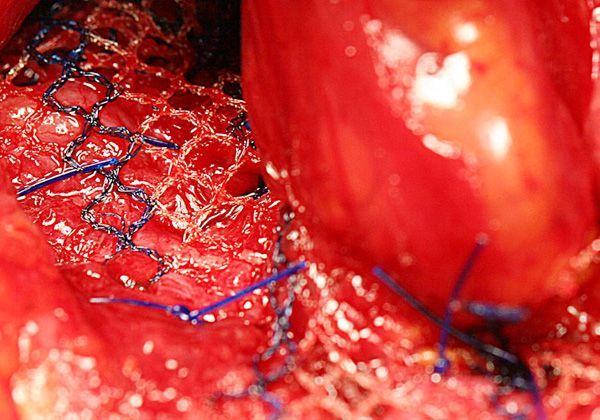
During inguinal hernia surgery, the intestines are first pushed back into the abdominal cavity. The hernial orifice is then closed. Traditionally, this is done using the Shouldice method, in which the abdominal wall is reinforced with the patient’s own tissue. Today, however, a synthetic mesh is more commonly used, as in the Lichtenstein procedure or through minimally invasive surgery using the TEP method (total extraperitoneal mesh repair). In these cases, the surgeon can perform the procedure with only small incisions. If the hernia is deep-seated or extends into the scrotum, the procedure may be somewhat more complex. Inguinal hernia surgery can be performed on an outpatient basis or in a hospital. Depending on the procedure and the patient, local anesthesia, regional anesthesia, or general anesthesia may be used.
Share this article

About the medical author
Prof. Dr. med. Ferdinand Köckerling
Medical Author · Director
Prof. Dr. med. Ferdinand Koeckerling – medical author: expert articles, professional insights and medical knowledge in the Leading Medicine Guide.
View full expert profile →