In many cases, severe diabetes leads to complications. For example, people with type 1 diabetes may suffer from chronic kidney failure. If insulin therapy does not lead to improvement, a pancreas transplant may help in some cases. It restores insulin production and normalizes blood sugar levels.
Here you will find further information as well as a list of selected specialists and centers for pancreas transplants.
Definition: What is a pancreas transplant?
With well-managed insulin therapy, people with diabetes can lead a largely normal life.
However, in about ten percent of people with diabetes, even intensive insulin therapy does not result in adequate metabolic control. Their metabolism repeatedly spirals out of control, leading to complications and life-threatening episodes of hypoglycemia.
People with diabetes who have severely damaged kidneys and require regular dialysis (blood filtration) may need a pancreas transplant. This involves implanting a donor’s pancreas into the patient’s body.
For example, if a person has severely damaged kidneys and requires regular dialysis (blood filtration), a pancreas transplant may be an option.
However, this type of procedure is performed only if
- diabetes has caused other serious complications and
- blood sugar levels cannot be adequately lowered through insulin therapy.
The surgery can be performed in different ways:
- Pancreas transplant following a previous kidney transplant,
- Simultaneous kidney-pancreas transplant,
- Pancreas transplant alone,
- Islet cell transplantation (transplantation of parts of the pancreas and insulin-producing cells into the liver).
The type of transplant used depends on the individual case. The most common procedure is the combined kidney-pancreas transplant. In this procedure, both the kidneys and the new pancreas come from the same donor.
A pancreas-only transplant can be performed even before kidney failure sets in.
Reasons for Pancreas Transplantation
Type 1 diabetes is a form of diabetes that typically develops during childhood or adolescence. The immune system of those affected produces antibodies that attack and destroy the body’s own cells in the pancreas. These so-called beta cells, which are part of the islets of Langerhans, are responsible for producing insulin.
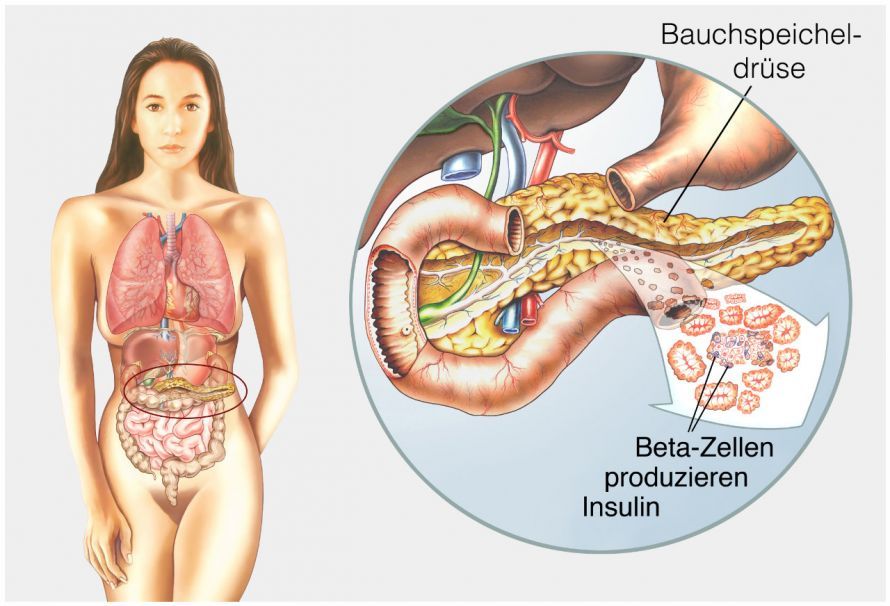
The body needs insulin to make sugar molecules from the blood available for metabolism. If the sugar does not reach the cells of the various organs and muscle cells, they cease to function.
In people with type 1 diabetes, the islet cells of the pancreas are usually destroyed at a very young age. For this reason, patients are forced to inject insulin regularly. This is the only way for sugar to get from the blood into the cells.
Since the walls of blood vessels cannot withstand high blood sugar concentrations, inflammation often develops there. As a result,
- thickening and stiffening of the vessel walls,
- reduced blood flow to the organs, and
- various forms of damage that develop over time.
This damage particularly often affects
- the kidneys,
- the heart,
- the retina of the eye, and
- the blood vessels in the legs (see “Diabetic Foot”).
A pancreas transplant is primarily considered when the kidneys have already stopped functioning. Clinical studies show that survival rates after a transplant are better than those of people who require insulin.
Methods and Surgical Procedures for a Pancreas Transplant
The combined kidney-pancreas transplant is performed under general anesthesia and takes between three and four hours. Before the operation, the medical staff examines the patient one last time and prepares them for anesthesia. They also inspect the donor organs and prepare them for the procedure.
At the start of the surgery, the surgeon—a specialist in pancreatic surgery—opens the abdominal cavity and the peritoneum. Since veins that are more easily accessible for connecting the organ are located on the right side of the body, the pancreas is transplanted there. Once the abdominal cavity is open, the surgeon exposes the necessary arteries and veins and connects them to the blood vessels of the donor pancreas.
The patient’s kidneys and pancreas are not removed.
The transplanted pancreas produces not only insulin but also digestive juices. Therefore, in addition to the donor organ, the surgeon transplants a short segment of the duodenum. By connecting this segment of the duodenum to the small intestine, the surgeon ensures that the secretions can drain properly.
Treatment with immunosuppressive medications begins during the operation itself. This is intended to suppress the immune system’s potential rejection of the donor organs.
Patient Care After Pancreas Transplantation
After the transplant, patients spend three to four days in the intensive care unit. It can take that long for the new organs to function properly. During the first few days, the patient is therefore often still given insulin injections. Dialysis is also performed.
It takes about three to four weeks before the patient is discharged from the hospital. During this time, doctors monitor the function of the new organs and check on wound healing. In addition, the patient’s dosage of immunosuppressive medications is adjusted.
Complications, Risks, and Prognosis
Every surgical procedure carries risks.
The most common complication following a pancreas transplant is the body’s rejection of the donor organs. In such a rejection reaction, the recipient’s immune system perceives the transplant as a foreign body.
To prevent this from happening, patients must take immunosuppressants for the rest of their lives. These are medications that suppress the immune system’s defensive response.
Doctors monitor the required dosage of these medications on a case-by-case basis in the weeks following surgery. The severity of the rejection reaction depends primarily on how well the cellular characteristics of the donor and recipient match.
There are three types of rejection reactions:
Hyperacute rejection: This reaction occurs either during the transplant or in the hours immediately following it. It is caused by incompatibility between the blood types or tissue characteristics of the donor and recipient. Such incompatibility is now ruled out during preoperative screening. As a result, this form of rejection is now rare. If it does occur, however, the transplant must be removed and a new donor organ transplanted.
Acute rejection: This reaction usually occurs within the first 90 days after the procedure. However, it can also occur years after surgery. It is also caused by the immune system recognizing the donor organ as a foreign body and activating various immune cells to destroy it. Doctors can usually treat acute rejection with medication.
Chronic rejection: This type of reaction does not occur until some time after the procedure, sometimes even several years later. Here, too, activated antibodies are responsible for the process. However, it proceeds much more slowly and insidiously. It may be necessary to adjust the dosage of the immunosuppressants being administered. Sometimes a repeat transplant is even necessary. This depends on the extent of damage to the transplanted organ and the surrounding tissue.
Other complications of a pancreas transplant may include:
- pancreatitis (inflammation of the pancreas),
- Leakage at the anastomosis between the patient’s own intestine and the transplanted duodenum,
- Pancreatic thrombosis.
Conclusion on Pancreas Transplantation
If insulin therapy does not lead to adequate metabolic control, people with diabetes may develop life-threatening complications. Kidney function often gradually deteriorates.
For people with type 1 diabetes and kidney damage, a pancreas transplant may be a viable option. Experts emphasize the improved survival rates after transplantation compared to those of patients who require insulin.
The surgery carries certain risks. Your doctor will explain these to you in detail. For example, the immune system may mount various rejection reactions against the transplanted organs.

Sources
- https://www.transplantation-verstehen.de/organe/pankreas
- https://www.transplantation-verstehen.de/organe/pankreas/gruende
- https://www.tk.de/techniker/gesundheit-und-medizin/behandlungen-und-medizin/diabetes/bauchspeicheldruesen-transplantation-2015498
- https://www.transplantation-verstehen.de/organe/pankreas/komplikationen