The heart is a vital organ that maintains the entire blood circulation. It pumps blood throughout the body and supplies all organs with oxygen and nutrients. The anatomy of the heart includes the atria, ventricles, and various heart valves that control blood flow.
The heart is located in the chest cavity behind the sternum and works continuously. A large volume of blood is pumped through the circulatory system every minute. A distinction is made between the systemic circulation and the pulmonary circulation. Conditions such as heart attack or heart failure can significantly impair its function.
What is the heart?
The heart is located behind the sternum, or breastbone, and is slightly tilted to the left. It is a powerful hollow muscle that normally weighs about 300 grams. Through regular contractions, it regulates the blood supply throughout the body. The blood circulated throughout the body carries vital substances such as oxygen and nutrients. It is no coincidence that the heart is considered by many to be the engine of life, given its indispensable role in maintaining the human circulatory system.
In an average person, the heart beats about 60–90 times per minute at rest. That amounts to over 100,000 beats per day. During this time, approximately 8,000 liters of blood flow through the body. Of course, these figures apply only to a person at rest. During periods of high stress or intense physical activity, blood flow can increase up to fivefold.
The Heart—Structure and Function
The heart, a hollow muscle, has four chambers. The two front chambers are called the atria and consist of the left and right atria. The larger chamber is called the ventricle and is, in turn, composed of two equally sized sections. A partition (septum) separates the two ventricles.
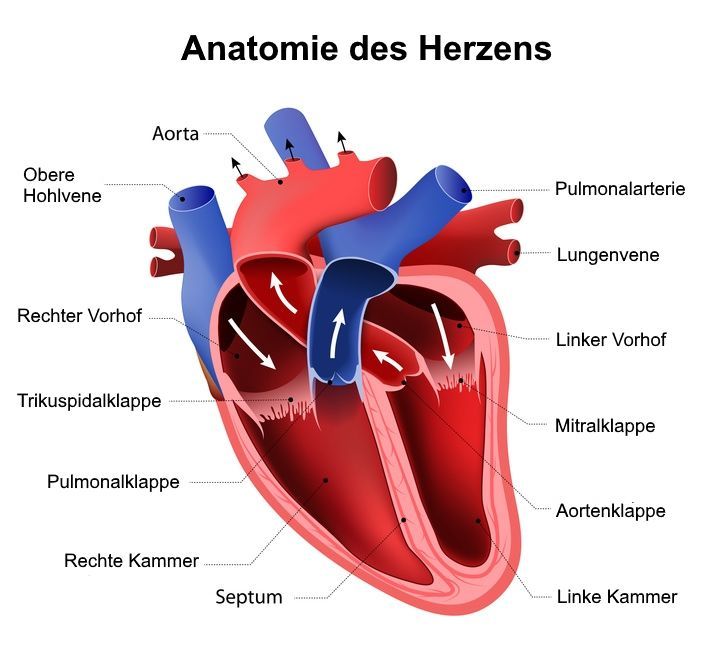
As part of the circulatory system, the atria collect venous blood before the ventricles take in the collected blood and pump it back into circulation. The blood then flows through the arteries to various parts of the body. Oxygen-poor blood flows to the lungs, while oxygen-rich blood flows to the rest of the body.
Heart valves are located at the openings of the heart muscle and between the atria and the ventricles; they determine the direction of blood flow. They ensure that a constant volume of blood flows through the heart. When using a stethoscope, doctors listen to the mechanism of the heart valves and the blood flow they regulate. The heart itself also depends on an adequate blood supply. To ensure this, it has its own system of blood vessels, the coronary arteries.
Physiological Importance of the Heart
The two most important physiological needs of humans are breathing and consuming food. Both processes enable the body to generate energy and maintain its vital functions. The nutrients contained in food are transported via the blood to various parts of the body. Similarly, the oxygen taken in through the air must pass through the lungs into the bloodstream to ultimately be utilized. Consequently, the heart plays a central role in both processes: breathing and the utilization of nutrients.
Furthermore, the muscle cells of the atrium release ANP, or atrial natriuretic peptide. Due to its vasodilatory effect (widening of blood vessels), atrial natriuretic peptide is primarily involved in regulating or lowering blood pressure, but it also affects the kidneys.
Heart Diseases
Like all organs, the heart can be affected by specific diseases that impair its function and endanger the body’s health. Heart diseases may result from congenital defects, but in many cases they are also a direct or indirect consequence of lifestyle. Factors such as diet, exercise, physical and psychological stress, and the use of substances such as alcohol or nicotine affect the condition of the heart and can lead to a wide range of symptoms.
The spectrum of different heart diseases is very broad. For this reason, the following sections explain only the most important or most common heart diseases.
Disorders and Malfunctions
A well-known disturbance of heart activity is cardiac arrhythmia. In this condition, the heartbeat follows an abnormal rhythm, which is classified into three types. Increased heart rates are called tachycardia; decreased heart rates are called bradycardia. In addition, extra beats (extrasystoles) may occur. Arrhythmias are often caused by irregularities in the conduction of electrical impulses, but they can also result from a metabolic disorder (e.g., hyperthyroidism). Furthermore, arrhythmias are often accompanying symptoms of another heart condition (e.g., myocarditis).
Some people suffer from congenital heart defects. These are usually due to abnormalities in the heart’s anatomy. The defective development of the organ during prenatal development manifests as adhesions, deformities, and disproportionate structures. This deviation from the normal structure of the heart is usually accompanied by reduced cardiac function.
Overview of congenital heart defects:
- Stenoses (narrowing) of the aortic arch or pulmonary valves
- Atrial septal defect (opening in the wall between the atria)
- Ventricular septal defect (opening in the wall between the ventricles)
High blood pressure, heart failure, heart attack
Today, high blood pressure is considered a widespread disease. It is estimated that up to 50 percent of the European population is affected by it. High blood pressure is characterized by higher resistance in the blood vessels than in a normal circulatory system. The heart must pump more forcefully to ensure an adequate blood supply. With chronic hypertension (high blood pressure), the heart muscle gradually enlarges. However, this enlargement means that the heart’s muscle cells can no longer be supplied with oxygen at a healthy level. The heart loses its ability to function effectively and becomes increasingly unable to withstand the pressure.
High blood pressure is therefore, alongside coronary heart disease, one of the most common causes of heart failure (cardiac insufficiency). Each year, 0.32 percent of the population develops heart failure. Doctors diagnose heart failure when the heart is unable to pump a sufficient volume of blood through the body without an increase in pressure in the atria. In severe cases, a pacemaker is implanted. Additionally, a heart transplant may be an option.
The term “coronary heart disease” refers to several conditions that can lead to similar long-term consequences. These include:
- Angina pectoris
- Atherosclerosis
- Heart attack
- Arrhythmias and heart failure
A heart attack is the most well-known heart condition. A heart attack is a medical emergency that, if left untreated, is fatal in most cases. When a branch of a coronary artery becomes blocked, the heart can no longer receive a full blood supply, causing muscle cells to die. This, in turn, further limits the heart’s ability to function and sets off a downward spiral in cardiac function.
Other heart diseases:
- Valvular heart diseases (valvular insufficiency and valvular stenosis)
- Pericarditis (a disease of the pericardium resulting from an infection)
- Functional cardiac neuroses (often not a typical cardiac condition; frequently of psychological origin)
Symptoms of heart disease
One of the first signs of heart disease is an irregular or unusual heartbeat (palpitations, extra beats, or a slow heartbeat). Many patients also complain of tightness in the chest. Rapid exhaustion after minimal exertion indicates heart failure. This loss of stamina is usually accompanied by increased fatigue and occasional arrhythmias.
Many heart conditions also manifest as pain that radiates from the chest area to the back and left arm. Women, in particular, may also experience diffuse upper abdominal pain. These symptoms are characteristic of a heart attack but may also be caused by other heart conditions. Chest pain must be evaluated by a doctor immediately.
The symptoms of various heart conditions are often similar. To determine the underlying cause and the best treatment, a doctor must conduct a thorough examination to assess your symptoms.
Conclusion
The human heart is a vital organ whose anatomy and function are closely intertwined. Understanding how the heart works makes it clear just how essential this process is for survival. The heart continuously pumps blood into the systemic circulation, supplying the entire body with oxygen and nutrients. At the same time, blood is directed into the pulmonary circulation, where it is enriched with oxygen. Electrical impulses control the heart’s rhythm, and at rest, the heart beats at a regular rate. In adults, the heart beats about 80 times per minute at rest and adapts flexibly to physical exertion.
Anatomically, the heart is located in the chest cavity, shifted to the left behind the sternum, and rests on the diaphragm. The heart is about the size of a fist and consists of a right and a left half, each with atria and ventricles. The large blood vessels ensure that blood flows in the correct direction, while heart valves prevent backflow. In addition, the heart is supplied by the coronary arteries, which encircle it like a wreath. The heart has a complex structure and exhibits a highly specialized architecture even at the microscopic level. It is housed within a protective system and continuously performs vital functions.
If the heart no longer functions properly, this can have serious consequences for the entire body. Nevertheless, the heart is an impressive system that maintains a stable circulatory system and reliably supplies the body with blood.
FAQ
How does the heart work?
The heart functions through the rhythmic contraction of the heart muscle. During this process, blood is pumped from the atria into the ventricles and then circulated throughout the body.
What are the functions of the heart valves?
Heart valves act like valves and prevent blood from flowing backward. They ensure unidirectional blood flow between the atria and ventricles, as well as into the large blood vessels.
What is the structure of the heart?
The anatomy of the heart consists of two atria and two ventricles. These are separated from one another and form the right and left halves of the heart.
What happens during a heart attack?
During a heart attack, the coronary arteries become blocked, so that the heart muscle is no longer supplied with enough oxygen.
How often does the heart beat?
In adults, the heart beats about 60–80 times per minute. The heart rate can vary depending on physical activity.