Da Vinci surgery is a minimally invasive, robot-assisted surgical procedure. It is used in urology, visceral surgery, and gynecology, among other fields. Doctors frequently use the Da Vinci system for prostatectomies, kidney surgeries, and surgeries on the urinary tract.
Here you will find further information as well as a selection of specialists and centers offering Da Vinci surgery.
Da Vinci Surgical Robot: Design and Function
The Da Vinci system is a robot-assisted, high-precision surgical procedure developed by the California-based company Intuitive Surgical.
“Robot-assisted” does not mean that a robot performs the surgery. It simply refers to robotic arms that are capable of significantly more precise and tremor-free movements than a human surgeon.
The Da Vinci robotic arms execute the movements directed by the surgeon in charge. The procedure is primarily used for treatments that require a very high degree of precision.
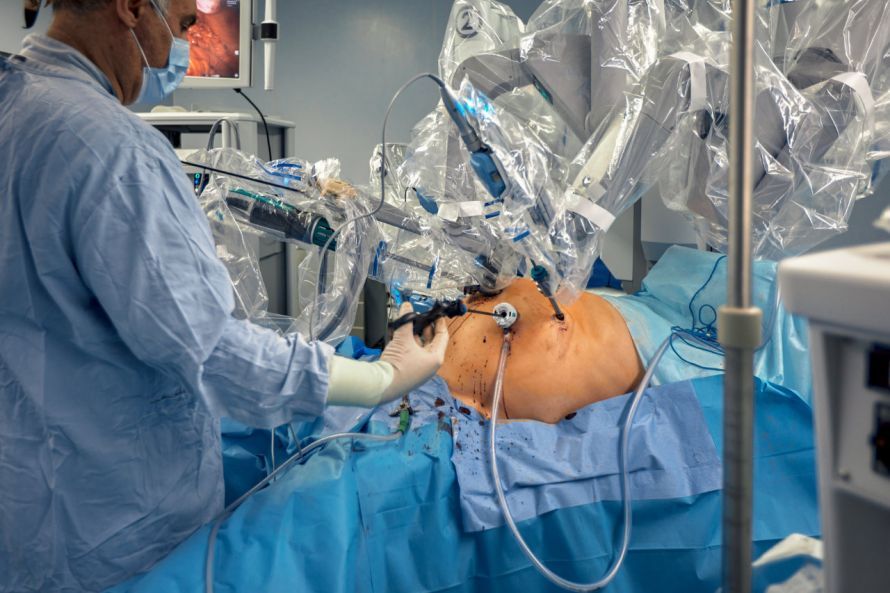
Surgeries using Da Vinci technology are performed on a minimally invasive basis. This does not require a large incision in the tissue, but only several very small incisions. Through these, the surgeon guides the robotic arms
- a 3D camera,
- light sources,
- the instruments needed for the procedure, and
- , if necessary, an ultrasound probe
. The surgeon views the camera image on a monitor, which allows them to navigate the surgical site and control the instruments inside the body.
Applications in Urology and Surgery
The procedure is used in various areas of visceral surgery (soft-tissue surgery), as well as primarily in
- urology,
- andrology, and
- gynecology.
Within these specialties, the procedure is used, for example, in oncology and in reconstructive urology.
Prostatectomy
A common example of a Da Vinci procedure is prostatectomy (removal of the prostate). This treatment is usually necessary due to prostate cancer. The prostate is located directly below the bladder, where it surrounds the urethra.
To avoid damaging important nerves and blood vessels, the surgeon dissects them with precision. This requires exceptional microsurgical skills. The surgeon must proceed with the utmost caution to avoid compromising the patient’s erectile function.
When suturing, the urethral sphincter must remain intact to preserve the patient’s urinary continence. A very high degree of precision is also essential in this context. This can be achieved with the help of the Da Vinci robot.
Kidney Surgery
During kidney procedures, the surgeon removes
- the entire organ (nephrectomy) or
- a portion of it (partial nephrectomy) or
- simply opens the kidney, for example, to remove a kidney stone.
The most common reason for a (partial) kidney removal is carcinoma or other forms of kidney cancer.
If kidney function is to be preserved, precision surgery of the highest caliber is essential.
Surgery on the urinary tract
Another common indication for the da Vinci procedure is surgery on the urinary tract:
- on the renal pelvis,
- on the ureter,
- the bladder, or
- the urethra.
Cystectomy, the removal of the bladder, is usually performed—as are prostatectomy and nephrectomy—due to malignant tumors such as carcinomas (bladder cancer).
Ureteral surgeries include
- ureterectomy, i.e., the complete removal of the ureter (often due to carcinoma),
- and reconstructive procedures, such as the correction of narrowings at the junction of the renal pelvis.
How does a Da Vinci surgery work?
A prerequisite for any surgery is always a comprehensive consultation between the doctor and the patient. During this consultation, the doctor explains the various options as well as the respective risks of the surgical techniques.
Before the actual surgery, the surgeons introduce carbon dioxide into the patient’s abdominal cavity through a small initial incision. This causes the abdominal wall to expand, giving the surgeon a clear view of the surgical site and allowing for optimal maneuvering of the instruments.
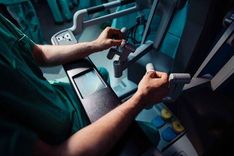
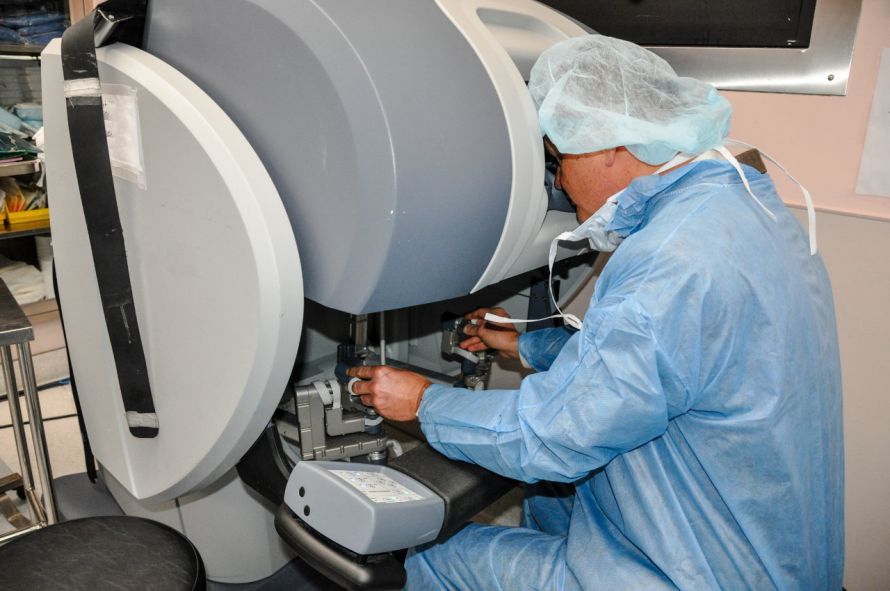
During the procedure, the surgeon sits at the operating table at a control console equipped with a screen. The screen displays a magnified view of the surgical field captured by the robot’s camera. At the console, the surgeon performs hand movements that are transmitted to the robot’s four arms.
Da Vinci technology filters out the surgeon’s involuntary movements and automatically compensates for twitches or hand tremors. The system also features a scaling function that converts the surgeon’s rough movements into finer instrument movements. This enables extremely precise surgical techniques.
The robot cannot operate independently. Consequently, it is not possible, for example, to program it to perform surgery automatically. Every single movement is manually controlled by the surgeon.
Da Vinci Xi System – Robot-Assisted Surgery with Flexible Approaches
The Da Vinci Xi System belongs to the most advanced generation of robot-assisted surgical systems. It features four robotic arms that can be positioned individually, providing the surgeon with a high degree of flexibility within the surgical field. The Vinci Xi is used particularly frequently in the departments of urology, gynecology, and general surgery, where precise incisions and microsurgical techniques are required. The improved 3D HD imaging provides the surgeon with an optimal view of the structures inside the body and facilitates complex procedures that require the highest level of precision.
Da Vinci SP System – Single-Port Technique for Minimally Invasive Procedures
The Da Vinci SP System (“Single Port”) enables procedures through a single access point. The camera and instruments are inserted together through a small opening into the abdominal cavity. This reduces the number of skin incisions and minimizes the burden on the patient. The Da Vinci SP is used in particular for urological procedures, such as those involving the prostate. It is also becoming increasingly important in other areas of minimally invasive surgery, as it allows for a gentle surgical technique while maintaining the precision of robot-assisted surgery.
Advantages & Disadvantages
From a medical perspective, the use of the Da Vinci robot offers significant advantages due to its tissue-sparing incisions:
- The external incisions are no larger than 2 cm.
- The instruments used are extremely maneuverable and can be optimally aligned at any time. This eliminates the need to hold organs aside, secure them, or move them into a specific position.
- The magnified view of the surgical field allows for extremely precise and safe work without damaging healthy tissue.
For you as a patient, this means the following compared to traditional surgical methods:
- a lower risk of bleeding,
- significantly faster wound healing,
- significantly less pain and, as a result, less need for pain medication,
- a shorter recovery period: you’ll be back on your feet faster and spend less time in the hospital,
- a lower risk of wound healing complications and other complications,
- and only very small scars.
Disadvantages of Da Vinci surgery include high costs (purchase and operation), longer surgery times, the surgeon’s lack of tactile feedback, greater effort required for instrument sterilization, and the lack of improvement in the most significant side effects of prostate removal—such as incontinence and impotence—compared to open surgery. In addition, the surgeon’s experience can be crucial to the success of the surgery.
Postoperative Care After Da Vinci Surgery: Healing and Rehabilitation
In most cases, the patient is allowed to take a few steps as early as the day after Da Vinci surgery. The nursing staff will assist you with this. Especially during the first few days, the attending physician monitors wound healing and pays attention to surgery-specific considerations.
You will generally be discharged very quickly after Da Vinci surgery. Further follow-up care can then be provided by a specialist in private practice.
Depending on the procedure, it may be strongly recommended that you begin physical therapy exercises immediately. After a prostatectomy, for example, these exercises help you strengthen the urethral sphincter.
Risks and Side Effects of Da Vinci Surgery
Some patients experience muscle soreness in the shoulder area for several days following the procedure due to the positioning required during surgery.
Furthermore, in the first few days, you may experience a feeling of fullness and some pressure-related pain. This is caused by the introduction of carbon dioxide into the abdominal cavity. This sensation will also subside.
Possible complications vary depending on the diagnosis and surgical technique. In general, with Da Vinci technology, they correspond to those of the respective conventional procedures. However, the risk of these complications occurring is often lower, for example with regard to
- bleeding,
- nerve damage, or
- wound healing complications.

About the medical author
Sabine Schneider
Editor-in-Chief
Sabine Schneider – medical author: Explore expert articles and medical expertise in the Leading Medicine Guide.
More about the medical author →