Expert Interviews
Inverse Prosthesis for Shoulder Conditions

Alexandra Pfitzmann ·
An inverse shoulder prosthesis is used when the natural structures of the shoulder—especially the rotator cuff—are so severely damaged that reconstruction is no longer a viable option. Due to the reversed joint geometry, the deltoid muscle takes over a large part of the movement, which can help patients regain good functional ability in daily life despite severe tendon damage.
The inverse prosthesis has proven particularly effective in cases of irreparable tendon tears, complex fractures, and advanced osteoarthritis, where conventional procedures such as the anatomical prosthesis reach their limits.
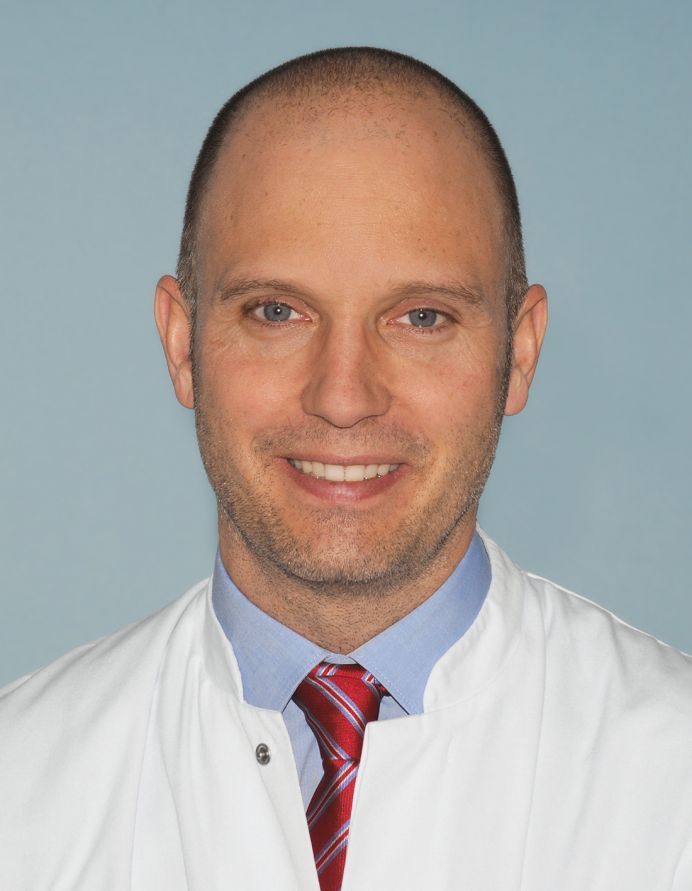
“The inverse shoulder prosthesis differs from the anatomical prosthesis in that the natural joint architecture is deliberately reversed. This concept has existed since 1989 and was developed to help patients whose rotator cuff is no longer functional. With the reverse prosthesis, an artificial head is attached where the glenoid cavity would normally be, while a socket is implanted in place of the original humeral head.
This reversal shifts the center of rotation of the shoulder joint inward and downward, which significantly improves the lever arm of the deltoid muscle. As a result, the muscle can work much more efficiently. “It is precisely this biomechanical advantage that enables many patients to lift their arm above the horizontal plane again despite the absence of a rotator cuff—something that would not be possible with an anatomical prosthesis in such cases,” explains PD Dr. Eden at the beginning of our conversation.
The inverse shoulder prosthesis works because it reverses the joint mechanics, thereby fundamentally altering force transmission. The fulcrum is shifted medially and caudally, which significantly lengthens the lever arm of the deltoid muscle. This allows the deltoid muscle to take over movements that are normally controlled by the rotator cuff.
Reconstructive therapy is no longer advisable when the biological and biomechanical prerequisites for a stable restoration of shoulder function have been permanently lost. In these situations, the inverse prosthesis becomes the only reliable option because it functions independently of the rotator cuff and shifts force transmission entirely to the deltoid muscle.
“The decision to use an inverse shoulder prosthesis instead of an anatomical one depends on whether the structures necessary for an anatomical repair are still functioning reliably at all. Originally, the inverse prosthesis was used almost exclusively in cases of so-called defect arthropathies—situations in which the rotator cuff, particularly the supraspinatus tendon, is irreparably damaged.
In such cases, the humeral head migrates upward because the central muscular ‘motor’ capable of lifting the arm is missing. While an anatomical prosthesis could alleviate pain in this situation, it would not achieve any functional improvement. The inverse prosthesis, on the other hand, uses the deltoid muscle as the primary driver and can thus enable good range of motion despite the absence of the rotator cuff. This area of application still exists and remains one of the most important indications. Over time, however, the range of applications has expanded significantly.
In cases of complex proximal humerus fractures in older patients—often over 75 or 80 years of age—bone quality is frequently so poor that osteosynthesis offers little hope of success. In the past, hemiprostheses were used in such cases, but they yielded functionally disappointing results. Since the inverse prosthesis has also been used in these cases, significantly better results have been observed, which is why it is now considered the treatment of choice in this age group,” says PD Dr. Eden, adding regarding treatment for omarthrosis:
“Even in cases of knee osteoarthritis—which was originally the domain of the anatomical prosthesis—the inverse prosthesis is becoming increasingly important. Although the rotator cuff is often still intact in patients with osteoarthritis, in practice we repeatedly encounter joints that are decentrated—the humeral head is no longer centered in the glenoid cavity but has shifted backward and downward. In such cases, an anatomical prosthesis performs worse biomechanically, whereas the inverse prosthesis delivers stable and reliable results even under these conditions.
Furthermore, it is less dependent on a permanently intact rotator cuff. When anatomical prostheses fail after ten to fifteen years, this is usually due to secondary rotator cuff insufficiency—and in such cases, the patient is switched to an inverse prosthesis anyway.”
There are certainly situations in which an inverse shoulder prosthesis would be technically appropriate and functionally promising, but one must nevertheless decide against it. Age is an important factor.
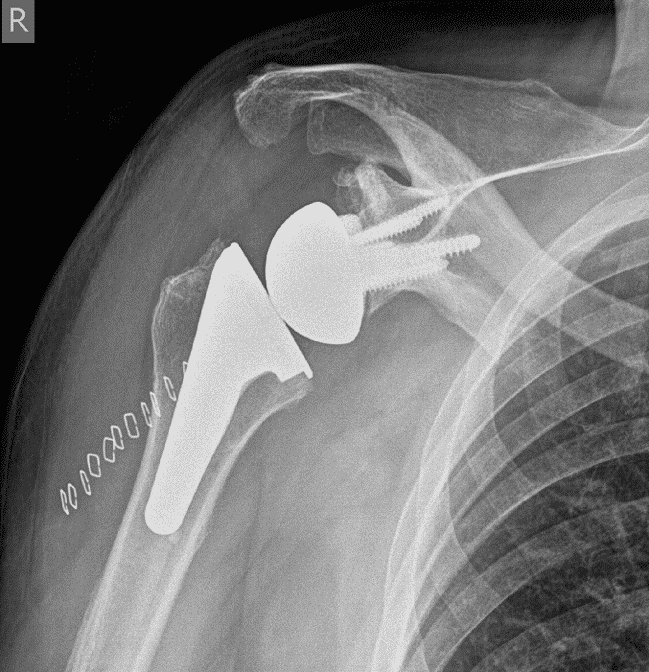 Photo: Inverse Prosthesis
“The average lifespan of a prosthesis is about fifteen to twenty years, and since the life expectancy of many patients is around eighty years, we try to plan the procedure so that, ideally, only one surgery is necessary. In very young patients, an inverse prosthesis would most likely require replacement later on, which is technically more challenging and carries higher risks. For this reason, its use in younger patients (under 60 years of age) is considered only in exceptional cases.
General health status also plays a key role. An inverse prosthesis is implanted under general anesthesia, and although the procedure today usually takes no longer than about an hour and a half, the risks associated with anesthesia must be carefully weighed. For patients with severe pre-existing conditions, impaired heart or lung function, or a high overall perioperative risk, surgery may not be justifiable despite good functional prospects.
It is crucial that the benefits of the prosthesis are proportionate to the risks. “A technically perfect prosthesis is of little use if the body cannot tolerate the procedure well,” explains PD Dr. Eden.
The materials used consist primarily of metal alloys—such as a metal “base plate” on the acetabular cup and a metal stem in the upper arm. For patients with a nickel allergy, titanium-coated implants can also be used. The bearing pair typically consists of a metal-plastic combination, in which the glenosphere (the hemispherical metal head) is metallic and the humeral socket is made of highly cross-linked plastic.
Age, activity level, tissue quality, and comorbidities collectively determine whether a patient will benefit from an inverse shoulder prosthesis, as they directly influence how reliably the deltoid-dominant mechanism functions and how stable the prosthesis remains over the long term. Recovery following shoulder replacement follows clear, well-established protocols—regardless of whether an anatomical or inverse prosthesis was chosen.
“Rehabilitation after an inverse shoulder prosthesis is essentially similar to that following an anatomical prosthesis. Patients typically remain hospitalized for three to four days; afterward, the arm is strictly rested for about six weeks before the actual rehabilitation phase begins. This approach has proven effective for both types of prostheses. There are only minor differences in the range of motion regarding rotation, but overall, the processes are very similar. What matters most is not so much the type of prosthesis as the amount of time the body needs to regain its strength.
After about three months, most people report that the procedure was worth it: pain is significantly reduced, the arm can once again be raised above the horizontal, and daily life is noticeably easier. From this point on, patients can also begin sport-specific rehabilitation. However, the extent of the arm’s restored strength depends heavily on the individual’s initial condition. For people who are physically active—such as a tennis player—long shots are once again a realistic possibility, while a powerful serve remains more difficult. A complete restoration of shoulder function is possible, but not the norm.
“For a younger, athletically ambitious patient with osteoarthritis, we would tend to favor an anatomical prosthesis because it is expected to provide better rotational ability,” explains PD Dr. Eden.
Osteoarthritis-related shoulder disease is one of the three main causes that can ultimately lead to prosthetic replacement—alongside complex fractures and defect arthropathy, in which the rotator cuff, particularly the supraspinatus tendon, is irreparably damaged.
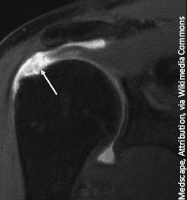 Photo: Rotator cuff tear
Regarding this, PD Dr. Eden clarifies: “While an anatomical prosthesis is not a suitable option for fractures and defect arthropathy, it is generally a viable option for shoulder osteoarthritis. At our clinic, we’ve observed that these three conditions occur with roughly equal frequency, and overall, the inverse prosthesis is implanted in 80–90% of cases. Above all, it is important for prevention to pay attention to warning signs from the shoulder at an early stage. Pain, loss of function, or increasing difficulty raising the arm overhead should prompt a visit to an orthopedic specialist.
An MRI can determine whether a tendon tear is present—and if it is repaired arthroscopically in a timely manner, the development of defect arthropathy can often be prevented. It is equally crucial to actively maintain shoulder mobility. The earlier concept of rest for osteoarthritis is now considered outdated. Movement, stretching exercises, and targeted muscle training help preserve function and prevent painful frozen shoulder. Muscular balance is particularly important: Many people primarily train the front shoulder and chest muscles but neglect the external rotators and back muscles, which are essential for stable shoulder function.
When it comes to typical patient groups, the picture is more nuanced. Due to osteoporosis, fractures affect women significantly more often—here, the proportion is at least two-thirds. In cases of osteoarthritis and defect arthropathies, however, the numbers are roughly equal between men and women.”
The DVSE-CEE certificate (German Association for Shoulder and Elbow Surgery – Certified Expert in Elbow and Shoulder Surgery) serves as proof of quality, demonstrating that a physician or clinic possesses verifiably high levels of expertise in the field of shoulder and elbow surgery.
Since there is no official subspecialty designation in this field—as there is, for example, in hand surgery—these certificates serve to transparently demonstrate experience, specialization, and structural quality—an aspect that is becoming increasingly important in the context of hospital reform and the growing centralization of specialized services.
“The certification system is structured in two stages: First comes the basic certificate, which includes both theoretical and practical modules. It forms the foundation for the expert certificate, which imposes significantly stricter requirements. In addition to completing additional module hours, physicians must demonstrate that they have performed at least 250 surgeries in the shoulder-elbow region over a three-year period, including one year at a specialized clinic. Only then is the expert certificate awarded—a clear indication that not only theoretical knowledge but, above all, surgical experience is required.
Clinics can also obtain certification. To do so, they must offer a diverse range of treatments, maintain a 24/7 emergency department, and meet defined staffing requirements—such as having a qualified director and deputy director. In addition, there is a special prosthesis seal awarded only to clinics at the “Gold” level that implant more than 50 shoulder or elbow prostheses annually and scientifically document their results.
This seal has been awarded to only a few facilities in recent years and demonstrates that they combine a high volume of cases, routine practice, and high-quality outcomes. To help patients understand the requirements behind these certifications, a clear explanation of the individual steps is helpful.
“These certifications show patients that they are being treated at a facility that meets high case volumes, specialized expertise, and verified quality standards—a crucial factor for safe care and good outcomes,” states PD Dr. Eden, adding:
“Complications can occur even in experienced centers, but the risk is significantly lower there—and that is precisely why routine is so crucial in shoulder arthroplasty. Possible problems include dislocations—that is, the prosthesis popping out of place—infections, loosening (septic due to bacteria or aseptic without infection), as well as vascular and nerve injuries. Specific to the inverse prosthesis is its dependence on the deltoid muscle: Since all force transmission occurs via this muscle, unfavorable tension or poor bone quality can lead to acromion fractures—breaks in the acromion, where the muscle is anchored.
Another typical complication is “scapular notching,” in which the socket attached to the upper arm rubs against the lower edge of the scapula and wears away bone there. Although modern implant designs have reduced this risk, it has not disappeared entirely. Capsular scarring leading to shoulder stiffness is also possible, even if the prosthesis fits perfectly from a technical standpoint.
Overall, however, the complication rate has dropped significantly today. While rates of up to 30% were previously reported for reverse prostheses, well-managed centers now report single-digit rates, typically only 3–5%. Precisely because these procedures are technically demanding and complications, if they occur, require complex revisions, it is so important for patients to seek out clinics that have a high volume of cases, certified expertise, and a proven track record in shoulder arthroplasty.”
Modern shoulder arthroplasty relies heavily on technical support today, but surgical skill remains a key factor.
“For shoulder arthroplasty, 3D planning is now routinely performed. For this, a CT scan is performed before surgery and then imported into specialized software. There, the shoulder joint can be visualized in three dimensions, the implant position can be precisely planned, and it is even possible to simulate how mobility might be affected after surgery. This planning is particularly crucial in cases of malalignment or complex bony anatomy, as it allows for precise determination of whether corrections must be made using bone grafts or angled implants. Navigation-assisted surgeries are also possible, but they are used only in very specific cases and are not standard practice.
Robotic assistance systems are also on the horizon—they are already in use in knee arthroplasty, and it is quite conceivable that they will also play a role in shoulder surgery in the coming years. However, this is still a long way off. Despite these technical advances, surgical experience remains a key factor for success. The anatomical prosthesis is considered more challenging because the cup must be positioned with millimeter precision and the rotator cuff must be protected during the procedure. Even small deviations can impair function. The inverse prosthesis is somewhat more “tolerant of errors” in this regard. The glenosphere—a hemispherical component—allows for slight angular deviations without compromising mobility.”
The ongoing evolution of the hospital landscape is bringing major structural changes to orthopedics and trauma surgery. While many procedures could be performed on an outpatient basis for medical reasons, complex surgeries such as shoulder and elbow replacements remain firmly rooted in the inpatient setting. In this phase of reform, in which cross-sector care models are gaining importance, the focus on quality, specialization, and reliable expertise is more critical than ever. This is precisely where the work of PD Dr. Eden and his team at Rummelsburg Hospital comes in—with a range of services that goes far beyond what many hospitals can offer.
“Many surgeries could be performed on an outpatient basis for medical reasons, while complex procedures such as joint replacements should remain in an inpatient setting. The current phase of reform is bringing a lot of change in this area, and it will be crucial that care in the future is organized more according to medical logic and less according to departmental boundaries,” notes PD Dr. Eden, and concludes our conversation by making it clear:
“Our clinic stands out because it covers the entire spectrum of shoulder and elbow surgery—from acute fracture management and arthroscopic procedures to complex prosthetic surgeries and challenging revision procedures. This breadth is a distinctive feature, as many facilities are either heavily focused on trauma surgery or concentrate exclusively on elective procedures. Here, however, both areas come together, enabling an exceptionally high level of surgical expertise across the board.
My training in trauma surgery further ensures that both complex injuries and elective procedures can be performed to a consistently high standard. The high caseload of over 800 surgeries per year underscores this experience and is reflected in the quality of outcomes. The fact that patients are increasingly traveling from more distant regions shows that our specialization and high level of expertise are widely recognized. Even though regional care remains our primary focus, the clinic has long been regarded as a nationally recognized center for complex shoulder and elbow surgery.”
- Senior Attending Physician, Shoulder & Elbow Surgery, Rummelsberg Hospital
- DVSE Certificate of Expertise in Shoulder & Elbow Surgery
- ~800 surgeries per year at the specialized center
- FOCUS Top Physician for Shoulder and Elbow Surgery
- Specializes in arthroscopic procedures, fractures, and instabilities
- Extensive expertise in shoulder and elbow joint replacement
- Board-certified specialist with additional certifications in: Specialized Trauma Surgery, Sports Medicine, Radiological Diagnostics, and Emergency Medicine
Share this article
Expert Interviews
Read next
- Expert interview
Expert interview with Professor Dr Elmar Herbst, PhD
Oct 15, 2026
Patient-centred and personalised knee surgery
Read more - Expert interview
Cardiogeriatrics: Significance and benefits in the context of hospital reform
Sep 21, 2026
Cardiogeriatrics: Significance and benefits in the context of hospital reform
Read more - Expert interview
Expert Interview with Professor Dr. Amadeus Hornemann, MPH
Sep 18, 2026
Prof. Amadeus Hornemann on Precision Medicine in Gynecology: Modern Surgery, New Techniques, Better Quality of Life
Read more