Expert Interviews
Urology specialist Dr. Hefty: “Bladder cancer is the poor relation!”

Sabine Schneider ·
He refers to bladder cancer as “the forgotten carcinoma”: As a renowned urologist, Dr. Robert Hefty focused his attention on bladder cancer early in his career. So it’s no wonder that he immediately joined the “Bladder Cancer Roadshow 2021” project, which aims to raise awareness of this type of cancer among the general public—including both specialists and primary care physicians. September 20, 2021, was an important date for the chief physician and his team at the Department of Urology at Heidenheim Hospital, as the response was overwhelming. The Leading Medicine Guide spoke with Dr. Hefty about this—and about the opportunities to continue raising awareness of bladder cancer in the future.

Leading Medicine Guide: When the bladder cancer roadshow toured Germany and Austria in the summer of 2021, you and the senior physician team from your clinic were one of the stops. How did that come about?
Dr. Robert Hefty, M.D.: Thanks to my training at the University Hospital of Ulm—where, incidentally, the first neobladder surgery was performed (a continent bladder substitute created from the small intestine—Ed.)—I’ve been working on bladder cancer for a long time. Many people know me, and I know many others who are also deeply involved in this field, including internationally. I have many contacts in the U.S. and throughout Europe. Even Australia and Asian countries are on the rise in this area.
Leading Medicine Guide: So you owe your participation to your excellent network?
Dr. Robert Hefty: In fact, I was approached directly by the organizers, Fa Photocure® and Wolf, since I’ve been working with them for years and I personally treat many bladder cancer patients. Unfortunately, compared to breast or colorectal cancer, bladder cancer is completely neglected in Germany. In the Anglo-American world, entire “Bladder Awareness” months are organized, during which the bladder receives a great deal of attention. We’re a long way from that here in Germany. The main message should be to alleviate people’s fear of urologists, although many don’t even realize that urologists aren’t just responsible for the prostate and don’t only treat men.
Leading Medicine Guide: And how did the day go? There was a huge turnout. Were there many questions from the audience—and were you, as chief physician, able to educate people in this way?
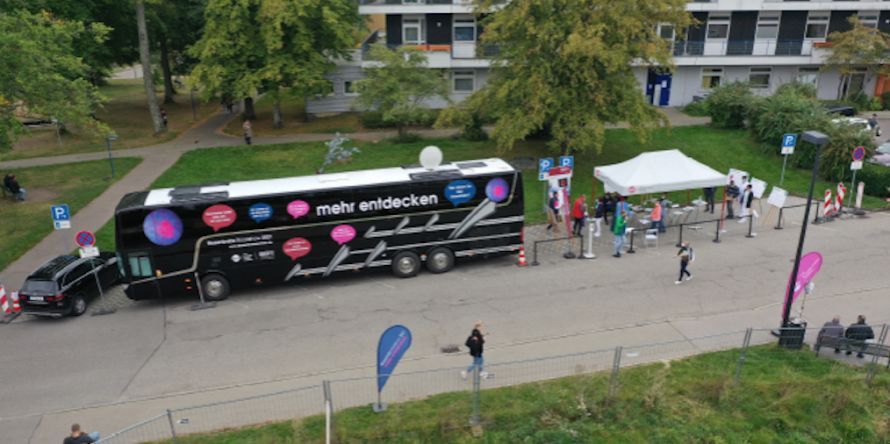
Dr. Robert Hefty: First of all, we had a perfect team consisting of the roadshow staff and our urology team, who worked together to make the preparations. We even had chocolates custom-made to promote the roadshow. Because we were located right at the hospital, there was indeed a large turnout of genuinely interested people. We were able to inform people through a series of stations covering various topics—including risk factors, symptoms, diagnosis, treatment, and so on. In addition, medical professionals demonstrated the latest urological equipment. Overall, the “Bladder Cancer Roadshow 2021” in Heidenheim must be seen as an important first step toward future events of this kind, because—as I said—people are simply not familiar with the topic.
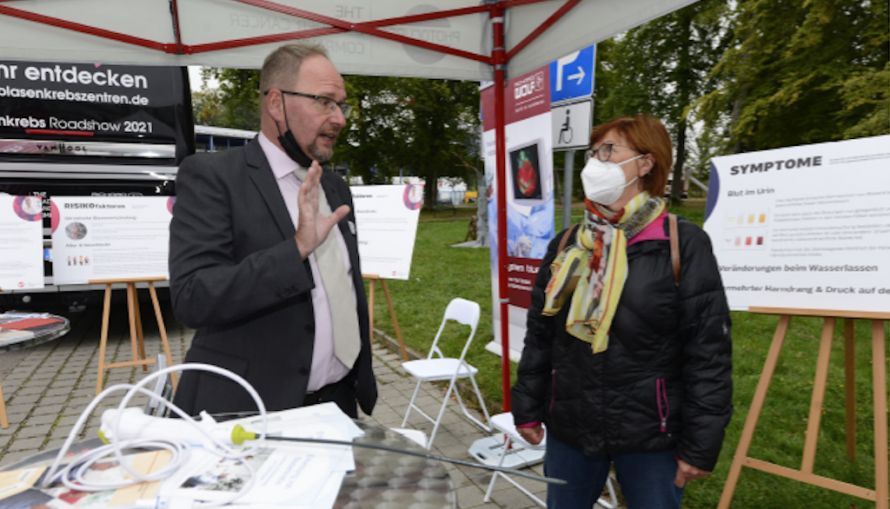
Education is essential: Dr. Robert Hefty speaking during the “Bladder Cancer Roadshow”
Leading Medicine Guide: In Germany alone, up to 30,000 people are newly diagnosed with bladder cancer every year. Yet you refer to this disease as “the forgotten carcinoma.” Isn’t that a bit of a discrepancy?
Dr. Robert Hefty: Because there’s still too little information available about it, and because many people downplay the problem of “blood in the urine”! Unfortunately, not even the Joint Federal Committee (GBA) includes a targeted screening for bladder cancer in its preventive care guidelines. We mustn’t forget that the GBA sets the guidelines for health care and thus determines which services are covered by statutory health insurance. After all, bladder cancer ranks fourth among tumors in men, and without treatment, it is highly aggressive.
Leading Medicine Guide: The high-profile roadshow came at just the right time. Now some time has passed again. How can we continue to raise awareness among the general public—and among the medical community as well?
Dr. Robert Hefty: We actually had two patients who responded immediately. They presented with acute bladder bleeding. Diagnostic tests revealed early-stage tumors in both cases. They were able to undergo surgery and were initially cured without losing their bladders entirely.
Leading Medicine Guide: If the number of bladder cancer cases is rising—especially among men—how can we counteract this? What should people do—or avoid doing—to prevent this disease? In other words: What are the risk factors?
Dr. Robert Hefty: The main risk factor is smoking, including former smokers—even if people haven’t smoked for twenty years, they were exposed to the agent that triggers the cancer. Furthermore, bladder cancer is recognized as an occupational disease among workers in the textile dyeing industry, hairdressers, and those in the leather processing industry. This means that bladder cancer also plays a role in public health.
Leading Medicine Guide: Although the disease is less common in women, it is more often detected only at an advanced stage. Why is that? Does it have anything to do with the symptoms?
Dr. Robert Hefty: No. The main reason is that in women, bladder bleeding is often downplayed, misinterpreted as a urinary tract infection, and thus treated incorrectly. Furthermore, the crux of the matter is that female patients with recurrent infections are at risk of malignant transformation. In women, the issue of “blood in the urine” is taken far too lightly. After all, women generally don’t go directly to a urologist with these symptoms.
Leading Medicine Guide: During the roadshow in Heidenheim, you also placed great emphasis on an “exchange on equal footing.” Surely that’s also related to the fact that you always approach your patients openly, isn’t it?
Dr. Robert Hefty: In general, I’m a very empathetic person and try to respond to all kinds of personalities. That’s why we at Heidenheim Hospital develop completely individualized treatment plans. I place a very high value on that! Of course, we follow the guidelines—not just national ones, but international ones as well. So we always strive to stay up to date—and to treat patients according to the standards of evidence-based medicine, meaning we always base our approach on the best data and sources available to us. This allows us to use current, scientifically validated information and integrate it into our treatments. In this way, we offer “high-class urologic medicine”—truly top-tier urology—backed by the best expertise.
Leading Medicine Guide: Dr. Hefty, thank you very much for these insights into the current state of bladder cancer. Perhaps this interview can also help a little to shine a light on “the forgotten carcinoma.”

A Sweet Way to Raise Awareness: Custom-made treats from a pastry chef highlight the urgency of the issue
Share this article
About the medical author
Sabine Schneider
Editor-in-Chief
Sabine Schneider – medical author: Explore expert articles and medical expertise in the Leading Medicine Guide.
More about the medical author →Clinics District Heidenheim gGmbH - Clinic for Urology and Pediatric Urology
ProfileExpert Interviews
Read next
- Expert interview
Cardiogeriatrics: Significance and benefits in the context of hospital reform
Sep 21, 2026
Cardiogeriatrics: Significance and benefits in the context of hospital reform
Read more - Expert interview
Expert Interview with Professor Dr. Amadeus Hornemann, MPH
Sep 18, 2026
Prof. Amadeus Hornemann on Precision Medicine in Gynecology: Modern Surgery, New Techniques, Better Quality of Life
Read more - Expert interview
Expert Interview with Professor Dr. Konstantinos Anagnostakos
Sep 15, 2026
Prof. Anagnostakos on Painful Knee Replacements
Read more