Expert Interviews
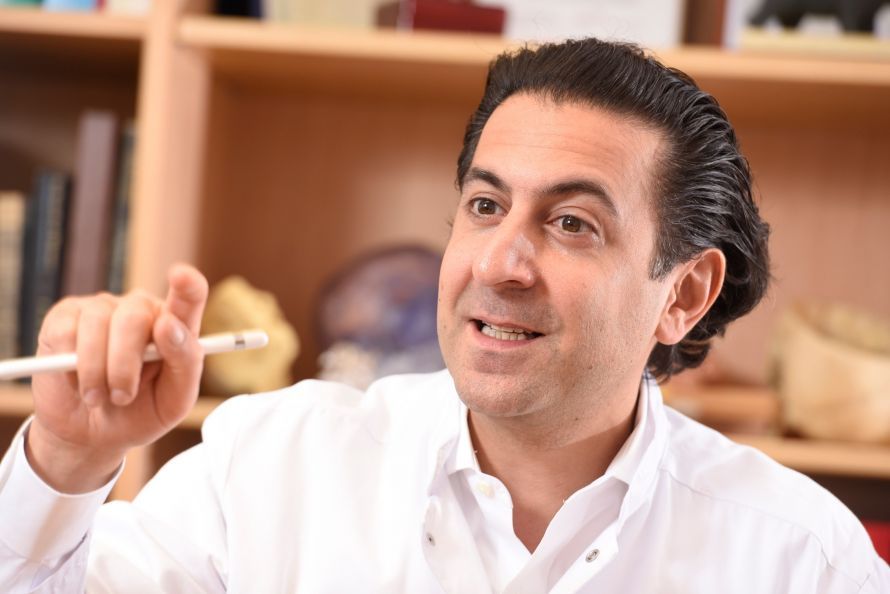
Vestibular Schwannoma—A Tumor of the Auditory Nerve: An Expert Interview with Prof. Dr. med. Amir Samii

Alexandra Pfitzmann ·
And suddenly, there’s whistling, hissing, beeping, and roaring in the ear. It becomes difficult to fall asleep because the sounds in the ear dominate one’s thoughts. Headaches often accompany these symptoms, and some people also experience severe tinnitus, dizziness, and nausea. The cause of this problem is what’s known as a vestibular schwannoma—originally called an acoustic neuroma—a (mostly) benign tumor in the inner ear canal at the point where the vestibular nerve exits into the cranial cavity. This relatively rare tumor most commonly affects people between the ages of 50 and 60. Statistically speaking, only 1 to 1.5 out of every 100,000 people are newly diagnosed with a vestibular schwannoma each year. Diagnosis and treatment require a high level of medical expertise, as surgical treatment in particular demands the utmost precision and skill. The editorial team of the Leading Medicine Guide had the opportunity to speak with one of the world’s leading specialists in vestibular schwannomas, Professor Dr. med. Amir Samii of the International Neuroscience Institute® (INI) Hannover GmbH, to learn more about this tumor, which is unfamiliar to many.
The tumor itself develops from so-called Schwann cells, which insulate the cranial nerves in the brain, thereby accelerating the transmission of information between individual nerve cells. In a person with a vestibular schwannoma, these cells grow rapidly and uncontrollably, encasing themselves in a capsule of connective tissue, which isolates them from the surrounding tissue. The cause of such tissue overgrowth remains unclear to this day. The use of mobile devices as a possible cause has now been ruled out. The condition is called a vestibular schwannoma because the growth originates from the vestibular nerve (nervus vestibularis). This nerve transmits information from the inner ear to the brain. Many patients are unaware for a long time that something is growing in their head that does not belong there. However, as soon as the first symptoms—such as noticeable ringing in the ears or hearing loss—become apparent, they typically visit an ear, nose, and throat (ENT) specialist.
The vestibular nerve, together with the auditory nerve (cochlear nerve), forms the eighth cranial nerve, the vestibulocochlear nerve. This is the nerve responsible for hearing and balance, and it runs from the inner ear through the internal auditory canal and the angle of the cerebellopontine angle into the brainstem. The myelin sheath of the cranial nerves consists of connective tissue cells, called Schwann cells, from which vestibular schwannomas develop—specifically when there is a genetically or sporadically caused loss of a tumor suppressor gene (these are genes whose products suppress the uncontrolled division of genomically damaged cells and can prevent the development of tumors).
To make a diagnosis, the patient’s external auditory canal and eardrum are examined. A hearing test is also performed using tone, speech, and brainstem audiometry (BERA test) to assess the function of the auditory nerves, along with an evaluation of the sense of balance. Finally, a magnetic resonance imaging (MRI) scan with contrast dye provides information on how advanced the tumor is and its exact location.
This benign tumor can be identified by the following symptoms:
- Sensorineural hearing loss
- Sudden hearing loss
- Tinnitus
- Dizziness
- Nausea and vomiting
- Headaches
- Facial nerve paralysis (nervus facialis)
- Sensory disturbances in the face
- Stiff neck
- Visual disturbances (double vision)
When a vestibular schwannoma is diagnosed, there are three treatment options: watchful waiting, radiation therapy, and surgery.
Several factors play a role in deciding which type of treatment makes the most sense. For example, it depends on the tumor’s exact location, its size, and its growth pattern. The patient’s individual medical history and personal preferences should also be taken into account. There are essentially three treatment options:
- The tumor is monitored to determine whether it continues to grow (a process called “wait and scan”) and whether immediate treatment is necessary.
- The tumor is treated with radiation therapy.
- The tumor is surgically removed.
Assessment and Classification of Tumor Size
I. Small intracanalicular tumor located solely within the internal auditory canal (meatus acusticus internus). < 10 mm. All three treatment options are possible. Tumor growth is monitored with regular MRIs and hearing tests. If hearing deteriorates or the tumor suddenly grows significantly, radiosurgical or microsurgical treatment may be considered.
II. Primarily intracanalicular tumor with protrusion into the cerebellopontine angle, but without contact with the brainstem. < 20 mm. All three treatment options are also possible here.
III. Tumor primarily located in the cerebellopontine angle with contact with the brainstem, but without compression. < 30 mm. Microsurgical resection should be the goal.
IV. Large tumor compressing the brainstem and surrounding cranial nerves. > 30 mm. Neurosurgical resection is strongly recommended.
“Worldwide, the number of surgical procedures is declining. The ‘wait and scan’ approach is very popular. It is important to note that each tumor is completely different. In some patients, the tumor remains stable for up to a decade, and hearing is not impaired. In other patients, a tumor can grow up to 3 mm per year. The rate of growth is determined by the tumor’s genetics,” Professor Dr. Samii begins in our conversation. “In some patients, a vestibular schwannoma is discovered incidentally—for example, following sudden hearing loss. The goal of stereotactic, outpatient radiation therapy using the so-called Gamma Knife is to stop the tumor’s growth,” explains Professor Dr. Samii.
The Gamma Knife uses natural gamma radiation from 201 small cobalt-60 radiation sources. For this purpose, a radiation guidance system consisting of 201 radiation channels is milled into a steel block. With precision in the range of tenths of a millimeter, the rays strike the tumor at a previously calculated point.
It is important to note that every patient reacts completely differently to the diagnosis. “One patient explains that he cannot live with having something in his head that doesn’t belong there, while another patient wants to avoid any form of intervention at all costs,” says Professor Dr. Samii, describing the various patient reactions. “Fundamentally, however, it should be noted that surgical removal of a tumor makes sense, as the patient is then cured. After all, the natural course of the disease is such that almost every patient with a vestibular schwannoma will, sooner or later, lose their hearing on the affected side if they decide against surgery. Of course, there is a risk that hearing will be permanently damaged during surgery and the patient will suffer hearing loss, but depending on the size of the tumor and the preoperative quality of hearing, there is—at least under optimal conditions—a high probability and a good chance that hearing will be preserved. “With radiation therapy, long-term results show that gradual hearing loss occurs,” clarifies Professor Dr. Samii. Late neurological effects can also result from radiation therapy, but they are rare.
If the tumor continues to grow unchecked, it may, in severe cases, compress the brainstem, which the patient will notice in the form of coordination problems. In the worst-case scenario, it can also lead to impaired cerebrospinal fluid circulation (cerebrospinal fluid circulation disorder)—at which point a vestibular schwannoma can become life-threatening.
The microsurgical procedure.
The idea of undergoing surgery on the head is not a pleasant one—after all, a hole is drilled into the skull. Let’s explain the procedure to help alleviate any fears. “The hole that is drilled into the patient’s head with a diamond drill to remove the tumor is about the size of a two-euro coin. The incision is usually made behind the ear, right at the hairline between the temporal bone and the cerebellum. To keep the opening small, the bone is removed step by step. After the procedure, the opening is then sealed again with bone cement, similar to what is done in dental surgery. The cement expands slightly when inserted into the opening, ensuring that everything is completely sealed again,” says Professor Dr. Samii, describing the process of opening and closing the skull.
Patients are usually very concerned about damage to the facial nerve (nervus facialis) during the operation, which can result in facial paralysis. “An experienced surgeon performs this operation without risking nerve damage. The accompanying neuromonitoring is extremely helpful; it continuously monitors the patient’s nerve response every second during the operation, providing the surgeon with real-time information as the tumor is gradually hollowed out from the inside to ultimately destroy the tumor structure,” explains Professor Dr. Samii confidently. For small and medium-sized tumors, the INI in Hanover—the Center for Skull Base Surgery and Reference Center for Neurosurgery—is able to preserve the facial nerve in nearly 100% of cases involving small tumors and in up to approximately 90% of cases involving large tumors.
The risk of possible—and usually only temporary—facial paralysis is far outweighed by the risk of leaving any tumor residue in the patient’s head.
Only temporary irritation of the facial nerve is possible. “We rarely leave a piece of the tumor capsule in place, but we do so when it is directly attached to the facial nerves and the nerve is so fragile and sensitive that the risk of injury seems too great. The remaining tumor can then be monitored regularly to observe its growth and determine whether radiation therapy or a second surgery will be necessary at a later date,” Professor Dr. Samii concludes regarding the preservation of the facial nerve.
The effort required in the operating room is considerable.
At the INI Hannover, seven people are involved in the surgical removal of a vestibular schwannoma—from the surgeon to the resident physicians, the anesthesiologist, and the scrub nurse. The procedure typically takes a total of 4–6 hours, with the opening of the skull alone taking 30–60 minutes. The patient, positioned in a semi-sitting position, has their head positioned in front of a surgical microscope throughout the entire operation. “Here at the INI, the patient stays in the hospital for 5–7 days after the surgery, and a subsequent recovery period of about four weeks is recommended before resuming normal daily activities,” says Professor Dr. Samii. Minor side effects such as mild dizziness, pain at the incision site, or headaches are to be expected, but these will subside. Mild balance disturbances are also possible initially. “The patient is then, of course, monitored, and this follow-up is repeated after one year,” explains Professor Dr. Samii, who has now performed over 1,000 surgeries in the brain region, including vestibular schwannomas, epidermoids (malformation tumors along the skull), and meningiomas (meningeal tumors). As for vestibular schwannomas, 50–100 cases are treated annually at the INI in Hanover.
Who pays for all of this?
Private patients, of course, receive 100% reimbursement of all costs if they wish to undergo surgery at INI Hannover performed by Professor Dr. Samii, an internationally renowned specialist. Professor Dr. Samii offers the following valuable insight: “We have a framework agreement with the Kaufmännische Krankenkasse Hannover (KKH), so that even patients with public health insurance have the option of undergoing surgery at the INI through this arrangement. For all other health insurance providers, there is the option to submit an individual case application, so that if the provider approves, the surgery will be performed at the insurance rate (flat-rate fee).” A total of over 200 patients with public health insurance undergo surgery at the INI each year.
Visions for the Future.
Looking to the future, Professor Dr. Samii hopes for greater predictive accuracy. “It would be so helpful if we could provide an even more precise prognosis regarding tumor growth and have more information through genetic sequencing. Work is also underway on better options for even better hearing preservation. This requires even more precise monitoring to optimize the preservation of all functions. In any case, the patient’s quality of life is always the top priority,” emphasizes Professor Dr. Samii, who always provides personalized, individualized care to his patients, thus concluding our conversation.
Professor Dr. Samii, thank you very much for your insights into this rather little-known yet important topic!
Share this article
About the medical author
Alexandra Pfitzmann
Editor
Alexandra Pfitzmann – medical author: expert knowledge, professional articles and medical insights in the Leading Medicine Guide.
More about the medical author →Expert Interviews
Read next
- Expert interview
Cardiogeriatrics: Significance and benefits in the context of hospital reform
Sep 21, 2026
Cardiogeriatrics: Significance and benefits in the context of hospital reform
Read more - Expert interview
Expert Interview with Professor Dr. Amadeus Hornemann, MPH
Sep 18, 2026
Prof. Amadeus Hornemann on Precision Medicine in Gynecology: Modern Surgery, New Techniques, Better Quality of Life
Read more - Expert interview
Expert Interview with Professor Dr. Konstantinos Anagnostakos
Sep 15, 2026
Prof. Anagnostakos on Painful Knee Replacements
Read more