News
Particulate matter is gaining attention as a possible cause of lung cancer in nonsmokers, according to recent studies

Sabine Schneider ·
Lung cancer is being diagnosed in non-smokers with increasing frequency. Globally, it is now the fifth leading cause of cancer-related deaths. As early as April 2023, the scientific journal *Nature* published an international study that investigated the link between fine particulate matter exposure and lung cancer in nonsmokers.
A team of scientists from the University of Miami explained in 2025 in the journal EClinicalMedicine that 20 percent of all lung cancer cases worldwide are caused by polluted outdoor air. In countries such as China, India, Pakistan, Bangladesh, and Nigeria, the figure is said to be as high as 25 percent. How can particulate matter contribute to lung cancer? How can lung disease be prevented?
What is fine particulate matter made of, and how does it enter the respiratory tract?
Smoking is still considered the number one risk factor for lung cancer. However, the fact is that bronchial carcinoma is also diagnosed in nonsmokers—and the trend is on the rise. In most cases, patients develop adenocarcinoma, a type of cancer known as non-small cell lung cancer. How does toxic fine particulate matter enter their lungs, and what are these particles actually made of?
In most cases, PM10—so-called fine particulate matter with a particle size of less than ten micrometers—and PM2.5 are produced by human-induced processes, primarily from traffic and agriculture, but also from heating:
- diesel engines
- wear and tear from tires, brakes, and road surfaces
- agricultural equipment
- from fertilizers
- intensive livestock farming, which produces large amounts of ammonia that form secondary particulate matter
- Heating systems and stoves in houses, apartments, and buildings
Rarely, these particles—which are visible only under certain conditions (such as a smog blanket)—also originate from natural sources:
- Soil erosion
- Volcanic eruptions
- Bushfires
Due to their small size, these tiny harmful particulate matter particles easily enter the human respiratory tract. PM2.5 particles are so small that they can even reach the alveoli.
To keep exposure levels low, limit values are already in place, though these vary internationally.The annual average levels in this country currently stand at 40 µg per cubic meter of air for PM10 (24-hour limit) and at 25 µg/m³ for PM2.5 (annual average target). These levels are significantly higher than the WHO’s recommended limits of 15 and 5 µg/m³. 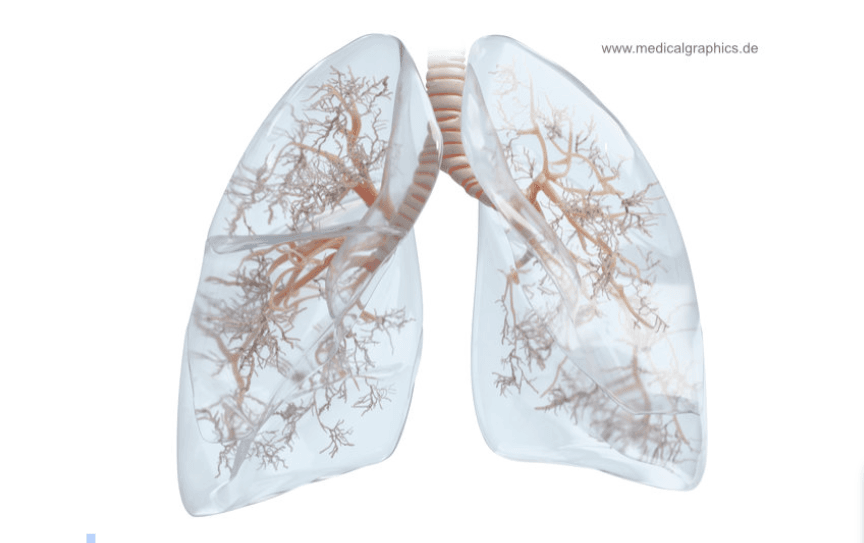
How can fine particulate matter contribute to lung cancer?
Scientists originally assumed that fine particulate matter could alter the genetic material of lung cells. This is because doctors have identified a specific genetic mutation in a protein—the EGF receptor (Epidermal Growth Factor Receptor)—in the majority of patients with adenocarcinoma. This mutation can then lead to uncontrolled growth of tumor cells.
In their 2023 study, the researchers used epidemiological data from four groups of people in the United Kingdom, Canada, Taiwan, and South Korea to demonstrate that there must be a link between lung cancer and exposure to PM2.5. Based on their subsequent mouse experiment, the team demonstrated that fine particulate matter does not itself cause the EGFR mutation, but that this mutation must already be present in the body—at least in part. But—and this is the crucial point—the combination of the altered receptor and fine particulate matter exposure promoted cancer growth in the animals. This was due to persistent inflammatory reactions in the lung tissue triggered by the fine particulate matter.
The Importance of a Messenger Molecule
In this context, the scientists also discovered that interleukin 1β, a signaling molecule of the immune system, plays a crucial role. This is because mice that received antibodies before being exposed to fine particulate matter developed lung cancer less frequently than their untreated counterparts. Consequently, interleukin 1β could be an option for the prophylactic treatment of people in regions with particularly high levels of fine particulate matter. However, Prof. Dr. Martin Göttlicher, director of the Institute for Molecular Toxicology and Pharmacology at the Helmholtz Center in Munich, does not view this as a suitable means of prevention. Instead, he advocated for a further reduction in the limit values for fine particulate matter.
Last year, a new European Air Quality Directive was indeed drafted, which also includes new PM10 and PM2.5 limits effective in 2030. It officially took effect at the end of 2024.
Conclusion
Smokers still have about ten times the risk of developing lung cancer compared to nonsmokers, explains Prof. Dr. Martin Göttlicher. But further studies also demonstrate just how urgently a new approach to particulate matter pollution is needed worldwide. These studies suggest that air pollution increases the risk of other diseases, such as cardiovascular disease and Alzheimer’s.
In this context, an international reduction in particulate matter emissions is crucial. As a weather phenomenon in March of this year in Poland and Germany clearly demonstrated, air pollution can drift in from neighboring countries. This is made possible by certain winds that can carry clouds of particulate matter. In addition, prolonged high-pressure systems prevent air from being replaced, allowing particulate matter to pollute the air over an extended period. In Germany, the Federal Environment Agency provides information on current air quality.
Sources
- fr.de/wissen/fordert-strengere-massnahmen-feinstaub-haeufige-ursache-fuer-tod-durch-lungenkrebs-forscherin-93581973.html
- https://www.br.de/nachrichten/wissen/neue-studie-so-entsteht-durch-feinstaub-lungenkrebs,TblXbgi
- https://www.pharmazeutische-zeitung.de/wie-feinstaub-das-lungenkrebsrisiko-erhoeht-139542/
- https://www.sciencemediacenter.de/angebote/23050
- https://www.deutsche-apotheker-zeitung.de/news/artikel/2023/04/12/wie-feinstaub-zu-lungenkrebs-fuehrt
- https://www.fr.de/panorama/zahl-der-lungenkrebs-todesfaelle-steigt-vor-allem-ein-wetterphaenomen-ist-verantwortlich-93597733.html
- https://www.aerzteblatt.de/news/feinstaub-immer-mehr-nichtraucher-erkranken-an-lungenkrebs-c31c863f-1dad-482c-a017-b721d9ce916e
- https://www.umweltbundesamt.de/themen/luft/regelungen-strategien/luftreinhaltung-in-der-eu/ueberarbeitung-der-richtlinie-zur-luftqualitaet#:~:text=The%20publication%20in%20the%20Official%20Journal%20of%20the%20European%20Union%20took%20place%20on%20November%2020,%202024
Share this article
News
Read next
- News
Scabies: A contagious skin disease that is easily treatable
Oct 26, 2026
Severe itching and minor skin changes should be taken seriously
Read more - News
Heat Rash: What's Behind the Itchy Blisters
Oct 23, 2026
Heat Rash: Heat and Sweat Can Disrupt the Skin's Balance
Read more - News
Enlarged Prostate – When Medication Is Sufficient and When Surgery Is Recommended
Oct 21, 2026
Why Many Men Ignore Urinary Problems for Too Long
Read more