News
Raynaud's Syndrome: When Fingers and Toes Suddenly Turn White

Melanie Al Tikriti, BSc ·
Cold and stress can temporarily and significantly restrict blood flow.
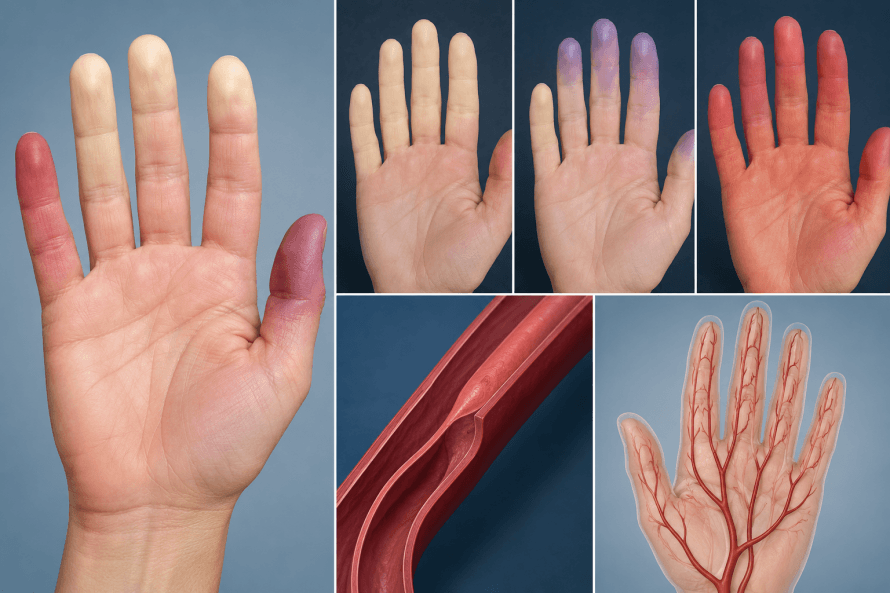
Suddenly, the fingers turn white, feel numb, and begin to tingle or ache. What may seem alarming at first is often a symptom of what’s known as Raynaud’s syndrome. In this condition, the small blood vessels in the fingers or toes constrict sharply for a short time, causing the affected areas to receive insufficient blood flow.
The symptoms usually occur in episodes and subside on their own after a while. Although Raynaud’s syndrome is often harmless, in some cases it can indicate another underlying condition. Therefore, recurring symptoms should be evaluated by a doctor.
Why the Blood Vessels Suddenly Narrow
In Raynaud’s syndrome, the small blood vessels react hypersensitively to cold or emotional stress. They constrict more than is normally necessary, thereby temporarily reducing blood flow. During an episode, very little blood reaches the fingers or toes. As a result, they lose their normal skin color and feel cold or numb. As soon as the blood vessels dilate again, blood flow returns and the symptoms subside.
Doctors distinguish between primary and secondary Raynaud’s syndrome. The primary form occurs without any identifiable underlying condition and is usually harmless. The secondary form, on the other hand, develops as a result of other conditions, such as rheumatic diseases or vascular disorders.
Cold is not the only trigger
Many people with the condition notice the symptoms mainly in winter or upon contact with cold water. However, other factors can also trigger an episode.
These include, among others:
- cold temperatures
- cold water
- sharp temperature fluctuations
- emotional stress
- anxiety or excitement
- Smoking
- vibrating tools
- certain medications
Not everyone reacts to the same triggers. Many people affected learn over time to recognize their personal triggers.
A typical symptom is a change in the color of the fingers
The most noticeable symptom of Raynaud’s syndrome is a sudden change in skin color. Often, individual fingers or toes first turn white, then blue, and finally reddish once the episode ends.
Typical symptoms include:
- white or bluish fingers
- cold hands or feet
- numbness
- tingling
- Pain when the extremities warm up
- Tightness
- Limited mobility during an episode
Usually, several fingers are affected at the same time, though the thumb is often spared.
When There May Be More Behind the Symptoms
It is not always the benign form of Raynaud’s syndrome. If the symptoms first appear in older age or if skin changes, slow-healing wounds, or severe pain develop alongside them, the cause should be investigated more closely.
Secondary Raynaud’s syndrome can be associated with autoimmune diseases such as scleroderma, lupus, or rheumatoid arthritis, among others. Vascular diseases or certain medications may also be potential triggers. Early evaluation helps identify possible underlying conditions in a timely manner.
How the Diagnosis Is Made
The typical description of the symptoms alone provides important clues. The doctor will ask about triggers, the duration of the episodes, and any possible comorbidities.
In addition, the hands are examined and blood flow is assessed. A procedure called nailfold capillary microscopy can be used to visualize the smallest blood vessels. Blood tests help rule out inflammatory or rheumatic conditions. Depending on the findings, further tests may be necessary.
What treatment options are available?
In the primary form, the focus is primarily on preventive measures. It is important to keep the hands and feet as warm as possible and to avoid known triggers.
If these measures are not sufficient or if a secondary form is present, vasodilator medications may be used. They improve blood flow and can reduce the frequency and severity of attacks. If another underlying condition is present, treatment of that condition takes priority.
What People with the Condition Can Do Themselves
Even small changes in daily life can help many people avoid or alleviate attacks.
These include:
- Keeping hands and feet warm
- Putting on gloves before going outside
- Avoiding cold water as much as possible
- quitting smoking
- Reducing stress
- Get regular exercise
- Actively move your fingers at the first sign of discomfort
Warm drinks or slowly warming your hands can also help restore blood flow.
Conclusion: If you know your personal triggers, you can avoid many episodes.
Although Raynaud’s syndrome is unpleasant for many people affected by it, it is often harmless. Simple preventive measures can often significantly reduce symptoms. If episodes occur particularly frequently or are accompanied by other symptoms, the cause should be evaluated by a doctor to identify any underlying conditions in a timely manner.
Share this article
Verified expertise
Recommended specialists
5 specialists
5 results


Dr. med. Dipl. oec. med., FESC Michael Lichtenberg
Chief Physician





News
Read next
- News
Scabies: A contagious skin disease that is easily treatable
Oct 26, 2026
Severe itching and minor skin changes should be taken seriously
Read more - News
Heat Rash: What's Behind the Itchy Blisters
Oct 23, 2026
Heat Rash: Heat and Sweat Can Disrupt the Skin's Balance
Read more - News
Enlarged Prostate – When Medication Is Sufficient and When Surgery Is Recommended
Oct 21, 2026
Why Many Men Ignore Urinary Problems for Too Long
Read more