LUCL reconstruction (lateral ulnar collateral ligament reconstruction) using a triceps tendon graft is a well-established surgical procedure for treating chronic elbow instability. Posterolateral rotational instability (PLRI) is one of the most common ligament instabilities of the elbow joint and, if left untreated, leads to persistent limitation of joint function. The procedure is used in particular when conservative treatment attempts have not been sufficiently successful or when recurrent instability is present. The goal of the surgery is to restore radial stability to the elbow joint and to achieve a lasting return to pain-free, functional mobility. By using an autologous triceps tendon graft, the lateral ulnar collateral ligament (LUCL) can be anatomically reconstructed, and the stability of the joint can be biomechanically restored.
LUCL Reconstruction Using a Triceps Tendon Graft to Restore Radial Stability
The image shows the surgical reconstruction of the lateral ulnar collateral ligament (LUCL) using a triceps tendon graft. This procedure specifically restores lateral stability to the elbow joint and ensures reliable joint guidance.
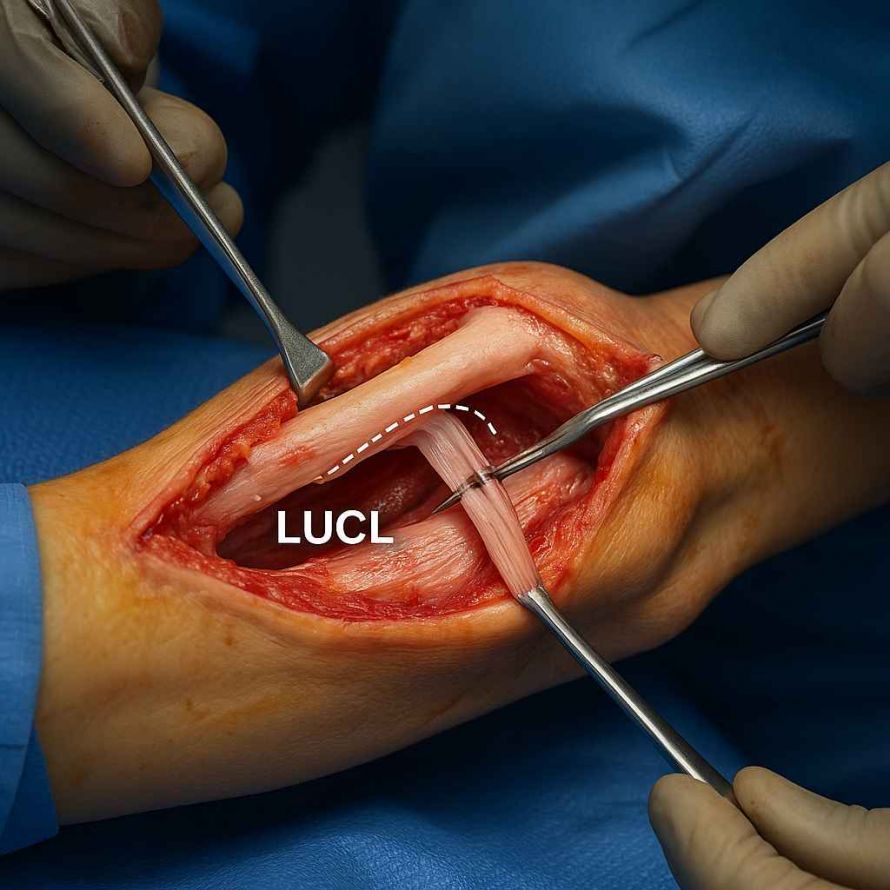
Illustration of the elbow with lateral ligament reconstruction (LUCL) and a triceps tendon graft to restore stability
Causes and Clinical Symptoms of LUCL Insufficiency
Lateral ulnar collateral ligament insufficiency (LUCL insufficiency) is one of the main causes of posterolateral rotational instability of the elbow. In this condition, the elbow joint loses its normal stability, particularly in the area of the lateral ligament complex. The injury often occurs after a fall onto an outstretched arm, during which the forearm rotates outward. This movement causes the lateral ulnar collateral ligament to become overstretched or to tear completely.
In addition to traumatic events, chronic stress or previous surgical procedures on the elbow joint can also lead to weakening of the ligamentous apparatus. Chronic LUCL insufficiency often occurs after repeated dislocations or micro-injuries, which, if left untreated, lead to increasing instability.
Clinically, the instability usually manifests as a sensation of the elbow “giving way” or a feeling of instability when weight is placed on the elbow. Patients frequently report pain in the lateral aspect of the joint, particularly when extending or rotating the forearm. In orthopedics and trauma surgery, this form of elbow instability is referred to as posterolateral rotational instability (PLRI).
In advanced stages, recurrent episodes of instability can lead to functional limitations and degenerative changes in the joint surfaces. A thorough clinical examination and imaging studies are therefore crucial for identifying the cause of the instability and initiating appropriate treatment.
Diagnosis of Posterolateral Rotational Instability of the Elbow
Diagnosing lateral ligament insufficiency of the elbow joint requires a careful clinical examination combined with imaging studies. The initial focus is on the patient’s medical history, which often reveals evidence of recurrent dislocations, pain, or functional limitations. Typical symptoms include discomfort when leaning on the arm or lifting heavy objects.
During the physical examination, various stability tests are performed. Particularly informative is the so-called O’Driscoll pivot-shift test, which involves a rotational and extension movement. If a subluxation-like “slipping” is observed during this test, it indicates posterolateral rotational instability (PLRI). Other clinical signs include pain or noticeable instability when rotating the forearm outward.
Magnetic resonance imaging (MRI) is typically used for diagnostic imaging. It allows visualization of the lateral ligament complex, including the lateral ulnar collateral ligament. This enables the detection of ligament tears, associated cartilage damage, or signs of chronic instability. In some cases, arthroscopy may also be useful to directly assess the condition of the joint structures and treat minor defects at the same time.
Accurately distinguishing between acute and chronic instability is crucial for treatment planning. While fresh ligament injuries can sometimes be stabilized conservatively, chronic or combined instabilities often require surgical reconstruction. This procedure specifically restores the lateral stability of the elbow to ensure long-term function and prevent recurrent dislocations.
Surgical Treatment: LUCL Ligament Reconstruction with Triceps Tendon Graft
If conservative treatment attempts fail to achieve sufficient stability of the elbow joint, surgical treatment is indicated. The goal of the procedure is to restore lateral ligament guidance in order to permanently resolve rotatory instability of the elbow. LUCL ligament reconstruction using a triceps tendon graft has established itself as a proven method for treating posterolateral rotatory instability of the elbow.
In this technique, the lateral ulnar collateral ligament (LUCL) of the elbow is reconstructed using an autologous graft. An autologous triceps tendon graft is typically used for this purpose. The graft is attached to the radial epicondyle of the humerus and anchored to the ulna to restore natural stability. This technique follows the concept of reconstruction using a triceps tendon graft, as described in several biomechanical studies.
In orthopedic and trauma surgery practice, lateral ulnar collateral ligament reconstruction has proven to be a reliable option for persistent elbow instability. It can be used for both primary and recurrent instability. International studies—such as those published in the *J Bone Joint Surg* and *J Shoulder Elbow Surg*—report very good functional outcomes and a low complication rate.
The Mayo Elbow Performance Score, which assesses range of motion, freedom from pain, and functional ability, is frequently used to evaluate the success of the surgery. Following successful LUCL reconstruction, patients generally show a significant improvement in stability and load-bearing capacity. The stability of the elbow joint can also be reliably restored arthroscopically or clinically, particularly when the reconstruction is correctly positioned within the lateral ligament complex.
Surgical treatment involving lateral ulnar collateral ligament reconstruction is now considered the standard of care for structural ligament insufficiency. Various techniques—such as the reconstruction or augmentation of the insufficient lateral ligament—are individually tailored depending on the extent of the defect. The goal is always to restore physiological guidance within the elbow joint and to prevent further ligament instability.
Postoperative Care and Rehabilitation Following LUCL Reconstruction
Postoperative care following LUCL ligament reconstruction with a triceps tendon graft follows a clearly structured approach that promotes healing of the ligamentous apparatus and enables safe restoration of joint function. It is crucial to protect the newly reconstructed structure from overuse while gradually rebuilding the mobility of the elbow joint.
In the first few weeks after surgery, the arm is usually immobilized in a special brace that allows for controlled movement. This phase is intended to allow the graft to heal to the ulna and the radial epicondyle of the humerus. Subsequently, physical therapy-based mobilization begins with passive and, later, active range-of-motion exercises. The goal is to maintain the stability of the elbow joint without compromising the ligament suture.
Several randomized controlled trials and retrospective analyses of LUCL reconstructions show that an individually tailored postoperative rehabilitation plan is crucial for the functional outcome. Gradual loading typically begins after six weeks, and full sports or occupational activity is usually possible after three to six months. The effect of early mobilization has been investigated in biomechanical studies and confirms the importance of controlled movement for graft healing.
In clinical practice, follow-up care is coordinated on an interdisciplinary basis between orthopedics and trauma surgery. Regular follow-up visits, combined with arthroscopic evaluation when necessary, ensure the success of the treatment. The goal of all measures is to permanently restore the stability of the elbow joint in cases of arthroscopically or clinically confirmed instability.
If conservative measures are required after the procedure—for example, to reduce pain or swelling—accompanying physical therapy and targeted strengthening programs are used. This conservative treatment supports the healing process and contributes significantly to improving joint function.
In the long term, the combination of surgical reconstruction and tailored postoperative care enables excellent restoration of the radial stability of the elbow joint and a significant improvement in the quality of life for those affected.
Prognosis and Possible Complications
The prognosis following LUCL ligament repair with a triceps tendon graft is generally very good. In clinical studies, most patients achieved complete restoration of function and a significant improvement in the stability of the elbow joint. The Mayo Elbow Performance Score often indicates near-normal range of motion and freedom from pain.
However, as with any surgical treatment, there are risks. Possible complications include temporary limitations in movement, swelling, or irritation in the area of the ulna or at the graft insertion site. Nerve irritation or infections occur less frequently. According to clinical data, the complication rate is significantly lower than that of other ligament reconstructions, particularly when the graft is properly placed and follow-up care is consistent.
In isolated cases, instability may recur or the graft may fail to integrate completely. In such situations, reconstruction or augmentation of the deficient lateral ligament complex is possible to permanently restore stability. Overall, ligament reconstructions of the lateral ligament complex show very good long-term results with high patient satisfaction.
The Importance of LUCL Reconstruction in Orthopedics and Trauma Surgery
LUCL reconstruction using a triceps tendon graft is now considered an established surgical treatment for elbow instability and is an integral part of modern orthopedics and trauma surgery. It represents an important method for restoring lateral and radial stability, particularly in cases of persistent or recurrent elbow instability.
In the scientific literature—for example, in articles from the *J Bone Joint Surg* or *J Shoulder Elbow Surg*—lateral ulnar collateral ligament reconstruction is described as an effective technique for restoring the biomechanical integrity of the elbow ligament complex. Biomechanical studies also confirm the positive effect of autologous triceps tendon grafts on the stability of the elbow complex.
Advances in surgical techniques—such as improved fixation systems and minimally invasive procedures—have further reduced the complication rate. Lateral ulnar collateral ligament reconstruction allows for precise restoration of the ligament’s anatomical alignment while maintaining high functionality.
In the long term, LUCLligamentoplasty with a triceps tendon graft for the treatment of posterolateral rotational instability has proven to be a key method for preventing recurrent instability and ensuring the stability of the elbow joint in cases of arthroscopically or clinically confirmed ligament insufficiency. As such, it has established a firm place in the management of complex ligament instabilities of the elbow and has become an indispensable part of orthopedic and trauma surgery practice.
FAQs on LUCL Reconstruction of the Elbow
When is LUCL ligament reconstruction necessary?
LUCL reconstruction is indicated when clinically evident elbow instability persists despite attempts at conservative treatment. Surgical treatment of the lateral collateral ligament may be necessary, particularly in cases of recurrent dislocations or pain in the lateral region. The goal is to permanently restore the stability of the elbow joint and prevent further damage.
How is the surgery performed?
In LUCL ligament reconstruction using a triceps tendon graft to treat posterolateral rotational instability, the procedure is performed through a small lateral incision at the elbow. The graft, usually an autologous triceps tendon graft, is anatomically fixed to the ulna and the radial epicondyle of the humerus. The procedure follows modern techniques for reconstruction using a triceps tendon graft, as described in current biomechanical studies. The correct placement of the graft is crucial for restoring physiological ligament tension.
What alternatives are there to surgery?
In mild cases, conservative treatment may be attempted first. This includes targeted strengthening exercises, physical therapy, and, if necessary, wearing a stabilizing brace. However, studies show that surgical treatment for recurrent instability yields better long-term results when the ligament structures are structurally damaged.
How safe is the procedure?
LUCL reconstruction is one of the established procedures in orthopedics and trauma surgery, with a low complication rate. The procedures are often performed in specialized centers that focus on the surgical treatment of elbow instability. Modern techniques enable precise reconstruction to address instability and stable stabilization of the elbow joint.
What role does the medial ligament play in the procedure?
In cases of combined medial and lateral ligament instability, additional augmentation of the insufficient lateral ligament may be necessary. This improves the interaction between both ligament complexes, which is crucial for the complete stability of the elbow joint.
What are the long-term outcomes?
Long-term studies show that most patients achieve full range of motion without pain following LUCL reconstruction using a triceps tendon graft. Studies such as the analysis of 47 LUCL reconstructions from leading centers confirm a high success rate with significantly improved function and stability. The method is now considered the gold standard for the surgical treatment of posterolateral rotatory instability of the elbow.