The treatment of atrial fibrillation and other cardiac arrhythmias has taken a historic technological leap forward with the introduction of Pulsed Field Ablation (PFA). While traditional methods rely on heat (radiofrequency) or cold (cryoablation), PFA—also known as electroporation—uses pulsed electric fields. This method is considered particularly safe and efficient in electrophysiology. What makes it unique is that the electric fields act selectively on heart muscle cells while sparing surrounding tissue such as the esophagus, nerves, or blood vessels. For patients, this often means shorter procedure times and a reduced risk of complications. PFA is increasingly establishing itself as the new gold standard in interventional cardiology.
What is Pulsed Field Ablation (PFA)? – The Principle of Electroporation Pulsed Field Ablation is based on the biophysical principle of irreversible electroporation. Strong electric fields are delivered via a special catheter for fractions of a second (in the nanosecond range). These fields create tiny pores in the cell membranes of the heart muscle cells (cardiomyocytes). These pores disrupt the cell’s osmotic balance, causing the cell to die (apoptosis) without resulting in massive tissue destruction due to burns. The treated area heals in a controlled manner and no longer transmits electrical interference signals—thus ending atrial fibrillation.
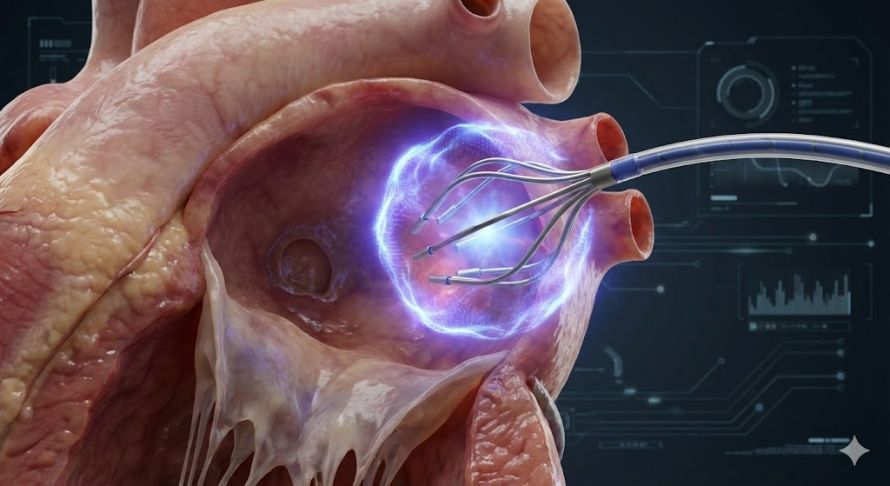
In Pulsed Field Ablation (PFA), electric fields create tiny pores in the heart cells to stop atrial fibrillation without generating heat.
PFA Compared to Traditional Methods
Difference from radiofrequency and cryoablation Current standard procedures in electrophysiology are thermal:
- Radiofrequency ablation: Heats the tissue (“cooking”).
- Cryoablation: Freezes the tissue (cryogenically).
Both methods are very effective but carry a small risk that the temperature may also damage surrounding tissue (e.g., the esophagus, which lies directly behind the heart). Pulsed Field Ablation is non-thermal. Since different types of tissue (heart muscle, nerves, blood vessels) react differently to electric fields, the cardiologist can adjust the energy so that only the heart muscle cells are affected. Nerves and blood vessels remain intact.
Procedure for PFA Treatment in the Cardiac Catheterization Lab The procedure is similar to that of a standard electrophysiological study (EPS):
- Access: Under local anesthesia and sedation (twilight sleep), the physician guides the PFA catheter through the femoral vein into the left atrium of the heart.
- Mapping & Positioning: Using 3D mapping or X-ray guidance, the catheter is positioned at the openings of the pulmonary veins (the most common trigger for atrial fibrillation).
- Ablation: The electrical pulses are delivered within a few seconds. The procedure, known as pulmonary vein isolation (PVI), is often completed in just a few minutes.
- Verification: The doctor immediately checks whether the disruptive signals have been blocked.
Safety and Efficiency
Advantages and Safety: Why PFA Is Considered a Revolution Pulsed Field Ablation offers decisive advantages in cardiology:
- Maximum safety: The risk of injury to the phrenic nerve (phrenic nerve palsy) or the esophagus is virtually eliminated.
- Speed: The actual ablation time is extremely short. The entire procedure often takes significantly less than an hour.
- Effectiveness: Studies show that isolation of the pulmonary veins is very long-lasting, which prevents recurrences of cardiac arrhythmias.
Who is a good candidate for Pulsed Field Ablation? The method is primarily suitable for patients with symptomatic, paroxysmal, or persistent atrial fibrillation in whom medication is not sufficiently effective. The electrophysiologist determines whether PFA is a better option than conventional procedures in an individual case based on the patient’s anatomical conditions.
FAQ
Is pulsed field ablation painful?
Since the procedure is performed under sedation (twilight sleep) or brief anesthesia, the patient feels nothing. Because no heat is generated, many patients also report less chest pain after the procedure compared to thermal methods.
How long does the PFA procedure take?
The procedure is very efficient. While traditional ablations often take 1–2 hours or longer, a PFA treatment can often be completed in under 60 minutes.
Are there any long-term effects associated with electroporation?
Since the procedure is still relatively new, long-term studies are currently underway. However, data collected over several years to date show no negative long-term effects but rather confirm the high safety of this tissue-specific approach.
Does health insurance cover this new method?
Yes, pulsed field ablation is an approved procedure and is covered by health insurance providers when indicated. It is primarily offered at specialized heart centers and university hospitals.

About the medical author
Sabine Schneider
Editor-in-Chief
Sabine Schneider – medical author: Explore expert articles and medical expertise in the Leading Medicine Guide.
More about the medical author →