Atrial fibrillation is a heart condition in which the heart muscle beats irregularly (arrhythmia). Typical symptoms of the condition include palpitations (an abnormally rapid heartbeat) or a fluttering sensation in the chest. The condition occurs primarily in older patients. Among people aged 70 to 80, one in seven to one in ten suffers from atrial fibrillation. Atrial fibrillation is one of the most common types of arrhythmia and is particularly prevalent in older adults.
Further information on causes, diagnosis, and treatment, as well as a list of selected specialists in atrial fibrillation, can be found below.
Unlike ventricular fibrillation, atrial fibrillation is not life-threatening. However, people with atrial fibrillation have an increased risk of having a stroke or heart attack, or of developing heart failure. Untreated, long-term atrial fibrillation often causes the heart’s atria to enlarge.
The earlier the heart condition is detected and treated, the sooner the patient can regain their normal sinus rhythm.
What are the symptoms of atrial fibrillation?
Paroxysmal atrial fibrillation (occurring in episodes) often causes no symptoms. Some people affected notice only a slight decrease in physical performance. Other patients with cardiac arrhythmias experience the following signs:
- Dizziness, even to the point of fainting
- Chest pain
- Shortness of breath
- Heart palpitations
- Restlessness
- Severe anxiety
These potential symptoms of atrial fibrillation can vary in severity depending on the specific form of the condition and do not occur to the same extent in all affected individuals.
The specific symptoms that occur depend on whether the heart
- beats too fast,
- at a normal rate, or
- too slowly
irregularly.
A rapid heartbeat is perceived as a frightening racing sensation, often accompanied by shortness of breath and severe chest pain.
A normal heart rate often leads to fatigue.
Slow cardiac arrhythmias usually cause dizziness. In the worst-case scenario, the person affected may faint.
Patients rarely notice chronic atrial fibrillation, as their heart muscle has already become accustomed to the irregular pumping.
Causes of Atrial Fibrillation
In healthy people, the sinus node in the right atrium sends an electrical impulse that is transmitted to the ventricles. There, it causes the heart muscle to contract. This is how the heartbeat is generated. The heartbeat pumps blood throughout the body.
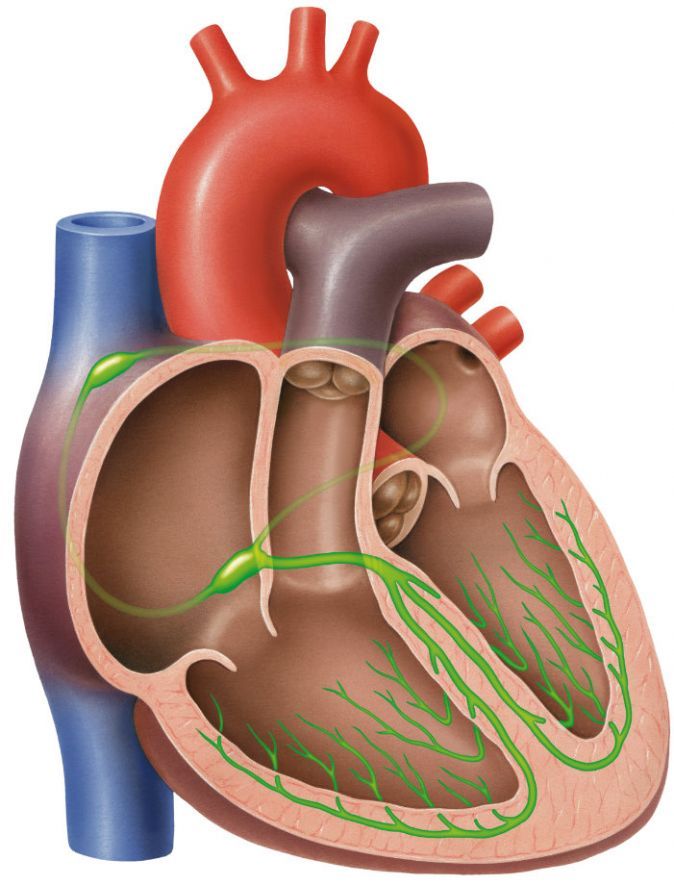
In atrial fibrillation, an excessive number of circulating electrical impulses are generated in both atria outside the sinus node. These uncoordinated signals are unable to trigger a normal muscle contraction. As a result, only a small portion of the signals reaches the ventricles, since the conduction pathway is additionally blocked. The development of atrial fibrillation is often due to structural changes in the heart tissue that disrupt electrical conduction.
This results in a slow arrhythmia. The atria and ventricles cannot fill with enough blood. If the patient also suffers from heart failure, the heart muscle pumps even less blood through the body. As a result, blood pressure drops.
If the sinus node generates a high number of electrical impulses, they cause tachycardia (an abnormally fast heart rhythm) in the ventricles below.
In the early stages, atrial fibrillation occurs only in episodes. After a few minutes or, at most, a few hours, the heart rhythm returns to normal on its own. In the early stages, atrial fibrillation occurs only intermittently, but it can progress to a persistent form as the condition advances.
There is still a significant need for research regarding the exact causes of this heart rhythm disorder. Medical professionals believe that the altered heart rate is caused by age-related scarring of the heart tissue. This tissue is no longer able to conduct electrical impulses as required. The signals circulating in the atria negatively affect normal heart function.
In addition, the risk of developing atrial fibrillation in older age appears to be genetically determined. Sometimes, however, it also develops spontaneously without any other cause.
Factors that contribute to this irregular heart rhythm include, for example,
- severe stress
- certain heart conditions (coronary artery disease, myocarditis, heart valve defects)
- long-standing high blood pressure
- lung diseases
- diabetes mellitus
- Kidney diseases
- Sleep apnea (brief pauses in breathing during sleep)
- Hyperthyroidism
- Long-term alcohol abuse
These factors are considered major risk factors for atrial fibrillation and can significantly influence the development of this cardiac arrhythmia.
Diagnosis of Atrial Fibrillation
People who experience one or more of the symptoms listed above should contact a specialist as soon as possible. Appropriate specialists include internal medicine physicians or cardiologists. The same applies if the atrial fibrillation does not resolve on its own within two days at the latest.
An irregular heartbeat can be diagnosed using a blood pressure measurement and an ECG (electrocardiogram). The doctor attaches electrodes to the patient’s chest to measure their heart rate. If atrial fibrillation is suspected, a stress ECG or a Holter monitor is usually used. Certain findings on the ECG can clearly indicate atrial fibrillation and are crucial for further diagnosis.
The exercise ECG is used to measure the heart’s electrical activity during physical exertion, i.e., when the heart is working harder. During the test, the patient sits on an exercise bike and pedals vigorously.
A Holter monitor measures the heart’s electrical activity over a period of 24–48 hours. For this test, the patient wears a small, portable ECG device that records the heart’s activity during the patient’s daily routine.
The physician evaluates the data once the measurements are complete.
Paroxysmal atrial fibrillation can be effectively recorded using an event recorder. The patient activates the device only when atrial fibrillation occurs. The doctor then analyzes the data on a computer.
An echocardiogram (ultrasound image of the heart) provides detailed information about the condition of the heart muscle and its pumping function. It also allows the examining specialist to clearly identify any blood clots that may be present.
An echocardiogram is performed using an ultrasound probe connected to a thin tube. The doctor inserts this tube through the patient’s mouth and throat until it reaches the middle of the esophagus. From there, the doctor can examine the right atrium in detail. The patient is given a mild sedative beforehand.
Treatment of Atrial Fibrillation
If the arrhythmia is caused by a thyroid disorder, the specialist will first treat only that condition. Afterward, the atrial fibrillation usually resolves on its own.
In cases of paroxysmal atrial fibrillation, the doctor prescribes special medications known as antiarrhythmics. The patient takes them as soon as they feel an episode beginning. Antiarrhythmics quickly bring the heart rate down to a resting rate of approximately 70 beats per minute.
However, the patient must be careful to take the medications exactly as directed: Accidental overdoses can significantly slow the heart rate. Atrial fibrillation accompanied by palpitations can also be effectively treated with medication. The goal of treatment is to stabilize the heart rhythm while alleviating symptoms.
To minimize the increased risk of stroke, the patient is also prescribed blood-thinning medications, such as Marcumar or Xarelto. These prevent the blood circulating in the atrium from clumping together and forming blood clots. These clots could then travel to the brain and block a major blood vessel there. Anticoagulation therapy for nonvalvular atrial fibrillation is a central component of treatment to prevent strokes.
Drug therapy does not always work. If the patient continues to experience symptoms, electrical cardioversion (electroshock treatment) is recommended. For this procedure, the patient is connected to various devices under short-acting anesthesia. These devices monitor blood pressure and oxygen supply. Two electrodes are then applied to deliver an electrical current through the heart muscle for fractions of a second. This restores the heartbeat to normal.
In most cases, the connections between the pulmonary veins and the heart trigger the condition in the patient. In this case, the patient can also be treated with pulmonary vein isolation (catheter ablation).
To do this, the doctor inserts a catheter (a thin plastic tube) through a small incision in the femoral vein, guiding it through the vena cava to the left atrium. There, the doctor ablates the muscle tissue causing the arrhythmia using high-frequency electrical current or cold.
Six to eight out of ten people with atrial fibrillation become permanently symptom-free following catheter ablation. Repeating the procedure further increases the patient’s chances of a successful outcome.
The German Heart Foundation advises that this procedure be performed only at a specialized cardiac center. This reduces the risk of complications due to the extensive experience of the physicians involved. In addition, an implanted pacemaker can significantly improve the patient’s heart function.
Patients with heart disease who also have atrial fibrillation sometimes experience relapses after successful treatment. People with heart failure who develop atrial fibrillation over the course of their lives generally die earlier than patients who have only cardiac arrhythmias.
Prevention of Atrial Fibrillation
While it is generally not possible to prevent the onset of atrial fibrillation, it is certainly possible to prevent the underlying conditions that directly lead to this arrhythmia.
Since narrowed coronary arteries are the main cause of the condition, it is recommended to
- eat a healthy diet,
- get enough exercise, and
- avoid smoking and
- excessive alcohol consumption
as much as possible. A healthy lifestyle can reduce the risk of atrial fibrillation and positively influence the progression of the disease.
FAQ
What is atrial fibrillation?
Atrial fibrillation is a heart rhythm disorder in which the atria contract in an uncoordinated manner, causing an irregular heartbeat; it is the most common heart rhythm disorder.
What symptoms can occur?
Typical signs of atrial fibrillation include palpitations, shortness of breath, dizziness, or anxiety, although atrial fibrillation can sometimes occur without any symptoms.
How is atrial fibrillation diagnosed?
Atrial fibrillation is typically diagnosed using an ECG, supplemented by long-term monitoring or an echocardiogram for a more detailed assessment of heart function.
What treatment options are available?
Treatment for patients with atrial fibrillation includes medications to regulate heart rhythm and reduce the risk of stroke, as well as invasive procedures such as catheter ablation when necessary.
Share this article

Sources
- S3-Leitlinie „Vorhofflimmern“ (AWMF-Register-Nr. 019-014), Stand 15.04.2025: register.awmf.org/de/leitlinien/detail/019-014