People who sweat profusely often suffer greatly from this bothersome, unpleasant condition. Common remedies such as deodorants usually provide only temporary relief. For those affected by hyperhidrosis (excessive sweating), surgery to permanently remove the sweat glands can therefore be helpful. During a minimally invasive procedure, the surgeon removes the sweat glands from the armpits. This suction procedure offers a safe and effective treatment for the problem.
Below you will find further information as well as specialists in sweat gland suction.
Definition: What is sweat gland suction?
Sweat gland suction is a permanent surgical removal of the sweat glands. The procedure reduces sweat production and thus prevents it in the future. It is a minimally invasive procedure, so it does not leave large scars.
To date, the procedure has only been performed in the underarm area.
Reasons for sweat gland suction
People have a particularly high concentration of sweat glands in the underarm area—about 140 per square centimeter. Frequent underarm sweating can have various causes:
- True hyperhidrosis: A dysfunction of the autonomic nervous system. Those affected sweat constantly, regardless of the outside temperature or physical activity.
- Axillary hyperhidrosis: Particularly heavy sweating under the arms. The condition is exacerbated by high temperatures and everyday activities such as climbing stairs.
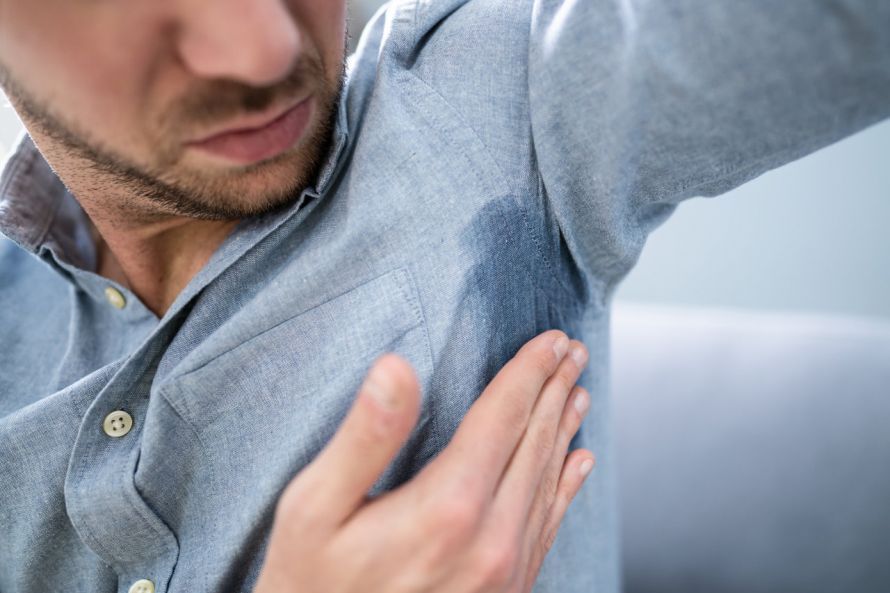
Many people with hyperhidrosis suffer from unsightly dark spots under their arms. The odor also leads to feelings of embarrassment and makes it difficult to interact with others. For those affected, this also means additional stress and discomfort.
Even antiperspirants specifically developed for hyperhidrosis often only partially fulfill their purpose. In many cases, only surgical intervention can provide a lasting solution to this problem.
The Sweat Gland Suction Procedure
The sweat glands under the armpits are located between the fat cells directly beneath the skin. The procedure takes only about 45 minutes and is performed under local anesthesia.
The doctor first applies an anesthetic solution to the underarm area. The incisions, approximately three millimeters wide, made above and below the armpit serve as access points for a cannula. Through these small incisions, the doctor inserts the cannula along the anterior axillary line into the subcutaneous fatty tissue.
The doctor then suctions out the sweat glands and closes the incisions with adhesive strips and a pressure bandage. The armpit is dry immediately after the procedure.
Depending on the intensity of the treatment, this procedure permanently removes 95 to 98 percent of the sweat glands in the armpit. A large portion of the hair follicles in the armpit area is also removed during the procedure.
This procedure should be distinguished from what is known as radical excision. In this procedure, the doctor completely excises the underarm skin—including the sweat glands. Since this type of surgery leaves a large scar, it is not recommended.
Treatment with Botox (botulinum toxin), on the other hand, has a much weaker effect than surgery. Furthermore, the effects of Botox last for only about eight months.
Patient Care After Sweat Gland Removal
After the patient wakes up from sedation, they remain under the doctors’ care for a short time for observation. However, the hospital usually discharges them on the same day.
For a period of two weeks, you must wear only special compression garments. However, you can shower again as early as the following day.
To prevent infection, the doctor will prescribe an antibiotic that patients must take for three days. Daily activities are usually possible immediately after surgery.
Be careful, though, and take it easy for one to two days.
Complications, Risks, and Prognosis
Sweat gland removal carries only a few risks. Since the sweat glands in the armpits account for only a small portion of total sweat gland activity, their removal does not disadvantage the body.
Due to the location under the arms and the minimally invasive incision technique, scars are barely visible after the procedure.
Of course, all aesthetic and plastic surgery procedures carry a slight risk of side effects. To ensure the procedure is as gentle and low-risk as possible, it should always be performed by an experienced specialist.
Afterward, patients should monitor for symptoms. Mild bruising often occurs in the treated area but is harmless. More serious complications could include, for example, circulatory problems in the skin.
More serious complications include
- inflammatory reactions,
- bleeding,
- irregularities in the skin’s surface or changes in pigmentation, as well as
- the formation of dimples and cysts.
The chances of a successful outcome with sweat gland suction are relatively high: the success rate is 70 to 80 percent.
However, the effects of the procedure sometimes begin to wear off after just a few years.
Conclusion
Sweat gland suction is a suitable option for people who sweat excessively. The procedure is performed on an outpatient basis. As with liposuction, the doctor performs the procedure through very small incisions at the edge of the armpit.
As part of postoperative care, patients wear compression garments for two weeks. In return, sweat gland suction provides them with a noticeable and lasting reduction in sweat production.

Sources
- https://meyer-gattermann.de/behandlungen/schweissdruesenabsaugung/
- http://www.drheitland.com/schweissdrusenabsaugung-muenchen/
- https://aestheticum-praxisklinik.de/behandlung/schweissdruesenabsaugung