The term “tinnitus aurium” comes from Latin and means “ringing in the ears.” Tinnitus refers to all sounds in the ears and head that cannot be attributed to an external sound source. It is an auditory perception that is usually audible only to the person affected. It is also known as hyperacusis. The sound is described as ringing, beeping, humming, or hissing. The psychological distress experienced by patients is very high due to the constant noise in their ears.
Here you will find further information as well as a selection of tinnitus specialists and centers.
What is tinnitus?
Medical professionals distinguish between
- rare objective tinnitus and
- the more common subjective tinnitus.
In objective tinnitus, a sound source within the body produces the noise. The sounds originate from the muscles or blood vessels and can often be detected using a stethoscope.
In the vast majority of cases, however, those affected suffer from subjective tinnitus. Only the person affected can hear the sound. If the ringing in the ears has been present for less than six months, doctors refer to it as acute tinnitus. Symptoms that persist for longer periods are referred to as chronic tinnitus.
Tinnitus is not a disease, but merely a symptom. Nevertheless, some people with tinnitus perceive it as life-disrupting and it causes psychological stress.
In some cases, the ringing in the ears can have serious effects on a person’s professional and/or personal life.
In Germany, about four percent of all adults are affected by tinnitus. Generally, more women than men suffer from this ringing in the ears. An increasing number of young people under the age of 30 are also affected.
Acute tinnitus resolves on its own in 80 percent of cases, sometimes even without treatment. With chronic tinnitus, the chances of a cure are significantly lower. However, the ringing in the ears usually becomes less noticeable over time.
How do you recognize tinnitus?
Almost everyone has experienced a sound coming from inside their head at some point. It comes and goes just as suddenly. However, if it doesn’t go away, doctors refer to it as tinnitus.
Those affected report sounds such as
- ringing,
- whistling,
- hissing,
- sawing, or
- humming.
The sounds are constantly present or occur intermittently. They can be loud or soft.
This constant noise exposure can lead to health problems:
- Irritability
- Difficulty concentrating
- Sleep disturbances
- Muscle tension in the jaw or cervical spine
- Headaches
- Earaches
- Dizziness
- Teeth grinding
- Anxiety
- Depression
Causes of tinnitus
How does objective tinnitus develop?
Sound sources within the body, located in the inner ear or surrounding tissue, cause objective tinnitus. The causes are organic in nature:
- Constricted blood vessels (the sound is usually perceived in sync with the pulse)
- Spasms of the ear or palate muscles
- Ear tumor
- Problems with the temporomandibular joint
- Failure of the Eustachian tube to close properly (the connection between the middle ear and the nasopharynx)
What causes subjective tinnitus?
There are many possible causes of subjective ringing in the ears. Very often, tinnitus is the result of a hearing impairment. Medical professionals believe that tinnitus develops in a similar way to phantom pain that occurs after an amputation.
Due to the hearing impairment, the corresponding auditory signals are either absent or perceived only weakly. The brain attempts to compensate for this by increasing activity in the relevant area and generating its own sounds.
If tinnitus arises from non-organic causes, stress is usually the trigger.
The following factors can trigger or contribute to tinnitus:
- Age-related or hereditary hearing loss
- Sudden hearing loss
- Noise and blast trauma
- Meniere’s disease (a disorder of the inner ear)
- Middle ear infection
- Perforated eardrum
- Eustachian tube dysfunction
- Blockages or narrowings in the external auditory canal (including earwax!)
- Foreign objects in the ear
- Tumors
- Otosclerosis (a disease of the inner ear bones)
- Drugs
- Certain medications, such as some pain relievers, antibiotics, antidepressants, or chemotherapy drugs
- TMJ problems, teeth grinding, and neck muscle tension
- Stress
- Psychological stress
- Emotional distress
- Chronic noise pollution
- Burnout
How is tinnitus classified by severity?
Depending on how severely the person is affected, doctors distinguish four severity levels.
- Grade 1: The person is not bothered by the tinnitus; they have adapted well to it
- Grade 2: Although the ringing in the ears is largely compensated for, it can be distressing, especially in stressful situations or during mental or physical exertion
- Grade 3: The ringing in the ears is significantly disruptive. The symptoms have consequences for both professional and personal life. Sleep disturbances, difficulty concentrating, muscle tension, and headaches interfere with daily life, as do feelings of helplessness.
- Grade 4: Enormous strain on the patient. The persistent ringing in the ears is often responsible for an inability to work and leads to severe psychological disorders. Due to severe anxiety and/or depression, a normal social life is impossible.
Who diagnoses tinnitus?
The specialist to consult for tinnitus is an ENT doctor. First, the doctor will take your medical history. They will need detailed information about
- the type and frequency,
- possible triggers or changes throughout the day, as well as
- the impact on daily life.
This is followed by a physical examination.
For example, an otoscopic examination can reveal whether
- it is simply a case of earwax buildup or
- whether the eardrum is damaged.
A hearing test assesses the hearing function of the inner ear; after all, hearing loss is often the cause of tinnitus.
Further tests include
- brainstem audiometry to check the auditory nerve or
- a tympanogram, which tests the mobility of the eardrum.
Among imaging diagnostic methods, the following is particularly used:
- a duplex ultrasound to detect vascular narrowing, as well as
- magnetic resonance imaging (MRI) to visualize tumors
are ordered.
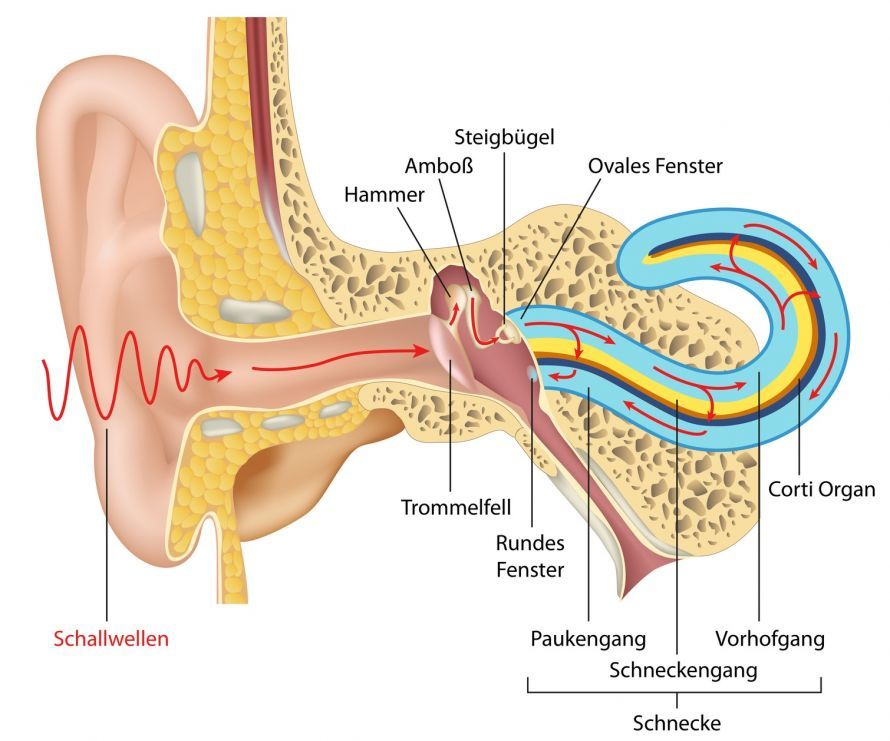
Anatomical Structure and Function of the Ear © bilderzwerg / Fotolia
Tinnitus is not necessarily the result of disorders in the auditory system. Disorders of the masticatory system or the cervical spine can also cause tinnitus. Therefore, further examinations usually follow.
For example, a blood pressure measurement may indicate high blood pressure. This could potentially have led to vascular changes near the ear.
Further insights can be gained, for example,
- a blood test,
- an examination of the masticatory system, or
- an orthopedic examination of the cervical spine
.
Treatment of Objective Tinnitus
Objective tinnitus is always caused by an underlying condition that serves as the source of sound within the body. Treatment therefore primarily involves addressing and resolving this underlying condition.
In the case of a tumor or atherosclerosis, surgery may be necessary. For spasms in the middle ear, magnesium supplements can provide initial relief. Medications are also used, for example, to lower blood pressure or to dilate blood vessels.
Another key pillar of treatment is providing the patient with psychological support. This may include education or coping skills training.
Treatment for Subjective Tinnitus
The best chances of a cure exist for acute tinnitus. If treatment is started immediately, the prognosis for complete resolution of the ringing in the ears is most favorable.
Chronic tinnitus, on the other hand, can rarely be cured. The focus of treatment is on alleviating symptoms and helping patients cope with the ringing in their ears as effectively as possible.
In some cases, the subjective ringing in the ears may be caused by other medical conditions. In such cases, as with objective tinnitus, treatment focuses on curing the underlying condition. However, there are often other causes that require more comprehensive treatment.
The following treatment approaches are initiated individually or in combination:
- Tinnitus counseling (coping training and education)
- Tinnitus retraining therapy
- Physical therapy
- Brain stimulation techniques (magnetic and/or electrical)
- Hearing aid fitting (for hearing loss)
- Physical therapies such as hydrotherapy, biofeedback, or Tai Chi
- Medications
Tinnitus Counseling
Tinnitus counseling is an essential component of therapy for both subjective and objective tinnitus.
The key elements of counseling are education and individualized guidance for the patient. We discuss life situations in which the tinnitus is particularly mild or particularly bothersome. For example, some patients have hardly any problems with tinnitus during the day, but do have trouble falling asleep because of it.
In some cases, simple and effective relief might come from
- learning a relaxation technique or
- creating artificial background noise in the bedroom
.
The stated goal of counseling is to encourage the patient and to highlight ways to best cope with the ringing in the ears.
Tinnitus Retraining Therapy
An important treatment method for chronic tinnitus is habituation therapy. The best-known form is tinnitus retraining therapy (TRT). In addition to counseling, TRT includes sound therapy.
The treatment aims to divert the patient’s attention away from the ringing in the ears. This helps push the tinnitus into the background.
A tinnitus masker is used for this purpose. This small device is designed to drown out the ringing in the ears and, over the course of treatment, eliminate it completely. In contrast, the tinnitus noiser does not mask the sound but instead distracts the patient from the tinnitus using background noise.
Both methods are used over an extended period of time, but success is not guaranteed.
Medications for Tinnitus
Medication is only recommended for the acute form of tinnitus. Medications are intended to
- improve blood flow to the inner ear,
- restore normal nerve activity in the brain, and
- normalize signal processing in the inner ear
.
The following are prescribed:
- cortisone preparations,
- substances that promote blood flow and relax muscles,
- diuretics, or
- calcium channel blockers to calm the nerve cells.
Which doctor treats tinnitus?
The specialist for people with ringing in the ears is an ear, nose, and throat (ENT) doctor. They can determine whether the cause is a cold, earwax blocking the ear canal, or sudden hearing loss. Problems with the cervical spine or temporomandibular joint can also affect the functioning of the ears. The doctors listed here are highly qualified tinnitus specialists.
Share this article

About the medical author
Sabine Schneider
Editor-in-Chief
Sabine Schneider – medical author: Explore expert articles and medical expertise in the Leading Medicine Guide.
View full expert profile →Sources
- S3-Leitlinie „Chronischer Tinnitus“ (AWMF-Register-Nr. 017-064), Stand 20.09.2021: register.awmf.org/de/leitlinien/detail/017-064