
Elbow pain is a common complaint and can result from overuse, improper alignment, inflammation, or a condition affecting the elbow joint. Elbow pain can occur acutely or develop chronically. Depending on the cause, it varies in intensity and location (on the outside or inside of the elbow).
The following article provides information on the causes of elbow pain, typical symptoms, as well as diagnosis and treatment options.
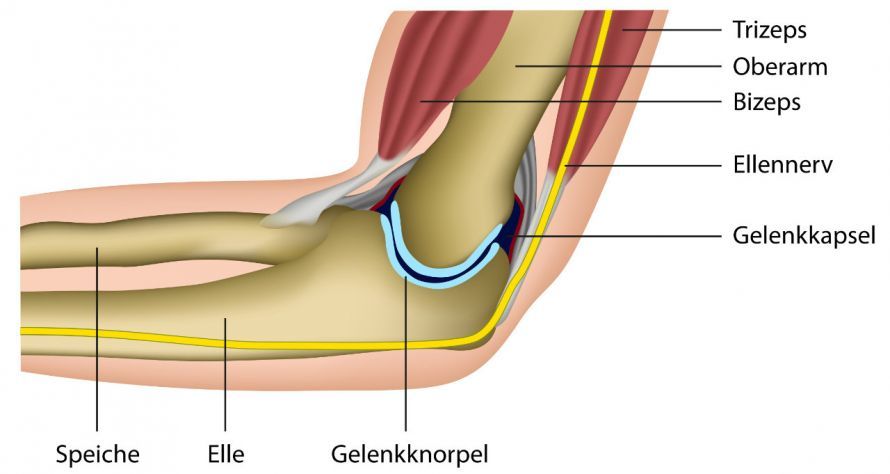
Anatomy of the Elbow
The type and severity of elbow pain depend, among other factors, on which structures of the elbow joint are affected.
The elbow joint consists of three sub-joints:
- humeroulnar joint,
- humeroradial joint, and
- the proximal ulnar-radial joint
.
These three sub-joints are surrounded by a common joint capsule. They connect the upper arm bone (humerus) to the forearm bones—the ulna and the radius.
The elbow joint is stabilized and guided by three strong ligaments: the two collateral ligaments and the annular ligament.
With these structures, the elbow allows
- allows the forearm to bend and straighten relative to the upper arm (ball-and-socket joint and hinge joint) and
- rotation of the forearm and hand (pivot joint).
The elbow therefore plays a very important role in the movements of the arm in everyday life, sports, and work.
Definition
Elbow pain refers to pain in the area of the elbow joint, the adjacent bones, tendons, ligaments, the bursa, or the surrounding muscles.
Symptoms can be acute or chronic, dull or sharp, radiate into the forearm, or be noticeable only when extending or bending the arm.
Depending on the affected structure, the following conditions are distinguished, among others:
- Tendon irritation, e.g., in tennis arm or tennis elbow
- Inflammation in the elbow
- Degenerative processes such as osteoarthritis of the elbow
- Neurological causes, e.g., cubital tunnel syndrome (= nerve compression in the elbow)
If additional symptoms such as swelling, redness, limited mobility, or tingling occur, a medical evaluation should be conducted.
Common causes of elbow pain, swelling, and inflammation in the elbow
The most common causes of these symptoms are varied and affect different structures of the arm.
In most cases, elbow pain results from improper use or overuse of the arm. It often occurs
- during everyday activities such as carrying shopping bags,
- during sports activities such as playing tennis or golf, or
- while working in a job that places heavy strain on the arm and elbow,
.
In addition, injuries resulting from an accident as well as elbow conditions can also cause pain.
Injury- and strain-related elbow pain
Injury- and strain-related elbow pain is caused, for example, by:
- a dislocation of the elbow joint
- a bone fracture in or near the elbow
- Injuries to the ligaments and tendons of the elbow joint, such as a torn ligament or a strain
- Muscle injuries or muscle tension in the elbow area
- so-called tennis elbow (pain on the outside of the elbow in tennis elbow | tennis elbow)
- so-called golfer’s elbow
- RSI syndrome (Repetitive Strain Injury syndrome) caused by repetitive activities and strain (e.g., “mouse arm” from frequent computer use)
Elbow pain caused by inflammatory conditions
Inflammatory conditions that cause elbow pain and can lead to inflammation include, among others:
- arthritis (joint inflammation) of the elbow joint
- rheumatoid arthritis
- Bursitis in the elbow joint
- tendinitis
Other causes of elbow pain
Other conditions that can cause elbow pain include:
- osteoarthritis, i.e., joint wear and tear, of the elbow
- osteoporosis (bone loss)
- loose bodies in the elbow joint
- Irritation of the ulnar nerve, for example, caused by the “musician’s bone” striking a sharp edge
Symptoms & Risk Factors for Elbow Pain in Tennis Elbow
Elbow pain is often caused by repetitive strain and overuse, especially during activities that involve regularly bending or extending the arm, as well as in sports such as tennis or other racket sports.
Poor posture, insufficiently strengthened forearm and shoulder muscles, advanced age, and pre-existing conditions such as osteoarthritis or rheumatic diseases also increase the risk of these symptoms.
Symptoms vary depending on the cause and range from localized pain in the elbow to pain radiating into the arm and tenderness in the joint area, as well as limited mobility. In cases of inflammation, swelling, redness, and warmth may also occur.
Typical symptoms also include stabbing or exertion-related pain on the outer or inner side of the joint, as well as discomfort when grasping, carrying, or lifting objects.
Often, the pain initially occurs only during activity but persists even at rest as the condition progresses.
Diagnosis of Elbow Pain
For effective treatment, the underlying causes of the symptoms must first be identified as part of the diagnostic process. The diagnosis is usually based on
- a review of the patient’s medical history (anamnesis),
- a physical examination, and
- additional tests such as X-rays, ultrasound, or magnetic resonance imaging (MRI).
Medical History for Diagnosing Elbow Pain
During the medical history interview, the doctor will first review the patient’s medical history. Among the questions the doctor will ask are:
- How exactly does the elbow pain manifest—is it stabbing, pressing, or pulling?
- Where exactly is the pain located—on the inside, the outside, in the elbow crease, or throughout the entire arm?
- When does the elbow pain occur, e.g., during certain movements?
- How long has the patient been experiencing elbow pain?
- What pre-existing conditions and injuries in the elbow area are known?
- Is there a possibility of overuse of the elbow, e.g., from playing tennis or golf, or from working at a computer?
Physical Examination
During the physical examination, the treating physician first palpates the elbow joint. He checks whether the joint is swollen or warm and simultaneously assesses its condition.
They will also perform several movement tests to assess the range of motion and pain levels in the elbow joint. The other joints and body posture are also evaluated as part of the physical examination.
Further Tests
In most cases, the doctor can make a preliminary diagnosis based on the medical history and physical examination. Additional tests may then be performed to confirm this diagnosis.
These include, among others, the following tests:
- X-ray: Can confirm suspected bone damage
- Ultrasound examination (sonography)
- Magnetic resonance imaging (MRI)
- Computed tomography (CT)
- Arthroscopy (joint examination)
- Blood test: Measures inflammation markers
- Joint aspiration: Removal of fluid from a joint effusion or a swollen bursa for subsequent laboratory analysis
What to Do About Elbow Pain? Treatment Options for Severe Elbow Pain
Treatment for elbow pain depends on the cause, the severity of the symptoms, and whether the pain is acute or chronic. In most cases, conservative therapy is sufficient to maintain joint function and reduce pain.
The first priority is to rest the arm. Temporarily reducing physical activity—especially during sports or work-related tasks—helps alleviate pain. In cases of overuse, repetitive movements, heavy weight-bearing, and frequent stretching and bending should be avoided.
In cases of inflammatory changes, anti-inflammatory medications are used to reduce swelling, redness, and severe pain. Depending on the findings, cold or heat therapy may also be used as a supplement.
Physical therapy is a central component of treatment. It improves mobility and involves targeted exercises to strengthen the muscles and tendons, or shock wave therapy, to prevent further overuse. Wearing a brace can be helpful to stabilize the joint.
In cases of degenerative changes such as osteoarthritis of the elbow, injections may also be administered into the joint to reduce friction and pain in the joint area. Surgical intervention is rarely necessary, such as in cases of advanced osteoarthritis or cubital tunnel syndrome.

Sometimes, braces can help with elbow pain © Robert Kneschke | AdobeStock
Surgical Treatment of Elbow Pain
Elbow pain cannot always be adequately relieved with conservative treatment measures. In such cases, surgical options may be considered. The following surgical treatment methods, among others, are available:
- Arthroscopy (joint endoscopy) of the elbow joint
- Osteotomy: Cutting through bone or removing bone segments, e.g., for elbow pain caused by osteoarthritis
- Implantation of an elbow prosthesis (artificial elbow joint)
Course and Prognosis
The course of the condition depends heavily on the underlying cause. In many cases, elbow pain can be significantly alleviated within a few weeks.
Acute symptoms often resolve without any lasting effects. However, if improper loading persists or if chronic inflammation or osteoarthritis is present, permanent limitations may result.
Early diagnosis and consistent treatment are therefore important.
Conclusion
Elbow pain comes in many forms, ranging from mild irritation to severe degenerative conditions. A timely diagnosis and targeted treatment are crucial for a good prognosis. If potential causes are identified early, pain can be effectively relieved and chronic progression prevented.
Frequently Asked Questions About the Causes, Symptoms, and Treatment of Elbow Pain on the Outer or Inner Side When Extending or Bending the Elbow
What are the most common causes of elbow pain?
Common causes include overuse injuries such as tennis elbow (outer side) or golfer’s elbow (inner side), inflammatory conditions, osteoarthritis, and nerve irritation. Improper biomechanics in daily life or at work also play a major role.
What are the typical symptoms of elbow pain?
Typical symptoms include stabbing or pulling pain on the outer or inner side of the elbow, tenderness, loss of grip strength, and limited range of motion. Inflammation is often accompanied by swelling and warmth.
How is elbow pain diagnosed?
The diagnosis is made through a medical history, physical examination, and, if necessary, imaging tests such as X-rays, ultrasound, or MRI. This allows the exact cause to be specifically identified.
How is elbow pain treated?
In most cases, rest, anti-inflammatory medications, and physical therapy are effective. Braces and other physical interventions may be used as complementary treatments. Surgery is rarely necessary.
Share this article