Huntington’s chorea is a rare, genetically caused brain disorder also known as Huntington’s disease or Huntington’s chorea. The disorder was first described in 1872 by the physician George Huntington and is also colloquially referred to as St. Vitus’ dance. It is caused by a mutation in a gene on chromosome 4, which leads to the progressive degeneration of nerve cells in the brain.
People with Huntington’s chorea usually develop the disease in adulthood, with the first symptoms often appearing between the ages of 30 and 50. The disease is inherited in an autosomal dominant pattern, meaning that an affected parent can pass on the gene. Typical symptoms include movement disorders, psychological changes, and cognitive impairments. Early diagnosis and targeted diagnostic testing are crucial for better understanding and managing the course of the disease.
What is Huntington's Chorea?
Huntington’s chorea (also known as Huntington’s disease or chorea major) is a rare, hereditary brain disorder. It is caused by a defective gene. In Germany, about 10,000 people suffer from Huntington’s disease. It is incurable and, in most cases, develops between the ages of 35 and 45. The course of the disease varies from patient to patient.
Typical symptoms include:
- Neurological and psychological disorders
- Changes in movement patterns
- Behavioral changes
In later stages, intellectual abilities also decline as nerve cells in the brain are slowly destroyed. In the final stage, those affected suffer from dementia. On average, the disease leads to death 15–20 years after onset.
The causes of the disease
Huntington’s disease is caused by the degeneration of nerve cells in specific regions of the brain. The disease affects women and men equally.
The gene responsible for the disease is not located on the X and Y chromosomes (which determine sex), but on the autosomes. The body has two copies of each of these chromosomes: one from the father and one from the mother. If one parent carries the genetic mutation, the child has a 50% chance of developing Huntington’s disease.
In rare cases (2 to 5 percent) of those affected, there is no known history of the disease in the family of origin. In these cases, the mutations may be de novo. The genetic changes are not inherited.
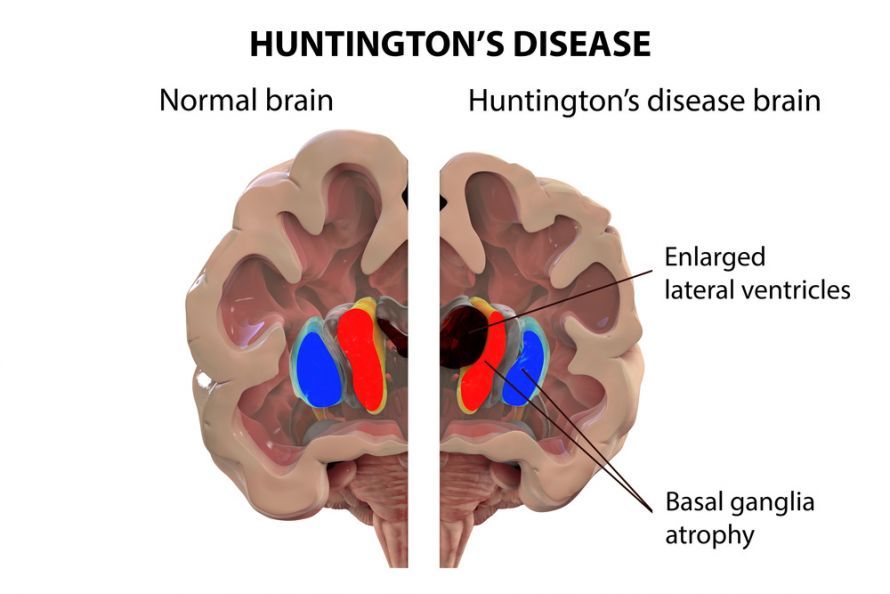 Areas of the brain in people with Huntington’s disease gradually deteriorate @ Dr_Microbe /AdobeStock
What are the symptoms of Huntington’s disease?
The changes manifest as follows:
- Disturbances in mood and motivation, characterized by impulsive behavior and disinhibition.
- Patients are irritable and aggressive. Some develop depression or increasing anxiety. A loss of cognitive abilities becomes progressively noticeable.
- Movement disorders usually appear suddenly; they are uncontrollable and exaggerated. At first, they resemble exaggerated gestures.
- The muscles of the tongue and throat are also affected.
- Speech becomes unintelligible and choppy.
- Difficulty swallowing occurs. Eating becomes difficult, and food may enter the windpipe. There is a risk of pneumonia.
- Later stages of the disease are characterized by muscle stiffness and a severe reduction in movement. The loss of muscle control is also evident in the face (sudden grimacing).
- Patients usually react to the reactions of those around them with depression, resignation, or suicidal thoughts.
- The brain’s ability to process information declines, and interpreting the facial expressions of others becomes increasingly difficult. Patients progressively lose their cognitive abilities, and some develop delusions.
After 15 years, nearly all patients develop dementia. In the final stage, those affected are usually bedridden and dependent on care.
The Diagnosis
If family members have already been diagnosed with the disease, Huntington’s chorea is a likely diagnosis for patients with symptoms. However, to confirm this diagnosis and determine the extent of nerve damage, psychiatric and neurological examinations are necessary.
Other diseases can also cause these symptoms. Since Huntington’s disease is very rare, primary care physicians and private practice neurologists often have little or no experience with it. Therefore, it is advisable to consult experienced specialists at one of the existing Huntington’s disease centers. A molecular genetic test provides evidence of the mutated gene.
A CT (computed tomography) or MRI (magnetic resonance imaging) scan shows the extent to which individual regions of the brain are affected. Using electrophysiological diagnostic (ENG) methods, the functionality of nerve cells and the nervous system can be assessed. Even healthy individuals who are at increased risk due to their family history can undergo genetic testing. This allows those affected to determine with certainty whether they will develop Huntington’s disease in the future.
Why is predictive testing problematic?
Knowing that one is a carrier of this genetic mutation is often problematic. The actual confirmation often has a negative impact on one’s mental well-being. For this reason, people with a genetic risk usually do not want to be tested.
For this reason, the administration of genetic testing is also subject to strict legal guidelines.
These include:
- The patient must receive thorough counseling in advance regarding the psychological consequences of an abnormal test result
- Minors may not undergo such testing.
- Tests may not be performed at the request of third parties (employers, insurance companies, or adoption agencies).
How does Huntington’s disease progress?
The first signs of the disease usually appear between the ages of 35 and 45. Very rarely, symptoms appear as early as childhood. An early onset of the disease often results in a severe course of the illness.
Psychological symptoms often begin several years before motor symptoms appear. Initially, hyperkinesia (involuntary movements) is usually noticeable; later, a reduction in movement develops. Swallowing difficulties often lead to loss of appetite and physical decline. Patients become increasingly dependent on care.
Stress can accelerate the progression of the disease. In contrast, a balanced lifestyle has a beneficial effect on the course of the disease.
Treatment of Huntington’s Chorea
Huntington’s disease cannot be cured or treated, as the degeneration of brain cells cannot be stopped.
Various forms of therapy are available to treat and alleviate individual symptoms. Doctors tailor these therapies to the individual needs of patients, as the disease progresses differently in each person:
- Medication: There are medications that relieve and alleviate certain symptoms. For example, neuroleptics can be used to treat severe, uncontrolled movements. Doctors prescribe antidepressants to treat depressive moods.
- Physical therapy, occupational therapy, speech therapy, and special dietary regimens help maintain independence and mobility over the long term.
- Swallowing therapy is also important and can be life-sustaining.
- Huntington’s Disease Centers: Since Huntington’s disease is a rare condition, its management and treatment pose a challenge for most doctors. Specialized Huntington’s disease centers, however, have the necessary experience. There, you—as a patient—and your family members are in the best hands.
Conclusion
Huntington’s disease, also known as hereditary St. Vitus’ dance or St. Vitus’ dance, is a complex brain disorder that was first described by Dr. George Huntington and named after him. Huntington’s disease is a genetic disorder; more specifically, it is a genetically altered form in which a mutated gene causes the disease. Huntington’s disease is inherited in an autosomal dominant pattern, which is why there is a high risk of developing the disease.
Huntington’s disease is a rare but serious form of the condition, in which the first symptoms often begin gradually. Typical symptoms usually appear in adulthood, with individual symptoms such as involuntary movements, psychological changes, and cognitive impairments occurring. The symptoms of Huntington’s disease can vary widely, and their severity increases over time. The disease often develops gradually, and its progressive nature is characteristic of this neurodegenerative disorder.
In clinical practice, Huntington’s disease is often suspected when patients present with corresponding symptoms, prompting targeted diagnostic testing and treatment. Diagnosis is usually made through genetic testing, while treatment for Huntington’s disease is primarily aimed at alleviating symptoms. Medication can help control chorea major and chorea minor and improve quality of life. However, Huntington’s disease cannot be cured; treatment can only influence its course.
Huntington’s disease progresses over time, and many people with the condition experience increasing limitations in their daily lives. Patients with Huntington’s disease therefore require long-term support, with both patients and their families equally involved. The disease affects both motor and cognitive functions, which is why Huntington’s disease becomes a significant burden over the years.
In summary, Huntington’s disease is a chronic condition with a complex course. Although there is no cure for Huntington’s disease, modern therapeutic approaches can help alleviate symptoms and improve quality of life. Multiple repeats of the genetic sequences trigger the onset of the disease and its manifestation in the body. Despite intensive research, the challenge remains to detect this disease early and treat it optimally, as symptoms often do not become clearly evident until a late stage.
FAQ
What is Huntington’s disease?
Huntington’s chorea is a genetic disorder of the brain in which nerve cells in the brain gradually die off. The disorder is also known as Huntington’s disease or Huntington’s chorea.
What are the symptoms of Huntington’s disease?
Typical symptoms include movement disorders, involuntary movements, psychological changes, and dementia. The symptoms usually develop gradually and worsen as the disease progresses.
How is Huntington’s disease inherited?
Huntington’s disease is inherited in an autosomal dominant pattern. This means that an affected parent has a 50 percent chance of passing on the mutated gene.
How is the diagnosis made?
The diagnosis is made through genetic testing and clinical evaluation. If Huntington’s disease is suspected, imaging techniques such as MRI are also used.
Is Huntington’s disease curable?
Huntington’s disease is currently incurable. Treatment is symptomatic, aimed at alleviating symptoms and slowing the progression of the disease.
Share this article

About the medical author
Sabine Schneider
Editor-in-Chief
Sabine Schneider – medical author: Explore expert articles and medical expertise in the Leading Medicine Guide.
View full expert profile →Sources
- S2k-Leitlinie „Chorea / Morbus Huntington“ (AWMF-Register-Nr. 030-028), Stand 31.01.2023: register.awmf.org/de/leitlinien/detail/030-028