What is asthma in children and young people?
In bronchial asthma, the airways are constantly irritated and hypersensitive. They react to certain triggers by causing the airways to narrow. This causes the muscles in the branches of the windpipe to spasm, the mucous membrane to swell and an increased amount of thick mucus to form. Air finds it harder to escape, particularly when breathing out.
This narrowing is generally reversible. Between attacks, children may appear completely normal. However, the irritation in the airways often persists, even without any noticeable problems. This is why regular treatment is advisable for many children.
How common is bronchial asthma in children?
Asthma is considered the most common chronic condition in childhood and adolescence. In Germany, around 4 per cent of children and adolescents are affected within a year; depending on the study and definition, the figures can be as high as 10 per cent. Before puberty, boys are affected more often than girls.
In infants, wheezing is very common in the context of colds. Between a third and half of children experience so-called obstructive bronchitis at least once during their first year of life. Not all of these children go on to develop asthma.
What symptoms do children with asthma show?
The symptoms usually occur in episodes and vary in severity. Typical symptoms include:
- A dry, hacking cough, particularly at night, early in the morning or after running about.
- A wheezing or humming sound when breathing out, also known as wheezing in medical terms.
- Shortness of breath, which may manifest as rapid breathing, retraction between the ribs or restlessness
- A tightness in the chest, which some children describe as pressure or a stomach ache.
- Rapid fatigue as soon as physical exertion is required, such as whilst playing.
In young children, a persistent, nagging cough following an infection is often the first sign. As they are hardly able to describe their symptoms, parents are best advised to note when the symptoms occur: whilst sleeping, whilst playing or in certain rooms.
Causes and triggers: What role do allergies play?
Asthma arises from a combination of genetic predisposition and environmental factors. The risk of asthma increases if parents or siblings suffer from asthma, hay fever or atopic dermatitis, or if the child has an allergic reaction to substances in the environment. Other risk factors include exposure to tobacco smoke during pregnancy and in the home, being overweight and being born prematurely. Children who grow up on a farm, on the other hand, are less likely to develop the condition.
Experts distinguish between different forms of asthma, which differ primarily in terms of their triggers.
Allergic asthma
From school age onwards, allergic asthma is the most common form. The immune system reacts to substances that are actually harmless. Typical allergens include house dust mites, pollen, animal dander and mould. Children with allergies often also suffer from hay fever or atopic dermatitis, as asthma and allergies frequently occur together.
Non-allergic asthma
In the youngest children, viral respiratory infections are the main cause. However, even without an allergy, the airways can react in asthma, for example to cold air, cigarette smoke, fog, emotional stress or physical exertion. Often, several factors act together.
Furthermore, studies show a link between the level of IgE in the unborn child and the development of asthma.
The body’s immune system produces immunoglobulin E (IgE) as a defence against parasites. It deploys this antibody specifically against foreign substances entering the body.
If large amounts of IgE are found on the umbilical cord at birth, the child has a threefold increased risk of developing asthma. Corresponding studies have been carried out on infants and young children.
Excessively high IgE levels are therefore a clear indication of an increased risk of developing allergic asthma.
Reference ranges for immunoglobulin E (IgE)
| Age | Total IgE |
| Adults | up to 100 IU/ml (240 µg/l) |
| Adolescents (10–15 years) | up to 200 IU/ml (480 µg/l) |
| Children (6–9 years) | up to 90 IU/ml (216 µg/l) |
| Young children (1–5 years) | up to 60 IU/ml (144 µg/l) |
| Babies (up to 1 year) | up to 12.2 IU/ml (29.3 µg/l) |
Diagnosing asthma in children: What does the examination involve?
It begins with a detailed discussion – the medical history. The doctor will ask when and how often the symptoms occur, what triggers them, and whether there is a family history of hay fever or atopic dermatitis. This is followed by a physical examination of the lungs using a stethoscope.
Lung function tests from around the age of six
From around the age of five or six, children are usually able to participate effectively in a lung function test. During spirometry, the child breathes out forcefully into a mouthpiece. Among other things, the test measures how much air the child can exhale in the first second. A test using a bronchodilator spray shows whether the airway narrowing resolves. In addition, an exercise test on a treadmill or a peak flow chart to be completed at home may be useful.
These measurements cannot be carried out reliably in infants and very young children. The diagnosis of asthma is then based on the pattern of symptoms and on whether trial treatment helps. If asthma is suspected, the GP’s surgery will also check for sensitisation, for example using a skin test or a blood test for specific IgE antibodies. Other causes, such as an inhaled foreign body, are ruled out.
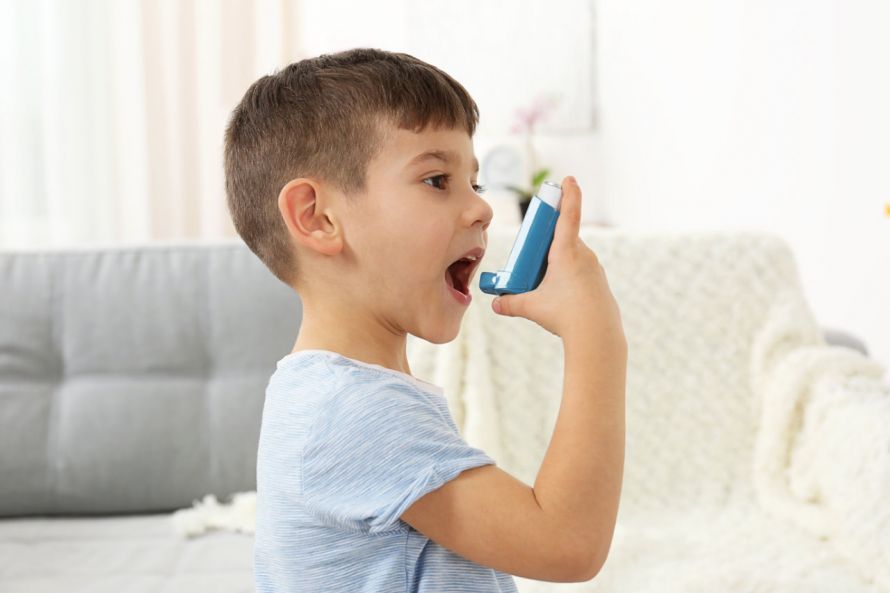
Treating asthma in children: Which medicines help?
The aim is well-controlled asthma: the child should be as symptom-free as possible, sleep through the night and be able to play and learn without restriction. The national clinical guideline no longer bases treatment on the severity of the condition, but on asthma control. Depending on how well this is achieved, the doctor adjusts the treatment according to a stepwise approach.
The medicines act directly where they are needed. Reliever medicines include fast-acting beta-2 agonists such as salbutamol. These widen the airways within a few minutes, but do not tackle the inflammation. If this is not sufficient, long-term treatment with inhaled corticosteroids is added. This active ingredient reduces inflammation in the airways and lowers the risk of attacks. Long-acting beta-2 agonists are only used in combination with corticosteroids.
| Procedure | Who is it suitable for? | Duration | Advantages and disadvantages |
|---|---|---|---|
| Emergency inhaler (fast-acting beta-2 agonists) | For all affected children to relieve acute breathlessness | Only when needed | Advantage: takes effect within a few minutes. Disadvantage: does not treat the inflammation; frequent use indicates inadequate control. |
| Inhaled corticosteroids | For children with recurrent problems | Over a period of months to years, with regular monitoring | Advantage: prevents attacks. Disadvantage: takes days to weeks to take effect; prolonged use may affect growth. |
| Combination with long-acting beta-2 agonists or montelukast | When cortisone alone is not sufficient | Tailored to the individual’s course of the condition | Advantage: better control. Disadvantage: Montelukast may cause sleep disturbances or mood swings. |
| Biologicals | For severe asthma | Long-term, in specialist centres | Advantage: targeted intervention in the immune system. Disadvantage: injections; only suitable for selected children. |
| Immunotherapy | For allergic asthma with a clearly identified allergen | Usually three years | Advantage: tackles the root cause. Disadvantage: only possible if asthma is well controlled. |
Inhaling correctly
Success depends heavily on technique. Very young children use a spacer with a mask; older children use a mouthpiece or a powder inhaler. After using cortisone, the child should eat something, drink something or rinse their mouth to prevent a fungal infection.
Education as part of asthma management
In asthma training, children and parents learn to recognise warning signs, use inhalers correctly and know how to act in an emergency. A written emergency plan provides reassurance at nursery and school.
Course and prognosis: Does asthma in children resolve itself?
The course of the condition varies greatly. Many children who only experience wheezing when they have a cold are symptom-free by the time they reach school age. In mild cases, it is not uncommon for asthma to disappear during puberty, particularly in boys. For allergic asthma, a rough rule of thumb applies: one third lose their symptoms by adolescence, one third require only minimal medication, and in one third the condition persists.
However, long-term studies show that asthma often does not simply go away with age. It can return in adulthood, even after years without any problems. A ‘wait-and-see’ approach is therefore not a viable strategy. Consistent treatment prevents attacks and protects lung function. This enables most people with asthma to lead a largely normal life.
Can a child with asthma take part in sport?
Yes, exercise is strongly encouraged. For some children, running about or running can trigger a cough or shortness of breath, particularly in cold weather. This is an indication that the treatment should be adjusted and is not a reason to ban sport. A slow warm-up and, following consultation with a doctor, using the emergency inhaler before training helps many children.
What should you do in the event of an asthma attack?
During an acute asthma attack, it is important to stay calm. The child should sit upright and support themselves with their arms. Parents should administer the emergency inhaler according to the emergency plan. Older children may find the ‘pursed-lip’ technique helpful: they breathe out slowly through slightly pursed lips.
If the shortness of breath does not improve quickly, if the child can barely speak, or if their lips and fingernails turn blue, you must call the emergency number 112 immediately.
When is medical help needed?
It is advisable to seek a paediatric assessment if a child repeatedly coughs at night, wheezes when breathing or becomes breathless quickly during physical activity. A persistent cough that lasts for several weeks after a cold should also be investigated. If the child has a diagnosed case of asthma, an appointment is needed if they are using their emergency inhaler more often than agreed. For complex cases, there are specialist paediatric pulmonologists as well as experts in allergies and asthma.
Frequently asked questions about childhood asthma, diagnosis and treatment
At what age can asthma be reliably diagnosed?
The first signs often appear in the early years of life. A definitive diagnosis is usually only made from around the age of five or six, when a lung function test can be carried out.
Is asthma curable?
Not in the strict sense of the word. However, in some children the symptoms subside; with proper treatment, the condition can usually be well managed.
Who is responsible for diagnosing and treating asthma?
Paediatricians are the first point of contact. In cases where the condition is unclear or severe, they consult paediatric pulmonologists and coordinate with the treating GP’s practice.
Is inhaled cortisone harmful to my child?
In low doses, inhaled cortisone is well tolerated, as it acts primarily in the bronchi. A slight delay in height growth is possible, which is why height is monitored regularly. Untreated asthma usually carries greater risks.
What helps with a cough caused by asthma?
Above all, good control of the airway inflammation. Cough suppressants do not address the cause and are no substitute for asthma inhalers.
How can parents prevent an asthma attack?
Regular use of inhalers, avoiding triggers and ensuring a smoke-free environment reduce the risk of an attack. An emergency plan helps you to react correctly at the first warning signs.
Share this article

About the medical author
Sabine Schneider
Editor-in-Chief
Sabine Schneider – medical author: Explore expert articles and medical expertise in the Leading Medicine Guide.
View full expert profile →Sources
- https://www.lungenaerzte-im-netz.de/krankheiten/asthma-bei-kindern/wie-haeufig-ist-asthma-bei-kindern/
- https://www.asthma.de/asthma/symptome
- https://www.netdoktor.de/krankheiten/asthma/
- https://www.schoen-klinik.de/asthma-bronchiale
- https://www.toppharm.ch/krankheitsbild/asthma-bronchiale
- https://www.internisten-im-netz.de/mediathek/blutbild-erklaerung/immunglobulin-e.html
- https://www.gesundheit.de/krankheiten/allergien/allergien-und-allergiesymptome/ige-wert-immunglobulin