Expert Interviews
Colon Cancer: Surgical Precision Is Key!

Sabine Schneider ·
When it comes to colorectal cancer, he is one of the very top specialists: His high level of surgical expertise is particularly evident in highly complex procedures—such as those for rectal cancer. In this area, Prof. Dr. med. Christoph A. Maurer and his team have even developed their own surgical technique. The Leading Medicine Guide spoke with the internationally renowned surgeon about, among other things, what makes for a successful surgery for this type of cancer.
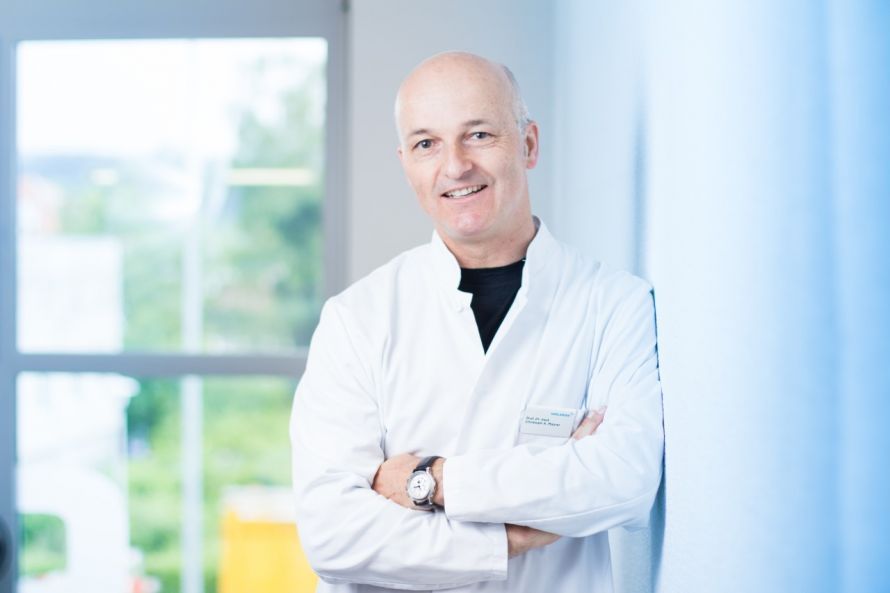
“Surgical precision is crucial!”
The rectum—also known as the terminal colon—is the final section of the large intestine. On average, the rectum is about twelve centimeters long and adjoins the anal canal. The experienced visceral surgeon Prof. Dr. med. Christoph A. Maurer points out that, of all the organs in the abdominal cavity, the rectum is the one most frequently affected by malignant tumors. But that is by no means the only interesting insight the specialist has to offer.
Leading Medicine Guide: Professor Maurer, you say that rectal cancers account for about forty percent of all colon tumors. That’s a staggering figure. Who is most commonly affected by rectal tumors?
Prof. Dr. med. Christoph A. Maurer: First of all, it’s important to note that a family history of inherited genetic mutations can be identified in less than ten percent of all patients. So, about ninety percent of cases have no family history—and in these cases, rectal cancer rarely occurs before the age of fifty. Furthermore, the tumor develops slowly over several years and, in about 97% of cases, follows the so-called adenoma-carcinoma sequence.
Leading Medicine Guide: Adenoma-carcinoma sequence?
Prof. Dr. med. Christoph A. Maurer: In the adenoma-carcinoma sequence, a small, flat polyp first develops, which slowly grows into an adenomatous mass or a mushroom-shaped adenoma. This colorectal polyp eventually becomes malignant and develops into an invasive tumor—that is, cancer. This process can take seven to ten years.
Leading Medicine Guide: Are there any risk factors that can be avoided?
Prof. Dr. med. Christoph A. Maurer: Modifiable risk factors for colorectal cancer include obesity, smoking, and high consumption of red meat, especially when charred on the grill.
Leading Medicine Guide: And how do I know if I have colorectal cancer? Through severe pain?
Prof. Dr. med. Christoph A. Maurer: A common statement from patients is: “I don’t feel anything, so I don’t have colon cancer!” But that is a misconception. The by far most commonly reported symptoms of rectal cancer are changes in bowel habits or the passage of bright red blood from the anus. The latter is often mistakenly attributed to hemorrhoids—which can have fatal consequences. Pain or intestinal obstruction are late-stage symptoms and thus indicate that the cancer is already at an advanced stage.

Leading Medicine Guide: If the diagnosis is colorectal cancer—how is treatment planning carried out?
Prof. Dr. med. Christoph A. Maurer: First of all, the diagnosis is made via a colonoscopy and the removal of a tissue sample, known as a biopsy. Next, the extent of the tumor is determined, typically through a CT scan of the abdomen and thorax and an MRI of the pelvis. Using this information, a treatment plan is developed for the patient at our interdisciplinary tumor board, taking the individual tumor stage into account. Often, the three treatment modalities—chemotherapy, radiation therapy, and surgery—are required in sequence.
Leading Medicine Guide: Are rectal cancer surgeries dangerous procedures?
Prof. Dr. med. Christoph A. Maurer: That also depends on the stage of the disease. In any case, however, rectal cancer surgeries fall within the field of highly specialized abdominal surgery. In Switzerland, they may now only be performed by a few centers. To qualify, a center must meet numerous requirements—for example, a minimum annual case load per clinic and per surgeon.
Leading Medicine Guide: But your institutions—and you yourself—meet these requirements, don’t you?
Prof. Dr. med. Christoph A. Maurer: Yes, both Solothurner Spitäler AG and the Hirslanden Clinic in Bern are considered leading centers of excellence for abdominal diseases, in part because they consist of a network of gastroenterologists, visceral surgeons, radiation oncologists, oncologists, and pathologists. It is precisely the interdisciplinary tumor board—that is, the close collaboration on every single case—that ensures our patients receive significant added value in terms of medical expertise.
Leading Medicine Guide: That’s surely also because such surgeries aren’t exactly easy...
Prof. Dr. med. Christoph A. Maurer: Exactly. The surgical site deep within the pelvis, the often confined pelvic space, the not uncommon obesity among patients, and—in men—the occasionally enlarged prostate make these rectal surgeries challenging. However, with the appropriate experience and expertise, these procedures are almost without exception performed precisely, with minimal blood loss, and without complications.
Leading Medicine Guide: When it comes to tumors in the rectum, there is certainly a fear of losing the anus and having to live with a colostomy.
Prof. Dr. med. Christoph A. Maurer: With the appropriate expertise, preoperative diagnostics and surgical techniques have advanced to such a degree today that a rectal resection is now rarely necessary. In our patient population, only about five to six percent experience a loss of the anus—and thus of normal continence—as a result of the disease.
Leading Medicine Guide: Does this apply to all of Switzerland?
Prof. Dr. med. Christoph A. Maurer: Unfortunately not; these encouraging figures are attributable to our expertise. Nationwide, a rectal resection is performed on an average of twenty-five percent of all patients with rectal cancer.
Leading Medicine Guide: Is it even possible for me to be cured of my rectal cancer?
Prof. Dr. med. Christoph A. Maurer: The long-term prognosis depends, on the one hand, on the tumor stage at diagnosis and, on the other hand, on the quality of the surgery. And it is precisely here—namely, in the quality of the surgery—that the precise performance of what is known as a total mesorectal excision is crucial. In this technique, the fat pad—which contains lymphatic vessels and lymph nodes and surrounds the rectum—is meticulously dissected from the pelvis along a thin layer of connective tissue. This mesorectal fat pad is, in fact, the site where the tumor can directly infiltrate or metastasize—that is, form secondary tumors. To prevent tumor recurrence in the pelvis, this fatty tissue—the mesorectum—must therefore be completely removed. In our practice, the local recurrence rate after a five-year follow-up period is less than three percent; even in long-term follow-ups, we remain below five percent. Incidentally, we published a book in 1998 to share our method with German-speaking surgeons. The book is titled “The Concept of Total Mesorectal Excision” and was published by Karger Verlag.
Leading Medicine Guide: Is additional chemotherapy and radiation therapy even necessary at all?
Prof. Dr. med. Christoph A. Maurer: The refinement and optimization of surgical techniques in the pelvis now allow us to forgo radiation therapy in about sixty percent of patients—specifically those patients for whom, according to guidelines, such therapy would be recommended following conventional surgery. As a result, a significant proportion of patients are spared the potential side effects of radiation therapy without compromising local recurrence rates or long-term survival. In contrast, for intermediate and advanced tumor stages, chemotherapy is recommended to prevent or treat distant metastases in the liver or lungs. Recently, chemotherapy has increasingly been administered prior to surgery.
Leading Medicine Guide: On average, how much quality of life do patients lose after rectal cancer surgery?
Prof. Dr. med. Christoph A. Maurer: My research team has developed a rectal replacement procedure. In this procedure, the large intestine—which is sutured to the anal canal—is reconfigured in such a way that a fecal reservoir develops, similar to that of a natural rectum. In addition, a peristaltic brake is created—meaning the forward-propelling intestinal movement slows down before reaching the anal canal. As a result, patients are much less likely to be bothered by frequent bowel movements, loose stools, or even incontinence after the surgical procedure. After just one year, our patients report virtually no complaints in this regard. By refining our surgical technique and deepening our anatomical knowledge of the pelvis, we are now also able to spare the nerves leading to the bladder and genitals to a great extent. As a result, urogenital dysfunction occurs much less frequently after rectal surgery when the surgeon has the necessary experience and performs the operation with great precision. Incidentally, we published this scientific finding as early as 2001 in a renowned surgical journal (Br J Surg).
Leading Medicine Guide: Many patients are unsure what to do after receiving a diagnosis. What do you recommend?
Prof. Dr. med. Christoph A. Maurer: I advise all those affected to seek further clarification at the slightest sign of doubt. No one should hesitate to seek a second opinion—even after treatment has already been completed if the outcome is unsatisfactory.
Leading Medicine Guide: Professor Maurer, thank you for these fascinating insights into the fine art of rectal surgery! We hope that many patients will draw a little courage from this conversation—and gain the knowledge that it’s best to consult a highly experienced specialist. We believe the success rates mentioned here speak for themselves!
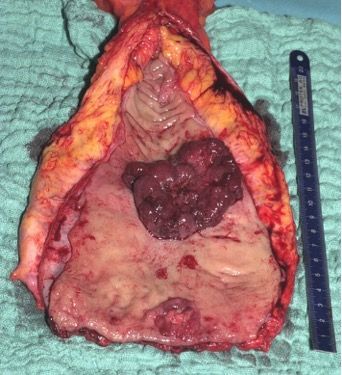
This image shows a longitudinal section of the rectum—the large tumor appears dark red in the center, and a smaller secondary tumor can be seen near the lower end of the specimen. The surrounding mesorectal fat is shown in yellow.
Share this article
About the medical author
Sabine Schneider
Editor-in-Chief
Sabine Schneider – medical author: Explore expert articles and medical expertise in the Leading Medicine Guide.
More about the medical author →Gastrointestinal Center Aare
ProfileExpert Interviews
Read next
- Expert interview
Cardiogeriatrics: Significance and benefits in the context of hospital reform
Sep 21, 2026
Cardiogeriatrics: Significance and benefits in the context of hospital reform
Read more - Expert interview
Expert Interview with Professor Dr. Amadeus Hornemann, MPH
Sep 18, 2026
Prof. Amadeus Hornemann on Precision Medicine in Gynecology: Modern Surgery, New Techniques, Better Quality of Life
Read more - Expert interview
Expert Interview with Professor Dr. Konstantinos Anagnostakos
Sep 15, 2026
Prof. Anagnostakos on Painful Knee Replacements
Read more