Expert Interviews
Joint Preservation Using Robot-Assisted Sliding Prostheses - Modern Endoprosthetics at ETHIANUM in Heidelberg

Alexandra Pfitzmann ·
The robot-assisted unicondylar partial knee replacement offers younger, active patients with knee osteoarthritis a joint-preserving, more natural alternative to total knee replacement—with a faster return to activity and no radiation exposure. The CORI system reliably enables implant positioning with millimeter precision, making the procedure a highly effective option with significant, previously untapped potential.
Studies show that up to 50 percent of all patients with knee osteoarthritis would be suitable candidates for a partial knee replacement—yet worldwide, only about ten percent receive this type of treatment. The editorial team of the Leading Medicine Guide spoke with Priv.-Doz. Dr. med. Philipp A. Michel, M.Sc., a specialist in orthopedics and trauma surgery with a focus on endoprosthetics and robot-assisted surgery, about this topic.
PD Dr. Michel has been working at the Center for Hip and Knee Endoprosthetics at ETHIANUM Heidelberg since July 2025, which he co-directs with Prof. Dr. med. Jörg Holstein. Previously, as a senior physician, he headed the Endoprosthetics Section at the University Hospital of Münster (Department of Trauma, Hand, and Reconstructive Surgery); he is habilitated and has published extensively in scientific journals.

When the Knee Dominates Daily Life—The Path to Diagnosis
Knee osteoarthritis rarely begins with a dramatic moment. It’s more of a gradual process: First, climbing stairs becomes painful; then your jogging route gets shorter; eventually, even walking the dog becomes difficult. When conservative treatments have been exhausted and quality of life declines, the question of joint replacement arises.
“The focus is usually on very basic limitations in daily life: pain when walking, problems climbing stairs or getting in and out of the car, and often an increasing restriction of movement because the knee can no longer be fully extended or bent. In some cases, there are also problems falling asleep or staying asleep.
By this point, many patients have already gone through a long history of treatment—including physical therapy, pain medication, injections (cortisone, hyaluronic acid, PRP), and other conservative measures—which eventually become insufficient,” says PD Dr. Michel, describing the typical course of the condition.
Since damaged cartilage in osteoarthritis cannot yet be regenerated, joint replacement remains the only curative option. This involves making a fundamental decision first: Is a total surface replacement necessary—that is, a prosthesis that replaces the entire knee joint—or is a partial replacement sufficient?
“Such partial prostheses can, for example, involve only the inner part of the joint (medial compartment). However, there are also cases of osteoarthritis that primarily occur on the outer side (lateral compartment) or behind the kneecap (retropatellar compartment). When people talk about a ‘slide prosthesis,’ they usually mean replacement of the medial compartment,” explains PD Dr. Michel.
When is a “slide” prosthesis an option?
Not every knee with osteoarthritis requires a total joint replacement. If the wear is indeed limited to a single compartment and the remaining parts of the joint are still healthy, a unicondylar sled prosthesis may be an option—a procedure that is significantly less invasive and largely preserves the natural feeling of movement.
A prerequisite is a stable anterior cruciate ligament, as it controls the rolling and gliding motion, which is fully preserved with a partial prosthesis. The collateral ligament guidance must also be intact.
“During the patient’s first visit, the most important thing is to really take the time to get to know the person in front of you. We set aside a full hour for each patient during their initial consultation at the ETHIANUM.
What symptoms are limiting their daily life? What hobbies are important to them? Should the knee once again allow for long hikes, relaxed cycling, or perhaps even golf or tennis? Or is the goal more about being able to walk short distances pain-free in old age? The needs vary enormously. Only once it’s clear who is actually sitting there and what that person needs do we proceed with the physical examination and review of the medical records they’ve brought with them,” says PD Dr. Michel.
The Diagnostic Evaluation
After the detailed consultation, the actual diagnostic process begins: clinical examination, ultrasound, and evaluation of existing X-rays. If necessary, high-resolution MRI scans are performed, which precisely show the condition of the cartilage in all compartments. Studies show that MRI diagnostics achieve a sensitivity of over 94 percent for severe lateral cartilage damage—significantly higher than traditional weight-bearing X-rays alone.
“During the examination, many patients report pain that primarily affects the medial compartment. To make a final decision, additional specialized X-rays are required: standing X-rays to measure the leg axis, weight-bearing X-rays to assess ligament stability, and other images that show the movement of the patella. For efficient evaluation, we rely on AI analysis from ImageBiopsy Lab. Based on these criteria, we assess step by step whether the patient is a suitable candidate for a sled. The key approach here is that we always take an open and positive stance toward the possibility of partial replacement. “Everyone who walks through the door is initially considered a potential candidate—unless the diagnostic findings reveal clear reasons against it,” explains PD Dr. Michel.
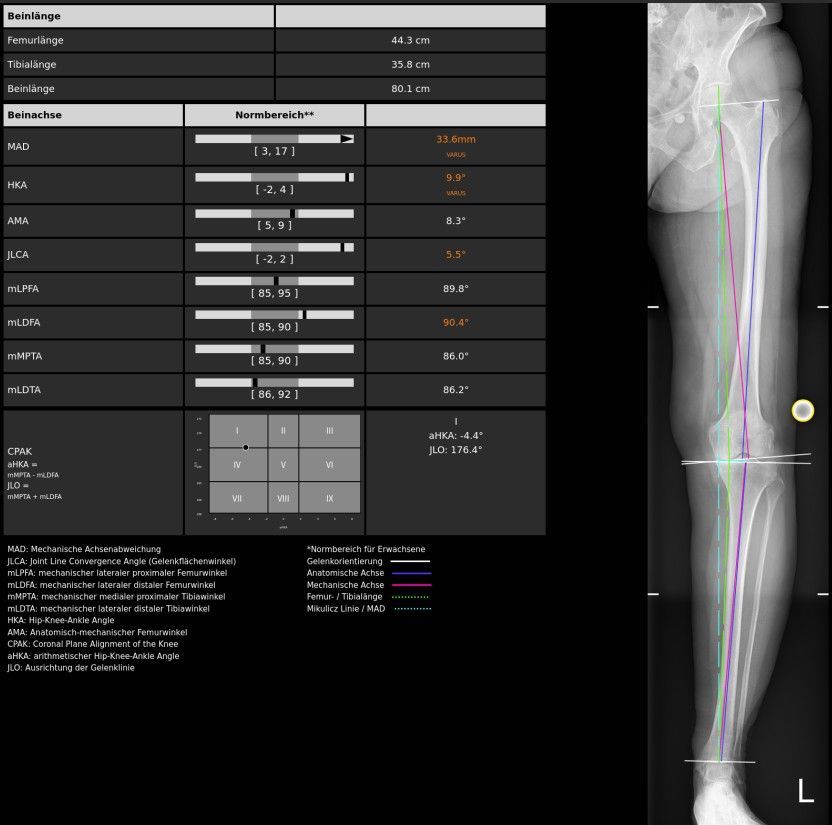
AI-assisted measurement of the leg axis in a full-leg standing X-ray using the IB Lab LAMA module from ImageBiopsy Lab. This allows for the reliable and rapid determination of bowlegs or knock-knees.
Anatomical Requirements in Detail
For a medial sled prosthesis, certain anatomical requirements must be met so that the procedure is appropriate and the prosthesis remains stable in the long term: “It is crucial that the cartilage in the lateral compartment is still sufficiently intact. The joint behind the kneecap should also be largely normal—although minor cartilage damage, such as that almost always found on MRI scans in people over 65, does not preclude the use of a sled prosthesis.
The osteoarthritis must be clearly limited to a single compartment (Figure 2). Ideally, the anterior cruciate ligament should be stable. In recent years, however, some flexibility has emerged in this regard: In older patients with secondary cruciate ligament insufficiency, a sled prosthesis may still be an option because certain deficits can be compensated for via the robotically precise adjustment of the prosthesis’s inclination. “These criteria—defined, among others, by the Oxford Group and currently being further developed by the AE (Endoprosthetics Working Group)—help reliably identify suitable candidates,” explains PD Dr. Michel.
At a Glance—Requirements for a Sliding Prosthesis: Isolated medial (or lateral) compartment osteoarthritis with bone-on-bone contact, preserved cartilage in the opposite compartment, functionally intact anterior cruciate ligament and medial collateral ligament, correctable leg alignment deviation (varus up to 10–15°), no inflammatory arthropathy.
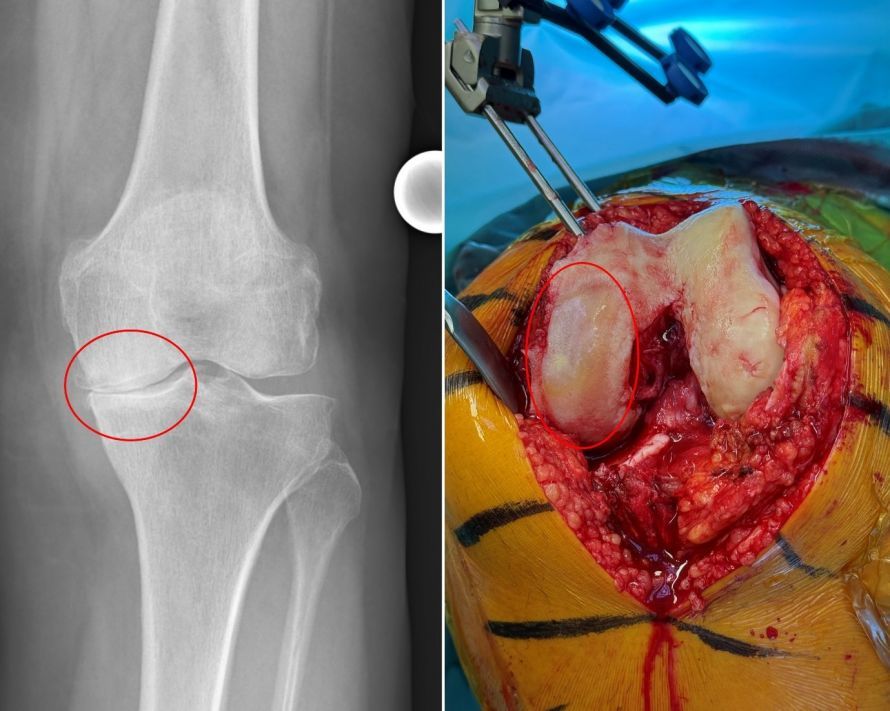
Typical presentation of anteromedial osteoarthritis in a 75-year-old patient. The X-ray shows the narrowed joint space in the medial compartment. During surgery, the absence of cartilage and the already worn-down bone in the medial joint compartment are evident. Age-appropriate cartilage coverage is present in the remainder of the knee joint (lateral and retropatellar compartments).
Great potential, limited use—why the sled prosthesis is so rarely used
In Germany, only about 14 percent of affected patients have received a sled prosthesis (unicondylar knee prosthesis, or UKA for short) to date—even though studies show that 41 to 49 percent of all candidates for total knee arthroplasty (TKA) would actually be suitable for a partial replacement. There is therefore a significant gap in care.
“Why is the sled prosthesis used so rarely? A major reason lies in the high level of technical precision required for this surgery. The bone cuts must be precise to the millimeter or even submillimeter, and ligament tension must be assessed with exact precision. Even small errors can lead to premature failure of a sled prosthesis.
A surgeon who performs about a hundred knee replacements a year will, statistically, only perform about fifteen sled prostheses—too few to build the necessary routine. But because they are rarely performed, they are also rarely taught, and many young specialists do not feel confident performing the procedure after completing their training. “It’s a vicious cycle,” analyzes PD Dr. Michel.
Registry data confirm this problem: Surgeons with less than a 5 percent UKA volume per year achieve the worst five-year survival rates (90 percent), while high-volume surgeons performing over 30 sled prostheses annually achieve rates of up to 96 percent. Added to this is a reimbursement issue: In the German DRG (Diagnosis-Related Groups) system, which regulates hospital reimbursement, the reimbursement for a partial prosthesis is often lower than for a total prosthesis—despite comparable or even higher technical requirements.
“It’s also important to get private practice colleagues on board. Many rely on older registry data, in which sled prostheses had a higher revision rate than total prostheses. This leads to advice that often goes something like this: ‘With a partial denture, you’ll need two surgeries; with a full denture, just one.’ When patients come to the consultation with this preconception, it’s difficult to change their perspective.
This requires education—and, above all, good results. Satisfied patients are ultimately the strongest argument,” emphasizes PD Dr. Michel.
More Preservation, Not Less Replacement—The Functional Advantages
The benefits of a sled prosthesis can be most convincingly communicated to younger, active patients by showing them that it’s not about “less” replacement, but about greater preservation of their own, functioning knee joint. The body of research on this topic is now impressive:
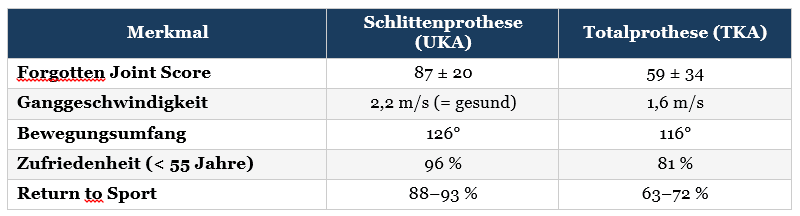
The so-called “Forgotten Joint Score” is particularly revealing: UKA patients “forget” their artificial joint significantly more often—a sign that the knee feels much more natural than after a total knee replacement. Walking speed also returns to the level of healthy control subjects (2.2 m/s) after a sled prosthesis, whereas it remains measurably reduced after a total prosthesis.
These observations are impressively confirmed by a recent Level I study: In a study recently published in the Journal of Bone and Joint Surgery (2026), Mortensen and colleagues, for the first time in a double-blind, multicenter RCT, directly compared the medial sled prosthesis with the total knee replacement—involving 350 patients across ten centers.
The Forgotten Joint Score revealed a clinically relevant difference of 14.1 points in favor of the sled prosthesis, which corresponds exactly to the threshold at which patients actually perceive the difference in their daily lives. Knee joint mobility was also significantly better, with seven degrees more flexion, as were knee-specific symptoms and pain scores in terms of overall quality of life. It is also noteworthy that the reoperation rate following a sled prosthesis—at 2.3 percent—was significantly lower than that following a total knee replacement—at 6.9 percent—a finding that sheds new light on standard registry analyses.
“What makes the sled prosthesis special is that the ‘return to sport’ is significantly better than with a total knee replacement—around 90 percent of patients return to their previous level of athletic performance. That is exactly what makes it so attractive to many active patients,” summarizes PD Dr. Michel.
A prominent example: Elite skier Lindsey Vonn received a lateral sled prosthesis in her right knee in April 2023, performed robotically with the MAKO system. In November 2024, she announced her comeback—at the age of 40. During the 2025–26 season, she won two World Cup downhill races before a serious fall at the Olympic Games in Cortina ended her comeback.
Prof. Wassilew (AE) comments: “This case impressively demonstrates what is medically possible—even if it cannot serve as a benchmark for standard care, and the risk of injury in elite sports exists regardless of the prosthesis.”
How Robotics Is Revolutionizing Precision—The CORI System
Robotic assistance with the CORI Surgical System (Smith+Nephew) is fundamentally changing surgical decision-making—even before the first incision is made. Instead of relying solely on preoperative X-rays and their own experience, surgeons receive a precise, three-dimensional image of the individual knee during surgery.
CT-free: less radiation, less effort
A key advantage of the CORI system over other robotic systems such as the MAKO (Stryker) is that it operates entirely without preoperative CT. The 3D bone model is created directly during surgery through surface scanning using a handheld probe and reflective markers. The ATRACSYS infrared camera system records the position over 300 times per second.
“For the patient, this means: no additional CT scan appointment, no radiation exposure, and no waiting for a radiologist’s appointment. The process from diagnosis to surgery becomes faster and simpler,” explains PD Dr. Michel.
Haptic Boundary Technology: Precision to 0.5 millimeters
At the heart of the CORI system is the hand-guided robotic drill—not a robotic arm, but an instrument that the surgeon guides himself. The system monitors the position in real time and automatically stops or retracts the drill if the planned boundaries are exceeded. The documented accuracy is 0.5 mm and 0.5° in all three planes.
“The plan created beforehand can be implemented precisely in the operating room, without any outliers and without any surprises later on in the X-ray image. Dynamic gap balancing is particularly valuable: The system detects soft-tissue tension across the entire range of motion in real time—before every bone resection. This enables individually tailored balancing that is virtually impossible to achieve manually. It provides safety and expands the scope of action,” explains PD Dr. Michel.
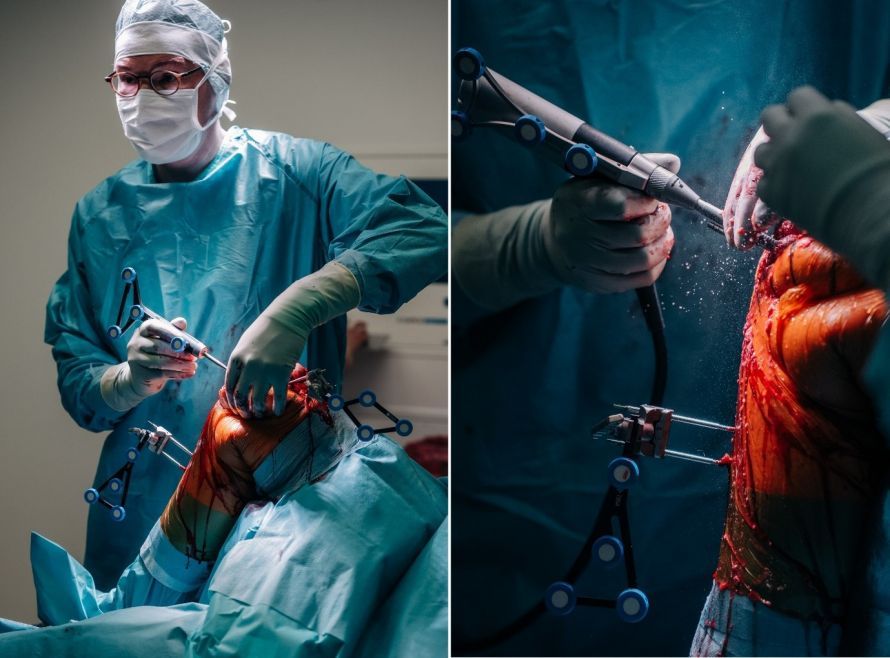
3D mapping of the joint surfaces followed by bone preparation using the high-speed milling machine.
The study data underscores the clinical relevance: In a prospective comparative study, 100 percent of robotic implants were within 2° of the planned position, compared to only 40 percent with conventional techniques. The outlier rate for the posterior tibial slope drops from 25 percent (conventional) to less than 4 percent (CORI/NAVIO).
Learning curve—the decisive advantage: With conventional methods, it takes 25 to 50 slider prostheses before a surgeon achieves reliable precision. With the CORI system, this learning curve is reduced to just 5 to 6 procedures—and implant accuracy falls within the target range from the very first case. For the first time, this enables even surgeons with a lower caseload to achieve excellent results.
What Patients Can Expect in Practice—Surgery, Recovery, and Exercise
CT-free 3D scanning and robotically guided preparation offer patients a number of concrete benefits: less blood loss, reduced pain in the first few weeks, and a faster recovery. Bone resection is gentler on the tissue, as the drill operates only within the stereotactically planned volume—robotic procedures require aggressive soft-tissue releases significantly less often.
“Let’s take a 65-year-old recreational golfer as an example—a profile I know well from my own experience. After receiving a sled prosthesis, he remains hospitalized for about three to four days. Rehabilitation isn’t strictly necessary because the implant can bear full weight immediately. Upon leaving the hospital, he is safely mobile with forearm crutches.
After two to three weeks, many are already able to do without the crutches. A follow-up examination takes place after six weeks, and if everything looks good, there’s little standing in the way of returning to the sport. “Between the eighth and twelfth week, most patients can start playing golf again—first on the driving range before venturing out for a full round,” explains PD Dr. Michel.
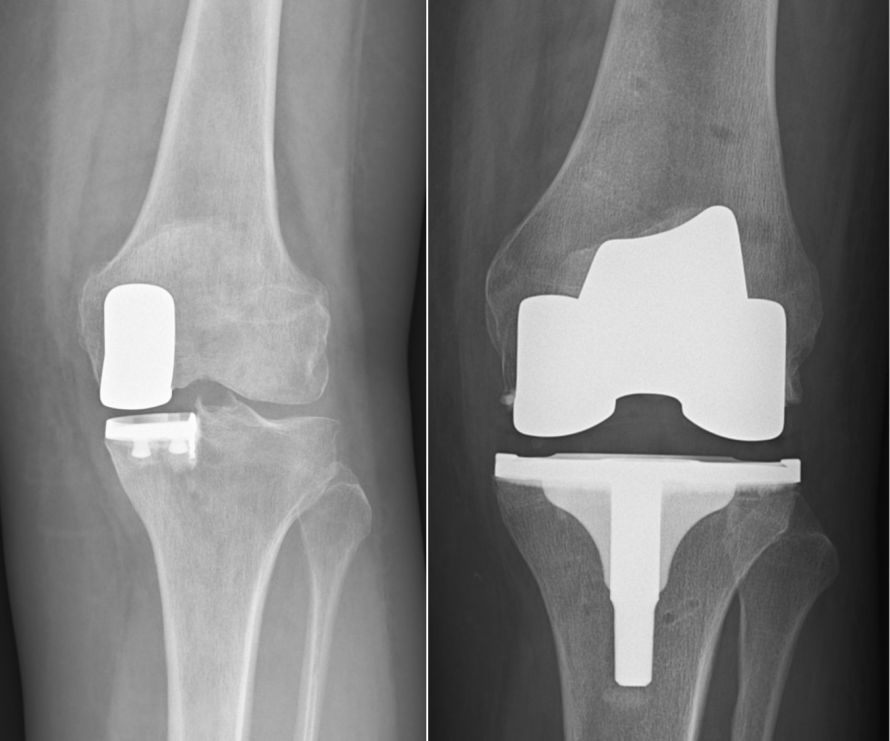
Comparison of X-ray images of a medial sled prosthesis (left) and a total prosthesis (right). The less invasive nature of UKA is evident due to the preservation of healthy cartilage and bone, as well as the cruciate ligaments.
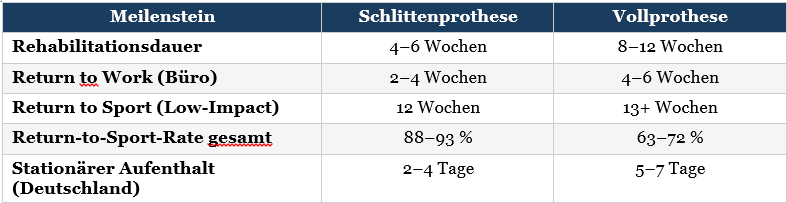
“Sports involving hard impacts or rapid changes in direction are generally not recommended, but they are certainly possible—and are much better tolerated than with a total knee replacement. Golf, cycling, hiking, skiing, or tennis can be done without any problems. Regular exercise, strong muscles around the knee, and good overall fitness support joint function and reduce the long-term strain on the prosthesis,” advises PD Dr. Michel.
Limitations and Risks—An Honest Assessment
“As compelling as the advantages of the sled prosthesis are—it is not the right solution for every patient. Transparency regarding limitations and risks is part of a reputable consultation. “There are clear contraindications: inflammatory arthropathy such as rheumatoid arthritis, severe flexion contracture, fixed varus deformity, or significant ligament instability.
Old injuries to the medial collateral ligament can be a contraindication. Even patients with severe wear across all three compartments of the knee require a total knee replacement—even the best robot can’t help in that case,” clarifies PD Dr. Michel.
PD Dr. Michel takes a nuanced view of the long-term results: “The major prosthesis registries show higher revision rates for sliding prostheses than for total knee replacements. However, these data reflect the average across all surgeons—including many low-volume surgeons. High-volume surgeons who perform more than 30 sled prostheses annually achieve 10-year survival rates of 97.5 percent—comparable to the best TKA outcomes worldwide.
In addition, the revision threshold is lower for a sled prosthesis: Conversion to a total knee prosthesis is a comparatively simple procedure, whereas revision of a failing total knee prosthesis is significantly more complex. The aforementioned study by Mortensen et al. provides an important perspective here: In the primary endpoint—the Oxford Knee Score—the difference between the partial knee replacement and the total knee replacement was statistically significant but, at 3.5 points, fell below the clinically relevant threshold.
This means that, in terms of the general functional score, both procedures perform similarly well. The decisive advantage of the sliding prosthesis is evident in the secondary endpoints—joint sensation, range of motion, and symptoms—as well as in the lower complication rate. So it’s not a matter of the sled prosthesis being superior in every respect, but rather that, for the right patient, it provides a more natural-feeling knee. For the majority of patients with knee osteoarthritis, the total knee replacement remains the correct and proven treatment option.”
The Approach at ETHIANUM—State-of-the-Art Technology in a Personal Setting
At the Center for Hip and Knee Arthroplasty at ETHIANUM Heidelberg, approximately 400 prostheses are implanted each year—hip and knee prostheses combined. At 30 to 40 percent, the proportion of sled prostheses is significantly above the national average.
“What matters is not so much the sheer number of procedures as the concept behind them. The focus here is on devoting sufficient time to each individual—during consultations, preparation, in the operating room, and during follow-up care. The entire process remains under one roof. We don’t perform ten prosthesis surgeries a day, but only as many as can be carried out responsibly with care and personal attention,” says PD Dr. Michel, describing the center’s philosophy.
Knee and Hip from a Single Source: Robotics Meets AMIS
The center takes a holistic approach to joint replacement surgery for the major joints. In addition to robot-assisted knee surgery using the CORI system, the AMIS technique is used for hip replacements—a minimally invasive anterior approach that follows a similar basic principle: modern technology, high precision, and thus tangible benefits for patients.
“Recovery after hip surgery using AMIS is often even faster than after knee surgery—most patients can be discharged after just three to four days. The combination of minimally invasive hip replacement, high-quality implants, and robotic assistance for knee replacements results in a treatment option that is medically state-of-the-art and takes place in a calm, personalized setting.
“We are able to offer the AMIS technique to all patients, regardless of their insurance status, through partnerships with Salem Hospital in Heidelberg and St. Josef’s Hospital in Viernheim,” adds PD Dr. Michel.
The technological concept at ETHIANUM: robot-assisted knee replacement (CORI Surgical System) for total and partial replacements, minimally invasive hip replacement (AMIS technique), and high-quality implant systems—all in a private hospital setting with individualized, personalized care.
Outlook—How More Patients Can Benefit
For more people to benefit from a sled prosthesis, a shift in thinking is needed on several levels: in education and training, in determining indications, and in the reimbursement structure.
“There are already dedicated pioneers who, through courses and workshops, are demonstrating that significantly more patients are eligible than many assume. They encourage surgeons to start with simple cases and build on their own experience. Because once you see how satisfied this group of patients is, you quickly gain confidence in the procedure. When people regain a surprising level of mobility after just a few weeks and bring that experience back to their practices, it changes perceptions,” PD Dr. Michel is convinced.
The Endoprosthetics Working Group (AE) already recommends more than 30 UKAs per surgeon per year, as well as a UKA share of over 20 percent per hospital. It is currently developing clinical guidelines for UKA indications. Together with the increasing prevalence of robotic assistance systems, which drastically shorten the learning curve, the sled prosthesis could achieve its well-deserved status in knee arthroplasty in the coming years.
Many thanks, PD Dr. Michel, for this well-informed and nuanced discussion on the opportunities and limitations of the robotically assisted sled prosthesis!
Priv.-Doz. Dr. med. Philipp A. Michel, M.Sc.
- Specialist in Orthopedics and Trauma Surgery, Specialized Trauma Surgery, Center for Hip and Knee Arthroplasty at ETHIANUM Heidelberg (Prof. Holstein / PD Dr. Michel)
- Areas of expertise: Knee and hip arthroplasty, robot-assisted surgery (CORI)
- Previously: Senior Physician and Head of the Endoprosthetics Section at the University Hospital of Münster, Department of Trauma, Hand, and Reconstructive Surgery (2013–2025)
- Habilitation thesis on tendon, ligament, and meniscus injuries of the lower extremity
- 30+ original research papers, 10 review articles, 3 book chapters
- Member: DGOU, DGU, AGA, AO, DKG, AE
Prof. Dr. med. Jörg Holstein
- Specialist in knee and hip surgery and joint replacement
- Focus: Minimally invasive techniques (AMIS, DAA)
- At ETHIANUM Heidelberg since 2018; previously spent nearly 15 years at Saarland University Hospital (including serving as Deputy Clinic Director)
- Board-certified specialist in orthopedics and trauma surgery with numerous additional qualifications
- Active in professional societies, with a broad range of scientific publications
References
[1] Stoddart JC, Dandridge O, Garner A, Cobb J, van Arkel RJ. The compartmental distribution of knee osteoarthritis—a systematic review and meta-analysis. Osteoarthritis Cartilage. April 2021;29(4):445-455. doi: 10.1016/j.joca.2020.10.011. Epub 2020 Nov 27. PMID: 33253887.
[2] EPRD – German Arthroplasty Registry. Annual Report 2025.
[3] Hamilton TW, Pandit HG, Lombardi AV, Adams JB, Oosthuizen CR, Clavé A, Dodd CA, Berend KR, Murray DW. Radiological Decision Aid to Determine Suitability for Medial Unicompartmental Knee Arthroplasty: Development and Preliminary Validation. Bone Joint J. Oct. 2016;98-B(10 Supple B):3–10. doi: 10.1302/0301-620X.98B10.BJJ-2016-0432.R1. PMID: 27694509; PMCID: PMC5047136.
[4] Pandit H, Jenkins C, Gill HS, Smith G, Price AJ, Dodd CA, Murray DW. Unnecessary contraindications for mobile-bearing unicompartmental knee replacement. J Bone Joint Surg Br. 2011 May;93(5):622-8. doi: 10.1302/0301-620X.93B5.26214. PMID: 21511927.
[5] Rodríguez-Merchán EC, Gómez-Cardero P. Unicompartmental knee arthroplasty: Current indications, technical issues, and results. EFORT Open Rev. June 6, 2018;3(6):363-373. doi: 10.1302/2058-5241.3.170048. PMID: 30034817; PMCID: PMC6026888.
[6] Murray DW, Pandit H, Weston-Simons JS, Jenkins C, Gill HS, Lombardi AV, Dodd CA, Berend KR. Does body mass index affect the outcome of unicompartmental knee replacement? Knee. Dec 2013;20(6):461-5. doi: 10.1016/j.knee.2012.09.017. Epub 2012 Oct 27. PMID: 23110877.
[7] Jiao X, Cao G, Wu J, Li Z, An S, Huang J. Assessing lateral femoral condyle cartilage prior to medial UKA: MRI vs. valgus stress radiograph. BMC Musculoskelet Disord. Aug 26, 2023;24(1):681. doi: 10.1186/s12891-023-06802-2. PMID: 37633881; PMCID: PMC10463517.
[8] Mortensen JF, Blanche P, Blom CS, Vase M, Overgaard S, Kappel A, Lindberg-Larsen M, Madsen F, Stephensen SL, Schrøder HM, Rasmussen LE, Kristensen PW, Østgaard SE, Odgaard A. Medial Unicompartmental Versus Total Knee Arthroplasty in the Treatment of Isolated Anteromedial Knee Osteoarthritis: Two-Year Results from a Double-Blinded, Multicenter, Randomized Trial of 350 Patients. J Bone Joint Surg Am. Apr 1, 2026;108(7):491-498. doi: 10.2106/JBJS.25.00612. Epub Feb 9, 2026. PMID: 41662451; PMCID: PMC13011945.
[9] Brilliant ZR, Garvey MD, Haffner R, Chiu YF, Mayman DJ, Blevins JL. Patients Who Underwent Unicompartmental Knee Arthroplasty Have Lower Joint Awareness and Better Function at 5 Years Compared to Those Who Underwent Total Knee Arthroplasty: A Matched Comparison. J Arthroplasty. Aug 2023;38(8):1464-1469. doi: 10.1016/j.arth.2023.01.063. Epub Feb 9, 2023. PMID: 36764405.
[10] Liddle AD, Pandit H, Judge A, Murray DW. Patient-reported outcomes after total and unicompartmental knee arthroplasty: a study of 14,076 matched patients from the National Joint Registry for England and Wales. Bone Joint J. June 2015;97-B(6):793-801. doi: 10.1302/0301-620X.97B6.35155. PMID: 26033059.
[11] Jones GG, Kotti M, Wiik AV, Collins R, Brevadt MJ, Strachan RK, Cobb JP. Comparison of gait in patients with unicompartmental and total knee arthroplasty with healthy controls. Bone Joint J. Oct 2016;98-B(10 Suppl B):16–21. doi: 10.1302/0301-620X.98B10.BJJ.2016.0473.R1. PMID: 27694511; PMCID: PMC5047137.
[12] Isaac SM, Barker KL, Danial IN, Beard DJ, Dodd CA, Murray DW. Does the type of arthroplasty influence knee joint proprioception? A longitudinal prospective study comparing total and unicompartmental arthroplasty. Knee. June 2007;14(3):212-7. doi: 10.1016/j.knee.2007.01.001. Epub 2007 Mar 6. PMID: 17344047.
[13] Cerasoli T, Favero A, Coliva F, Fogacci A, Pasquini A, Zaffagnini S, Marcheggiani Muccioli GM. Sports participation after unicompartmental knee arthroplasty: High return rates independent of implant design or technique, a systematic review and meta-analysis. J Exp Orthop. Jan 11, 2026;13(1):e70514. doi: 10.1002/jeo2.70514. PMID: 41531478; PMCID: PMC12793043.
[14] Witjes S, Gouttebarge V, Kuijer PP, van Geenen RC, Poolman RW, Kerkhoffs GM. Return to Sports and Physical Activity After Total and Unicondylar Knee Arthroplasty: A Systematic Review and Meta-Analysis. Sports Med. Feb 2016;46(2):269-92. doi: 10.1007/s40279-015-0421-9. PMID: 26744336; PMCID: PMC4728176.
[15] Kievit AJ, Kuijer PPFM, de Haan LJ, Koenraadt KLM, Kerkhoffs GMMJ, Schafroth MU, van Geenen RCI. Patients return to work sooner after unicompartmental knee arthroplasty than after total knee arthroplasty. Knee Surg Sports Traumatol Arthrosc. September 2020;28(9):2905-2916. doi: 10.1007/s00167-019-05667-0. Epub Aug 30, 2019. PMID: 31471724; PMCID: PMC7471109.
[16] Wilson HA, Middleton R, Abram SGF, Smith S, Alvand A, Jackson WF, Bottomley N, Hopewell S, Price AJ. Patient-relevant outcomes of unicompartmental versus total knee replacement: systematic review and meta-analysis. BMJ. February 21, 2019;364:l352. doi: 10.1136/bmj.l352. Erratum in: BMJ. April 2, 2019;365:l1032. doi: 10.1136/bmj.l1032. PMID: 30792179; PMCID: PMC6383371.
[17] Jensen CB, Petersen PB, Jørgensen CC, Kehlet H, Troelsen A, Gromov K; Lundbeck Foundation Centre for Fast-track Hip and Knee Replacement Collaborative Group. Length of Stay and 90-Day Readmission/Complication Rates in Unicompartmental Versus Total Knee Arthroplasty: A Propensity-Score-Matched Study of 10,494 Procedures Performed in a Fast-Track Setting. J Bone Joint Surg Am. June 16, 2021;103(12):1063-1071. doi: 10.2106/JBJS.20.01287. PMID: 33784260.
[18] Chatellard R, Sauleau V, Colmar M, Robert H, Raynaud G, Brilhault J; Société d’Orthopédie et de Traumatologie de l’Ouest (SOO). Medial unicompartmental knee arthroplasty: does tibial component position influence clinical outcomes and arthroplasty survival? Orthop Traumatol Surg Res. June 2013;99(4 Suppl):S219-25. doi: 10.1016/j.otsr.2013.03.004. Epub 2013 Apr 24. PMID: 23622861.
[19] Batailler C, White N, Ranaldi FM, Neyret P, Servien E, Lustig S. Improved implant position and lower revision rate with robotic-assisted unicompartmental knee arthroplasty. Knee Surg Sports Traumatol Arthrosc. 2019 Apr;27(4):1232-1240. doi: 10.1007/s00167-018-5081-5. Epub July 31, 2018. PMID: 30066017.
[20] Adamska O, Modzelewski K, Szymczak J, Świderek J, Maciąg B, Czuchaj P, Poniatowska M, Wnuk A. Robotic-Assisted Total Knee Arthroplasty Utilizing NAVIO, CORI Imageless Systems, and Manual TKA Accurately Restore Femoral Rotational Alignment and Yield Satisfactory Clinical Outcomes: A Randomized Controlled Trial. Medicina (Kaunas). Jan. 27, 2023;59(2):236. doi: 10.3390/medicina59020236. PMID: 36837438; PMCID: PMC9963242.
[21] Smith+Nephew. CORI Surgical System – Dynamic Gap-Balancing. Technical White Paper. 2023.
[22] Yee DKH, Leung JTC, Chu V, Man G, Lam GYT, Lau JKY, Choi TL, Chau WW, Ng JP, Ong MT, Ho KK, Yung PS. Reliability of pre-resection ligament tension assessment in imageless robotic-assisted total knee replacement. Arthroplasty. September 2, 2024;6(1):44. doi: 10.1186/s42836-024-00266-y. PMID: 39218949; PMCID: PMC11367864.
[23] Wang H, Wang M, Yang X, Tang Z, Song X, Min G, Lan Y. A comparative study of clinical and radiographic outcomes in total knee arthroplasty assisted by the CT-free Smith & Nephew CORI robotic system versus the Brainlab Knee3 navigation system. J Robot Surg. Feb 10, 2026;20(1):233. doi: 10.1007/s11701-026-03198-8. PMID: 41663550; PMCID: PMC12886256.
[24] Saad A, Mayne A, Pagkalos J, Ollivier M, Botchu R, Davis E, Sharma A. Comparative analysis of radiation exposure in robot-assisted total knee arthroplasty using popular robotic systems. J Robot Surg. March 16, 2024;18(1):120. doi: 10.1007/s11701-024-01896-9. PMID: 38492073.
[25] Bell SW, Anthony I, Jones B, MacLean A, Rowe P, Blyth M. Improved Accuracy of Component Positioning with Robotic-Assisted Unicompartmental Knee Arthroplasty: Data from a Prospective, Randomized Controlled Study. J Bone Joint Surg Am. April 20, 2016;98(8):627-35. doi: 10.2106/JBJS.15.00664. PMID: 27098321.
[26] Kayani B, Konan S, Pietrzak JRT, Huq SS, Tahmassebi J, Haddad FS. The learning curve associated with robotic-arm-assisted unicompartmental knee arthroplasty: a prospective cohort study. Bone Joint J. Aug 2018;100-B(8):1033-1042. doi: 10.1302/0301-620X.100B8.BJJ-2018-0040.R1. PMID: 30062950.
[27] Migliorini, F., Schäfer, L., Schneider, J., et al. Coronal plane alignment of the knee (CPAK) phenotypes and their relationship with gap patterns in robotic-assisted total knee arthroplasty: a clinical trial. Orthopädie (2026). https://doi.org/10.1007/s00132-026-04797-x
Share this article
About the medical author
Alexandra Pfitzmann
Editor
Alexandra Pfitzmann – medical author: expert knowledge, professional articles and medical insights in the Leading Medicine Guide.
More about the medical author →Expert Interviews
Read next
- Expert interview
Cardiogeriatrics: Significance and benefits in the context of hospital reform
Sep 21, 2026
Cardiogeriatrics: Significance and benefits in the context of hospital reform
Read more - Expert interview
Expert Interview with Professor Dr. Amadeus Hornemann, MPH
Sep 18, 2026
Prof. Amadeus Hornemann on Precision Medicine in Gynecology: Modern Surgery, New Techniques, Better Quality of Life
Read more - Expert interview
Expert Interview with Professor Dr. Konstantinos Anagnostakos
Sep 15, 2026
Prof. Anagnostakos on Painful Knee Replacements
Read more