Expert Interviews
Knee Surgery, Joint Replacement, and Sports Orthopedics: A High Level of Expertise at the DUO Duderstadt Practice—An Expert Interview with Prof. Wachowski

Alexandra Pfitzmann ·
Prof. Dr. med. Martin Wachowski is one of the leading specialists in the fields of knee surgery, knee replacement, and sports orthopedics. Thanks to his many years of experience and extensive expertise in the treatment of knee conditions and injuries, he has made a name for himself far beyond the region. He enjoys an excellent reputation particularly in joint replacement and is known for his innovative approaches to cartilage surgery as well as his specialization in minimally invasive procedures. His treatment areas of focus include the management of cruciate ligament tears, patellar instability, and osteoarthritis. In doing so, Prof. Dr. Wachowski relies on state-of-the-art medical procedures, including cartilage cell transplants and minimally invasive procedures such as MPFL augmentation and trochleoplasty. His treatment approaches are based on the latest scientific findings, which he actively refines to provide his patients with the best possible care.
In addition to his clinical work, Prof. Dr. Wachowski is deeply involved in scientific research. With numerous publications and in-depth expertise in the biomechanics of the knee joint, he has made a significant contribution to the advancement of orthopedic surgery. His goal is to integrate innovative research findings directly into patient care, thereby putting advanced treatment methods into practice. At the DUO practice—Duderstadt Trauma Surgery and Orthopedics—Prof. Dr. Wachowski has established a center distinguished by highly qualified medical care and personalized attention to his patients. The practice serves as a central point of contact for people with knee conditions, injuries, or sports medicine issues. Here, state-of-the-art treatment methods are employed, whether for rehabilitation following sports injuries or for the long-term management of chronic joint conditions.
A particular focus is placed on interdisciplinary collaboration with physical therapists and other specialists to provide patients with holistic care. In addition to surgical treatment, Prof. Dr. Wachowski places great emphasis on comprehensive counseling and education to ensure that each treatment plan is individually tailored to the patient’s needs. Through his innovative approach, scientific expertise, and patient-centered practice, Prof. Dr. med. Martin Wachowski has established himself as a recognized expert in knee surgery. His practice, DUO, enjoys an excellent reputation as a leading center for knee surgery and sports orthopedics.
The editorial team of the Leading Medicine Guide spoke with the knee specialist about the high level of expertise at his practice.
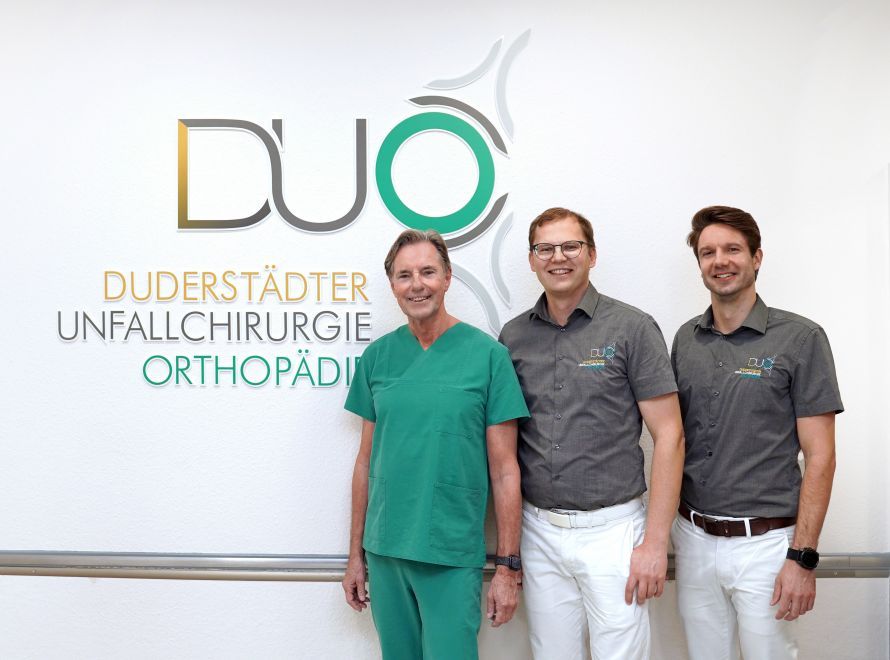
The knee joint is one of the most complex and heavily stressed joints in the human body. It enables mobility and stability and plays a key role in everyday activities and sports. However, injuries, signs of wear and tear, or congenital deformities can lead to pain and restricted movement, which significantly impair quality of life. Whether it’s acute sports injuries such as torn cruciate ligaments, progressive osteoarthritis, or the need for a joint replacement—precise diagnosis and individually tailored therapy are crucial for successful treatment. In such cases, it is essential to consult an experienced medical team specializing in knee surgery, joint replacement, and sports orthopedics.
“The DUO Practice in Duderstadt offers a comprehensive range of services, particularly in the field of shoulder and knee surgery. Whether these are minor procedures on the meniscus in the knee or for shoulder impingement issues—we, of course, also offer the full spectrum of conservative therapies. If conservative therapies are not effective, we also perform complex surgeries, stabilize joints, replace cartilage, or implant partial or total prostheses. We have the option of performing outpatient surgery right here in our practice, where our colleagues from the anesthesia department assist us, and we also work at both the nearby St. Martini Hospital and the University Medical Center Göttingen, where outpatient or inpatient procedures can be performed. Personally, it is important to me that we focus on specific core areas and can then offer a complete range of services encompassing all our core competencies within those areas. “It’s not enough to have only one or two options available. Because only when you have the full range of options can you freely choose what’s actually best for each patient—rather than making a decision out of a lack of alternatives,” said Professor Dr. Wachowski at the start of our conversation.
Modern knee surgery today offers numerous innovative treatment options to provide long-term relief for cartilage damage and preserve joint function as effectively as possible.
Cartilage cell transplantation and minimally invasive procedures, in particular, have established themselves as gentle and effective methods. While cartilage cell transplantation uses the body’s own cells to specifically regenerate damaged tissue, minimally invasive techniques allow for more precise procedures with less strain on the patient. These procedures not only shorten healing time but also help ensure long-term preservation of the natural joint. To achieve optimal results, it is crucial to rely on an experienced medical team that combines state-of-the-art methods with individualized treatment planning.
“When it comes to cartilage surgery, we at the DUO Clinic are very well-equipped and, in addition to traditional cartilage cell transplantation, also offer the ‘Minced Cartilage’ procedure, a single-stage cartilage transplant. This means the treatment is completed in just one session. We have the option of performing this therapy both at the University Hospital and at St. Martini. We have been offering traditional cartilage cell transplantation at the university for many years. This two-stage procedure has been extensively tested and researched for years. “Especially for young and athletically active people, this is a procedure that has been proven to yield very good results,” Prof. Dr. Wachowski emphasizes.
The minced-cartilage procedure is a cartilage transplant used to treat cartilage defects in the knee. In this procedure, the patient’s own cartilage cells are harvested, enriched with the patient’s own blood components during surgery, and transplanted into the damaged area. This minimally invasive procedure shortens healing time and enables a rapid restoration of mobility. The method is particularly well-suited for younger, active patients with medium-sized cartilage defects, but can also be promising for older patients.
In modern medicine, interdisciplinary collaboration plays a central role in providing patients with the best possible care. Complex diseases and injuries often require the expertise of various medical disciplines to ensure a comprehensive diagnosis and a personalized treatment plan.
Particularly in orthopedics, joint replacement, and sports medicine, close cooperation between surgeons, radiologists, physical therapists, and other specialties is crucial for successful treatment and rapid rehabilitation. By sharing knowledge and experience, the best possible treatment plan can be developed and implemented for each patient.
“For example, we maintain close ties with nearby rehabilitation clinics, with which we are happy to consult as needed. We also have a relationship with an outpatient rehabilitation center that is primarily attended by younger patients and athletes, whether before or after surgery or during conservative treatment. When it comes to surgical treatments in general, the collaboration and coordination with St. Martini Hospital are excellent—in part because the hospital’s layout keeps distances short. And thanks to our close cooperation with the University Medical Center, we naturally have comprehensive specialist support, as we can consult all necessary specialties for complex treatments. This allows us to work together to choose the right setting for the patient and involve other subspecialties, such as rheumatologists, cardiologists, or internists. In this way, patients always have the right specialist by their side,” explains Prof. Dr. Wachowski.
Since January 1, 2025, Dr. Sebastian Höller has been a valuable addition to the team at the DUO practice in Duderstadt. The orthopedic specialist focuses on reconstructive shoulder and knee surgery as well as sports orthopedics.
“Dr. Sebastian Höller has been involved in knee and shoulder surgery at the University of Göttingen for over seven years, where we have already performed many surgeries and worked together extensively. Our collaboration complements each other perfectly. Dr. Höller, who is also a certified knee surgeon and a D-Arzt (a physician specializing in work-related injuries), is deeply involved—both personally and professionally—in sports medicine and has long overseen the athletes’ clinic at the university, specifically caring for the basketball players of BG 74, Göttingen’s first-division basketball team. He also offers a sports medicine clinic at the DUO practice,” says Prof. Dr. Wachowski, describing his work at the practice:
“When a patient comes to see me, it’s important for me first to understand exactly what their problem is. Some patients come in with an MRI report and explain that they have cartilage damage in such-and-such a spot, for example. But for me, the findings aren’t the decisive factor at first. What’s important is to first listen to how the patient describes their problem and symptoms in their own words. Only then can I understand where the patient stands—including their expectations and what they need to address them. Ultimately, imaging findings (MRI or X-ray) aren’t relevant at all, since everyone’s needs are completely different and the primary symptoms don’t always stem from an obvious finding on the imaging. Furthermore, it is crucial to take plenty of time to examine the patient thoroughly; only then does imaging come into play as the final piece of the puzzle, allowing us to gradually develop a diagnosis and a solution to the problem. It is particularly important to me to explain every step in detail to the patient, and I want to involve them in the entire process. After all, the patient should be able to fully grasp and understand exactly what is causing the problem. Only then can the patient themselves reflect on what their goal is. And for this defined goal, the various options must be thoroughly discussed so that we can work together to find a path toward a decision—one that, in the end, is made solely by the patient.”
Revision surgeries in knee and shoulder surgery are complex procedures that become necessary when an initial surgery has not achieved the desired outcome or when complications such as implant loosening, infections, or recurrent injuries occur.
These procedures present a particular challenge for the treating physician, as he must not only take the original problem into account but also deal with altered anatomical structures, scar tissue, and possible bone defects. Precise planning, custom-fitted implants, and state-of-the-art surgical techniques are crucial for restoring joint function as effectively as possible and enabling patients to achieve long-term improvements in their mobility and quality of life.
“We frequently see patients in our practice who require revision surgery and who also come to us for a second opinion. In most cases, the situation is complex, and we must carefully assess whether another surgery would actually solve the problem—which could potentially entail new risks—or whether it might be better to learn to live with the problem. Another surgery isn’t always the best solution. It is fundamentally important for every patient to seek treatment where there is a high volume of cases and a high level of expertise. However, patients should be even better informed, especially when it comes to complex joint problems, and they should also be willing, when in doubt, to travel long distances to see exactly the specialist they need. At the same time, logistics must be improved so that patients can easily travel longer distances without having to bear the full cost of long trips themselves,” explains Prof. Dr. Wachowski, adding further hopes for the future:
“It would be good to have fundamentally better coordination between pre-treatment, core treatment, and post-treatment. This requires having the right points of contact. Unfortunately, it’s often the case that the patient is sent to rehabilitation or physical therapy, and then we hear nothing more. Patients also have to wait far too long for necessary appointments, and sometimes they aren’t treated 100% optimally in rehabilitation or physical therapy—here, communication, for example, between the doctor and the rehabilitation facility needs to be improved and made more frequent.” And with that, we conclude our conversation.
Thank you very much, Professor Dr. Wachowski, for this fascinating insight into your work at the DUO practice in Duderstadt!
Share this article
Expert Interviews
Read next
- Expert interview
Expert interview with Professor Dr Elmar Herbst, PhD
Oct 15, 2026
Patient-centred and personalised knee surgery
Read more - Expert interview
Cardiogeriatrics: Significance and benefits in the context of hospital reform
Sep 21, 2026
Cardiogeriatrics: Significance and benefits in the context of hospital reform
Read more - Expert interview
Expert Interview with Professor Dr. Amadeus Hornemann, MPH
Sep 18, 2026
Prof. Amadeus Hornemann on Precision Medicine in Gynecology: Modern Surgery, New Techniques, Better Quality of Life
Read more