News
Lucerne Foot Center: 3D X-rays of the foot and ankle—unique in Switzerland—for top-quality treatment

Sabine Schneider ·
A revolutionary imaging technique that has been used only once before in all of Switzerland: With Curve Beam’s innovative LineUp system, the Lucerne Foot Center, led by Dr. Daniel Krapf, is taking a giant leap forward in diagnostics and patient care—and making headlines in the process. This entirely new method of performing three-dimensional X-rays while the patient is bearing weight brings about a lasting improvement, particularly in the orthopedic treatment of patients with complex foot or ankle conditions. As a result, Dr. Krapf’s team has already been able to help many patients in a short time using this state-of-the-art technology. No wonder, then, that people from all over Switzerland and abroad are coming to Lucerne!

Dr. Krapf – in his role as team physician for FC Lucerne
Innovative 3D X-ray – The Foundation for Cutting-Edge Diagnostics and Therapy
Dr. Daniel Krapf and his medical team at the Lucerne Foot Center have been offering patients the innovative LineUp system from Curbe Beam since June 2020. This state-of-the-art technology provides unprecedented insight into foot anatomy: LineUp is a 3D X-ray machine that, for the first time, enables a complete view of the feet and ankles while the patient is standing—thus accurately depicting the load-bearing situation.
Our foot—a highly complex weight-bearing structure
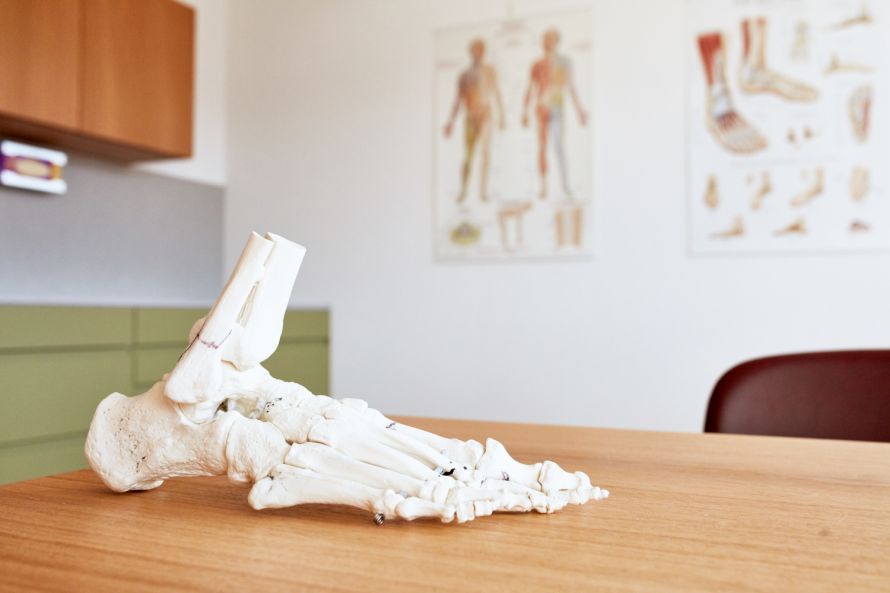
With nearly thirty bones, about the same number of joints curved across multiple planes, roughly twenty muscles, and no fewer than a hundred ligaments—the foot, as a weight-bearing organ, is an extremely complex structure. “Comprising a quarter of all our bones and joints, our relatively small feet therefore have an enormous task: They support the entire body and thus perform at a high level day after day,” says Dr. Krapf. He immediately adds a caveat: “Provided, of course, that they’re functioning properly. Because as soon as the feet’ function is impaired, our mobility is immediately and severely limited.”
The ailments that can occur in this part of the body are just as varied and complex as our feet themselves. “These symptoms can be a sign of a mechanical problem,” explains the specialist, “or the result of a metabolic disorder, a vascular, neurological, or spinal condition.” That’s why it’s important to seek treatment for foot problems at a center that specializes in this part of the body.
Before LineUp: 2D X-rays under load or 3D CT—but without loading
For this reason, it was also a significant step for Dr. Krapf’s team that he was able to close a diagnostic gap in the analysis of foot and ankle complaints. Until now, three-dimensional imaging of bones and soft tissues in the foot and ankle under load was either impossible or uncommon. And this is precisely what matters most for diagnosis, since many symptoms only occur under load.
Until now, conventional X-rays had to be used to create only a two-dimensional image of the foot under load—that is, while standing. However, this was never entirely satisfactory for the perfectionists on Dr. Daniel Krapf’s team, nor was 3D computed tomography, which must be performed while lying down and cannot replicate the weight-bearing conditions of the foot or ankle.
Closing this gap took years: It began in December 2014, when the PedCat innovation delivered digital 3D volumetric tomography while the patient was standing. Its successor is now called LineUP: Dr. Daniel Krapf became aware of its exceptional capabilities during a clinical rotation with Prof. Martinus Richter, MD, who serves as chief physician at the Clinic for Foot and Ankle Surgery at the hospital in Rummelsberg, near Nuremberg, Germany. The Lucerne-based specialist also visited other clinics abroad equipped with LineUP (pedCat) technology to get a firsthand look. This exchange of experiences had a significant impact—Dr. Krapf wanted to implement this very innovation at the Lucerne Foot Center for the benefit of his patients.
With LineUp: Maintaining the loaded bone position can improve treatment outcomes
“I haven’t regretted this decision for a single second,” he says. Clearly: “Visualizing the load-bearing situation is immensely important, especially in the treatment of the foot and ankle,” he adds. “The bone position in the foot changes under load—and it is precisely this loaded bone position that must be captured for specific therapy planning.”
The LineUP system from CurveBeam, based in Warrington, U.S., now uses the new 3D X-ray imaging technique to capture and analyze every bone deformity and instability in the feet or bones in detail using 0.3-millimeter-thick cross-sectional images— “in action.” Projections or specific foot positions that are difficult or impossible to visualize with 2D X-ray imaging no longer need to be created. LineUp thus enables a quick and precise analysis of deformities and positions. As a result, Dr. Krapf and his skilled team have access to more information than ever before with minimal effort.
Thanks to this additional information, corrections or even surgical procedures can be planned more accurately and with significantly greater safety. Every step of treatment is individually tailored to the specific situation—but patients at this renowned center are already familiar with that. Here, too, the principle applies: The more precise and customized the analysis and planning of a surgery, the better the surgical outcome—and, as a rule, the faster the healing process.
LineUp—for the best patient care
But these are not the only advantages of the innovative CurveBeam LineUp, as Dr. Krapf emphasizes: “As a cone-beam computed tomography system, it emits significantly less radiation than traditional CT procedures,” he says. In addition, Dr. Krapf can not only generate three-dimensional images from the data provided by LineUp—he and his team are also able to create two-dimensional X-ray images from the scans. This eliminates the need for additional radiation exposure and also reduces the time required for both patients and medical staff during the examination. “Whereas it used to take a very long time—due to the high workload on the equipment—for a patient to get a CT appointment after the two-dimensional X-ray, both images are now available practically immediately,” explains Dr. Krapf. This is a particularly significant advantage in emergency situations.
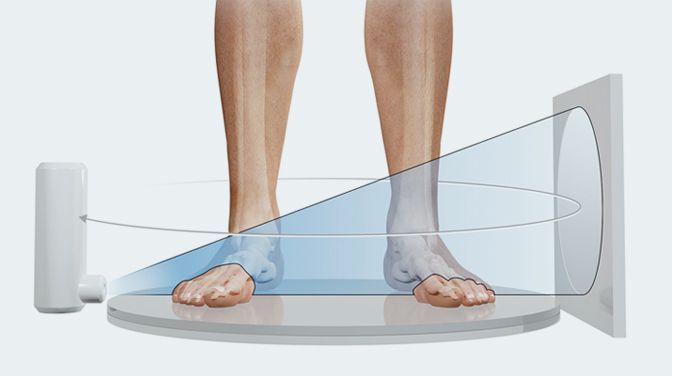
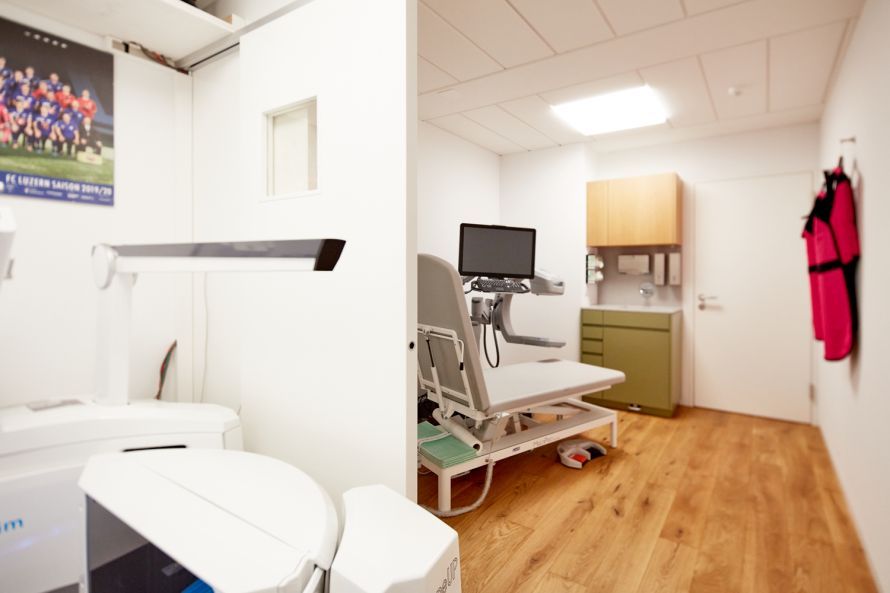
Thus, the days of tedious examinations—which tested the patience of both patients and staff—are finally over in Lucerne. That’s because the direct examination using the new LineUp is remarkably fast, simple, and comfortable: it typically takes less than 2 minutes to capture all necessary images in a single pass. To do this, patients simply need to stand on a small blue disc inside the cylindrical, knee-high LineUp unit. On the surrounding white ring, there are two supports as well as a stool available in case patients are unable, unwilling, or unable to stand. Once the patient is properly positioned on the blue disc, a gray door segment closes the cylindrical device—and the scan can begin. An X-ray tube on one side and a flat-panel sensor on the other then move horizontally around the foot.
For Dr. Daniel Krapf and his team, the advantages of LineUp are obvious: Not only is it time-consuming to ensure proper patient positioning during conventional 2D X-rays or CT scans—but these often involve painful forced positions that are now a thing of the past thanks to this innovation and have fortunately become unnecessary. And yet the image quality is impressive in terms of resolution and contrast. The costs associated with an examination using the innovative CurveBeam LineUp are even significantly lower than standard CT costs. In addition, the images can be easily reproduced—and when it comes to biomechanical analyses or research purposes, the new images are superior to traditional X-rays.
Additional Diagnostic Features—and Perfect Insoles
For the Lucerne Foot Center, LineUp is also a real asset in other areas of modern patient care. It’s not just the new diagnostic capabilities that are impressive: In an affiliated laboratory for orthopedic biomechanics and motion analysis at the Hirslanden Clinic St. Anna Meggen, biomechanical data on an individual’s gait can also be recorded—on an eight-meter-long track equipped with sensitive plates. This allows Dr. Krapf and his colleagues to draw further conclusions about joint stress, bone alignment, and muscle function in the feet and legs during specific phases of walking. Dr. Krapf: “To do this, we attach reflective markers—which are later illuminated by infrared light and filmed—and surface electrodes to the patients’ bodies, and simultaneously measure muscle electrical activity on the skin as well as pressure and force through the plates on the track.”
These diagnostic capabilities will later enable the production of perfectly custom-made insoles for the feet of people with diabetes and patients with sensory disturbances. For athletes, too, footwear and training plans can be optimally tailored. Foot and ankle surgery has also been taken to a new level by this innovation, as specialist Dr. Krapf explains: “From hallux valgus to flatfoot correction, complex surgeries can now be optimally planned using this data when indicated.”
Incidentally, the Lucerne Foot Center has had a new location since June 2020: It is located right in the heart of Lucerne, now at Töpferstraße 5, where it is easily accessible—and, of course, in addition to the innovative LineUp device, the facility is fully equipped to address all questions regarding the diagnosis and treatment of foot and ankle conditions.
Share this article
About the medical author
Sabine Schneider
Editor-in-Chief
Sabine Schneider – medical author: Explore expert articles and medical expertise in the Leading Medicine Guide.
More about the medical author →Foot Center Lucerne
ProfileNews
Read next
- News
Kidney Stones – Modern Treatments, from Shock Waves to Lasers
Oct 7, 2026
Why Sudden, Severe Flank Pain Can Be a Warning Sign
Read more - News
Retinal Detachment: Flashes of Light Can Jeopardize Vision
Oct 5, 2026
Retinal Detachment: Quick Action Can Save Your Eyesight
Read more - News
The waiting period for a semen analysis prior to planned fertility treatment
Oct 5, 2026
Semen analysis: The effects of short waiting periods
Read more