

Ocular prosthetics involves the fabrication and fitting of artificial eyes (also known as prosthetic eyes or glass eyes), which are implanted following the loss of an eye. It is not intended to restore vision, but rather to ensure a natural appearance and boost the self-confidence of those affected.
The process includes a consultation, the custom handcrafted fabrication of the prosthesis, and precise fitting to the eye socket. Regular follow-up visits are important to ensure an optimal fit and prevent complications.
Ocular prostheses are usually made of glass or plastic and are precisely matched to the healthy eye. Modern prostheses look very realistic and are very comfortable to wear.
Ocular Prosthetics – A Specialized Field for Customized Artificial Eyes
Ocular prosthetics is a specialized field at the intersection of medicine, craftsmanship, and aesthetic care. It focuses on the custom fabrication, fitting, and follow-up care of ocular prostheses, also known as artificial eyes. The goal of ocular prosthetics is to restore a natural appearance following the loss or severe damage to an eye and to ensure long-term comfort for the patient.
A high-quality ocular prosthesis is precisely tailored to the eye socket, the shape of the remaining eye, the iris color, and the overall facial symmetry. This allows the prosthesis to blend seamlessly into the facial appearance and contributes significantly to patients’ quality of life, self-confidence, and social well-being.
Ocular Prosthetics – Further Information
What Is Ocular Prosthetics?
Ocular prosthetics refers to the individualized care provided to people with an ocular prosthesis. It is used whenever an eye is no longer present or could not be preserved functionally due to an accident, illness, tumor, inflammation, or congenital malformation. The ocular prosthesis does not replace visual function but serves primarily for cosmetic, anatomical, and psychological rehabilitation.
The scope of ocular prosthetics includes, in particular:
- the fabrication of custom glass or plastic prostheses,
- precise fitting to the eye socket,
- matching the color and shape to the healthy eye,
- checking the fit, mobility, and tolerability,
- as well as regular follow-up care and replacement of the prosthesis.
Modern ocular prosthetics combines the highest precision with many years of experience. Each prosthesis is a handcrafted, one-of-a-kind piece and is tailored to the anatomical conditions and aesthetic needs of the individual.
When is an ocular prosthesis needed?
An ocular prosthesis is needed when an eye has had to be removed or is permanently so severely damaged that an aesthetic restoration is required. Common causes include severe eye injuries, tumors, painful blindness, congenital malformations, or inflammatory conditions. Even after surgical procedures such as enucleation or evisceration, fitting a suitable ocular prosthesis is an important part of rehabilitation.
The prosthesis serves several purposes. It helps maintain the shape of the eye socket, protects the sensitive tissue, and ensures that the face appears as harmonious and natural as possible. For many patients, fitting an ocular prosthesis is therefore not only medically beneficial but also of great emotional importance.
How does the fitting of an ocular prosthesis work?
The fitting of an ocular prosthesis takes place in several steps and is tailored individually to the patient. The process begins with a thorough assessment of the eye socket, taking into account its shape, size, mobility, and the condition of the surrounding tissue. A decision is then made regarding which prosthesis shape and material are best suited for the patient.
The next step involves the artisanal fabrication of the prosthesis. It is designed to match the existing eye as closely as possible in terms of shape, color, and surface texture. Of particular importance are the lifelike reproduction of the iris, the color nuances of the sclera, and the fine vascular patterns.
After insertion, the prosthesis is checked for fit, comfort, and visual appearance. If necessary, adjustments are made until a harmonious and comfortable result is achieved. The first customized fitting following surgery is referred to as a “model fitting.” Even after the initial fitting, regular checkups are important so that changes in the eye socket can be detected early and the prosthesis can be adjusted or replaced as needed.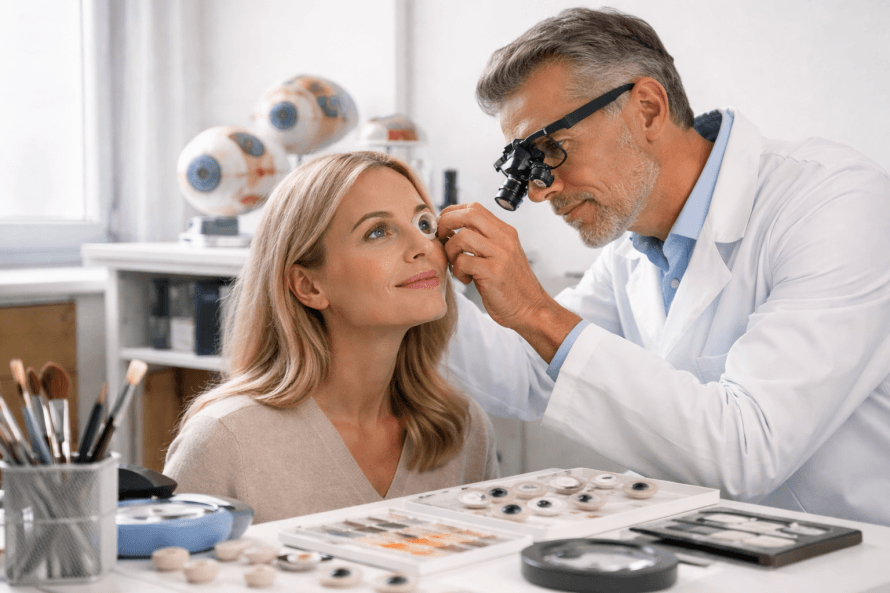
What does the range of services in ocular prosthetics entail?
The scope of services in ocular prosthetics encompasses far more than simply the fabrication of an artificial eye. The focus is on holistic care that takes into account functional, aesthetic, and psychosocial aspects. In addition to distinguishing between ocular prostheses and ocular epitheses, this also includes specialized care for infants and toddlers with congenital malformations.
Key services include:
- custom fabrication of ocular prostheses,
- initial fitting following eye surgery or injuries,
- care for children and adults,
- Fitting for congenital malformations,
- reworking, polishing, and replacement of existing prostheses,
- as well as advice on care, cleaning, and handling.
Depending on the diagnosis, different materials are used. In Germany, glass eyes are traditionally used frequently, while plastic prostheses are also common internationally. Which option is suitable depends on the anatomical conditions, individual needs, and the desired treatment goal.
What qualifications do eye prosthesis specialists have?
Specialists in ocular prosthetics possess extensive knowledge of anatomy, materials science, color design, and precision craftsmanship. High-quality care requires a great deal of experience, precision, and a trained aesthetic eye. Since every eye socket is unique, fitting an ocular prosthesis demands great craftsmanship and a high degree of empathy.
Collaboration with ophthalmologists, eye clinics, and surgical centers also plays an important role. This ensures that medical treatment and prosthetic care are optimally coordinated. Especially after surgery or in complex cases, close interdisciplinary coordination is crucial for a good outcome. Typical complications following eye removal, such as dry anophthalmic socket syndrome or post-enucleation socket syndrome, require specialized evaluation and are managed in collaboration with experienced centers.
Range of Medical Services
Treatments
- Custom-Made Eye Prostheses
- Initial care following enucleation or evisceration
- Fitting of artificial eyes for congenital malformations
- Replacement and renewal of existing ocular prostheses
- Follow-up care, checkups, and polishing of ocular prostheses
- Advice on cleaning, care, and daily handling
Ocular prosthetics is thus an important specialty for people who, after the loss of an eye, require an aesthetically high-quality, individually customized, and long-term viable solution. A professionally crafted ocular prosthesis can play a crucial role in harmonizing one’s appearance and sustainably improving one’s quality of life.

About the medical author
Jörg Schmidt
Medical Author · Cologne
