
An ocular prosthesis—often referred to as a glass eye—is a custom-made medical device that is fitted after the loss of an eye. While it does not restore vision, it plays a central role in the patient’s appearance, facial symmetry, and psychosocial well-being. The key to successful treatment lies not only in the quality of the prosthesis itself, but also in its proper fitting and ongoing ophthalmological care. Those who inform themselves early on about the options, procedures, and follow-up care involved in ocular prosthetics can actively contribute to a long-term, stable, and well-tolerated solution.
The loss of an eye is almost always a profound experience for those affected—physically, functionally, and emotionally. In addition to medical treatment, the question eventually arises as to what further care might look like and what options are available to restore a natural appearance. An ocular prosthesis, often colloquially referred to as a “glass eye,” does not restore vision, but it can play a significant role in stabilizing a person’s appearance, self-confidence, and quality of life. What matters most is not just the prosthesis itself, but the quality of ophthalmological care, surgical treatment, and long-term follow-up care.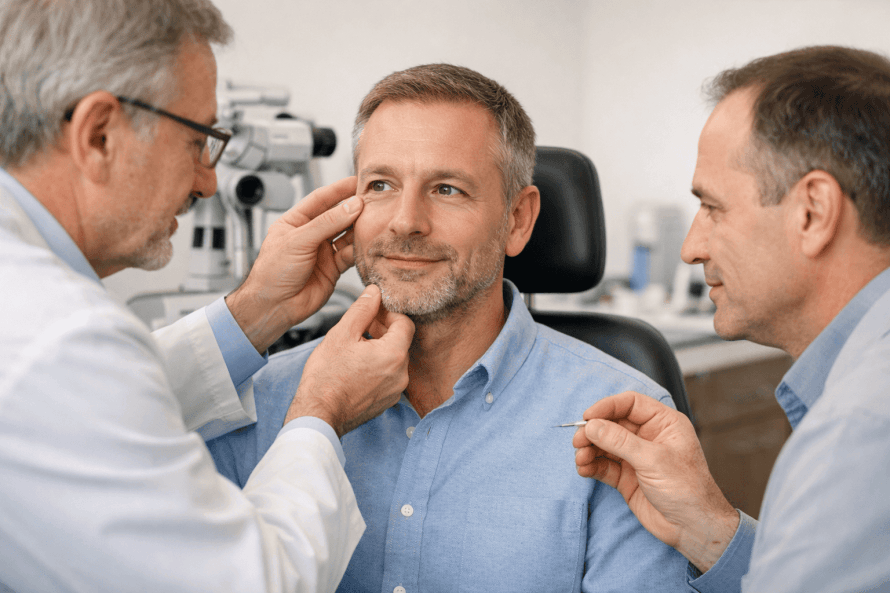
When an ocular prosthesis is an option
An ocular prosthesis is typically considered after the removal of an eye, such as following severe injuries, tumors, congenital malformations, or in the case of a blind, painful eye that requires surgical treatment. The goal is to restore the eye socket as harmoniously as possible so that the prosthesis fits well, is well-tolerated, and blends in unobtrusively in everyday life. Many patients are initially unsure of what to expect. The most important point to clarify is this: A modern ocular prosthesis serves primarily for aesthetic and psychosocial rehabilitation. It cannot replace vision, but it can help restore a sense of normalcy.
Types, Fitting, and Follow-Up Care
A basic distinction is made between glass prostheses and plastic prostheses. Which option is suitable depends on the individual situation, the shape of the eye socket, and personal requirements. Glass prostheses are valued for their very smooth surface and good tolerability. Plastic prostheses are more robust and may offer advantages in cases with more complex anatomical conditions. The key is not a one-size-fits-all recommendation, but rather a custom-fitted solution developed in close collaboration between the ophthalmologist and the ocularist.
To achieve a good result, the actual treatment process begins long before the final prosthesis is inserted. First, the eye socket must be surgically and functionally prepared to create a stable, as symmetrical as possible, and highly mobile foundation. Depending on the initial situation, this may involve loss of the eye through enucleation or evisceration, and sometimes also reconstructive correction of the eye socket or eyelids. The prosthesis is then individually customized. Shape, size, iris pattern, color, and fit play a decisive role in this process. A good ocular prosthesis should not look artificial; ideally, it should be barely noticeable in everyday life.
Aftercare is just as important as the fitting itself. The eye socket and eyelids change over time, and the prosthesis itself must also be checked regularly. Some patients require only routine checkups, while others need closer monitoring—for example, in cases of scarring, irritation, pressure points, poor prosthesis fit, or cosmetic asymmetries. For this reason, care should never be considered in isolation. In many cases, those who wear an ocular prosthesis require long-term care from a specialized ophthalmology team that monitors the function, tolerance, and protection of the remaining sighted eye.
Specialized Ocular Prosthetic Care
Specialized ocular prosthetic care places particular emphasis on the combination of ocular prosthetic care with ophthalmoplastic and reconstructive surgery. Only in this way can patients with complex issues related to eye loss, the eye socket, eyelids, and ocular prosthetics receive optimal, interdisciplinary care. This close integration is a real advantage for patients because diagnostics, surgical treatment, prosthesis fitting, and follow-up care can be coordinated seamlessly. Especially after difficult medical experiences, this provides structure, security, and streamlined care.
Many people also wonder how much effort is required for care and daily life with an ocular prosthesis. As a rule, after a period of adjustment, it is possible to lead a very normal life. Work, social interactions, and many sports activities are usually well within reach. It is important to maintain careful hygiene, attend regular checkups, and be prepared to seek medical advice early on if irritation, discharge, a feeling of pressure, or changes in the fit occur. Persistent symptoms may indicate dry anophthalmic socket syndrome or post-enucleation socket syndrome. The issue of costs can also be easily resolved in many cases, as both public and private health insurance plans cover the treatment.
Consultation and Next Steps
Anyone who needs an ocular prosthesis or already wears one and is experiencing problems with fit, tolerance, or the eye socket should not delay seeking an evaluation. Especially if you are experiencing symptoms, it is worthwhile to consult with specialized physicians and ocular prosthodontists who can jointly assess surgical, reconstructive, and prosthetic aspects of specialized ocular prosthetic care. You can request a personalized consultation and examination through the Leading Medicine Guide. This will help determine which treatment is medically appropriate, what the next steps are, and how function, aesthetics, and quality of life can best be balanced.

About the medical author
Jörg Schmidt
Medical Author · Cologne
