The liver (hepar) is the largest gland in the human body. A malfunction or liver disease can quickly become life-threatening. In particularly severe cases, liver surgery is the only remaining option.
Here you will find further information as well as a selection of specialists and centers for liver surgery.
Anatomy: What is the structure of the liver, and what are its functions?
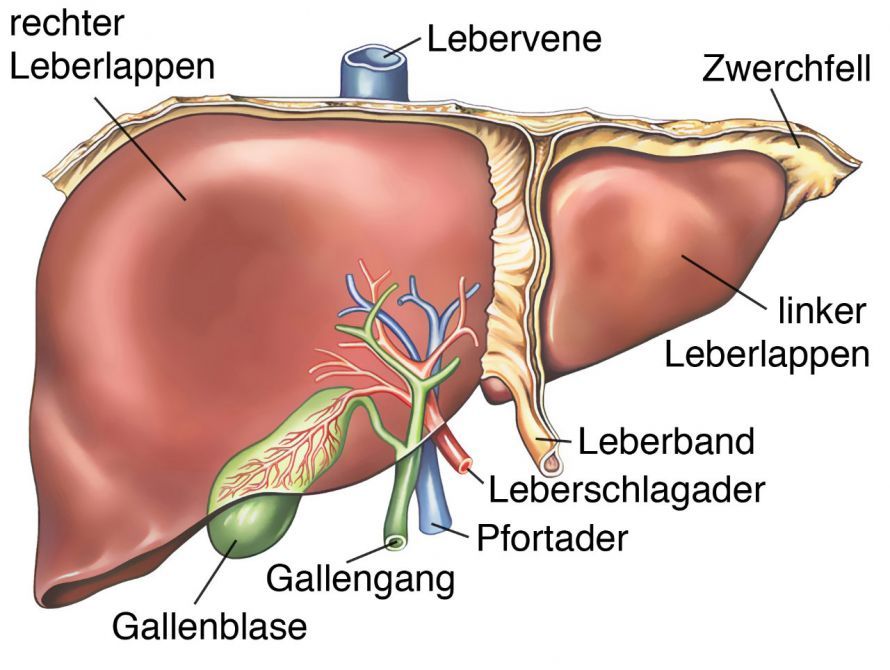
The liver is a large and vital metabolic organ located in the upper right abdomen. The liver is divided into two major sections—the right and left lobes—which are further subdivided into a total of eight segments. The right lobe is significantly larger than the left.
Through the portal vein—a vessel about as thick as a thumb—the liver receives blood from all the unpaired abdominal organs, along with the nutrients from the intestines that it carries.
The liver’s main functions include, for example:
- the production and secretion of bile acids (important for fat digestion)
- storing sugar in the form of glycogen (animal starch)
- the synthesis of the body’s own proteins, as well as
- the storage of vitamins, and
- the breakdown of toxic substances (e.g., ammonia, alcohol) and medications.
Thanks to this wide range of functions, the liver is also regarded as the central hub of human metabolism. Liver diseases and impairments of its function can therefore quickly become life-threatening, which is why early detection and treatment are extremely important.
This video provides further illustrative information on the anatomy of the liver and its functions:
What types of liver surgeries are there?
Below is an overview of the different types and purposes of liver surgeries:
- Liver biopsy
- Ascites puncture
- Liver transplant
- Liver cyst surgery
- Liver resection
- Transjugular intrahepatic portosystemic shunt (TIPS) placement
What happens during a liver biopsy?
A biopsy is the removal of a tissue sample for subsequent examination in the laboratory.
A liver biopsy is the most appropriate method for diagnosing diffuse or unclear liver diseases, such as viral hepatitis. Today, the procedure is no longer performed blindly but is guided by imaging techniques.
Using a biopsy needle, a cylindrical tissue sample is removed from the liver for further histological examination.
The procedure is performed under local anesthesia at the puncture site and can be done on an outpatient basis. However, due to the potential risk of bleeding, bed rest is recommended on the day of the procedure.
What is an ascites tap?
In an ascites puncture (ascites = abdominal fluid), a long needle is inserted into the abdominal cavity to drain abdominal fluid. This is performed under local anesthesia and with the aid of ultrasound.
The abdominal fluid—up to five liters—drains from the abdominal cavity through the puncture needle under sterile conditions. It is then collected for further microbiological testing. At the end of the procedure, the hollow needle is withdrawn and the puncture site is sutured.
In principle, the plastic tube can initially be left in place as a so-called drainage tube to allow the fluid to drain. However, it is important that the puncture site be covered with sterile material. Otherwise, there is a risk of peritonitis with serious (even fatal) complications.
What exactly happens during a liver transplant?
During a liver transplant (medically known as a liver transplantation), the diseased liver is removed and replaced with a donor liver within 16–24 hours. This is a major and highly complex surgical procedure that must be thoroughly planned. It is indicated only when liver function is so severely impaired that the patient’s life is at risk.
The incision is usually made along the rib cage or in the upper right abdomen. The abdominal muscles are then spread apart, and the abdominal cavity is opened. The diseased liver is then removed (medically known as a hepatectomy) and the donor organ is implanted. It is important that the donor organ be connected to the donor’s blood vessels (artery and vein).
Careful hemostasis and the placement of drains are essential to remove wound secretions and blood during the first few days after surgery. This allows for the early detection and treatment of postoperative bleeding or infections. The abdominal incision is then closed and covered with sterile dressings.
What does liver cyst surgery mean for patients?
Liver cysts are fluid-filled, spherical structures in the liver that are usually benign. They can occur spontaneously or as a result of infections (most commonly caused by parasites such as worms). Spontaneously occurring cysts can generally be left alone but should be monitored.
If the cyst is or becomes large enough to impair liver function, it should be drained or removed. In some cases, the cysts also cause increasing pain that is difficult to treat. The risk of the cyst rupturing increases as its diameter grows, so its size can ultimately be a reason for cyst removal.
The procedure can be performed via laparoscopy. In some cases, if the cyst is superficial, it can be drained without an incision—simply by puncturing the skin (percutaneously). However, it is extremely important that no cyst contents enter the abdominal cavity. Otherwise, this could lead to the spread of parasites.
For larger cysts or those located deep within the liver, open surgical treatment is recommended. This is performed through an incision in the right upper abdomen below the rib cage or along the midline. The affected lobe or segment of the liver is then exposed, and the cyst is loosened and punctured so that its contents can be aspirated. Afterward, the cyst can be safely excised.
How much liver tissue can be removed during a liver resection?
The liver has an astonishingly strong ability to heal itself. It is possible to remove up to 75% of its mass, and it can regenerate on its own afterward. This type of partial liver removal is called a segmental resection or hemihepatectomy. Hemihepatectomy means that one lobe of the liver is removed; “hemi” comes from “half.”
If, on the other hand, the entire organ must be replaced (= hepatectomy, liver resection), a donor organ—that is, a liver transplant—is necessary. Since liver resections are generally major surgeries, laparoscopy is only possible in rare cases. In most cases, the abdominal cavity must be opened via a long incision in the upper right abdomen or along the midline to gain extensive access to the organ.
What complications can occur?
The liver has a rich blood supply. During a large segmental resection, the patient therefore loses a significant amount of blood due to the removal of the diseased portion of the liver. In cases of severe bleeding, the portal vein is temporarily clamped. This drastically reduces blood flow to the liver (known as the Pringle maneuver).
However, the lack of blood supply exposes the remaining liver—which is to be preserved—to oxygen deprivation. This deprivation damages the remaining liver (hypoxemia), increases the risk of complications, and can contribute to liver failure.
Additional measures to reduce the risk of bleeding include the gentle separation of tissue layers using a water jet (water-jet dissection). This method does not cut through the tissue but rather pushes it apart. This device is now available in many hospitals.
An unnoticed injury to small bile ducts can lead to what is known as a “bile fistula,” in which bile fluid leaks into the abdominal cavity. In such cases, repeat surgery is usually unavoidable.
When is a transjugular intrahepatic portosystemic shunt (TIPS) placed?
A transjugular intrahepatic portosystemic shunt (TIPS) is a bypass circuit for the hepatic circulation. As a result, part of the blood from the portal vein no longer flows through the liver but drains directly into the inferior vena cava (V. cava inferior). This treatment option is used, for example, in cases of esophageal bleeding caused by excessive pressure in the portal venous system or to prepare for a liver transplant.
Under general anesthesia, the internal jugular vein in the neck is first punctured. An angiography catheter is then advanced through this puncture site, passing through the right atrium, the superior and inferior vena cava, into the hepatic vein, and finally into the portal vein. A connection is then established between the portal vein and the hepatic vein using a balloon catheter and a stent, permanently linking the two vessels (= shunt; “bypass between two vessels”). Most of the blood then flows through this shunt, relieving the burden on the liver.

About the medical author
Prof. Dr. med. Susanne Regus
Medical Author
Prof. Dr. med. Susanne Regus – medical author: expert articles, professional insights and medical expertise in the Leading Medicine Guide.
More about the medical author →