The Makoplasty procedure is a robot-assisted surgical technique. It enables the surgeon to achieve greater precision during the implantation of artificial knee and hip joints. In addition, the medical team can use the Makoplasty system to determine the optimal placement of the endoprosthesis even before surgery.
Here you will find further information as well as a list of selected specialists and centers that offer Makoplasty.
What is Makoplasty?
The Makoplasty procedure is a robot-assisted surgical procedure. It is primarily used for the implantation of
- artificial knee joints (partial or total replacements) as well as
- artificial hip joints
. It does not perform the surgery on its own, as the term “robot” might suggest.
Makoplasty merely provides valuable support before and during the surgery. The robotic arm technology controls and refines the surgeon’s movements in the surgical field. The surgery is still performed by an experienced orthopedic surgeon.
Makoplasty technology relies on
- a pre-operative computed tomography scan and
- a surgical navigation system with a 3D camera.
Makoplasty enables the surgeon to make bone cuts with the highest precision. This is of the utmost importance when implanting artificial joints.
What is particularly groundbreaking is the consideration and preservation of the individual tension relationships in the knee created by the ligaments.
Advanced hip osteoarthritis is often the reason for a hip replacement. Using Makoplasty, the surgeon can very precisely prepare the implant site for the hip prosthesis with special drills. A key innovation here is the consideration of pelvic movements as well as the individual bone shape.
This incorporation of individual parameters supports better implant function and rapid healing. At the same time, patients experience fewer symptoms compared to conventional surgical methods.
Functional Components of the Makoplasty System
The Makoplasty system consists of three functional units
- Planning Station,
- surgical navigation system with a 3D camera, and
- a robotic arm with bone instruments.
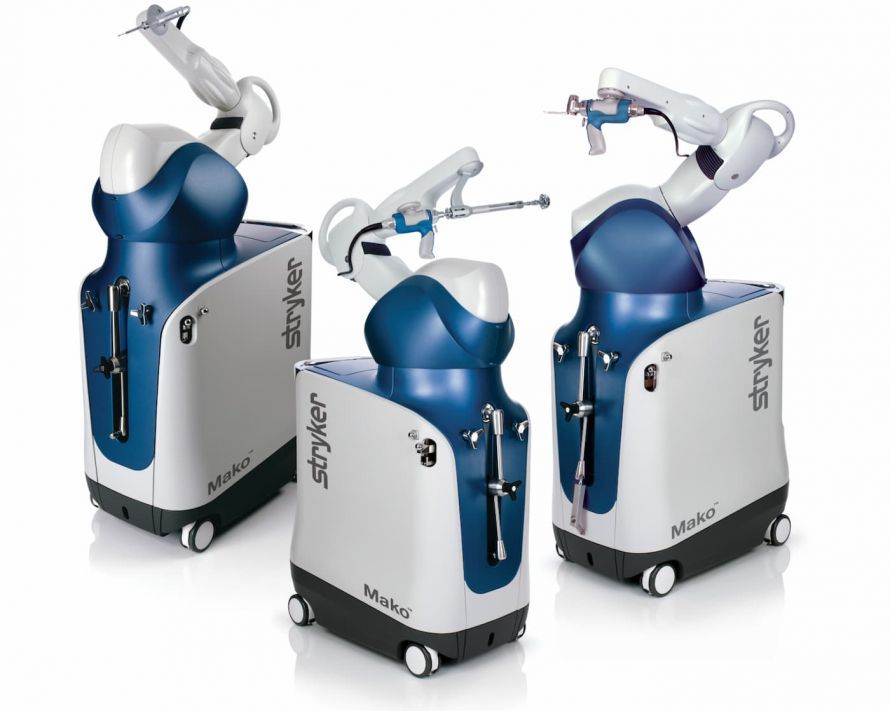
Three Mako robotic arms from Stryker with various attachments. Right: Saw attachment for artificial knee joints. Center: Ball mill for preparing the acetabulum for a hip prosthesis. Left: precision drill for the highly accurate implantation of sled prostheses © Stryker
Technology from the U.S. and Germany
The Makoplasty system was developed by the U.S.-based Stryker Corporation, headquartered in Kalamazoo, Michigan. The company, which has been listed on the New York Stock Exchange since 1979, is responsible for the entire procedure, including the necessary instruments and computer programs.
Stryker is also responsible for providing technical instruction and training to orthopedic surgeons who are authorized to offer Makoplasty at their clinics. In addition, a MAKO product specialist from the company is present during every Makoplasty procedure.
Following its acquisition of the German implant manufacturer Leibinger, the company now has a headquarters in Germany. It operates several production sites there.
Reasons for Knee or Hip Joint Replacement
Various conditions can damage the knee or hip joint so severely that it can no longer be treated. Patients then suffer from severe pain and limited mobility.
In such severe cases, an artificial joint can offer relief. A joint prosthesis allows the joint to move pain-free again, enabling the patient to resume a normal life.
The decision to undergo joint replacement is independent of whether you wish to take advantage of the Makoplasty procedure or prefer conventional surgery.
The Makoplasty Procedure Compared to Conventional Knee Replacement
In knee replacement surgery, the surgeon must position the prosthesis so that
- the ligament tension at the knee,
- the leg axis, and
- range of motion
are optimally restored.
The precision achieved with the Makoplasty surgical procedure—thanks to robotic assistance—is already impressive. However, it is not the only distinguishing feature of knee replacement with Makoplasty compared to conventional surgery. The most important advantage lies in the consideration of the individual tension balance in the knee.
In conventional surgery, the surgeon implants the knee prosthesis based on anatomical experience. He then adjusts the ligaments as best as possible to the new knee conditions.
With Makoplasty, this experience-based implantation is no longer necessary. Instead, the system calculates the optimal fit for the artificial knee joint. To do this, it measures the individual stability (range of motion) of the ligaments. The fit of the prosthesis is planned so that the tension conditions after surgery correspond to the natural conditions prior to knee osteoarthritis.
Compared to conventional surgery, patients can expect a faster healing process and better knee joint function.
The Makoplasty procedure compared to conventional hip replacement
In hip replacement surgery, the optimal placement of the endoprosthesis is also of the utmost importance. The following factors are taken into account:
- the range of motion,
- stability, and
- leg length.
Conventionally, the surgeon relies on two-dimensional X-ray images and positions the prosthesis based on personal experience.
As with knee replacements, Makoplasty also calculates the optimal fit for the implantation of an artificial hip joint. The computer incorporates
- individual pelvic mobility (pelvic tilt while sitting and standing) and
- the bone shapes of the pelvis and femur
. Here, too, the calculations are based on a three-dimensional image created using CT.
After surgery, you’ll benefit from faster healing and improved joint function.
Makoplasty further reduces the already low risk of complications associated with hip replacement, such as the risk of dislocation.
The Makoplasty Procedure
The entire Makoplasty procedure consists of three steps, two of which are performed immediately before surgery. Only the third step involves the actual surgery.
Step 1: Precise mapping of the bony structures of the knee or hip joint
In the first step, a computed tomography (CT) scan of the knee or hip joint is performed. The individual cross-sectional images are digitally assembled into a three-dimensional image of the bony structures of the knee or hip.
This image is necessary to initially optimize the fit of the artificial joint on the computer screen. The data forms the basis for guiding the surgical instruments and is essential for determining the individual adjustments.
Step 2: Determining Individual Adjustments
After the CT scan is completed, the patient undergoing knee replacement is administered anesthesia. The specialists then measure the individual ligament tensions as the knee is bent and straightened. For hip replacement, the pelvic tilt is measured while the patient is standing and sitting, before anesthesia is administered. This measurement is important for the fine-tuning of the endoprosthesis alignment.
The fine-tuning itself is performed on the monitor. Even slight shifts and rotations of the artificial joint affect
- the range of motion and tension ratios in the knee or
- the stability of the hip joint.
The specialist thus virtually determines the optimal three-dimensional position of the joint component.
Step 3: Performing the Surgery
During Makoplasty, the surgeon receives feedback on the correct orientation of the instruments as they are positioned. The robotic arm allows the instruments to be positioned with an accuracy of less than ±0.5 millimeters and ±1 degree. At the same time, an enlarged view of the surgical site is displayed on computer screens.
With this support, the surgeon can make the bone cuts or mill the bone without damaging sensitive structures such as
- blood vessels,
- nerves,
- muscles, or
- ligaments
.
The Makoplasty system therefore also offers significant advantages in terms of surgical safety.
Postoperative Care Following Joint Replacement
Postoperative care following joint replacement using the Makoplasty procedure is the same as for conventional joint replacement.
Movement without heavy strain is very important for a rapid healing process. A healthy diet consisting of natural, unprocessed, and varied foods also promotes the healing process.
Risks and Complications of the Makoplasty Procedure
The surgical risks associated with Makoplasty are extremely low. They are essentially the same as those of conventional joint replacement.
Furthermore, during the surgery, the positions of the bony joint components must be marked. To do this, special marker pins are fixed into the bone. This usually requires two small additional puncture incisions (small, puncture-like skin incisions). It is also important to note the radiation exposure associated with computed tomography (CT) scans.
As with any surgery, there is a risk of infection: Theoretically, infectious agents can be introduced into the wound during the procedure. This risk is minimized by appropriate hygiene measures implemented by the hospitals.

About the medical author
Prof. Rudi G. Bitsch
Medical Author · Heidelberg