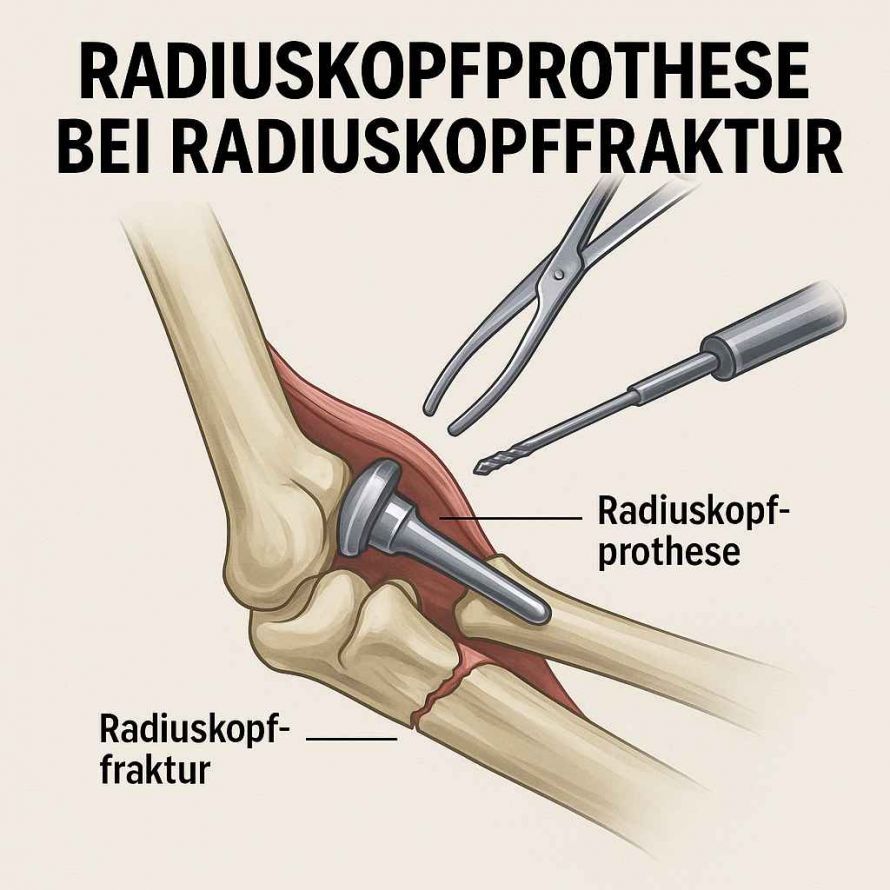
A radial head prosthesis is implanted when the radial head—that is, the upper part of the radius in the elbow joint—can no longer be preserved or stably reconstructed following a fracture. In modern trauma surgery, the implantation of a radial head prosthesis is considered a proven method for restoring joint mobility and stability. Particularly in cases of complex Mason III radial head fractures, the surgery enables precise restoration of joint function. Anatomically shaped implants mimic the natural radial head and help prevent secondary complications such as osteoarthritis or instability in the elbow joint. The procedure is performed surgically and is often modular in design to optimally adapt the prosthesis to the patient’s individual anatomy.
Anatomy of the Radial Head and Its Role in Stability
The radial head transmits forces from the wrist to the elbow and serves as the central stabilizer of lateral joint guidance. In cases of displaced fractures of the radial head or complex radial head fractures, the stability of the entire joint may be compromised. Modern radial head prostheses are anatomically shaped and modeled after the natural structures to restore these biomechanical functions.
Part of the Complex Joint Mechanics of the Elbow
The elbow joint consists of three sub-joints that are closely interconnected. The radial head is part of this complex joint mechanism and enables the interaction between the radius, ulna, and humerus. Injuries to the elbow region often compromise the stability of the elbow joint. A correctly positioned radial head prosthesis restores the physiological rotational movement of the forearm and the stability of the lateral ligament complex.
Radius Head Prostheses in Modern Trauma Surgery
Indications and Surgical Procedures
Fractures of the radial head account for about one-third of all injuries in the elbow region. Surgical treatment is necessary, particularly for displaced or comminuted radial head fractures, to restore stability to the elbow joint. The treatment of radial head fractures depends on the severity of the injury and the anatomical and biomechanical factors involved. For reducible fractures, open reduction and osteosynthesis can be performed.
If the fracture is complex or severely comminuted, implantation of a radial head prosthesis is primarily recommended. This replaces the head of the radius with an anatomically shaped implant that stabilizes mobility and preserves joint kinematics. Concomitant injuries to ligaments or the capitulum can be surgically treated at the same time. Radial head prostheses are implanted via a lateral approach to the elbow and are guided by the guidelines of Morrey and Van Riet RP.
The prosthesis stabilizes the radial head and preserves elbow function. Studies published in *J Shoulder Elbow Surg*, *J Bone Joint Surg Br*, and *Clin Orthop Relat Res* confirm that the radial head prosthesis achieves very good clinical outcomes following a radial head fracture.
Implantation of a Radial Head Prosthesis for Non-Reconstructable Fractures
In cases of non-reconstructable fractures, the destroyed radial head is removed and an anatomically matched radial head prosthesis is implanted. This surgery is intended to restore function and stability in the elbow joint. The radial head prosthesis for non-reconstructable fractures is inserted via a lateral approach, with the shaft of the implant anchored in the radius.
The implantation of a radial head prosthesis stabilizes the joint structure and protects against secondary complications such as osteoarthritis or instability. Modern implants, including monopolar and bipolar radial head arthroplasty systems, allow for precise adaptation to the individual anatomy. Comparative studies in *J Hand Surg*, *J Orthop Trauma*, and *Ulster Med J* demonstrate a high success rate with a mean follow-up of several years.
Compared to radial head resection or the implantation of other prosthesis models, this procedure offers clear advantages in terms of functional stability and postoperative care. Radial head resection is rarely performed today because it increases the risk of instability. Modern systems such as the Tornier prosthesis provide permanent stabilization of the joint and improve the long-term prognosis.
Reconstruction or resection of the radial head—when is a prosthesis necessary?
Radial head resection versus prosthesis implantation
Radial head resection is used only in rare cases when implantation of a radial head prosthesis is not possible. While resection of the radial head can relieve pain in the short term, in the long term it more frequently leads to instability in the elbow joint. In contrast, an anatomically adapted radial head prosthesis permanently stabilizes the joint and preserves natural joint kinematics. Studies published in *J Shoulder Elbow Surg* and *J Orthop Trauma* show that radial head resection causes more complications and functional loss than the implantation of radial head prostheses.
Mason Classification and Decision-Making Criteria
The Mason classification categorizes radial head fractures into different severity grades. Surgical treatment is particularly necessary for Mason Type III fractures, i.e., displaced and comminuted fractures. While reconstructable fractures can be treated with osteosynthesis, for complex injuries involving non-reconstructable fractures, a radial head prosthesis is the procedure of choice. Factors such as associated injuries, instability, and the condition of the radial head determine the decision between reconstruction, resection, or implantation.
Prosthesis Models and Materials for Radius Head Prostheses
Monopolar, bipolar, and modular systems
Various prosthesis models are used in radial head arthroplasty. Monopolar systems consist of a fixed connection between the head and the stem, whereas in bipolar radial head arthroplasty, the head is mounted on a movable joint and adapts better to joint kinematics. Modular implants allow for individual adaptation to the anatomy of the radial head and improve stability in the elbow joint. These systems are considered the standard in modern trauma surgery, as they optimally meet biomechanical requirements and support natural movement of the elbow.
Clinical Outcomes and Biomechanical Aspects
Numerous clinical studies, including those published in *J Bone Joint Surg Br*, *Clin Orthop Relat Res*, and *J Am Acad Orthop Surg*, demonstrate good functional outcomes following the implantation of radial head prostheses. Biomechanical analyses confirm that modern implants stabilize load distribution within the joint and preserve range of motion. The long-term outcomes following bipolar radial head arthroplasty or modular implantation are stable, with high patient satisfaction and a low revision rate.
Early Mobilization and Physical Therapy
Postoperative care typically begins early, usually within a few days after surgery. Targeted physical therapy restores joint function and reduces the risk of restricted movement. Structured postoperative care and physical therapy promote healing and prevent complications such as osteoarthritis or instability. The focus is on gradually increasing the load on the elbow to achieve full restoration of mobility.
Postoperative Care and Rehabilitation
Following the implantation of a radial head prosthesis, follow-up care usually begins within a few days. The goal is to gradually restore mobility of the elbow joint and optimally stabilize the prosthesis. Postoperative care and rehabilitation follow a standardized protocol based on the recommendations of current studies, including those by Van Glabbeek F and Morrey.
In the treatment of a radial head fracture, early mobilization is crucial to prevent complications. Following radial head replacement for acute fractures of the radial head, weight-bearing can be increased after only a short time. Modern prostheses, such as the Tornier systems, support stable healing and reduce the risk of factors leading to revision.
Functional follow-up care is often provided at specialized centers for trauma surgery and orthopedics. It includes physical therapy measures to promote joint movement and support muscle development. Studies such as “The radius: a review of the treatment of comminuted fractures of the radial head” and “A cadaver study on radial head stability” confirm that structured rehabilitation is crucial for the functional outcome.
After about six to eight weeks, the joint is typically able to bear weight in most cases, and patients achieve good range of motion. A follow-up examination is typically conducted after radial head implantation with a mean follow-up of several months to assess function and stability.
Risks and Complications Associated with Implantation
Despite the high success rate, isolated complications may occur following the implantation of a radial head prosthesis. In rare cases, infections, loosening of the prosthesis, or restricted range of motion may occur. Studies such as those published in *J Shoulder Elbow Surg*, *J Hand Surg*, and *J Orthop Trauma* indicate that complications occur more frequently in cases of unstable or multiple-displaced fractures of the radial head.
Inadequate fitting of the implant can also cause biomechanical problems. Therefore, great importance is placed on the anatomical fit and correct positioning in the capitulum region to ensure optimal stability in the elbow joint. Modern implants, such as monopolar or bipolar radial head systems, significantly minimize this risk.
Other risks include premature osteoarthritis or associated injuries that can delay the healing process. In some cases, revision surgery may be necessary. However, studies published in *Clin Orthop Relat Res* and *J Bone Joint Surg Br* show that most patients achieve stable long-term results and that the prosthesis permanently stabilizes elbow function.
FAQs on the Radial Head Prosthesis
When is a radial head prosthesis necessary?
A radial head prosthesis is implanted when the radial head is destroyed by a complex fracture—usually a Mason Type III fracture—and reconstruction is not possible. Implantation of a radial head prosthesis restores joint stability and prevents instability or osteoarthritis.
How is the surgery performed?
The procedure is performed surgically and begins with the removal of the destroyed radial head. The implant is then precisely positioned in the elbow. The procedure stabilizes the joint and allows for early postoperative rehabilitation.
What are the risks associated with implantation?
Possible risks include infection, loosening of the implant, or temporary limitations in movement. However, thanks to modern implants, such as the Tornier or Morrey systems, serious complications are rare.
How long does the postoperative rehabilitation take?
Postoperative rehabilitation typically lasts six to eight weeks. During this time, the joint is gradually mobilized to restore full range of motion. Targeted physical therapy improves joint function and reduces the risk of instability.
What are the long-term outcomes?
Long-term studies with a mean follow-up of several years show that patients achieve very good stability and mobility following the implantation of a radial head prosthesis. In most cases, the joint remains permanently weight-bearing, and the prosthesis preserves the biomechanical function of the elbow.